
Workplaces are changing quickly. And with technology reshaping jobs, uncertainty has become the new normal. Mastering in-demand skills is essential for job security and career growth.
AI tools and automation aren’t just buzzwords anymore—they’re transforming workflows. In fact, AI is changing key in-demand skills. 64% of HR managers agree. For many, these tools feel like helpful partners. They streamline tasks, boost flexibility, and increase productivity.
This shift is also redefining training. It’s no longer just about technical skills. The focus is on fostering human-AI collaboration and balancing hard and soft skills. Adaptability, critical thinking, and emotional intelligence are just as vital as technical know-how.
TL;DR
- The skills landscape in 2026 is shaped by AI adoption, automation, and hybrid work, as technical expertise alone isn’t enough.
- Generative AI and prompt engineering are the single fastest-growing skill requirement across industries.
- Human “power skills” like adaptability, critical thinking, and emotional intelligence are the capabilities AI can’t replicate, and employers are prioritizing them accordingly.
- This guide covers 20 in-demand skills (10 technical, 10 human/strategic) with practical descriptions and workplace context.
- To close skill gaps: assess current capabilities, create personalized learning paths, and use the right LMS for continuous development at scale.
What are the most in-demand skills employees need in 2026?
The most in-demand skills in 2026 combine technical proficiencies like generative AI, data analysis, cybersecurity, and cloud computing along with human capabilities like critical thinking, adaptability, emotional intelligence, and cross-functional collaboration. Employers increasingly value employees who can work alongside AI tools while bringing judgment, creativity, and leadership that technology can’t replicate.
What does the current landscape of in-demand skills look like now?
The global workforce in 2026 is navigating a landscape shaped by rapid technological advancement and shifting industry demands. Generative AI, automation, and digital tools are redefining jobs and highlighting the need for adaptable, critical thinkers who can work alongside these technologies rather than compete with them.
Employers are hiring for a blend of technical and human skills: strong collaboration, complex problem-solving, and the ability to learn continuously. Research by Harvard Business School and The Burning Glass Institute puts this into stark perspective: while 85% of companies claim they’ve adopted skills-based hiring, only 0.14% of hires were affected by degree requirement removal. The intention is there but the follow-through is not.
Organizations are addressing these shifts through a skills gaps analysis that identifies where teams fall short and guides targeted training. By building capabilities in AI, leadership, and resilience, businesses stay competitive and prepare employees for what’s next.
Why are in-demand skills important?
For employers, in-demand skills drive better results, fuel faster growth, and maintain a competitive edge. The TalentLMS 2026 L&D Benchmark Report found that 95% of HR managers agree that better training and skill development improve employee retention and make skills investment a retention strategy.
For employees, these skills are a career safety net. They help individuals adapt, innovate, and confidently take on new challenges while opening doors to opportunities and providing security in the market.
Which are the 20 in-demand skills employees need in 2026?
Technical and digital skills (hard skills) | Human and strategic skills (soft skills) |
Generative AI & Prompt engineering | Critical thinking & Complex problem-solving |
Data analysis & Visualization | Adaptability & Continuous learning |
Cloud computing | Effective communication |
Cybersecurity | Creativity & Innovation |
Software & Web development skills | Emotional Intelligence & Empathy |
Digital marketing | Leadership & Social influence |
| Blockchain | Resilience & Stress tolerance |
| UX Design | Cross-functional collaboration |
Robotics & Automation | Cultural Intelligence |
AR & VR | Time management & Project management |
Technical & digital skills
1. Generative AI & Prompt engineering
AI has reshaped every role. From content creation to software development. Employees who know how to use AI tools effectively, craft precise prompts, and integrate AI into existing workflows are in the highest demand. Developing strong AI skills—from prompt engineering to AI-assisted decision-making—has become essential for employees across roles. This isn’t about replacing human work; it’s about amplifying it. Prompt engineering, AI-assisted decision-making, and understanding model outputs are now baseline expectations.
But there’s a gap between adoption and impact. According to Synthesia’s 2026 AI in Learning & Development report, most L&D teams are using AI primarily for content creation. They don’t use it for the harder, higher-value applications like personalized learning paths or skills gap analysis. The tools are accessible but using them strategically is the in-demand skill.
2. Data Analysis & Visualization data
These drive decision-making across every industry. The ability to collect, interpret, and turn raw data into clear stories is essential. Proficiency in tools like SQL, Python, Excel, and Tableau helps professionals uncover trends, optimize strategies, and communicate findings that influence business direction.
3. Cloud computing
Cloud computing is a top skill in 2026. Consider it as the backbone of modern business infrastructure. It enables companies to store, access, and manage data securely and at scale. Skills in platforms like AWS, Google Cloud, and Microsoft Azure are consistently among the most requested in job postings across industries.
4. Cybersecurity
As cyber threats grow in number and sophistication, cybersecurity skills are more critical than ever. Professionals in this space protect sensitive data, prevent breaches, and manage risk. Expertise in threat analysis, ethical hacking, and incident response, along with certifications like CISSP or CEH, sets employees apart.
5. Software & Web development
Software development powers everything from mobile apps to enterprise systems. Proficiency in languages like Java, Python, and JavaScript remains highly valued, alongside an understanding of agile methodologies and DevOps practices that keep development cycles efficient.
6. Digital marketing
Digital marketing connects brands with audiences through data-driven strategies. Skills in SEO, social media management skills, content marketing, and paid advertising are in steady demand. Knowing how to use analytics platforms like Google Ads and track performance metrics is what separates strategic marketers from tactical ones.
7. Blockchain
Blockchain is reshaping how industries handle data security, transparency, and decentralized operations. It’s widely applied in finance, supply chains, and healthcare. Skills in smart contract development and distributed ledger architecture are growing in demand as more organizations explore blockchain use cases.
8. UX design
UX design ensures digital products are intuitive, accessible, and enjoyable to use. It involves user research, wireframing, prototyping, and testing. As companies compete on experience rather than features alone, skilled UX designers are increasingly central to product teams.
9. Robotics & Automation
Robotics and automation are transforming manufacturing, logistics, and operations. Skills in programming robotic systems, integrating automation into workflows, and designing efficient processes help organizations scale while reducing manual overhead.
10. AR & VR
Augmented and Virtual Reality are creating immersive experiences in training, education, healthcare, and retail. Skills in 3D modeling, spatial design, and development platforms position professionals at the forefront of how businesses deliver experiences and upskill teams.
Human & strategic skills
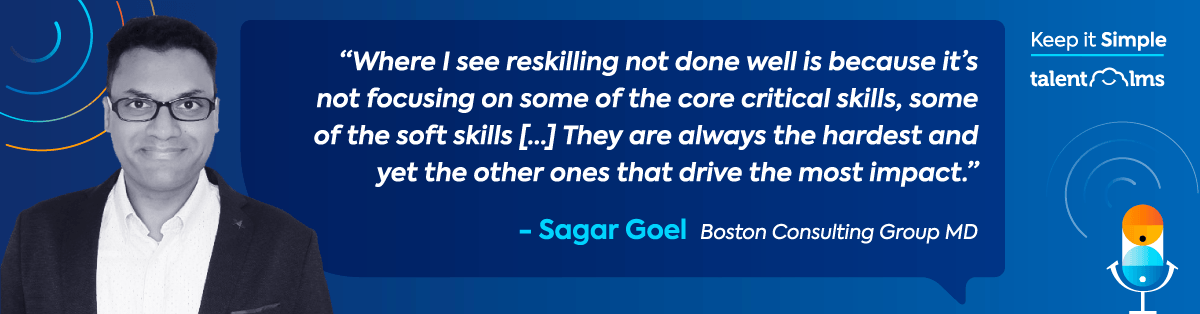
As Sagar Goel mentions in The building blocks of successful employee reskilling, from TalentLMS’s podcast series, effective reskilling isn’t just about technical skills—it also depends on developing the higher-order skills that drive the greatest impact.
11. Critical thinking & Complex problem-solving
Critical thinking helps employees evaluate information objectively and solve layered business problems. In a world where artificial intelligence handles routine analysis, the human ability to ask the right questions, challenge assumptions, and make judgment calls under ambiguity is what drives high-impact and informed decisions.
The more AI automates, the more critical this skill becomes.
12. Adaptability & Continuous learning
The pace of change is exponential. Employees who embrace continuous learning, seek feedback, and adjust quickly to new tools and roles are the ones who stay relevant. This is the meta-skill behind every other skill on this list.
13. Effective communication
Clear communication, written and verbal, ensures ideas land, teams align, and projects move forward. In hybrid and remote environments, the ability to convey complex information simply and listen actively has become a non-negotiable workplace skill.
14. Creativity & innovation
Creativity generates fresh ideas. Innovation turns them into action. In an era where AI can produce content and code, the human capacity to think laterally, connect unrelated concepts, and propose original solutions is what differentiates good teams from great ones.
15. Emotional Intelligence & Empathy
Emotional intelligence helps people understand and manage their emotions, plus recognize others’. It’s the foundation of strong working relationships, conflict resolution, and team cohesion. Employees with high EQ build trust, support team development, and foster positive workplace cultures.
16. Leadership & Social influence
Leadership isn’t about title or authority. It’s about inspiring others, giving constructive feedback, and guiding teams toward shared goals. Social influence is the ability to motivate, persuade, and bring people along, and it’s what makes leaders effective at every level.
17. Resilience & Stress tolerance
Resilience allows people to recover from setbacks. Stress tolerance keeps them steady under pressure. In fast-moving organizations dealing with constant change, these skill sets are what prevent burnout and sustain performance over time.
18. Cross-functional collaboration
Modern work happens across teams, departments, and time zones. Cross-functional collaboration means communicating effectively with stakeholders from different disciplines, contributing to shared objectives, and working productively in all work settings.
19. Cultural Intelligence
Cultural Intelligence (CQ) is the ability to work effectively across cultures, respect diverse perspectives, and adapt communication styles to different contexts. As workforces become more global and distributed, CQ is essential for inclusive, high-functioning teams.
20. Time management & Project management
Time management ensures focus on what matters most. Project management turns priorities into structured execution. Together, they help employees deliver consistently—meeting deadlines, managing competing demands, and maintaining quality under pressure.
How to close skill gaps in your organization
Identifying and closing skill gaps is how L&D teams turn workforce strategy into results. Here’s how:
Assess skill gaps
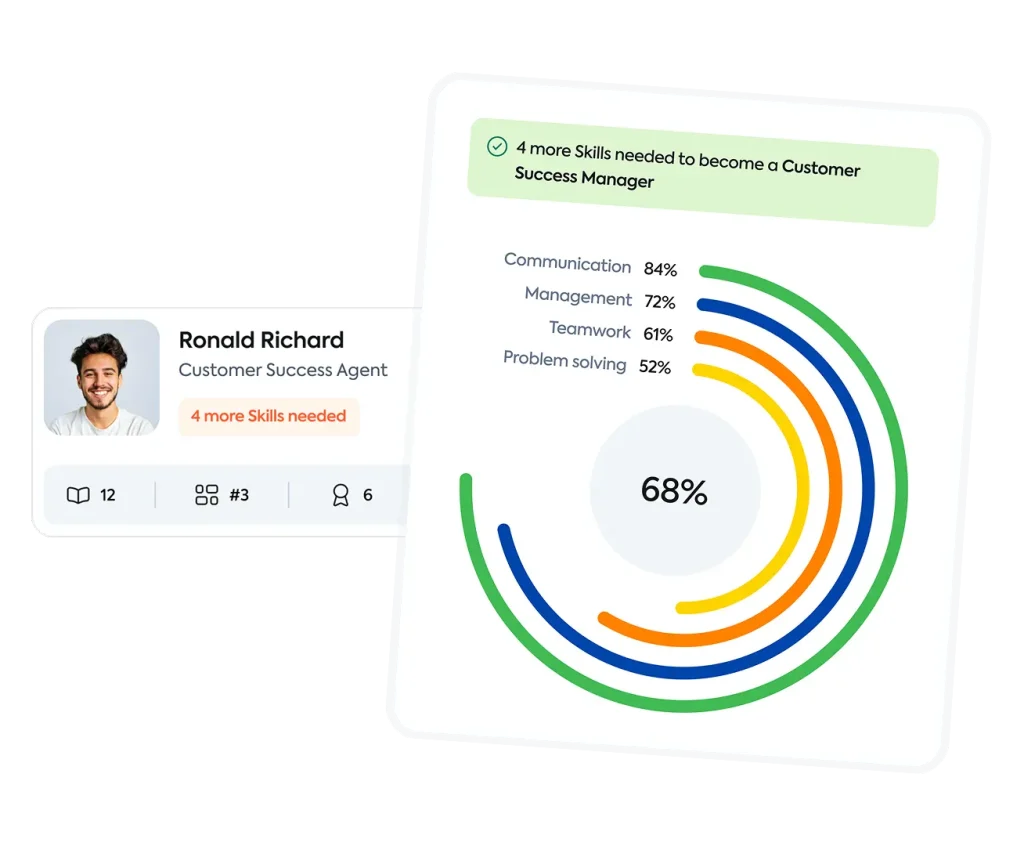
Start with a clear picture. Begin with a skills gap analysis to compare current employee capabilities against what your organization needs now and next. Combine performance reviews, 360-degree feedback, and role-specific benchmarks to identify where the gaps are and which ones matter most.
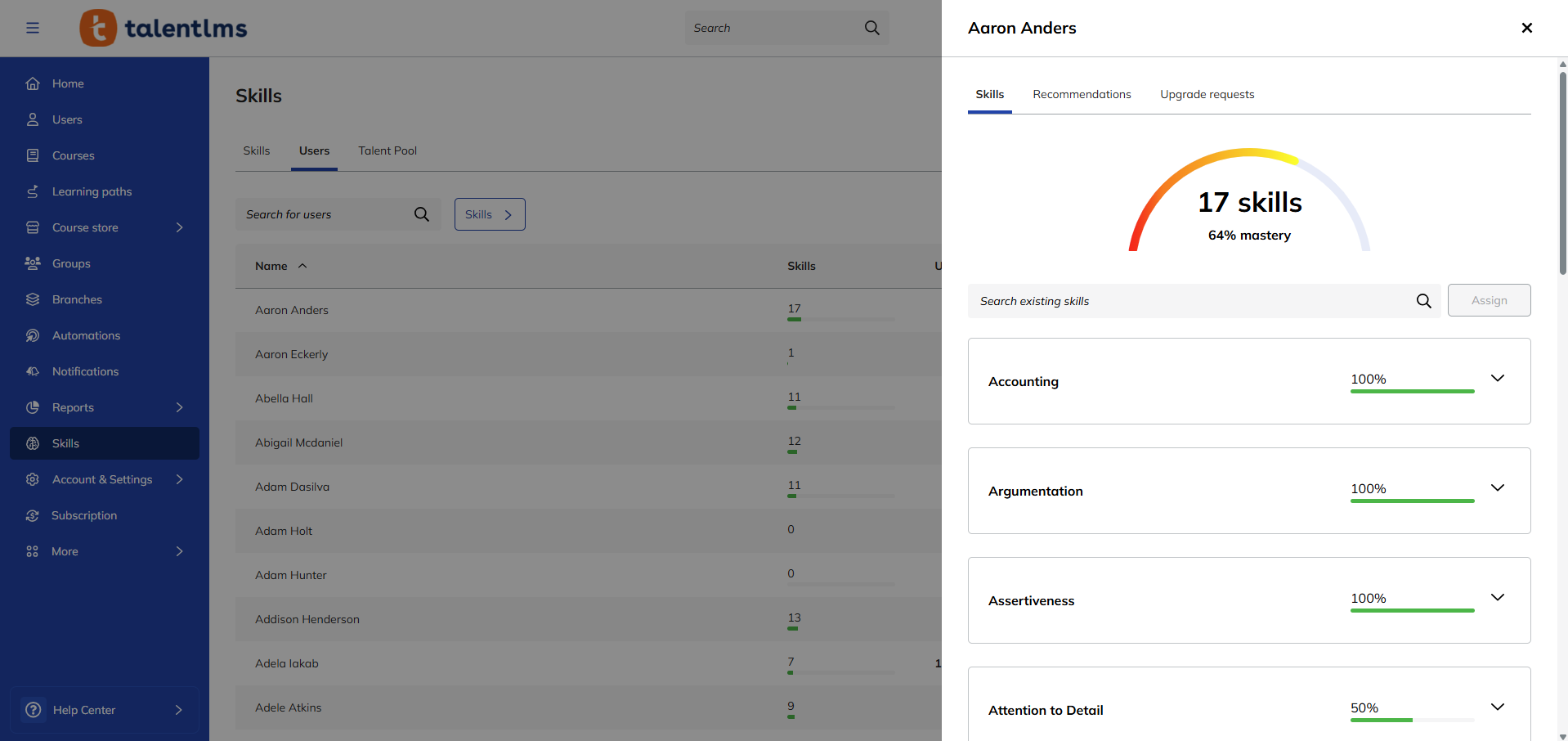
Then, with features like Skills on your LMS leaders and managers can map and track competencies in detail across the organization, making the invisible gaps visible.
Create personalized learning paths
Generic training doesn’t move the needle. Map individual development plans based on each employee’s role, career goals, and learning style.
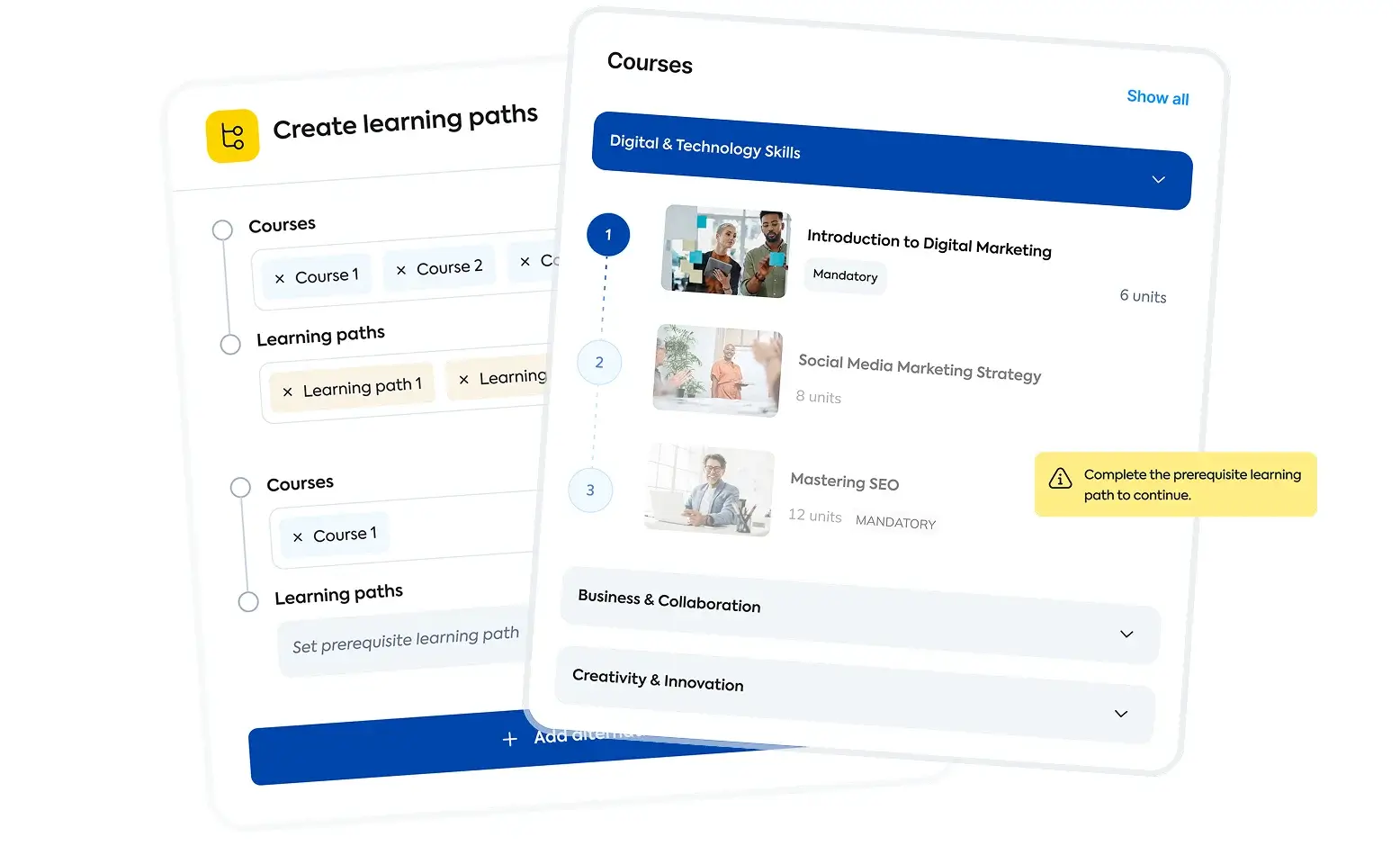
With Learning Paths, L&D teams can turn scattered courses into structured journeys that guide employees from skills gap to competency.
Leverage AI technology
Scale training without scaling headcount. An LMS like TalentLMS centralizes content delivery, tracks progress, and keeps teams aligned across locations.
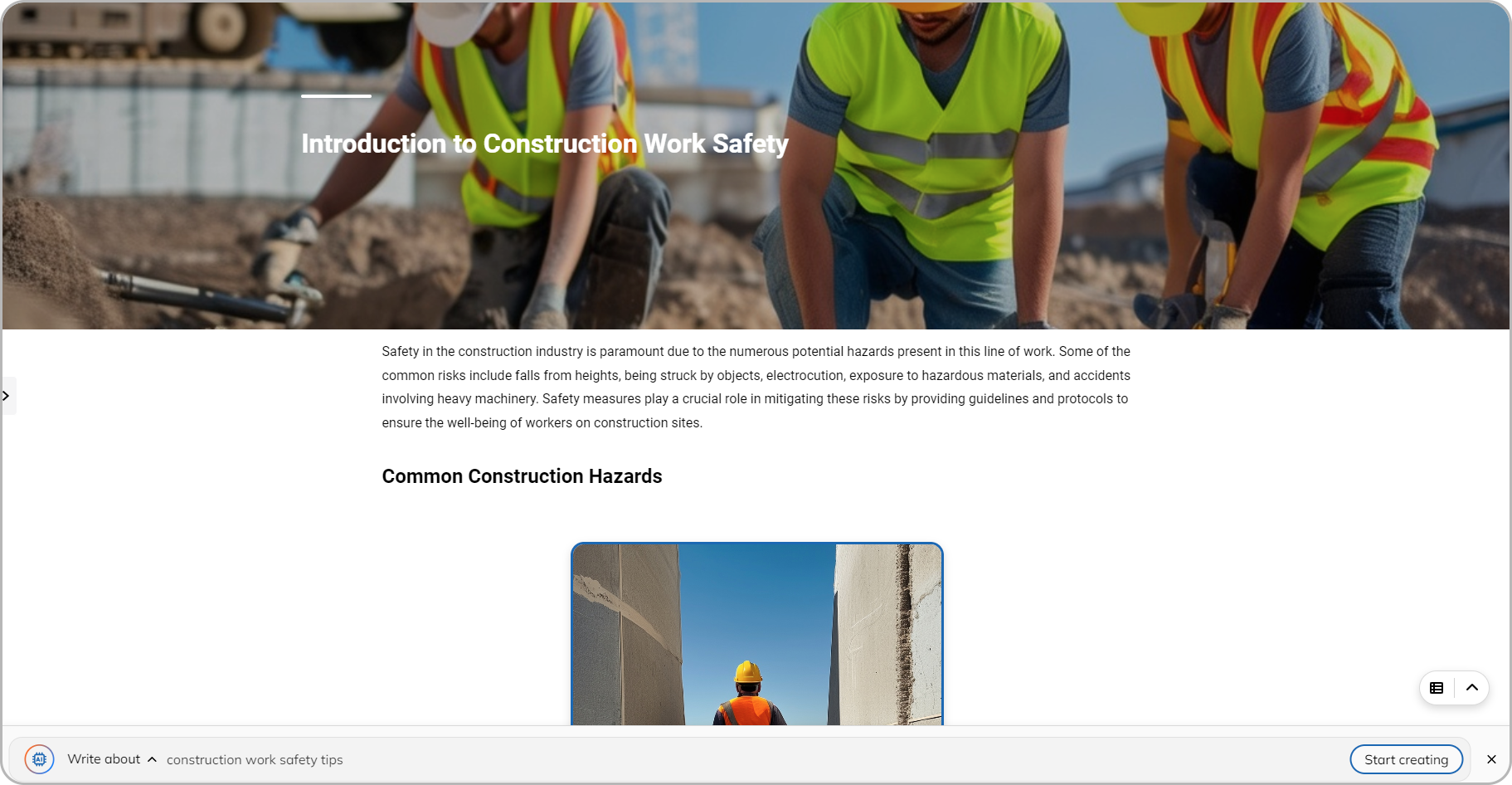
Use TalentCraft to generate course content with AI technology and cut development time while maintaining quality.
Focus on continuous development
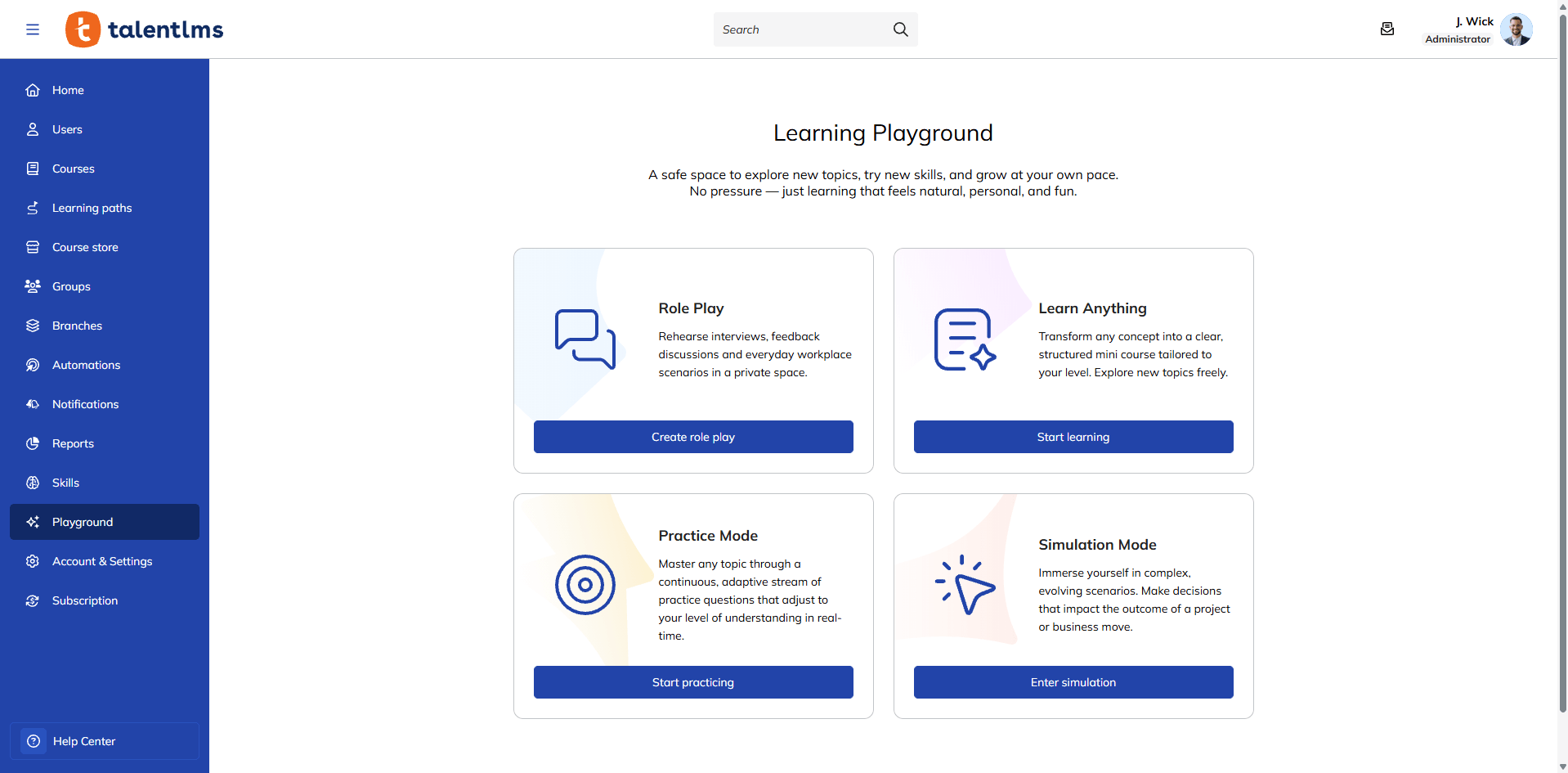
Skill-building isn’t a one-off initiative. Offer microlearning modules for on-the-go learning. Give employees hands-on practice environments, like Learning Playground, to apply new skills in a safe environment. There, learners can practice peer or customer conversations, test knowledge, and apply learning in realistic, self-led, and safe scenarios to build real-world confidence.
Evaluate and adjust
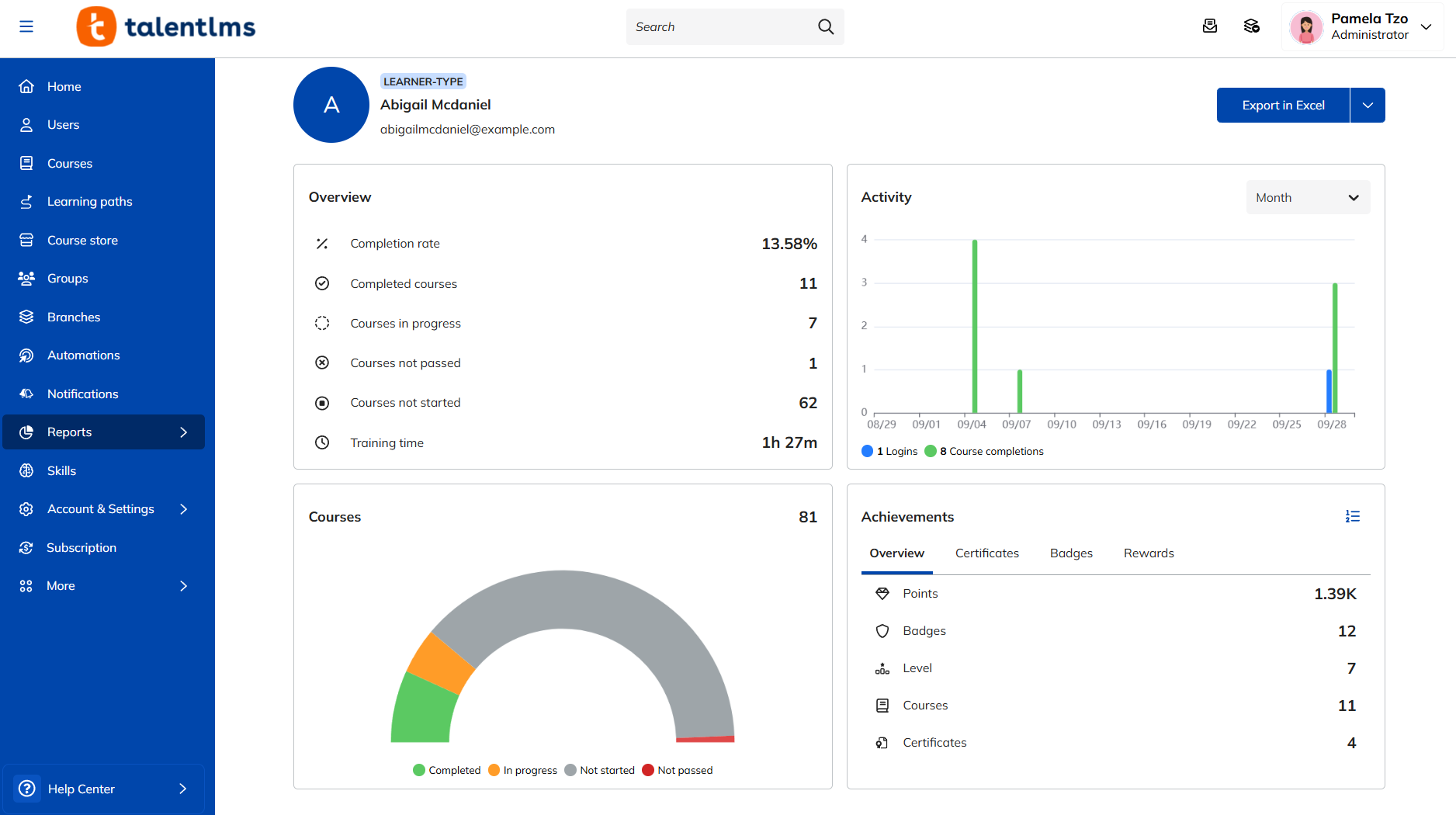
Track what’s working or not in your training with Reporting features. Measure skill proficiency gains, performance improvements, and retention rates. Then, make sure to gather learner feedback. Adjust programs as roles, new technologies, and business priorities evolve.
Future-ready starts by building in-demand skills
The future belongs to those who adapt, learn, and innovate. In 2026, the race of businesses and employees alike to stay competitive boils down to in-demand skills.
Employees need a balance of technical expertise and human-centric abilities to thrive in this tech-driven era. From mastering AI to honing emotional intelligence, organizations that embrace continuous learning and close skill gaps will lead the way.
Start today by equipping your workforce with what they need to not just survive but excel in their careers and workplaces.
FAQs
Which in-demand skills should I prioritize for my team?
Run a skills gap analysis that maps your team’s current capabilities against the roles and goals your organization is hiring and planning for. Focus on the gaps with the highest business impact first.
What AI skills are in demand?
Prompt engineering, AI-assisted decision-making, and integrating AI outputs into existing workflows. These apply across roles—marketing, HR, operations—not just technical positions. The gap isn’t tool access; it’s using AI strategically.
How can organizations close skill gaps?
Map current capabilities against business needs, build personalized learning paths, invest in tools like TalentLMS to scale training, and foster continuous development through hands-on practice and personalized learning. Track proficiency gains and learner feedback to keep programs aligned as priorities shift.
Why are human skills important when AI is automating more tasks?
Because AI handles the routine tasks, like analysis, content generation, and data processing. But the soft skills artificial intelligence can’t replicate become the main differentiator. Critical thinking, emotional intelligence, and cross-functional collaboration are what drive team performance, resolve conflict, and turn AI outputs into real impact.