Workplace skills are changing faster than ever before. New tools and processes constantly pop up at work that employees must learn on the fly just to keep up with their daily tasks. In fact, 70% of skills used in most jobs are expected to shift.
That constant need to adapt leads managers to expect higher output. Performance expectations jumped for 65% of employees this year alone, based on a recent TalentLMS L&D Report.
At the same time, finding the time for all that learning remains a huge hurdle for most companies. Heavy workloads leave no room for training, according to 50% of HR managers and 53% of employees.
This also puts immense pressure on learning and development teams to close those knowledge gaps. However, traditional learning management systems simply weren’t built for such rapid demand. They mostly act as basic filing cabinets for outdated courses.
An AI LMS removes those friction points so skill-building fits naturally into a busy workday. It changes how organizations build, deliver, and track their entire training programs.
What is an AI LMS?
An AI Learning Management System (LMS) is a learning platform that uses artificial intelligence functionality to improve course creation, delivery, and the learner experience. Unlike a traditional LMS, an AI LMS acts like an active teaching assistant. It studies how your team learns and figures out exactly what they need to know to grow.
Instead of forcing everyone through the exact same training, the system adapts to each person. It automatically handles the busywork of enrolling employees and tracking their progress. It then recommends specific lessons to fix individual skill gaps so no one wastes time on things they already know.
How an AI Learning Management System impacts L&D
When companies upgrade to an AI-powered LMS, the daily routine for learning and development teams changes completely.
Personalized learning paths at scale
A major benefit comes from building personalized learning paths for every single employee. An LMS with AI looks at individual goals and current abilities to map out the perfect training journey, which simplifies the whole learning process.
Because of that customized approach, advanced workers get to skip the basics, while struggling learners receive extra support. That shift away from a one-size-fits-all model solves a massive blind spot for companies. A recent TalentLMS Skills Visibility Report found that only 12% of organizations face zero skills visibility issues, which shows how important this feature is.
Data-driven decisions
Standard tracking tools usually leave managers guessing about what their teams actually know. In fact, a major Gartner study revealed that only 8% of organizations possess reliable learner data on workforce skills.
An AI Learning Management System solves this massive corporate blind spot by looking at deeper patterns like knowledge retention and real-time engagement rates. It tracks how engaged learners are, measures how well they remember the information, and predicts where your team’s skill gaps will appear next.
Faster, smarter course development
Creating a high-quality training module traditionally takes weeks of writing, designing, and formatting. An AI learning system shrinks that timeline down to just hours.
The AI platform handles the heavy lifting by generating the core text, building interactive quizzes, translating materials into different languages, and even creating the necessary images.
At Tagmarshal, the solo L&D manager used the AI tools in TalentCraft and saved over 180 hours of one-on-one training time while simultaneously boosting course completions by 600% and signups by 350%. The technology essentially turns a single instructor into a full-scale content studio.
Benefits of using an AI LMS for your training program
Beyond the day-to-day impact on L&D, an AI LMS delivers measurable business outcomes that make the investment worthwhile.
More engagement, less drop-off
Training completion rates naturally climb because people pay closer attention when the material directly applies to their daily work and future ambitions.
The training also feels more applicable because an AI LMS feeds learners the exact skills they need right at the perfect moment.
By adding gamification into the mix, the system builds a strong habit of continuous learning. Employees keep coming back because the experience feels highly relevant and personally rewarding.
Training that sticks
When some people take a generic course, they might miss a core concept and fall behind later. An AI LMS notices exactly where someone gets stuck and steps in to help. The platform adjusts the material right then and there, so the person fills their knowledge gaps before moving forward.
Time back for strategic L&D work
Administrative tasks like enrollments, reminders, and grading eat up hours of valuable time every week. An AI system takes over the heavy lifting by handling these progress reports and daily workflows.
The newfound time frees managers to build skills proactively rather than waiting for problems to appear. Currently, 42% of managers only address skill gaps when performance issues actually arise. With the busywork gone, leaders can spot and fix those knowledge gaps long before they affect the bottom line.
Better ROI visibility
Connecting training results to company goals often feels like guessing. An AI LMS changes that by linking learning progress directly to measurable business outcomes.
Instead of just tracking who clicked through a video, the platform measures actual skill mastery. The software even predicts future training needs and spots learners who might need extra help before they fall behind.
Scalable across teams and audiences
Expanding your training program usually means multiplying the workload for every new department or region. An AI LMS solves that bottleneck by letting you train employees, partners, and customers from one central platform.
The software also automatically creates separate learning branches with tailored content for specific groups. AI translators make localization instant, so global teams get the material in their native language without waiting months for manual translation.
10 features every AI LMS should have
The features are what make an AI LMS powerful, and in today’s tech-driven world, these go well beyond simple chatbots.
1. AI content creation
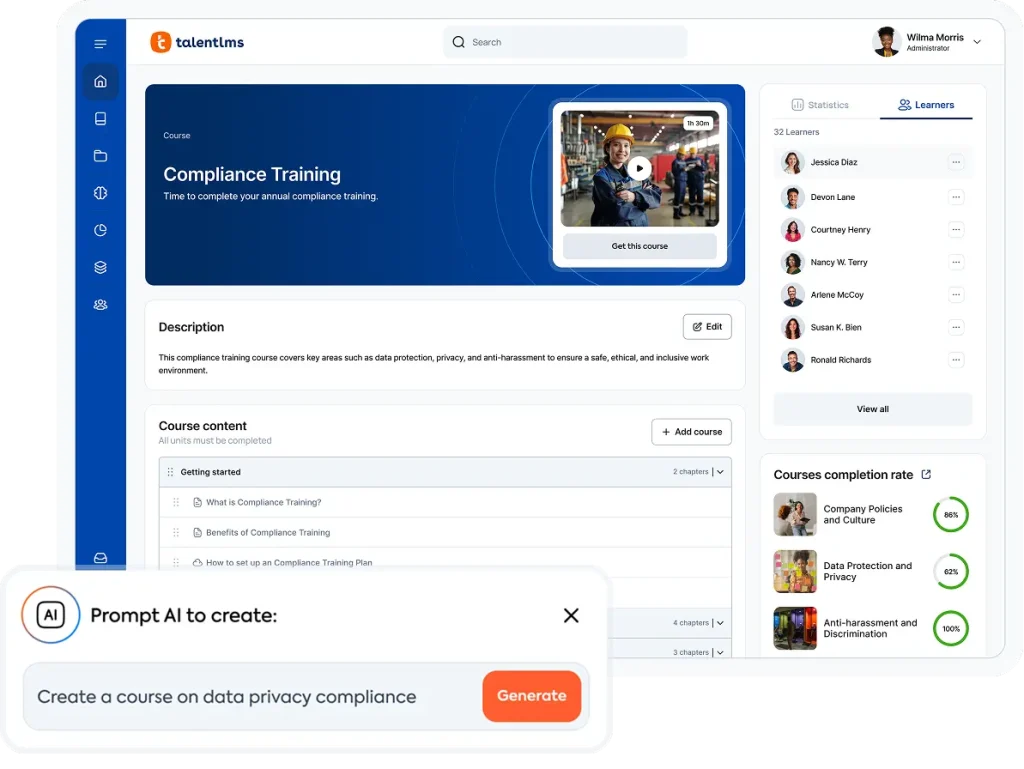
A lot of teams adopt these platforms because they can instantly generate complete lessons, summaries, and graphics from a single prompt or document. That frees up their time in a big way, so it’s a must-have for any good AI LMS.
A good example of how this looks is how TalentLMS builds interactive quizzes using the AI Test Creator and rewrites existing text for different reading levels. You can also use an embedded AI Translator alongside content creation tools like TalentCraft, to turn raw videos and presentations into structured, multilingual courses in seconds.
What to look for:
- Create courses from a prompt, topic brief, or uploaded document
- Create quizzes and flashcards automatically from course content
- Generate learning objectives, lesson summaries, and labelled graphics
- Rewrite content for different reading levels or tones
- Translate content into multiple languages during creation
- Generate images, scenarios, and visual learning aids
- Convert existing documents, videos, and presentations into structured engaging courses
2. Personalized learning
An AI LMS handles personalized learning by adjusting the material to match each person’s role and current knowledge level. When the software handles the customization, learners stay more focused because they see how the lessons help their daily work.
TalentLMS supports this through Learning Paths, which guide learners step by step through connected courses in a structured order, personalizing the journey, reinforcing knowledge, and supporting long-term growth. Admins set the sequence so each course unlocks only after the previous one is complete, ensuring learners build on what they’ve already covered.
What to look for:
- Structured learning paths that sequence courses for progressive skill-building
- Step-by-step course unlocking to reinforce knowledge before advancing
- Personalized training journeys that support long-term growth
- Easy path creation and management for admins
3. AI learning assistant
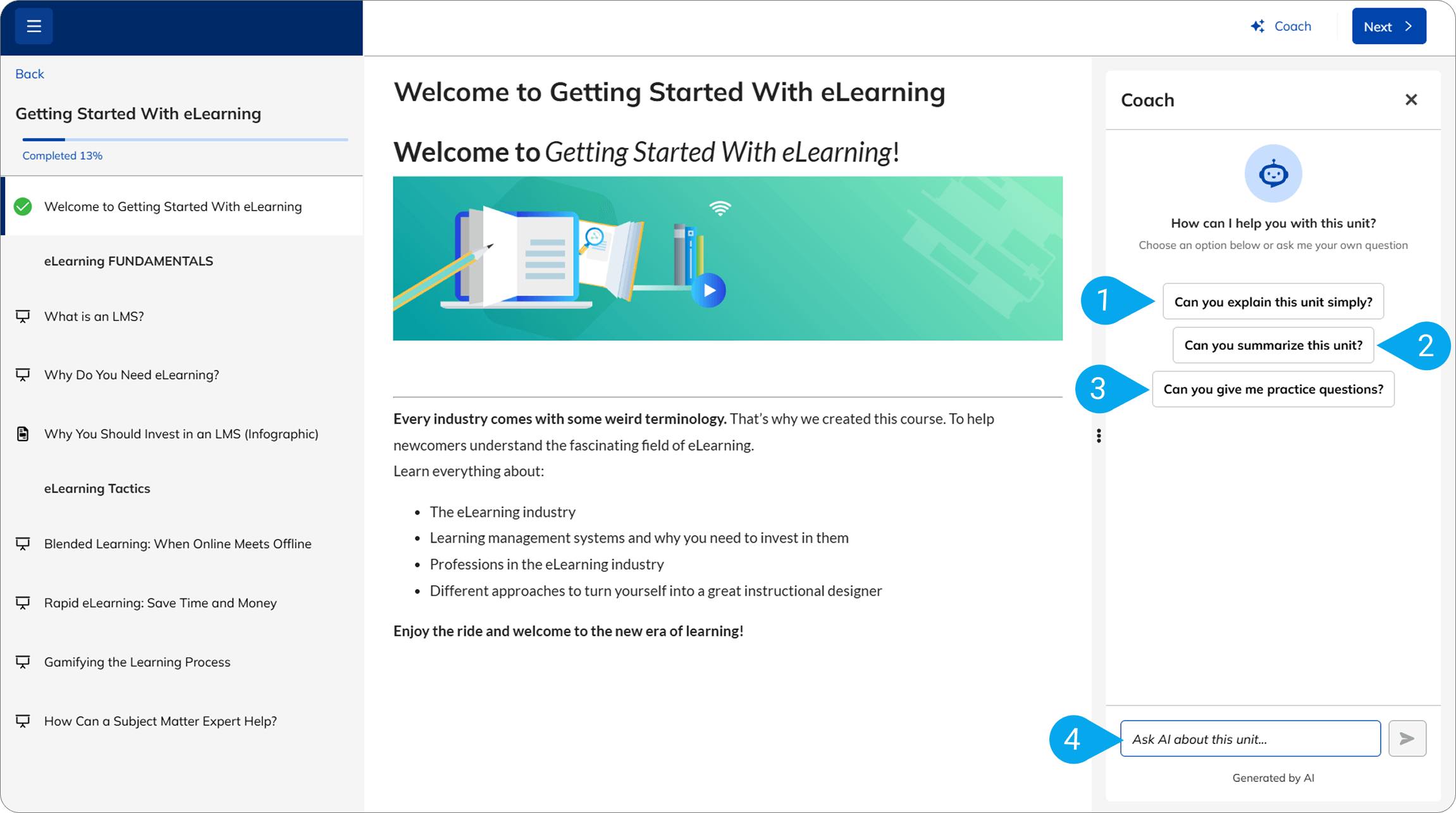
Waiting for an instructor to reply to a question halts progress. An AI LMS with a built-in learning assistant removes that bottleneck by giving learners real-time support whenever they need it.
TalentLMS features an AI Coach, a built-in coach that guides learners in real time with helpful explanations, summaries, and practice questions, offering support whenever it’s needed. Instead of waiting for an instructor, learners can keep moving.
What to look for:
- Real-time learner guidance and explanations
- Summaries to reinforce key concepts
- Practice questions available on demand
- Always-available support (not limited to instructor hours)
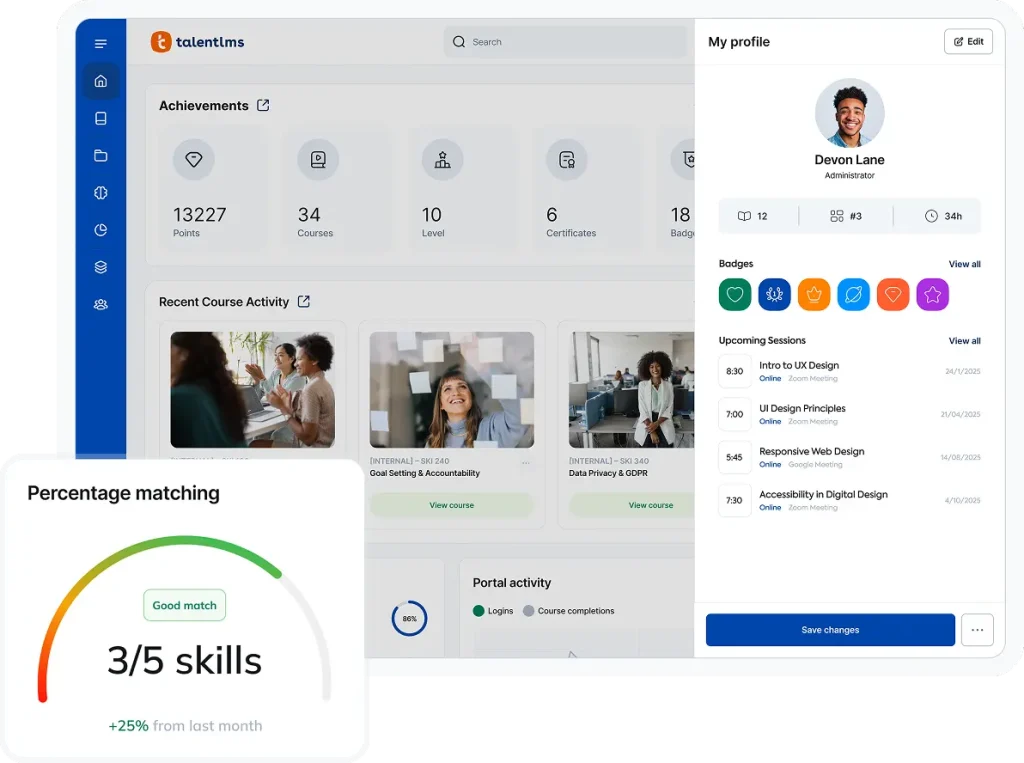
4. Skills intelligence
An AI LMS removes the skills gap blind spot by mapping out exactly who knows what across the entire company.
Getting this kind of visibility right without AI takes months of manual tracking, but smart platforms turn that messy data into a clear picture in minutes. With the built-in Skills feature from TalentLMS, leaders can easily spot exact knowledge gaps at the individual or team level to see who needs extra training and who is ready for a new role.
What to look for:
- Centralized skills taxonomy management
- Skills-to-role mapping
- Employee skill profiles with evidence
- Skill-gap detection at the individual, team, and organizational level
- Competency mapping and workforce readiness analysis
5. Assessment & feedback
Real knowledge retention goes beyond passing a basic multiple-choice quiz. The best AI learning platforms help employees actively practice and prove they can apply what they’ve learned.
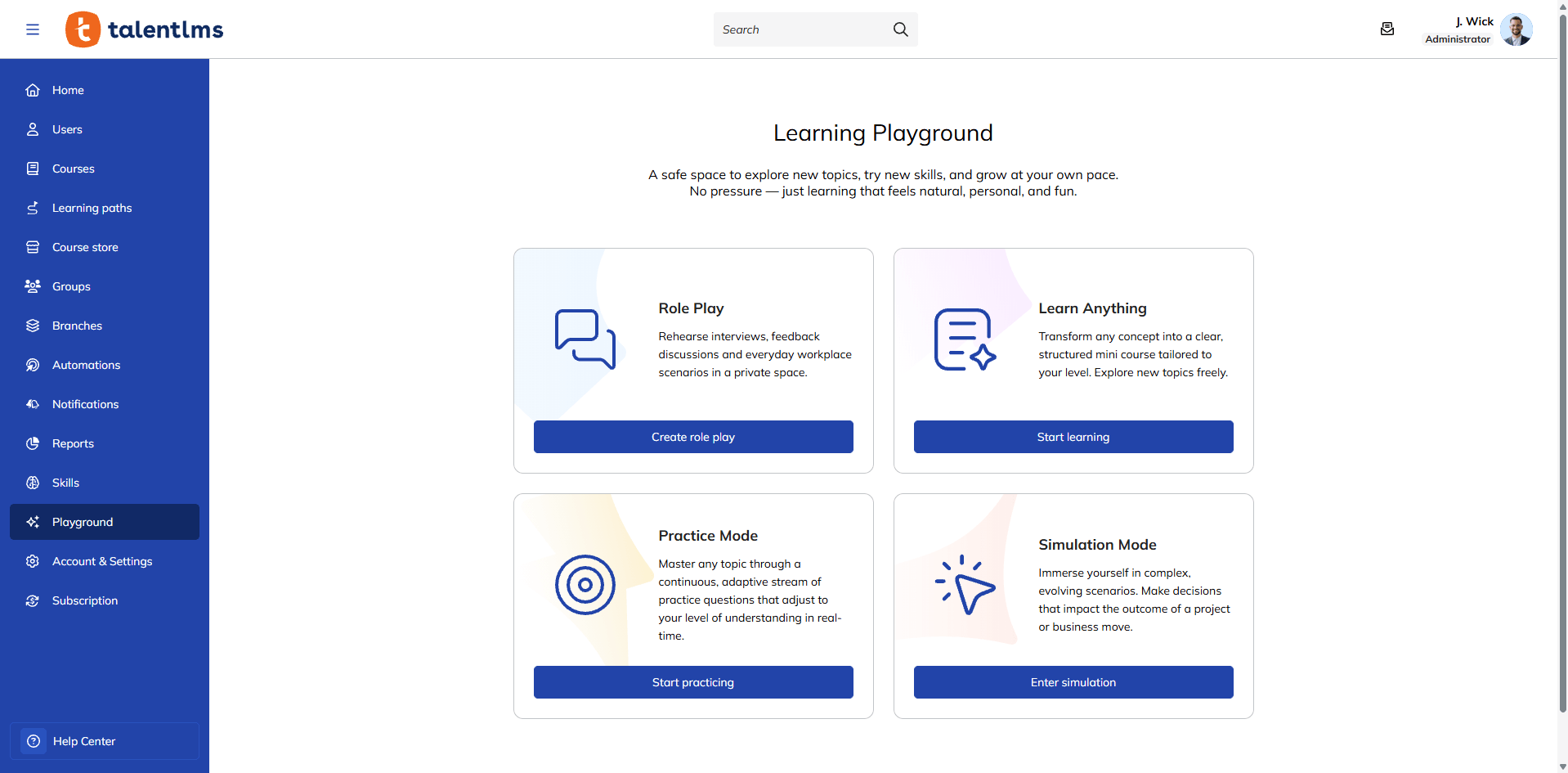
TalentLMS approaches this from two angles. The AI Test Creator instantly generates assessments from your course content, with multiple question formats and adjustable difficulty so you can measure understanding without building every quiz by hand. Separately, Learning Playground gives learners a self-led space to practice conversations, build skills, and work through realistic scenarios, helping them build confidence before they need to perform on the job.
What to look for:
- AI-generated assessments aligned to learning objectives
- Multiple question formats and adjustable difficulty
- Practice environments for realistic scenarios and skill-building
- Real-time learner guidance and support
6. Learning analytics
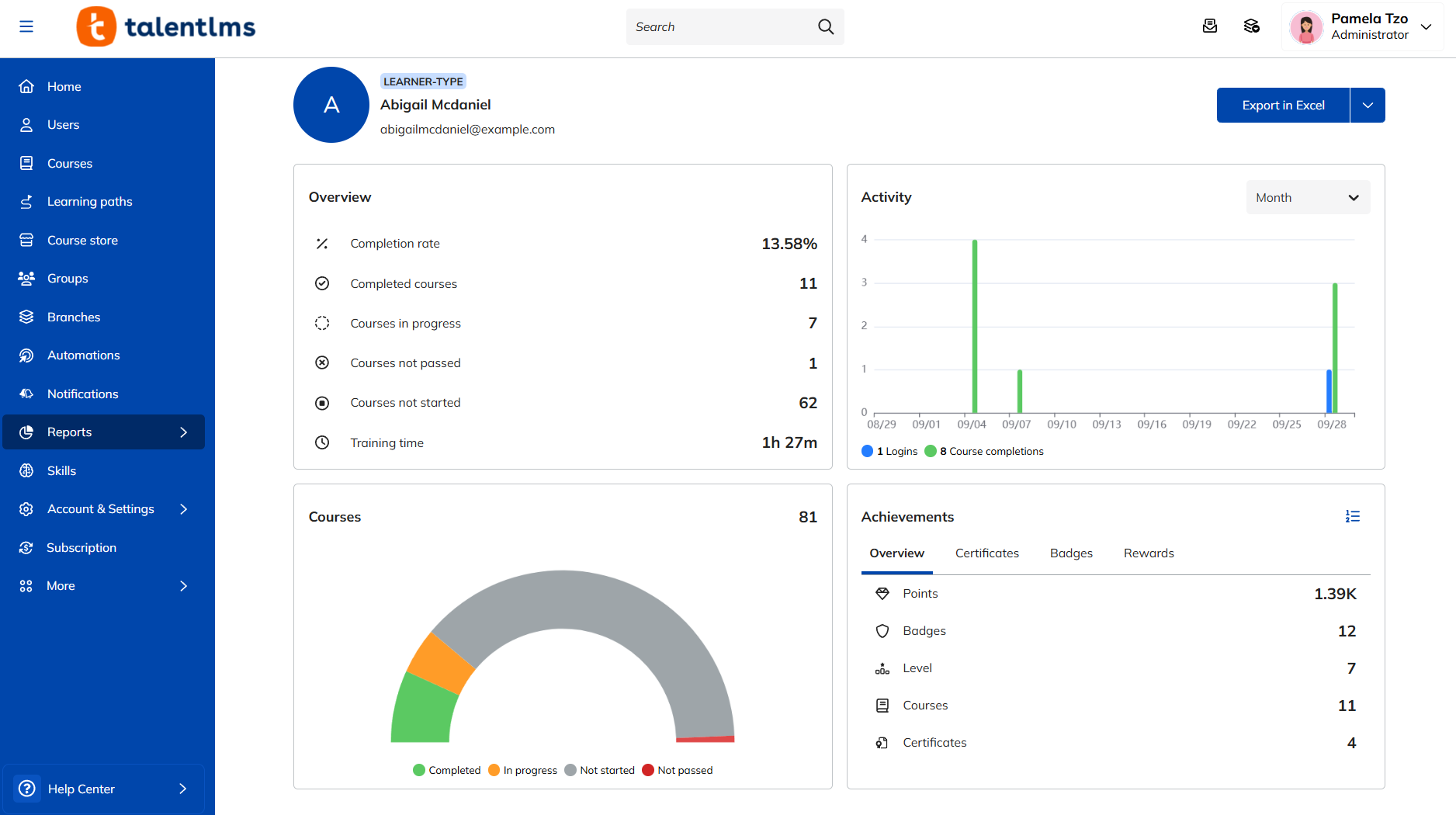
Sifting through basic completion numbers leaves managers guessing about true team readiness. Smart analytics fixes that by translating basic numbers into clear, predictive insights.
With a platform like TalentLMS, you can use real-time reports to intervene early and measure the exact return on your training budget.
What to look for:
- Learning effectiveness analysis beyond basic completion rates
- Engagement patterns and drop-off risk detection
- Skill growth tracking over time
- Training ROI measurement
- Executive summaries and scheduled delivery
7. Admin and Automations
With an AI LMS, you can set up simple rules to handle repetitive tasks so you’re not doing them manually. For example, TalentLMS automates routine admin work through a combination of features. Automations trigger actions based on user behavior like completions, expirations, or inactivity. Notifications send reminders and updates at key events, and Certifications track renewal deadlines.
What to look for:
- Action triggers based on user behavior (completions, expirations, inactivity)
- Compliance tracking and certification management
- Report generation and scheduled delivery
- Reminder and notification automation
8. Manager enablement
Corporate training often bypasses middle managers entirely. Many organizations also use AI coaching platforms to help managers develop coaching, feedback, and leadership skills at scale. But since team leaders are the ones responsible for day-to-day performance, they are the ones who actually need to champion their team’s development and lead by example.
As Al Dea said on the Talent Talks podcast, “if a specific leader doesn’t actually feel like they’re capable of doing it or actually hasn’t been enabled or shown how to do it, it just makes it a lot harder for them to actually want to lean into something like that.”
Enabling managers means giving them the practical tools to see exactly where their team stands. With features like the Group Supervisor role in TalentLMS, leaders can see skill-gap reports and learning progress. They have the hard data right in front of them to step confidently into that coaching role.
What to look for:
- Team skills dashboards with drill-down
- Skill-gap reports per team member
- Progress, coordination, communication, and guidance of group participants by managers through the platform
9. Social & collaborative learning
The best knowledge sharing usually comes from a quick chat with a veteran colleague rather than a formal slide deck. But capturing that natural, peer-to-peer knowledge at scale remains a challenge.
TalentLMS’s built-in Discussions feature gives teams a space to share knowledge within courses.
What to look for:
- Internal subject matter expert identification and recommendations
- Peer-to-peer knowledge sharing spaces
- Collaborative learning groups tied directly to course material
- Smart moderation for user-generated content
10. Enterprise AI features
Enterprise teams require a solid foundation of compliance before they can even test AI learning tools.
Building your training environment on a secure platform like TalentLMS covers the essential access foundation from day one. The software handles GDPR compliance, ISO certifications, role-based compliance, and single sign-on, so your IT department signs off without a worry.
When evaluating tools for enterprise-level deployment, verify these specific security controls:
- Strict data privacy controls that meet regional compliance standards
- Role-based permissions to restrict sensitive features
- Clear audit logs paired with human review workflows
- Options for private models tailored to highly regulated industries
AI is the here and now
The world of learning has grown and changed more than many people thought possible. 10 years ago, it would’ve been impressive to predict that we now have AI-powered learning tools to help upskill and reskill teams.
While it’s hard to predict exactly where L&D will be in another ten years, you can make the absolute best use of what you have right now. An AI-powered learning platform is the most effective learning foundation for any modern organization. As recent TalentLMS research revealed, your people want to learn, and they need to keep adapting. Give them the platform to match that ambition.
FAQs
What makes an LMS AI-powered?
Active adaptation and automation are what make an LMS AI-powered. Instead of passively hosting static courses and tracking clicks, an AI platform predicts knowledge gaps, generates customized learning paths on the fly, and eliminates administrative busywork in real-time.
What are the best LMS platforms with AI?
There are several AI LMS on the market. TalentLMS is currently among the top AI-powered LMS platforms. You should always prioritize systems that offer built-in content authoring, predictive analytics, and easy workflow integrations rather than those that simply bolt a basic chatbot onto legacy software.
What’s the ROI of adopting an AI-powered LMS?
The ROI of an AI-powered LMS is driven by drastically reduced administrative labor and faster time-to-competency for employees. McKinsey research estimates that generative AI can reduce course development time by 30–50%. For the wider business, the impact leads to quicker onboarding, higher completion rates, and the ability to close skill gaps before they affect performance.
How do you evaluate an AI learning platform before buying?
You evaluate an AI platform by testing it against your specific daily bottlenecks using your own training materials. During a demo, ask the vendor to generate a course or a report using your actual documents rather than their polished examples. Assess exactly how much manual cleanup the AI requires afterward, and that the system still handles basic tasks—like enrollments and user groups—flawlessly.
Who should use an AI LMS?
Lean L&D teams, rapidly scaling businesses, and organizations operating across multiple languages will see the most immediate benefit from an AI LMS. It is the ideal infrastructure for any company currently buried under manual admin tasks or needing to upskill a diverse workforce quickly to stay competitive.
Are AI-generated training courses accurate and secure?
Yes, provided you use a reputable enterprise platform that isolates and encrypts your proprietary data. The most secure systems ground their artificial intelligence strictly in your verified internal content, which prevents the AI from sharing company secrets externally and stops it from “hallucinating” or inventing incorrect information.