Research Report:
Next-gen Onboarding: Redefining the New Hire Journey
New research report by TalentLMS and BambooHR reveals how generational trends, AI, and work setting are reshaping the onboarding experience. It sheds light on different onboarding delivery methods, spotlighting what clicks, what flops, and where the cracks show.

Key highlights
Off to a good start
73% of employees are satisfied with their onboarding experience.
AI-unready
60% of employees didn’t receive training on AI tools during onboarding.
Info overload from day one
42% were overwhelmed with too much information at once.
- Introduction
- Inside the onboarding experience: A strong start
- Cracks in the welcome: Gaps, disconnects, and growing pains
- AI in onboarding: Adoption, impact, and generational trends
- Learning & development beyond day one: How new hires build skills
- The mechanics of successful onboarding: The right pace, the right setup
- The heart of onboarding: Belonging and connection
- 12 research-backed fixes for better onboarding
- Conclusion
- Methodology
- Published
- Author
- Ana Casic
- Research team
- Ana Casic, Eri Paneselina, Fiona McSweeney, Michelle Ercanbrack, Kate Tray
- Expert contributors
- Gary Cookson, Neena Newberry, Lilith Christiansen, Julia Phelan, Ph.D
Introduction
There was a time when employee onboarding was little more than a formality, when a quick trip through the HR checklist was all it took. New hires were given a surface-level tour of the office and organization before swiftly moving on to their desk to start work.
That’s not the case anymore.
Today, onboarding is arguably the most mission-critical moment in the employee lifecycle. With a heavy weight on its shoulders, it’s no longer just about showing new hires the landscape. It’s now expected to help them navigate their new role in a new organization with confidence, clarity, belonging, and purpose.
And the impact is measurable.
Organizations that get onboarding right are up to 103% more likely to see improvements in employee engagement and retention. Those who get it wrong risk early-stage regret, productivity loss, and rising levels of attrition.
To understand what onboarding looks like now and what the next chapter holds, TalentLMS partnered with BambooHR and surveyed over 1,100 US employees from four generations, all of whom started a new job in the past year.
Onboarding is no longer just about getting up to speed. It’s a critical moment of validation, where new employees get their first glimpse into whether their decision to join was the right one, with 65% of employees agreeing that onboarding felt like the beginning of a continuous learning journey. From there, onboarding becomes the launchpad for ongoing growth and development, signalling a shift from onboarding as a one-time orientation to a foundational phase that drives growth, belonging, and long-term engagement.
Inside the onboarding experience: A strong start
Onboarding is the complete emotional, informational, and interpersonal journey a new hire goes through as they transition into a company. And it’s integral to the ultimate success of the employee at their organization.
According to previous research by BambooHR, almost a quarter of all new hires cry in their first week of onboarding. It’s a powerful reminder of how emotionally charged the onboarding experience can be. On average, companies have only 44 days to convince new hires to stay.
Our latest study reveals that most new hires are satisfied. The not-so-good news? Satisfaction isn’t evenly distributed. There are clear warning signs of where onboarding programs are falling short.

From delivery methods to manager support, the following data reveals the strengths of modern onboarding. And the gaps that need urgent attention.
Satisfaction with onboarding: High ratings across the board
Most new hires feel positive about onboarding. Seventy-three percent of all employees were satisfied with their onboarding experience.
Approval varied slightly by generation. Seventy-six percent of Gen Z and Gen X were satisfied with their onboarding experience, and they were followed closely by 75% of Millennials. Baby Boomers trailed behind, with 68% reporting satisfaction with their onboarding.
A similar positive pattern emerged when we asked new hires to rate their onboarding experience in terms of expectations met. Sixty-nine percent of employees said their onboarding reflected the expectations set during the interview process. It’s a strong outcome, but not airtight. Twelve percent of employees disagreed, and 19% were non-committal.
What this means:
While every employee is unique, employers should dig deeper into generational differences to even out levels of satisfaction with onboarding. Particularly around polarizing topics such as values, communication styles, and preferred tools or technologies.
Sizing up onboarding delivery: Hybrid onboarding wins
In today’s evolving workplace, there’s no blueprint for the way businesses should deliver onboarding. But not all onboarding methods perform equally, and delivery is a key factor that shapes the experience.
The following graph breaks down how companies are delivering onboarding. So, which method leads to the highest satisfaction?
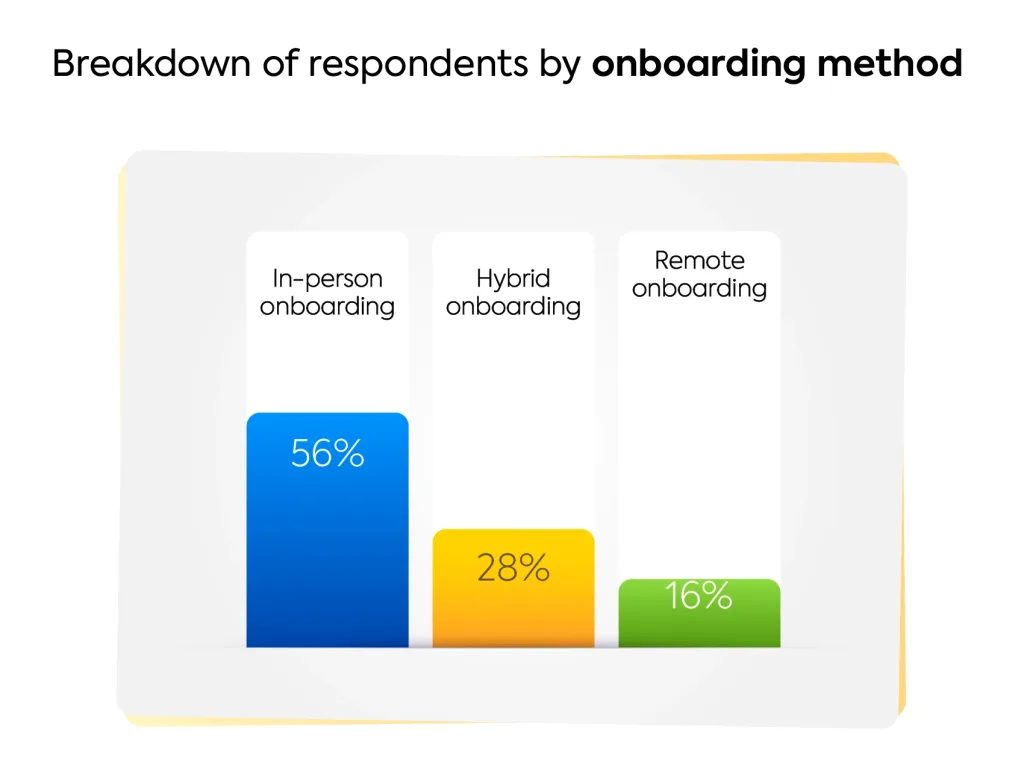
Among all methods, hybrid onboarding (onboarding that blends digital and in-person elements) emerges as the clear frontrunner. Seventy-five percent of employees whose onboarding was hybrid were satisfied with the experience. This outpaces satisfaction with both in-person onboarding and remote onboarding, which scored 73% and 71% respectively. On the surface, these margins appear small. But they’re statistically and strategically meaningful when we dig deeper.
“Hybrid onboarding is likely to work best if the intended employee experience is also a hybrid one. There is no sense having an entirely in-person or remote onboarding experience if the role is hybrid, or vice versa. The nature of planning a hybrid onboarding experience means that there are conscious decisions made about what would work best in each type of environment for the new starter. For example, which tasks could they get on with and learn more about whilst remote, and which things are best done in-person? Who do they need to meet with and get to know, and which of these are best done remote or in-person? It is the intentional effort that makes the difference, whereas with fully in-person or fully-remote onboarding experiences, there is often a lack of such intentionality. New starters whose onboarding experience is done in this way, with proper thought and attention to how to help them work best in each type of environment, are likely to then be able to carry that on into their roles; applying the same level of thought and attention to how they do their work and which tasks are best suited to each environment they work in.“

Hybrid onboarding didn’t just outperform in-person and remote methods in terms of employee sentiment—it was also considered to be more effective. Seventy-three percent of employees who experienced hybrid onboarding said it accelerated their ability to contribute and perform in their role. At the same time, 69% of employees onboarded in-person and 61% of employees onboarded remotely expressed the same sentiment.

Hybrid onboarding also led the way in helping employees meet job-specific expectations. Seventy-two percent of employees whose onboarding was hybrid said it gave them what they needed to be successful in their role. Success in this area drops to 67% for in-person onboarding and 63% for remote onboarding.
On the subject of ongoing growth, hybrid onboarding also rose to the top. Seventy-four percent of employees who experienced hybrid onboarding said it felt like the beginning of a continuous learning journey. But continuous learning only registered as a positive outcome for 63% of employees onboarded in-person and 60% onboarded remotely.
Consistently ranking third behind hybrid and in-person onboarding in all areas, the narrative around remote onboarding raises red flags for HR teams. It suggests that employees onboarded remotely are less likely to feel prepared, capable, and supported, leaving new hires under-equipped and disconnected.
What this means: To recruit, retain, and ramp up talent in a distributed world, organizations should build flexible, blended onboarding programs that combine virtual elements with human touchpoints. And, where practical, use in-person moments to address shortfalls in remote onboarding
What makes onboarding a performance driver
The high satisfaction scores are a useful temperature check on how employees perceive their onboarding experience. But what shapes that sentiment? To find out, we looked deeper.
Breaking satisfaction into specific touchpoints and measurable outcomes, we found that effective onboarding does so much more than tick boxes. It empowers employees by equipping them with the clarity, confidence, and connection they need to succeed.
76% of employees said onboarding made them feel welcome and valued at their new company.
Sixty-nine percent of employees said that onboarding accelerated their ability to contribute and perform in their role. Dig a little deeper into the data, and we see where this confidence stems from: 73% of employees agreed that onboarding clearly explained their job responsibilities and expectations. And for 75% of employees, onboarding helped them understand company goals and their role in supporting them.
Drilling down into the (make-or-break) emotional experience of new hires, we see further indicators of onboarding success. Specifically, ones that help build long-term engagement.
For 65% of new hires, onboarding eased the anxiety and uncertainty of being a new employee. But perhaps most importantly, 76% of employees said onboarding made them feel welcome and valued at their new company.
What this means: To set new hires up for success, onboarding needs to do two things well: provide clarity and build confidence. That means clearly outlining roles, expectations, and how each person fits into the company’s goals. And just as importantly, helping them feel welcomed, supported, and less anxious from day one.
The onboarding anchors: HR and people managers
Now, what about the human element of a strong onboarding experience? It matters, and it makes a real impact. Our data shows that the two key supporting roles are showing up where it counts. Employees are overly satisfied with the support they receive from HR and from their direct managers.
Sixty-seven percent of employees were satisfied with the support they received from HR during onboarding. And an even greater number (75%) of employees said their manager was also there to support them.
This last finding is particularly encouraging, considering existing research around the role of managers during onboarding and beyond. The relationship between a manager and a new team member is one of the strongest predictors of onboarding success. Studies consistently show that managers account for 70% of the variance in team engagement. And that’s true from day one. When managers are actively involved in onboarding, new hires are 3.4 times more likely to describe their experience as exceptional.
So, while the current 75% approval rating is a strong start, it suggests opportunities for even greater engagement moving forward.
What this means:
Organizations must equip managers to lead onboarding with empathy and intention. That means training, empowering, and holding them accountable for setting the tone, building trust, and making new hires feel supported from day one.
Cracks in the welcome: Gaps, disconnects, and growing pains
So far, the onboarding picture looks promising. For most new hires, the overall experience leaves them feeling satisfied, supported, and set up to succeed. But beneath surface-level satisfaction rates, there are hairline cracks and holes in the foundation: 39% of employees had second thoughts about their new job during onboarding.
But that’s just the beginning.
Nearly half of Gen Z employees (49%) had second thoughts about their new job during onboarding—more than any other generation. Millennials came next at 42%, followed by 36% of Gen X and 29% of Baby Boomers.
Nearly half of Gen Z employees (49%) had second thoughts about their new job during onboarding—more than any other generation.
Perhaps even more troubling is this: nearly a third (32%) of employees said their onboarding experience left them disappointed about their new company. Gen Z was the most likely to feel disappointed in the company following their onboarding experience (40%), followed by 35% of Millennials, 28% of Gen X, and 22% of Baby Boomers.
Let’s dive into what’s underneath.
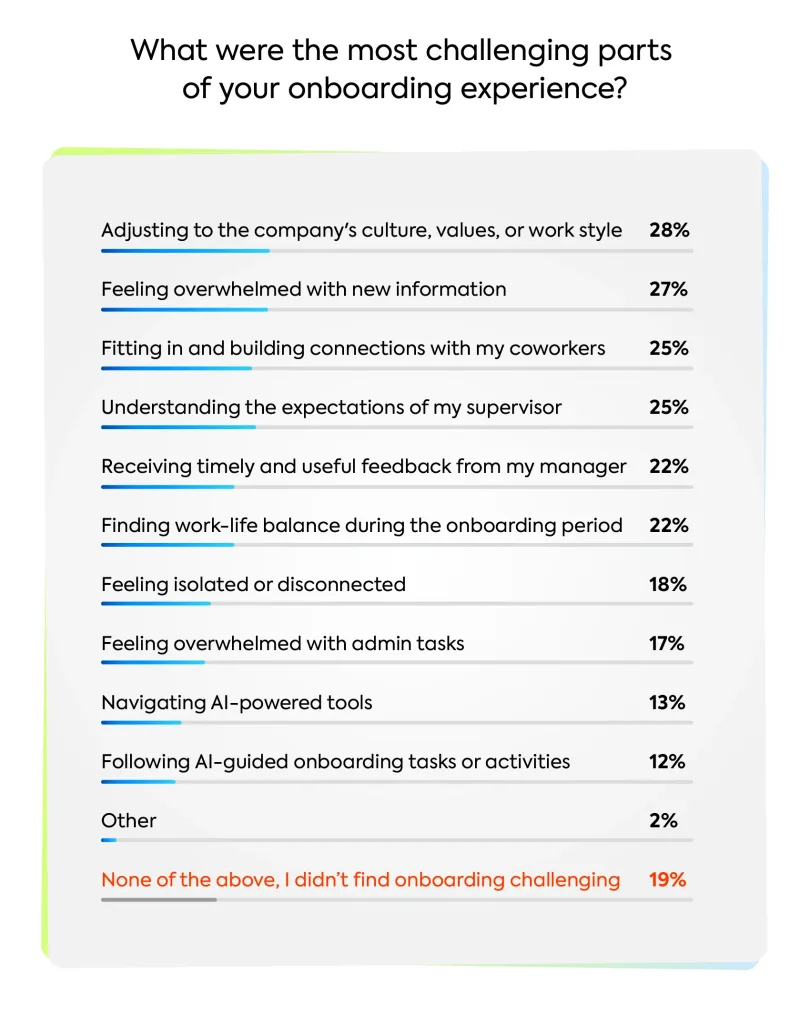
The majority of surveyed employees have identified various challenges in onboarding. Only 19% said they didn’t find onboarding challenging.
The most common struggles? Adjusting to the company’s culture topped the list, followed closely by information overload, difficulty fitting in and unclear expectations. The following graph breaks down the most common friction points that new hires faced.
The cultural disconnect: New hires struggle to adapt and build connections
Onboarding is often the first real exposure new hires get to a company’s culture and its community. If culture’s not well articulated, new hires may feel adrift or unsure of what’s expected of them. And if it doesn’t live up to expectations, they may not stick around at all.
The top onboarding challenge for new hires is adjusting to the company’s culture, values, or work style.
We’ve seen that on a micro level, onboarding makes new hires feel welcomed. But on a macro level, many still feel disconnected. While paperwork and tools might get sorted in week one, adapting to the company’s culture proves more elusive. That’s not just a feeling. The data showed that the biggest onboarding challenge is adjusting to the company’s culture, values, or work style.
Another data point echoes this sense of disconnect: the third most common challenge a new hire faced is fitting in and building connections with coworkers. It’s a telling detail. Because, taken together, two of the top three challenges reveal the same story: culture and connection are where things slip.
What this means:
If nearly a third of new hires are struggling to adjust to the culture, values, or work style, then something’s off. To reduce early-stage regret and disengagement, organizations should build in more intentional opportunities for human interaction, cultural immersion, and peer connection from day one. Employees don’t need another welcome email. They need real signals about how things actually work in their new company.
Information overload: From welcoming to overwhelming
After onboarding, new employees generally feel well-informed. But this comes at a cost. As we’ve seen on the previous graph, the second-biggest challenge for employees during onboarding was being overwhelmed with new information. Reinforcing this pattern of cognitive overload, a separate finding revealed that 42% of employees felt onboarding overwhelmed them with too much information at once.
What might be driving this? A data dump or heavy emphasis on paperwork and compliance could be a part of it. Supporting this, another data shows that over half (52%) of employees said their onboarding focused more on admin tasks than practical job training.
52% of employees said their onboarding focused more on admin tasks than practical job training.
What this means:
Pace and delivery need a rethink. To reduce overload and improve early engagement, organizations should balance onboarding activities with downtime that lets new hires absorb information and settle in. This means streamlining content, spacing out delivery, and shifting the focus from endless meetings and admin tasks to role-readiness and meaningful learning.
The missing feedback: Employee voices get lost in onboarding
Feedback is a powerful lever for improvement, particularly early in the employee lifecycle when formative experiences shape long-term engagement. But its value extends beyond this. When employees are invited to share their experience, it signals psychological safety, builds trust, and gives organizations the insights they need to refine and personalize the onboarding journey. Yet, too often, feedback during onboarding is treated as an afterthought.
While 66% of employees said they were able to provide feedback on training or orientation, nearly one in three new hires (29%) said they weren’t given the chance to provide feedback. That’s a significant number of employees starting their journey feeling that they haven’t got a voice.
29% of employees weren’t given the chance to provide feedback during onboarding.
And that’s a real problem.
Nearly half (45%) of employees said they felt a sense of belonging during onboarding thanks to opportunities to give feedback or ask questions. For Gen Z, this matters even more. For them, feedback is the top driver of building belonging during onboarding.
What this means:
Companies are missing opportunities for using feedback to improve onboarding, build early trust, and nurture engagement. To close this gap, organizations should embed structured feedback touchpoints throughout the onboarding process. For example, using short pulse surveys, informal check-ins, or (anonymous) feedback channels. For Gen Z especially, these moments of dialogue can make all the difference in fostering connection and trust.
The human disconnect: When onboarding misses the personal touch
With new hires experiencing an undercurrent of strong emotions during onboarding, receiving support from people, not just platforms, is vital. But at a time when technology is playing a bigger part in the process, is this critical component falling short?
The data says yes. That sense of human connection is slipping in the workplace. And for many, it’s already missing from onboarding.
Nearly a third (31%) of new hires said that onboarding lacked human interaction. That’s a signal that the personal side of onboarding isn’t keeping pace with the digital delivery. And as we’ll see in the next section zooming in on generational differences, the younger the generation, the more they felt the human touch was missing during onboarding.
But that’s not all. The shift isn’t just emotional. It’s behavioral. AI is becoming a go-to support tool for new hires, which is great. But what’s not so great is that it replaces human guidance.
During onboarding, 32% of employees relied more on AI tools than on asking a manager, HR, or a colleague. Even though a larger part, 53%, didn’t do so, one-third turning to AI over people raises questions about how approachable human support is. It also hints at a deeper pattern. Among all generations, Gen Z was most likely to turn to AI over people.
32% of employees turned to AI tools more often than to a manager, HR, or colleague.
What this means:
A smooth digital flow isn’t enough. When the human side of onboarding fades into the background, new hires are left navigating big changes without real connection. A process can guide and automate, but it can’t replace people and connection.
Generational differences: Onboarding challenges hit Gen Z the hardest
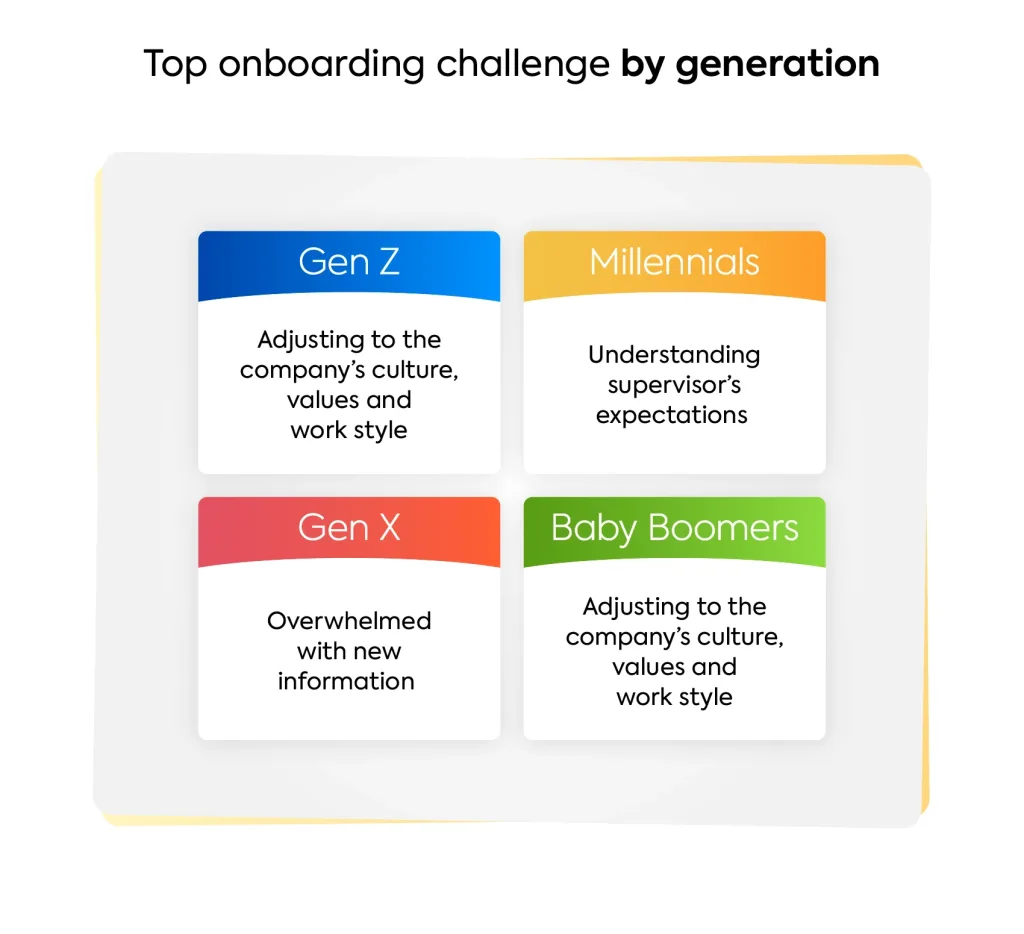
The numbers tell us that all generations experience onboarding challenges and shortfalls differently. Gen Z feels more overwhelmed, disconnected, and disappointed than any other group during onboarding. At the other end of the scale? Baby Boomers seem to breeze through with minimal roadblocks. Let’s break these insights down.
Forty-seven percent of Gen Z said they found onboarding overwhelmed them with too much information at once. This compares with 44% of Gen X employees, 41% of Millennials, and just 31% of Baby Boomers. And when onboarding leans too heavily on admin? The newest generation calls it out again: 60% of Gen Z employees said paperwork took priority over hands-on training, versus only 40% of Boomers.
The younger the generation, the more acutely new hires feel disconnected. Forty-one percent of Gen Z said that onboarding lacked human interaction, followed by Millennials (33%) and Gen X (29%). In contrast, only 18% of Baby Boomers shared this sentiment.
Gen Z was also the most likely to feel let down by their new employer during onboarding. Forty percent of Gen Z employees said their onboarding experience left them feeling disappointed in their new company. This figure drops to 35% for Millennials, 28% for Gen X, and just 22% for Baby Boomers.
“These findings correlate with the level of work experience each generation has So, it’s not surprising that Gen Z—often newer to the workforce—is the most overwhelmed by onboarding. They’re navigating new environments with less context and confidence than their more experienced colleagues. Post-pandemic, onboarding has shifted significantly toward remote and hybrid formats, emphasizing flexibility and scalability—but often at the expense of human connection. This is especially tough for Gen Z, who value real-time feedback, mentorship, and interpersonal connection. Meanwhile, more experienced generations may rely more on their previous experiences to fill in gaps when onboarding falls short. An effective onboarding experience should do far more than check administrative boxes—it should accelerate integration into the company’s culture, foster early relationship-building, and equip employees with the knowledge and tools to be productive. Otherwise, companies risk disengaging new hires and potentially losing the talent they worked so hard to recruit.”

Disappointment combined with a cultural disconnect is a ticking time bomb for Gen Z retention. For this generation, values aren’t just nice to have. They’re non-negotiable. In fact, 61% of Gen Z workers place equal importance on an employer’s values as they do on salary. And 42% say they’d quit a job due to a lack of social purpose or strong enough values.
What this means:
Onboarding needs to evolve beyond a one-size-fits-all approach. Organizations should learn more about trends that run through different age groups. And tailor onboarding to meet each group’s expectations, learning styles, and cultural priorities. Gen Z deserves particular focus. For them, onboarding isn’t just a process; it’s a proof point.
Different delivery methods, different obstacles: What each setting reveals
Does how and where people work shape how they experience onboarding? A closer look at our data shows that it does. This comes through clearly in the top challenges reported by remote, on-site, and hybrid workers.
- For remote employees, the most challenging part of the onboarding experience is information overload.
- For on-site employees, the primary challenge is adjusting to the company’s culture, values, or work style.
- For hybrid employees, building connections and adapting to the culture are tied as the top challenge.
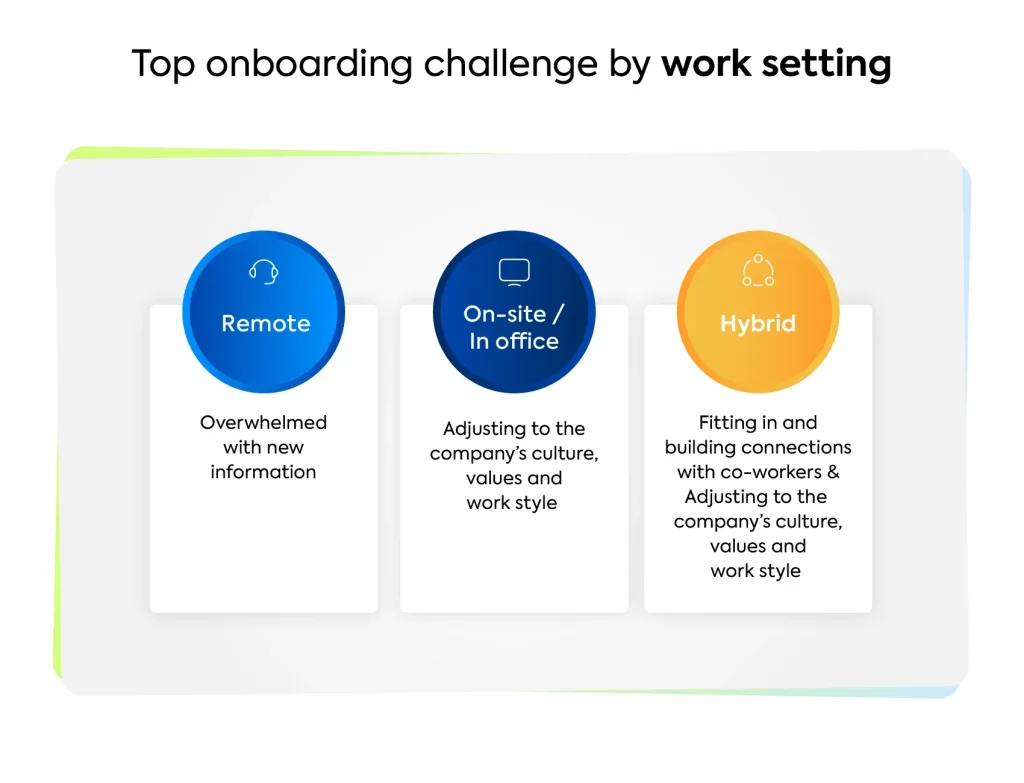
It’s, perhaps, no great surprise that remote workers feel the burden of information transfer most heavily. Without the benefit of real-time support, face-to-face clarification, or casual peer learning, remote onboarding often becomes a dense cascade of documents, tools, and asynchronous communications.
But the data reveals a paradox: new hires who are more physically present in the office don’t necessarily feel more connected to the culture or their coworkers.
Culture is typically communicated through unspoken rules, shared behaviors, and environmental cues. These can be especially pronounced (and sometimes overwhelming) in physical office settings. Being physically present exposes new hires to those dynamics more quickly, which perhaps explains why they see the gaps more clearly or feel the pressure to “fit in” more acutely.
Interestingly, hybrid employees experience the greatest difficulty building coworker connections. A possible reason for this could be that this group occupies a “liminal” space. They’re not fully embedded in office culture, yet not as structurally supported as remote teams. This inconsistency may make social integration harder when trying to form authentic early workplace relationships.
When it comes to accelerating employees’ ability to contribute and perform, remote onboarding lands last (61%). In-person scored higher at 69%, and hybrid topped the list at 73%. A mix of face time and flexibility seems to hit the sweet spot for getting new hires up to speed.
What this means:
Different work models create different friction points. Employers should tailor onboarding strategies to match work environments, which means optimizing data flow and prioritizing clarity and context for remote hires; providing cultural immersion support for in-person employees; and deliberate connection-building opportunities for hybrid workers who risk falling through the cracks.
AI in onboarding: Adoption, impact, and generational trends
AI is increasingly entering the onboarding conversation. According to existing research, 68% of U.S. organizations already use AI in hiring and onboarding. And, why wouldn’t they? Onboarding sits at the intersection of structured processes, employee experience, and scalable communication. This makes it a natural entry point for automation.
When implemented well, AI can lift the administrative burden of onboarding, personalize learning paths, and streamline communication. This frees HR to focus on strategic work. But is AI improving the new hire experience? Let’s dive into the data to find out.
Beyond the hype: More promise than practice
Despite growing buzz, AI hasn’t yet become standard practice. Our findings show that AI in onboarding is far from universal. Actually, it’s still sidelined. More than half of employees (53%) surveyed said AI wasn’t used at all during their onboarding.
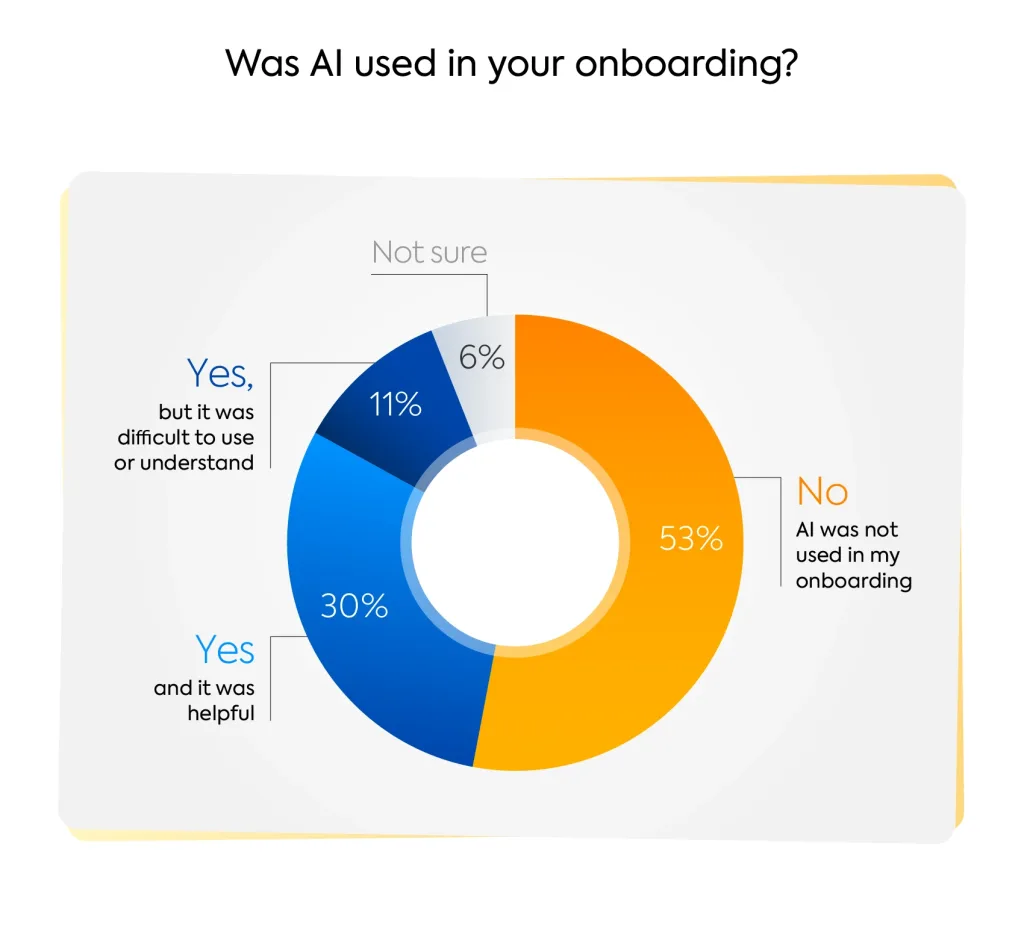
Among the 41% who did encounter AI in some form, the responses were split, with the largest portion (30%) finding it helpful. This points to the promise of AI to improve the onboarding experience when implemented well, whether through onboarding chatbots, recommendation engines, or automated knowledge delivery. However, 11% of new hires said they found AI difficult to use or understand during their onboarding program.
53% of employees say AI was not used in their onboarding.
What this means:
AI holds promise, but its impact depends on thoughtful implementation. It’s not enough to install a chatbot or automate a workflow. Employees need intuitive design, context, and guidance to get real value.
The AI training gap: Tools alone don’t teach
The gap between AI use and impact warrants further investigation. But, the lack of training on how to use AI certainly could be a contributing factor: 60% of employees said they received no training on how to use AI tools during onboarding.
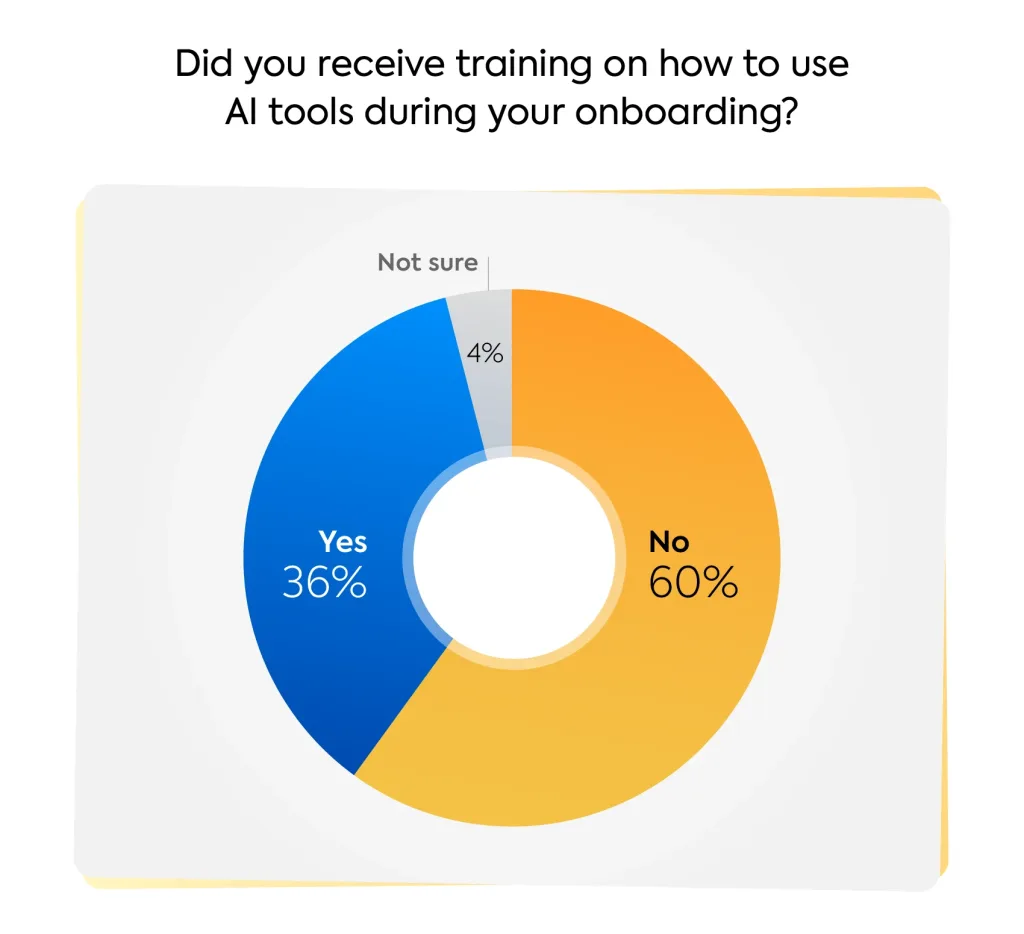
That’s a missed step with real consequences. When new hires are handed tools without context, they’re left guessing—or worse, avoiding them altogether. It’s not just about giving access to AI. It’s about training them to use it with confidence and purpose, from day one.
“This research is a wake-up call: skipping AI training during onboarding is a missed opportunity. When used well, AI can accelerate time-to-productivity; but only if employees know which tools to use, when to use them, and when not to. Otherwise, new hires may skip foundational learning, leading to performance issues as complexity in their role increases.
It’s no surprise Gen Z turns to AI first. This represents a chance for organizations to offload some onboarding burden from managers. By training a proprietary AI model on internal materials—like handbooks and training docs—companies can offer AI-comfortable employees a first stop for routine questions. That frees up managers to focus on deeper coaching and context.“

What this means:
Rolling out AI without equipping people to use it is a half-step. When training is skipped, even the most powerful tools fall flat. Or worse, they create confusion. To bridge this gap, organizations should embed AI-specific training into onboarding programs. That means offering hands-on practice, practical courses, clear use cases, and ongoing support to ensure new hires feel confident leveraging AI. Without these basics, AI becomes just another tool collecting dust.
Generational trends in AI
Analyzing our data through a generational lens, we found that younger employees are, in general, more likely to encounter AI during onboarding. Fifty-eight percent of Gen Z employees say AI was used in their onboarding. While 51% of Millennial new hires say AI was used during onboarding. The figures drop to 32% for the Gen X cohort and 19% for Baby Boomers.
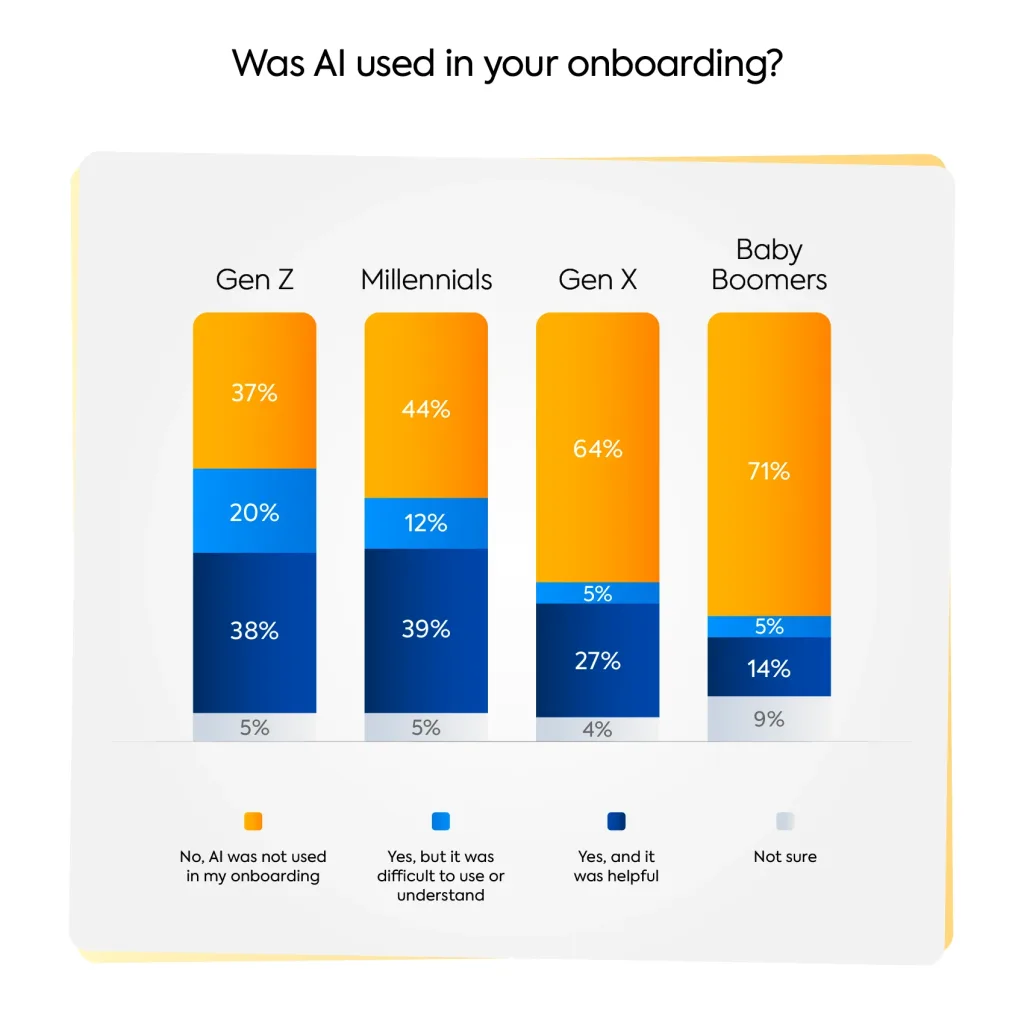
But digital exposure doesn’t always equal ease. One in five Gen Z new hires (20%) said they found the AI tools they used during onboarding difficult to use or understand. While just 12% of Millennials struggled with the AI tools they used as part of onboarding.
How helpful is AI to different generations?
Millennials reported the most positive experience, Baby Boomers, the least. Thirty-nine percent of Millennials found using AI helpful during onboarding. And 38% of Gen Z, followed by 27% of Gen X employees, were helped by AI tools during orientation and onboarding. After this, there’s a dramatic drop. Just 14% of Baby Boomers said the AI tools they encountered were useful.
When in doubt, ask the AI, says Gen Z
AI’s role becomes even more complex when we look at behavior. Many employees do lean on managers, HR, or colleagues for guidance. Yet, a significant portion is turning to AI tools first. And in some cases, more often. As seen above, 32% of employees said they used AI tools more frequently than they asked a person for help during onboarding.
Gen Z is leading this behavioral shift. Forty-four percent of Gen Z employees preferred AI to human help, compared to 37% of Millennials, 29% of Gen X, and just 14% of Baby Boomers.

At a first glance, this may reflect a comfort with tech and an expectation that digital tools should deliver fast, frictionless answers. But the story runs deeper. It could equally be a reluctance to ask for help in person, or having no one to turn to.
As seen in the section above “The human disconnect: When onboarding misses the personal touch,” Gen Z was the most likely to say their onboarding lacked human interaction. In that context, turning to AI over people may be less about preference and more about absence. When real-time human support feels out of reach, digital tools become the default.
What this means:
Assuming digital natives can navigate AI without help is a mistake. To close the gap between access and impact, organizations must prioritize enablement. That means offering clear guidance, context, and AI training to all generations as part of the onboarding journey.
Moreover, if new hires are defaulting to AI, but AI tools don’t meet their needs, what’s the fallout? Organizations need to ensure AI tools are well-designed, clearly explained, task-appropriate, and supplemented by accessible human support.
Onboarding delivery meets AI behavior: Is there a link?
How AI shows up during onboarding isn’t just about access. It’s also shaped by the onboarding method. The way onboarding is delivered—remote, in-person, or hybrid—can influence how and when new hires turn to digital tools.
Our data shows that employees who went through hybrid onboarding were the most likely to rely on AI over people for support (38%). That’s notably higher than both remote and in-person groups, where only 29% said the same.
This insight adds another piece to the onboarding puzzle: how delivery method shapes help-seeking behavior.
So what’s driving this? The flexibility of hybrid onboarding may come with fuzzier boundaries. Without clear signals about whom to ask or when, AI becomes the fallback—reliable, always available, and not waiting on a Slack reply. But convenience isn’t the same as connection. If human support isn’t baked into the hybrid experience, new hires might default to AI not by preference, but by necessity.
What this means:
While hybrid onboarding provides flexibility, it can blur the clarity around who to ask and when. To keep new hires from relying on AI by default, make it easier for them to reach real people. Encourage direct messaging and quick informal calls to keep human support within easy reach. Set up dedicated ‘on-call’ team members or rotating support champions for onboarding. These can be go-to points of contact for new hires, ensuring real-time human guidance is always available.
Learning & development beyond day one: How new hires build skills
Onboarding marks the beginning of a continuous learning journey for 65% of employees. What’s more, 64% said onboarding training encouraged curiosity and experimentation. So, what does that growth trajectory look like?
“It’s encouraging that 65% of employees see onboarding as the beginning of a continuous learning journey. That early signal matters. When organizations clearly link onboarding to continuous learning, skill development, and career growth from day one, it shows that learning isn’t a one-time event—it’s an ongoing cultural priority. Embedding conversations about skill development into onboarding strengthens engagement, motivation, and retention from the start. It also helps new hires see how they can grow within the organization—something today’s workforce actively looks for when evaluating job opportunities.”

The data shows a reasonably balanced mix between hard and soft skills, although compliance still tops the list. On the surface, we have a well-distributed and healthy topline view of skills building. It’s only when we start to zoom in that the scales start to tip.
Top skill-building challenges: Pressure to perform disrupts development
Onboarding isn’t just about forms and intros; it’s a critical window for growth. It’s when new hires should start sharpening the skills they’ll rely on every day. But the data tells a different story: the majority of employees faced challenges building their skills during onboarding. Even though 38% didn’t face challenges, most still ran into friction.
So what’s blocking progress? Having access to training doesn’t guarantee growth. Our research reveals a key tension: for many new hires, short-term, on-the-job demands get in the way of true skill building.

Despite being eager to learn, a quarter of new employees felt pressure to perform before their training was complete. And for a similar number, the learning journey stops before it’s really got started: 24% of new hires said there was no follow-up or continuation after their initial onboarding.
A generic, one-size-fits-all approach also discredits the career development top-line messaging for some: 23% of new hires cited a lack of personalized learning options during onboarding.
On the bright side, 58% of employees agreed that their onboarding included a development plan to grow their skills within the company. And 69% of all new hires have access to training resources to continue learning after onboarding.
What this means:
Growth doesn’t always come easily when you’re a new hire. Organizations need to bridge the gap between development promises and day-to-day realities. That means protecting time for training, ensuring learning continues beyond the first week, and offering role-relevant, personalized learning paths.
Meeting multi-generational learning needs
While some employees breeze through onboarding, many struggle to build the skills they need. The younger employees were the least likely to report a smooth learning journey: 28% of Gen Z employees and 33% of Millennials said they didn’t experience any challenges at all during onboarding, compared with 45% of Gen X and 49% of Baby Boomers.
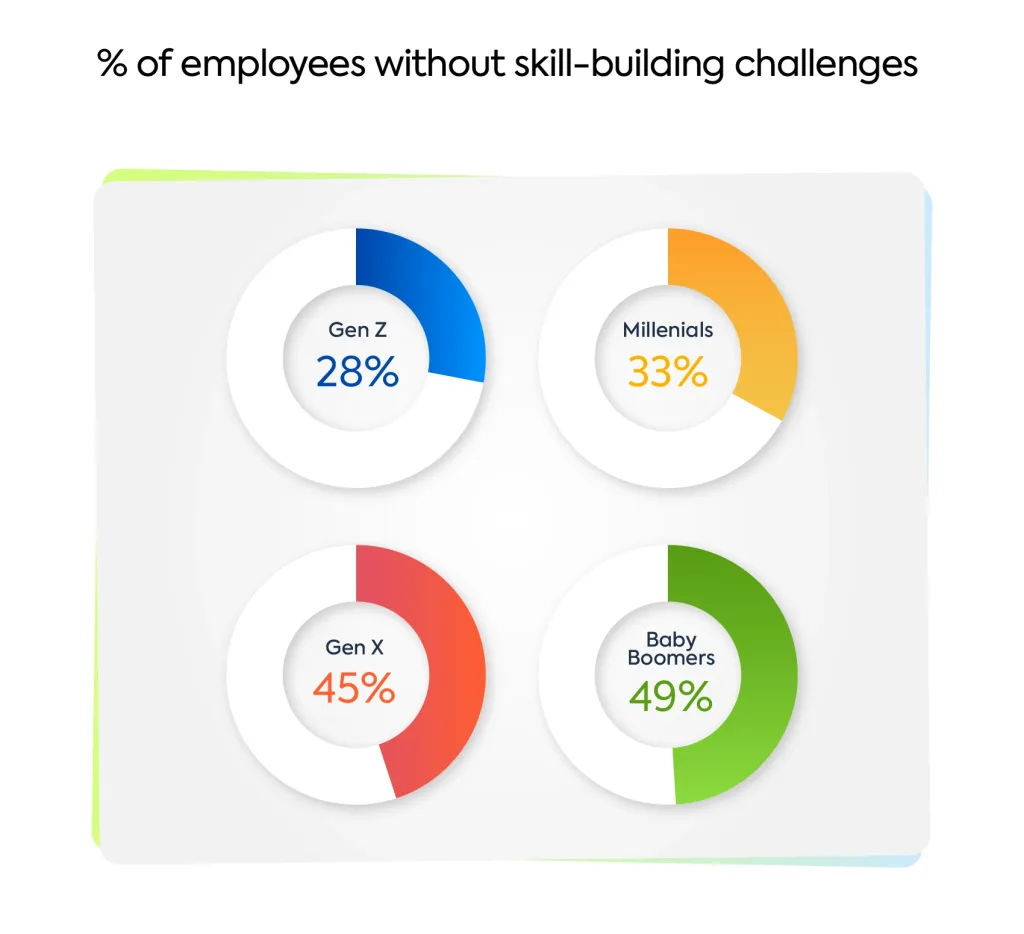
Diving deeper into the data, it appears that personalized learning is a particular pain point for younger generations. Nearly a third (31%) of Gen Z employees and 26% of Millennial new hires found it difficult to build skills during onboarding because the training lacked personalized learning options. Only 16% of Baby Boomers and 19% of Gen X reported the same challenge.
Finally, despite their reputation as digital natives, the younger cohorts miss the human touch most and notice when it’s missing. Twenty-three percent of Gen Z employees and 22% of Millennials said the training lacked human connection or guidance. In comparison, only 11% of Baby Boomers and 17% of Gen X felt the same.
What this means:
Older workers may be comfortable with structured, self-directed formats. But younger employees expect onboarding to be more than a series of eLearning modules. They want personalized, relevant, and human-centered learning that sets them up for long-term growth.
Making learning last: How onboarding setup shapes success
The story doesn’t end after onboarding is finished. Access to continued learning is just as critical. And, no surprise, the delivery model plays a decisive role in shaping the experience.
Once again, the data point to a hybrid model as the gold standard for success. Remote onboarding suffers in comparison.
Specifically, 73% of hybrid employees were satisfied with access to training resources after onboarding. This outshines employees working onsite (69%) and remotely (64%).
At the other end of the scale, feelings of dissatisfaction are most deeply felt by remote employees. Twenty-one percent of remote workers expressed dissatisfaction with the continued provision of training resources, compared to 14% of on-site and just 10% of hybrid employees.
What this means:
Organizations should learn more about what makes hybrid onboarding such a strong model to follow when it comes to access to ongoing learning. And what makes remote onboarding more of a challenge in this respect. And then design onboarding with this in mind.
The mechanics of successful onboarding: The right pace, the right setup
What are the building blocks of effective onboarding? Beyond big-picture factors like culture and technology, the difference often lies in the details. Structure. Timing. Flow. These are the invisible forces that can either anchor a new hire, or leave them adrift. In this section, we dig into the mechanics: how onboarding is paced, how it’s delivered, and how that shapes confidence, clarity, and connection.
Onboarding timing: Rushed, dragged, or just right?
When onboarding is too short, employees can feel thrown into the deep end. When it drags on, it risks becoming repetitive or disengaging.
Finding the right balance isn’t easy. But our data shows most organizations are, generally, hitting the sweet spot.
Seventy-percent of employees felt their onboarding lasted “just right”, giving them enough time to learn and settle in. At the same time, for the majority of employees (81%), the pacing of onboarding was also manageable. This is a strong signal that many programs are well-timed and structured.
Yet, imbalances remain. Three in ten employees felt the onboarding training missed the mark. It was too short for 20%, and too long for 10%. That’s nearly a third of new hires starting off on the wrong foot. These outliers reveal weak spots that can quietly undercut early engagement.
But who’s feeling rushed, and who’s stuck in onboarding limbo? The answer depends on where they work.
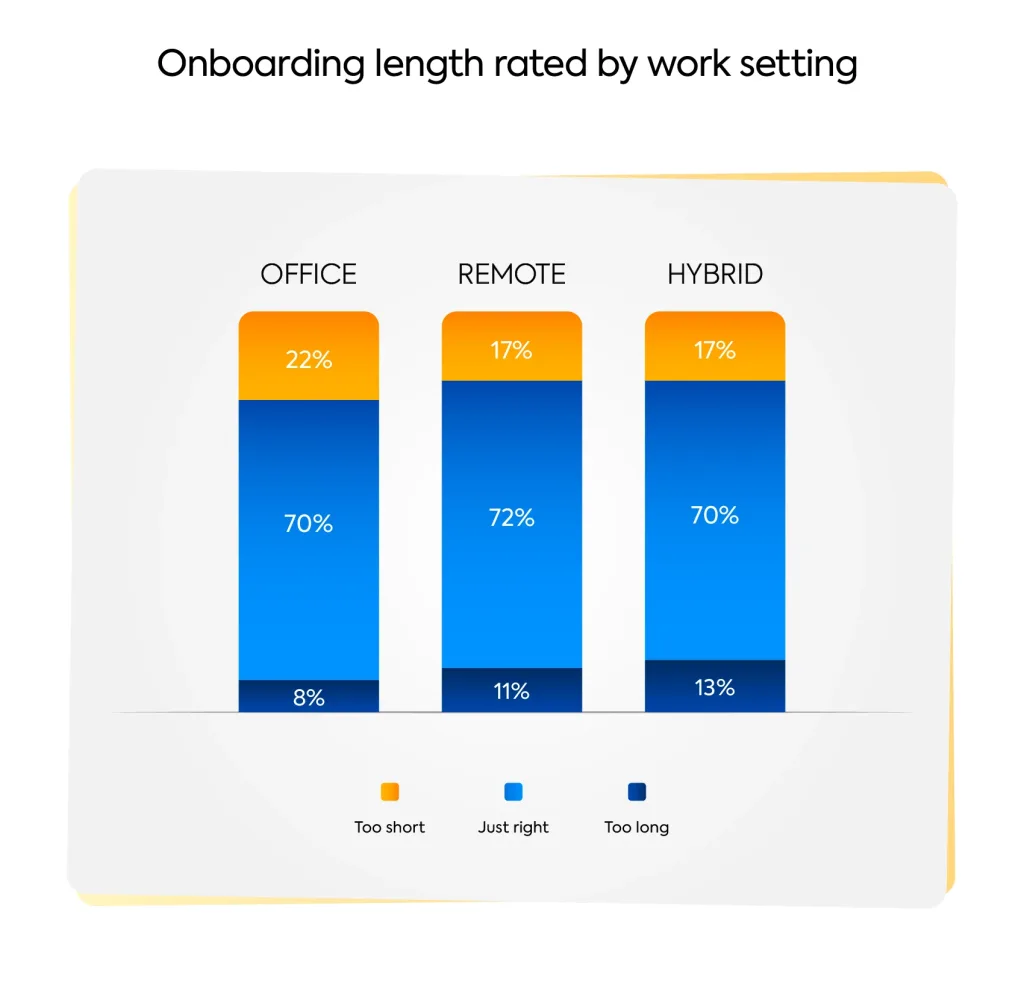
Remote workers were slightly more likely to say the length was ideal, with hybrid and office-based employees reporting the same response. Interestingly, office-based employees were most likely to feel that onboarding was too short (22%), compared to 17% of hybrid and remote employees. This may reflect compressed timelines for in-office roles, where in-person interactions can mask weak spots in onboarding design.
Hybrid employees were most likely to say onboarding dragged on too long (13%), compared to 11% of remote and only 8% of on-site employees. This suggests that hybrid onboarding, while effective, may benefit from clearer transitions between early training and full role integration.
What this means:
While most programs hit the mark, a notable share of new hires still feel rushed or stuck. To fix this, organizations should build in checkpoints to assess individual progress and adjust pacing as needed.
How long until new hires are integrated?
It’s one thing to finish onboarding. It’s another to feel like you’re integrated into your role. Integration doesn’t automatically follow onboarding. It goes beyond completing training or knowing the systems. It’s an emotional milestone that happens when a new hire not only understands what they need to do but also senses how their work fits into the team, the culture, and the organization’s purpose. Likewise, it’s also the point where they begin to feel a sense of belonging, confidence, and ownership.
Forty percent of employees felt fully integrated in their new role within the first two weeks (8% on day one, 32% within two weeks). A quarter of employees (25%) were fully integrated within the first month, while 20% of new hires felt integrated within three months.
In total, 9% of employees took more than six months or more to feel settled into their role. (7% of these new hires finished their formal onboarding program, not feeling integrated at all.)
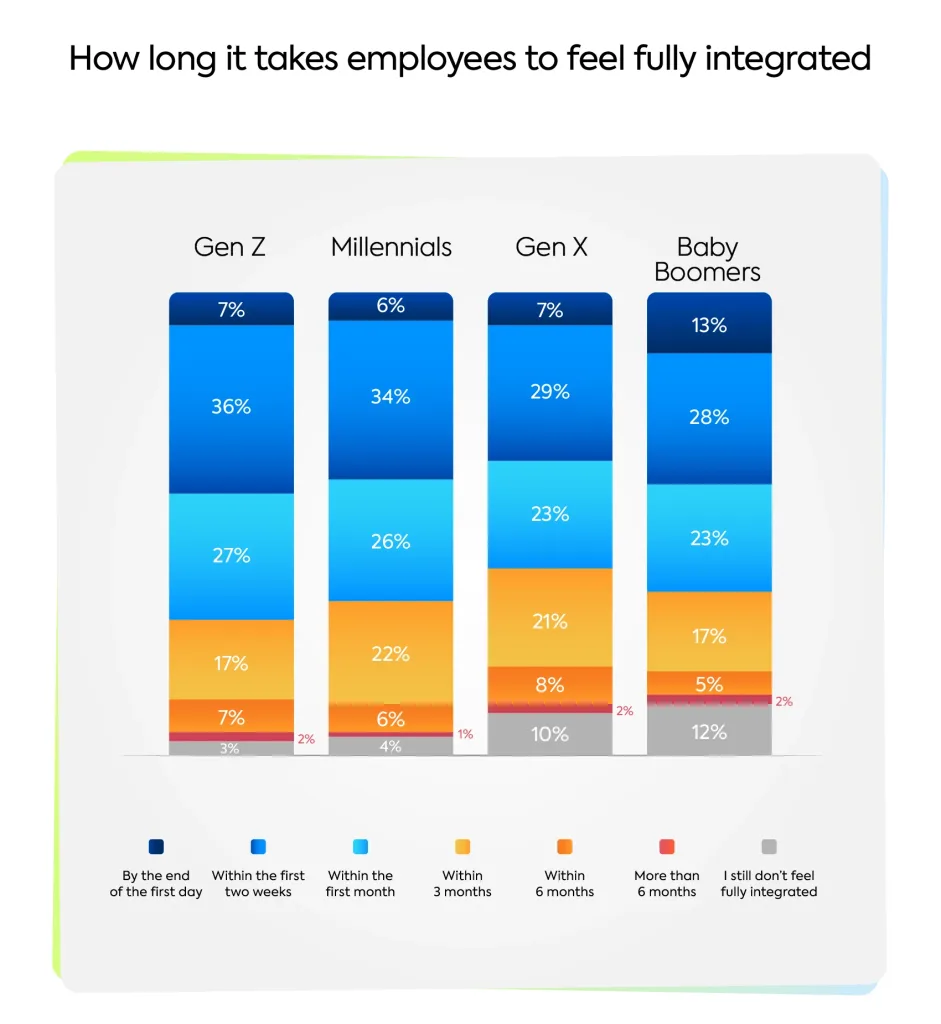
Nine percent may not seem much. But this extended runway may be especially problematic in fast-moving or high-turnover industries, where early performance matters most.
What this means:
While most employees feel settled within the first few weeks, a significant minority take months to truly find their footing. To close the gap, employers should check in regularly and foster team connections until new hires feel fully embedded, not just informed. And consider extending support beyond the onboarding period, where necessary.
Onboarding resources: Solid foundations, generational cracks
When employees have the tools, content, and learning formats that meet their needs, they’re far more likely to hit the ground running. And most employees report positively on the practical aspects of onboarding: 77% of employees were satisfied with their level of access to necessary tools and resources during onboarding.
When it comes to how spot-on onboarding content is, 73% of new hires were satisfied with its relevance, depth, and usefulness. Moreover, 71% were satisfied with the format in which training was delivered.
71% of employees were satisfied with the format in which training was delivered.
These numbers suggest that, on the whole, organizations are doing well at providing new hires with the building blocks they need to start strong. But they don’t tell the full story.
Content quality drew the highest dissatisfaction levels across generations. Nearly 1 in 5 Baby Boomers (18%) report being unsatisfied with the content of their onboarding training. This compares to 14% of Millennials, 13% of Gen X, and 11% of Gen Z.
This finding may reflect the depth of experience Baby Boomers typically bring to a new role. With decades of professional expertise, if onboarding content is too generic or basic, it’s more likely to fall short for this cohort.
What this means
To improve onboarding outcomes across all age groups, organizations should rethink training content through the lens of career stage and role complexity. Tailored onboarding isn’t just for early-career employees; it matters at every level. That means offering more advanced, context-rich training for seasoned hires and avoiding a one-size-fits-all approach that may feel too basic for those with years of experience.
The heart of onboarding: Belonging and connection
The road from new hire to team member is built on human moments. Beyond schedules, software, and spreadsheets lies a more powerful dimension: community and connection.
In a new role, these softer elements of onboarding aren’t fringe benefits. They’re foundational. Employees who feel they belong at a company are more engaged, resilient, and committed to their role. Research shows that employees who feel they belong are 56% more likely to perform at a high level and 50% less likely to leave. Which translates to tens of millions of dollars in productivity gains every year.
And yet, these outcomes don’t happen by accident. Earlier in this report, we saw just how challenging it is for new hires to connect with coworkers and company culture. So what helps new employees feel more than just another number on the payroll?
A blueprint for belonging: The human touch matters most
Structure, systems, and information downloads have traditionally been viewed as a way to bring new employees into the fold. But a feeling of belonging is driven by how people are treated and included, not just what they’re told.
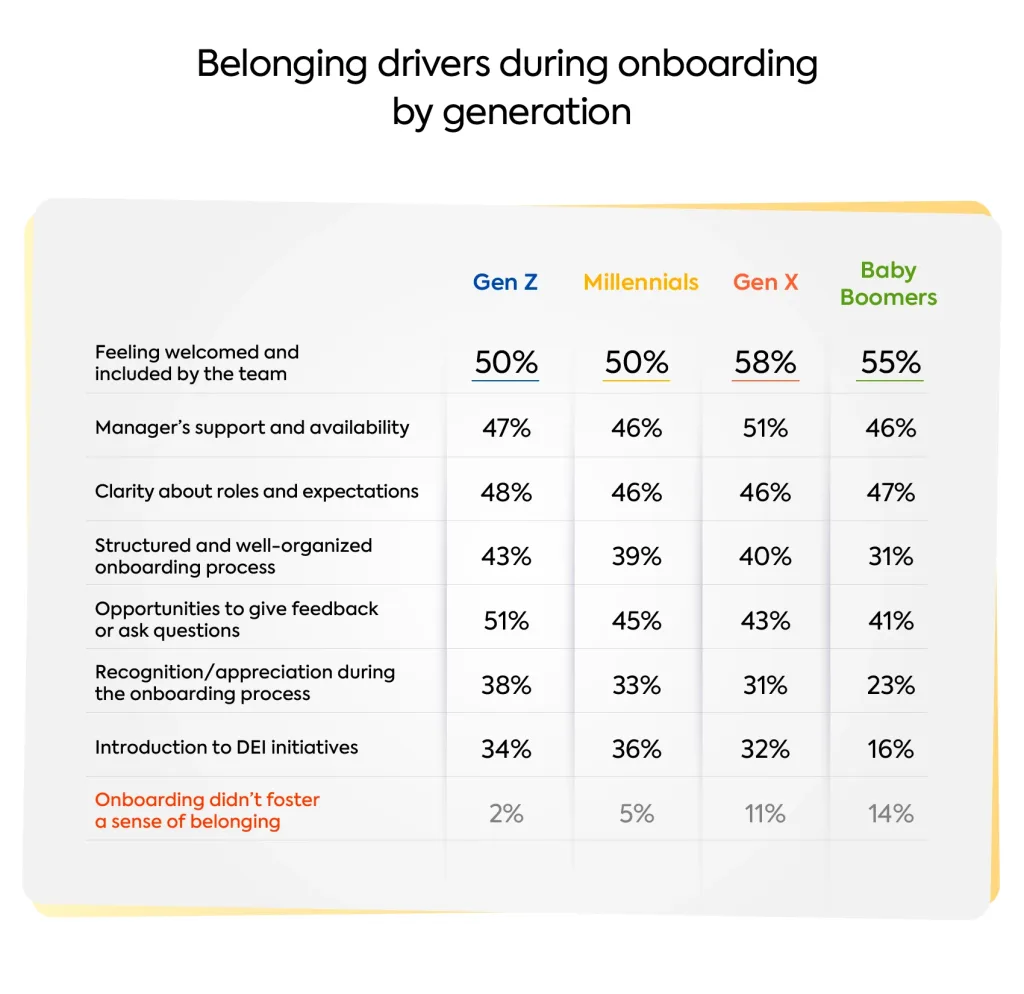
When asked what drove their sense of belonging during onboarding, employees pointed to three top drivers:
- Feeling welcomed by the team (53%)
- Support from managers (48%)
- Clarity about one’s role and expectations (47%)
These findings show that belonging during onboarding isn’t just about culture. It’s rooted in day-to-day human interactions and clarity. Feeling welcomed, supported, and having a clear understanding of one’s role gives new hires the footing they need to connect, contribute, and stay.
What’s more, 45% of all employees felt a sense of belonging during onboarding from opportunities to give feedback or ask questions. Yet nearly one in three weren’t given the chance to provide feedback.
Breaking down differences across age groups, a few patterns emerge. Openness, agency, and two-way communication are valued particularly deeply by the youngest intake. For over half of all Gen Z new hires (51%), the ability to ask questions and share input is their strongest predictor of belonging. Millennials, Gen X, and Baby Boomers are all in agreement; the greatest driver of belonging for all of them was feeling welcomed and included by their team.
What this means:
To strengthen social connections and team dynamics across generations, organizations should prioritize human touchpoints, and provide safe and accessible spaces for questions and feedback.
The social side of onboarding: Building bonds that count
Making friends at work might seem secondary in performance-driven environments. But social bonds play a crucial role in engagement and retention. Companies that overlook this human aspect of onboarding miss a powerful lever for improving individual and team performance.
Workplace friendships create a sense of psychological safety. Which is a key ingredient for innovation, collaboration, and long-term satisfaction. According to Gallup, employees who have a “best friend” at work are seven times more likely to be engaged and twice as likely to describe their workplace culture as “thriving.” Friendships also serve as a multiplier for onboarding success, helping new hires gain clearer insights into roles, expectations, and team dynamics.
Our data shows that, even in an era of remote and asynchronous work, forming friendships is still top of mind for new employees. Sixty-one percent of new employees said they care about making friends at work. That desire spans all generations, with some differences.
Especially for the youngest employees, forming friendships during onboarding is front of mind. It peaks at 66% for Gen Z, dropping to 61% for Millennials and Gen X, and bottoming out at 55% for Baby Boomers.
Making friends at work matters most to Gen Z (66%). They’re followed by Millennials and Gen X (61%), and Baby Boomers (55%).
This desire for connection is encouraging news for employers, especially given the well-documented benefits of workplace relationships. However, since ‘fitting in’ and building connections with colleagues rank among the top three onboarding challenges, there’s still work to be done before organizations can fully unlock those benefits. Still, onboarding training is a strong starting point. When asked, 65% of new employees agreed that onboarding training helped them build meaningful connections with their colleagues.
What this means:
Organizations should be intentional about facilitating peer connections during this early window. That means including social bonding opportunities into the onboarding program. And collaboration tools within onboarding and training platforms used to bring new hires and existing employees together in an informal setting.
12 research-backed fixes for better onboarding
So, how can employers harness this information and turn insights into next steps? Here are 12 strategies, with a series of supporting tactics, to help provide structure and clarity.
#1 Demystify company culture
What did new hires say? Adjusting to their new company’s culture, values, or work style is the top challenge for employees.
What can employers do?
- Move beyond value statements by sharing real stories and behaviors that show what culture looks like in practice.
- Offer a dedicated time when leaders, founders, or long-tenured employees talk openly about how the company works, collaborates, and makes decisions.
- Pair new hires with team members (culture ambassadors or onboarding buddies) who can guide them through unspoken norms and answer questions in a safe, informal way.
- At 30 days, ask new hires what aspects of the culture feel clear or confusing. And refine onboarding touchpoints accordingly.
#2 Ease the overwhelm (especially for Gen Z)
What did new hires say? Forty-two percent of employees said they were overwhelmed by too much information during onboarding, especially Gen Z.
What can employers do?
- Break onboarding into digestible sprints (weekly or milestone-based) instead of front-loading everything in the first few days.
- Provide a quick-start guide to reduce initial overwhelm.
- Replace lengthy manuals with interactive, searchable knowledge bases.
#3 Cut the admin, amplify the practical
What did new hires say? Over half (52%) of employees said their onboarding focused more on admin tasks than practical job training.
What can employers do?
- Focus early content on immediate job-readiness (for example, hands-on practice, product walkthroughs, live demos, or task-based learning).
- Use checklists to track essentials, but pair them with interactive activities such as job shadowing or simulations.
- Streamline or automate onboarding admin (for example, paperwork and policies) before day one using digital preboarding tools.
- Prioritize what new hires need to confidently start their job in week one, not what’s easiest to distribute or to check off.
- Combine required (compliance) training with early team involvement or customer exposure to foster practical engagement.
#4 Customize by generation
What did new hires say? Different generations face distinct onboarding challenges. Gen Z struggles most with cultural integration and human connection, while Millennials seek clarity on manager expectations. Baby Boomers were more dissatisfied with content relevance and training quality. Gen X prefers onboarding that’s structured and streamlined.
What can employers do?
- Offer flexible delivery formats. Blend short-form digital learning with more structured, role-specific modules.
- Tailor tone, pacing, content, and focus based on generational preferences and career stage.
- Avoid assumptions based on age alone. Collect onboarding feedback by age group and/or experience level and adjust content or structure accordingly.
- Use data to inform personalization, but give all employees the ability to self-direct and choose what works best for them.
#5. Automate with consideration and care
What did new hires say? Thirty-two percent of new employees relied on AI more than people for help during onboarding, but only 30% found it helpful. And 60% said they received no training on AI.
What can employers do?
- Introduce AI tools with clear guidance and training.
- Use AI to handle routine queries or admin tasks, but ensure human touchpoints are in place for complex or emotional questions.
- Don’t outsource critical moments. First-day welcomes, goal setting, and feedback conversations should always be led by humans, not chatbots.
- Pair tech with people. Introduce AI tools alongside onboarding buddies, manager check-ins, and peer communities.
- Monitor when and how new hires seek help. If AI is overused and under-delivering, it may signal a gap in accessibility or trust.
#6. Prevent early-stage regret
What did new hires say? Nearly 4 in 10 employees (39%) had second thoughts during onboarding.
What can employers do?
- Audit the recruitment-to-onboarding handoff to ensure what’s promised during hiring is echoed and reinforced during onboarding.
- Create a “first 30 days” alignment checkpoint to confirm if reality matches expectations.
- Involve recruiters, talent acquisition (TA), and HR professionals in onboarding design to align messaging and address gaps in perception vs. experience.
#7. Double down on manager engagement
What did new hires say? A quarter of new hires don’t receive support from their manager during onboarding and struggle with unclear supervisor expectations. The same number said their manager was unprepared for onboarding.
What can employers do?
- Train managers to conduct structured check-ins throughout the first 90 days.
- Provide onboarding toolkits specifically for people managers.
- Make manager engagement a tracked onboarding KPI.
- Train managers to set direction for new hires early and clearly.
#8. Facilitate feedback early and often
What did new hires say? Almost a third of new hires (29%) didn’t have a chance to provide feedback during onboarding.
What can employers do?
- Build multiple feedback checkpoints into onboarding. For example, at the end of week 1, and at 30, 60, and 90 days.
- Ask about emotional as well as operational experiences. For example, “Do you feel connected?”
Publicly act on feedback to show responsiveness and trustworthiness.
Use pulse surveys, 1:1 check-ins, and anonymous channels to fill in gaps and surface timely issues.
#9. Protect time for training
What did new hires say? Twenty-five percent of new hires felt pressured to perform before training was complete, and 24% said there was no follow-up after onboarding.
What can employers do?
- Block out protected training time in calendars and workflows.
- Use onboarding milestones to signal readiness before assigning full responsibilities.
- Follow onboarding with structured “month two and three” learning plans.
# 10. Prioritize personalized learning from day one
What did new hires say? Nearly a third of Gen Z (31%) and 26% of Millennials said their training lacked personalized learning options.
What can employers do?
- Implement learning pathways that adapt to role, career stage, and individual preferences.
- Use pre-boarding surveys to gauge learning styles and tailor early training accordingly.
- Blend self-paced content with live coaching and/or peer shadowing for greater direct and personal impact.
# 11. Tap into hybrid onboarding’s strategic edge
What did new hires say? Employees who experienced hybrid onboarding had the highest level of satisfaction (75%) and effectiveness (73%), compared with in-person and remote models.
What can employers do?
- Design onboarding programs that combine remote efficiency with in-person depth.
- Schedule virtual onboarding sessions followed by live cohort meetups.
- Explore in more depth what makes the hybrid onboarding model so successful, and apply findings when designing future onboarding programs.
# 12. Remove the obstacles to skills building
What did new hires say? Only 38% of new employees said they didn’t encounter any challenges building skills during onboarding.
What can employers do?
- Use quick pulse surveys during onboarding to identify and remove skill-building roadblocks before they derail the learning journey.
- Introduce pre-boarding surveys or role-specific assessments to make upskilling more relevant.
- Extend onboarding training where appropriate and fix with measurable development milestones.
Conclusion: The starting line and its lasting reach
In 2025, there’s beauty in onboarding. But also something of a beast.
A multifaceted, colorful creature with long talons and an extended reach, its influence extends well beyond a 30, 60, or 90-day window.
Sixty-five percent of employees say onboarding marks the beginning of a continuous learning journey, confirming its role as a foundation for future success, not just a gateway to a job. But that’s just the start. Continue to treat it well, and it will also sharpen performance, deepen engagement, and drive long-term retention. Neglect or underestimate it, and it will bite, leaving new hires alienated, overwhelmed, undervalued, and looking for the exit.
Our research captures these two faces of onboarding, revealing both impressive wins and pressing challenges. Most new hires feel welcomed, confident, and well-equipped to succeed in their role and more. But some feel overwhelmed, underdeveloped, and emotionally disconnected.
These issues don’t affect all groups equally. Gen Z, the incoming backbone of the workforce, reports the highest levels of information overload and cultural alienation. Meanwhile, Baby Boomers are more likely to find training content generic and uninspiring. These generational differences signal that a one-size-fits-all model is no longer viable.
Operating and delivery models echo this sentiment. Hybrid onboarding consistently outperforms both remote and in-person methods, boosting satisfaction, preparedness, and access to ongoing learning. In contrast, remote onboarding presents the greatest risks: new hires in remote settings report lower support, higher overload, and weaker connection. The work environment also shapes challenges. Remote employees struggle with information flow, in-office hires with cultural fit, and hybrid workers with peer connection.
AI presents a compelling opportunity to personalize onboarding at scale. But it must be deployed with care. The data is clear: while some new hires use AI more than people to find answers, only a fraction find it helpful. Without thoughtful design, training, and a strong human support system, AI may erode connection instead of enabling it.
Looking ahead, the most successful onboarding programs will be those that combine digital innovation with deep human insight. They’ll be flexible enough to adapt to different generations and work settings. And they’ll be structured to promote clarity, community, and continuous growth, from day one through to year one and beyond.
The companies that get this right won’t just tame the beast; they’ll give it wings to fly.
Methodology
The survey was conducted online in May 2025, surveying 1,156 U.S.-based employees across industries, all of whom started a new job in the last 12 months. Minor discrepancies in total figures may exist due to rounding.
Generational breakdown of surveyed employees:
- Gen Z (ages 20 to 28): 99 respondents
- Millennials (ages 29 to 44): 299 respondents
- Gen X (ages 45 to 60): 300 respondents
- Baby Boomers (ages 61 to 79): 258 respondents
Gender breakdown of the respondents:
- Female: 520 (44.98%)
- Male: 636 (55.02%)
Dive deeper into original research by TalentLMS


Bring out the best in your teams.
Get started with the most versatile and affordable employee training platform, no credit card needed.