New Research:
The TalentLMS 2026 Annual L&D Benchmark Report
From year-over-year training benchmarks to learner–leader gaps, see the data that defines the new era of learning. To turn insight into action, the report lays out 10 evidence-backed interventions to hardwire development. Plus, lift the lid on Learning Debt: What it is and how to spot it.

Key highlights
L&D 360 view: From learners to learning leaders
A full-circle snapshot of workplace learning, from the employees taking training to the leaders shaping it.
Macro trend: The emergence of learning debt
Learning debt is quietly piling up as work outpaces development. The result: A slow bleed of skills and knowledge.
AI tightrope: Upskilling talent vs. automating it away
47% of leaders say AI training is built to automate jobs. Signaling that many train for automation, not augmentation.
- Executive summary
- Inside corporate L&D: Ownership, budgets, and metrics
- Why L&D gets stuck: Systemic, strategic, and everyday barriers
- How L&D challenges have shifted over time
- TalentLMS customer voice
- The multitasking red flag: When learning loses focus
- 10 interventions to turn learning into a growth engine
- Workforce readiness: Navigating skill gaps
- L&D in the age of AI: Design, deployment, and dilemmas
- AI skepticism and blind spots
- AI training: Between promise and peril
- The anatomy of workplace learning
- 3 L&D macro trends
- Conclusion
- About this research
Executive summary
The skills economy is being rewritten in real time. AI is reshaping what people need to know, do, and deliver, faster than organizational structures can adapt. The result is a workplace caught between acceleration and inertia. Companies are racing to reskill for an AI-driven future while relying on structures built for yesterday’s world.
This TalentLMS 2026 L&D Benchmark Report captures that inflection point. Based on data collected through 2025, and compared with earlier findings from 2022 to 2024, it explores how learning is evolving and what’s holding it back.
Our research integrates two vantage points: HR leaders overseeing learning initiatives and employees receiving formal training. Together, they offer a dual perspective on how learning is managed and how it’s experienced.
The analysis also draws on insights from external research and leading L&D practitioners, anchoring the report in both evidence and practice.
Combined, the findings point to a structural fault line: Learning is expanding in scope but contracting in space. Organizations are multiplying programs, tools, and ambitions, yet the conditions for learning — time, focus, and cognitive bandwidth — keep shrinking.
Half of learning leaders and 53% of employees say high workloads leave little room for training, even when it’s needed.
The data from this report underscores this critical conflict: According to half of the surveyed employees and learning leaders, high workloads leave little room for training, even when it’s needed.
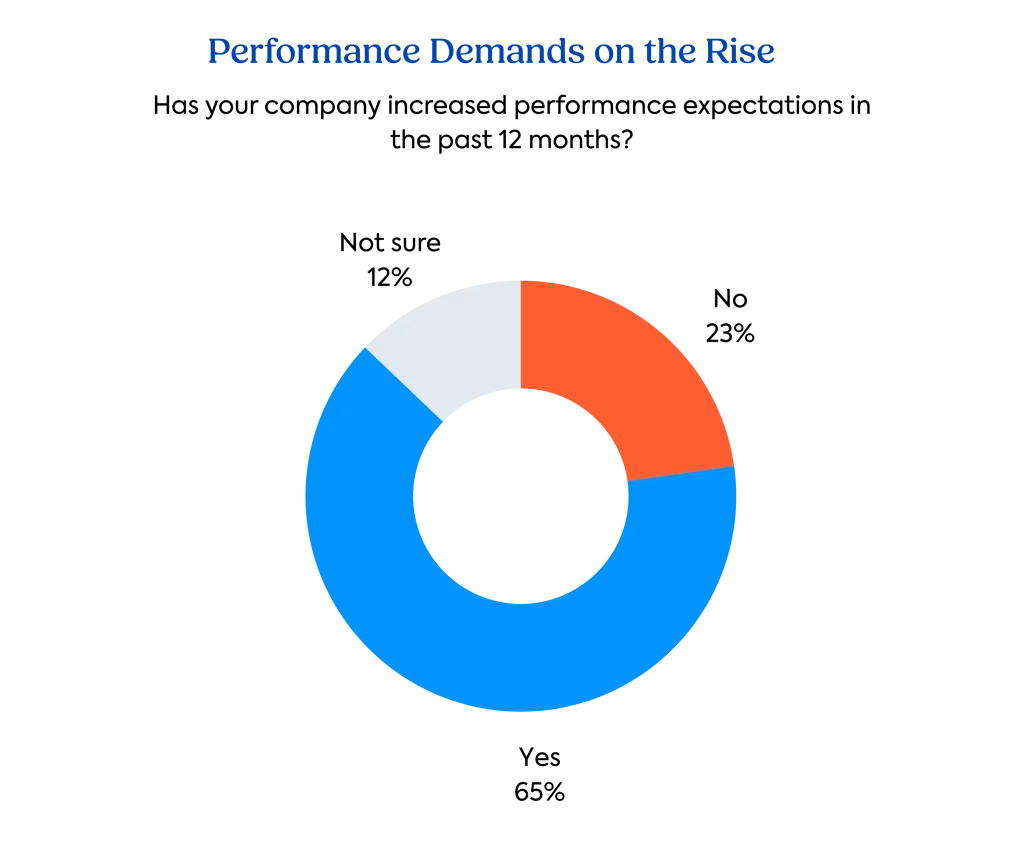
Employees work inside a permanent sprint, where attention is fragmented and reflection is sidelined. The space for learning is collapsing under the weight of doing. Sixty-five percent of employees say performance expectations have risen this year, yet lack of time remains the biggest barrier to learning.
The numbers confirm what employees and learning leaders both feel: Technology can advance overnight. But people and cultures can’t.
In short, the balance is off.
This report reveals how organizations can redress the balance by turning motion into momentum. And lay the groundwork for cultures where learning moves with progress, not behind it.
Inside corporate L&D: Ownership, budgets, and metrics
Before diving into the data, let’s look at the types of learning leaders we surveyed and why.
In many organizations, L&D sits within or reports directly to HR rather than operating as a standalone function. Our sample focused on HR managers who oversee or influence learning programs. By focusing on this group, we were able to obtain a reliable snapshot of how organizations design, fund, and prioritize L&D.
To complement the quantitative findings, we also brought in qualitative insights from experienced L&D practitioners, expanding the data with context and depth.
All of these perspectives set the stage for what follows: A robust analysis into who drives learning inside organizations, how budgets are shifting, and how success is measured.
Who owns L&D initiatives in companies?
To understand how learning is structured, we asked HR leaders who primarily manage L&D in their companies.
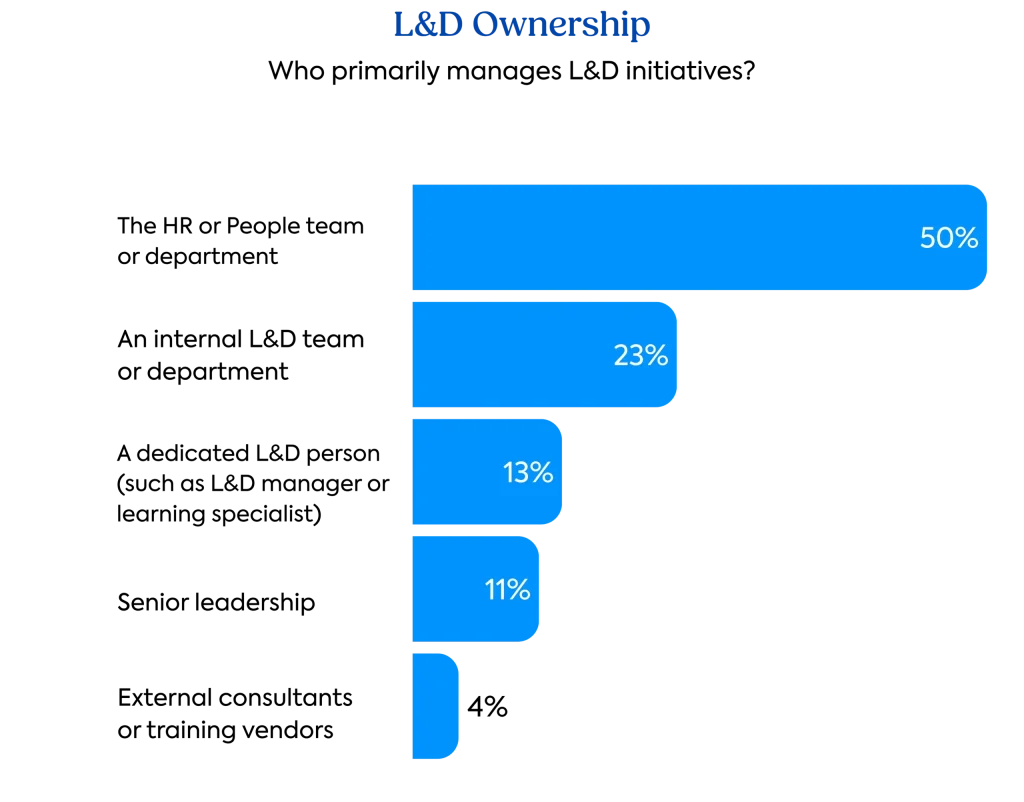
Half of the HR managers surveyed say L&D is managed by HR or People teams. Another 36% say it’s run by a dedicated L&D team (23%) or an individual (13%). The rest rely on senior leaders (11%), external consultants or vendors (4%).
Together, the results show that learning ownership takes different forms depending on how companies set up learning. And what they expect from it. Organizations are relying on structures that reflect their size, maturity, and approach to learning.
L&D spending trends: How training budgets have evolved
With ownership established, the next focus is funding. How much are companies investing in their learning strategies, and how has that spending shifted over time?
The graph below compares annual L&D budgets per employee in 2022 and 2025, offering a snapshot of how learning spend has changed in that period.
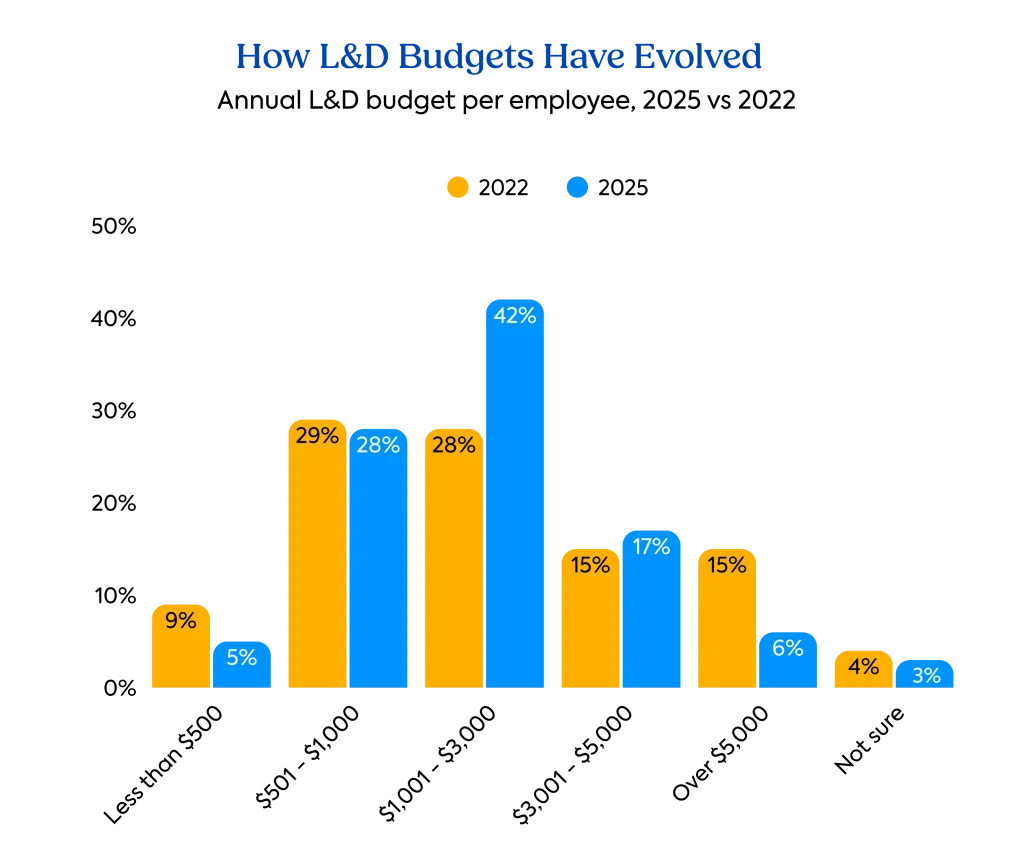
The big takeaway? The middle ground is the new normal. Outliers are fading. Fewer companies underinvest (< $500) or overspend (> $5,000) on training. The largest share now invests between $1,000 and $3,000 per employee, marking a shift toward standardized, sustainable budgets.
At first glance, flat budgets might indicate stagnation. But given inflation and tighter margins, holding steady may actually signal greater commitment, not caution. L&D spending is becoming more intentional — less reactive, more measured. This is backed up by the drop in “Not sure” responses, which suggests organizations are tracking spending more closely.
That commitment is showing up in sentiment, too. Satisfaction with L&D budget has climbed steadily, with 76% of HR managers satisfied in 2025, up from 61% in 2022.
L&D ROI: Measuring success and business alignment
Some business functions are easier to quantify than others. Sales points to deals closed and new clients. Marketing shows leads and conversions. But L&D’s impact isn’t as immediate. It’s not reflected in quarterly numbers. Instead, it shows up in long-term performance, engagement, and retention.
Still, the vast majority of those leading training and development are confident in showing their ROI. Difficulty measuring learning ROI is seen as a challenge by only two in ten HR managers.
But how exactly is the success of L&D initiatives measured? To find out, we asked HR leaders about the metrics they use to assess success in their companies. Here’s what they told us.
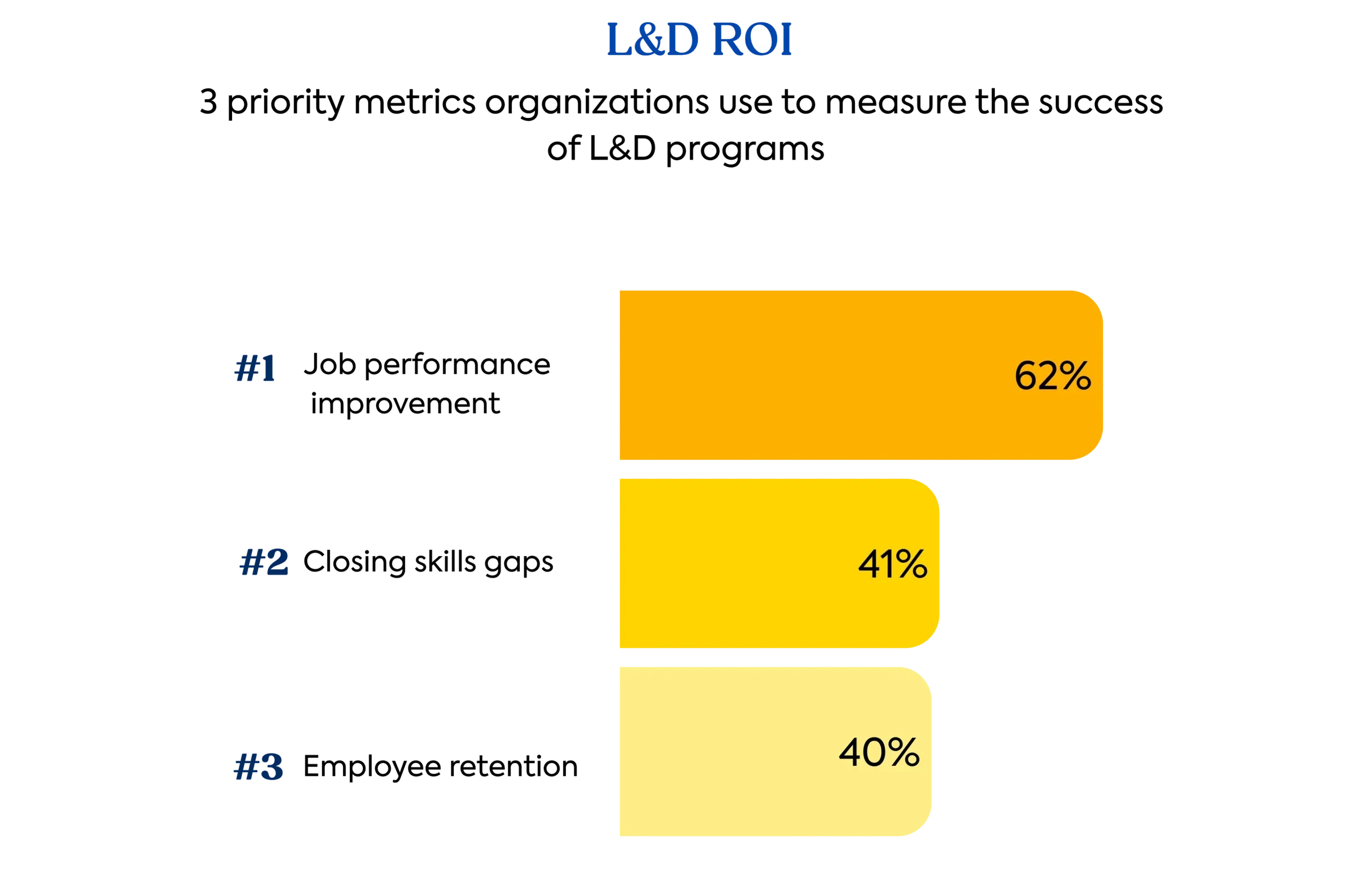
Secondary measures of L&D success include business impact (selected by 37% of HR managers), career growth outcomes (31%), and satisfaction with training (28%).
When it comes to business alignment, 75% of HR managers say their company’s L&D strategy is aligned with KPIs. Only 5% disagreed, showing that most organizations view learning as part of the business engine.
That signal of maturity is reinforced by another change in perception. According to HR managers, the share of executives who see L&D as “a cost rather than an investment” has fallen from 54% in 2022 to 41% in 2025.
Benchmark data: Year-over-year training satisfaction
TalentLMS L&D research has tracked employee satisfaction with training since 2022. The next graph shows how satisfaction levels have evolved over time.
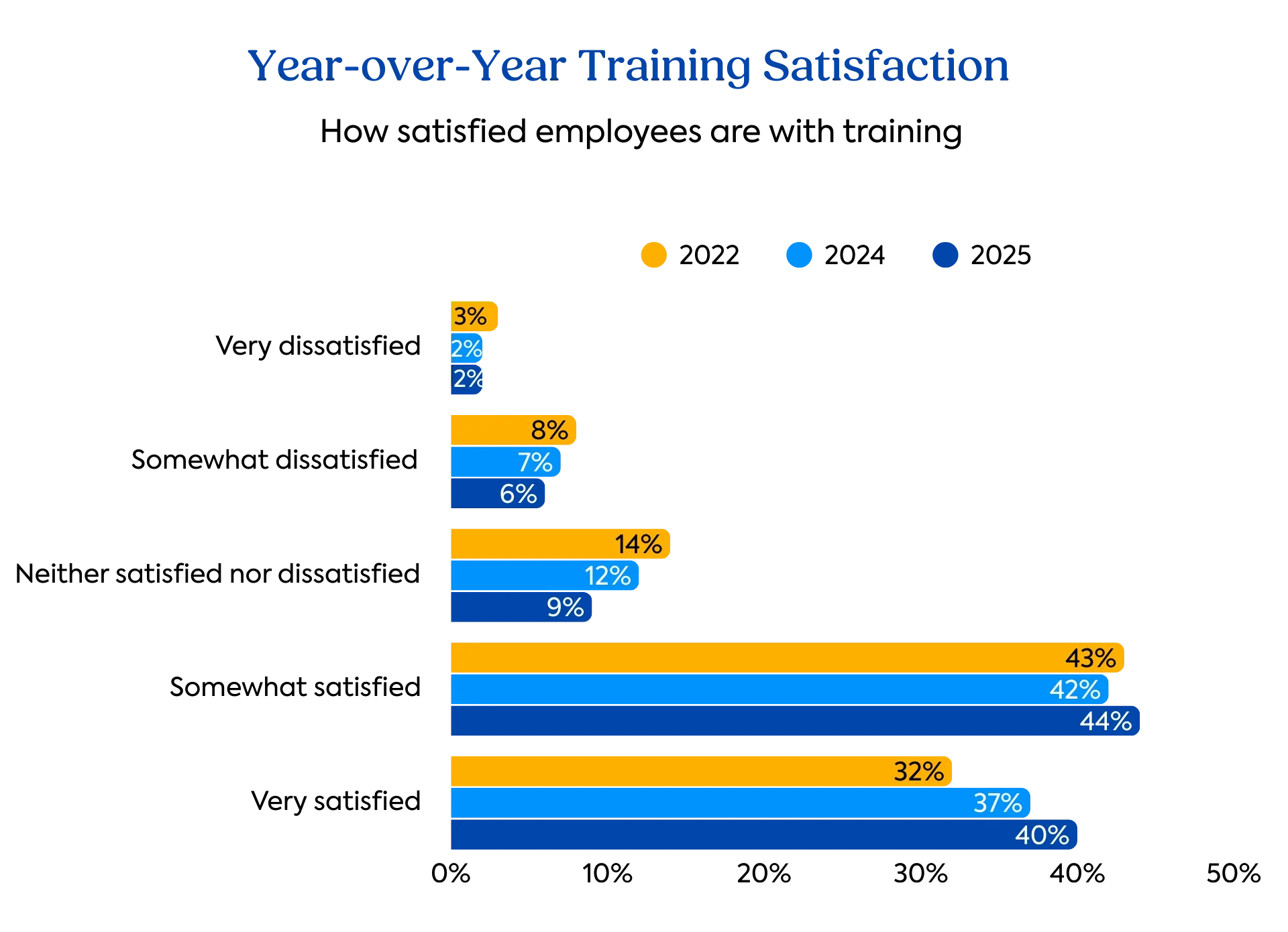
The data suggests that employee training programs are steadily improving in quality and relevance, creating a more positive learning experience across the workforce. Employee satisfaction with training has continued to climb year over year. In 2025, 84% of employees say they’re satisfied, up from 79% in 2024 and 75% in 2022. Dissatisfaction, meanwhile, has dropped.
These results point to steady progress in how learning is designed, delivered, and experienced.
The business case for L&D: A proven retention driver
Training doesn’t just build skills. It builds commitment. In our survey, 95% of HR managers agreed that better training and skill development improve employee retention. And employees see it the same way: 73% said stronger learning and development opportunities would make them stay longer at their company. Together, these findings point to development as one of the most reliable ways to keep talent engaged and loyal.
95% of HR managers agree that better training and skill development improve employee retention.
Now, let’s look at another piece of the puzzle. How likely are employees to jump ship due to limited learning opportunities? In 2024, fewer employees said they’d leave if denied training — likely reflecting a more cautious job market. But in 2025, that figure rose again to 35%, showing that development expectations are climbing back up the agenda.
The takeaway is clear. When learning is prioritized, people stay. When it’s not, they decide to take their talent elsewhere.

Why L&D gets stuck: Systemic, strategic, and everyday barriers
The World Economic Forum’s Future of Jobs Report found that an increasing share of the workforce (50%) completed training in 2025, compared to 41% in 2023. This upward trend signals that companies are actively prioritizing L&D to anticipate and address future skill requirements.
Yet even with this momentum, L&D continues to face systemic and everyday challenges that hold progress back. Let’s examine where those barriers lie.
Real-world barriers for L&D teams
Surveyed HR managers identified a familiar trio of barriers standing in the way of effective learning. As we’ll see, the obstacles aren’t about lack. They are about limits.
Obstacle 1: Time constraints
Time stands out as the single biggest barrier to learning, as reported by HR leaders. Supporting data shows the extent of the problem. Over the past three years, time has been the biggest training challenge for employees. What’s more, half of HR managers (50%) say high workloads in their companies leave little room for training, even when it’s needed. The challenge for organizations is no longer creating learning opportunities. It’s making more space for them.
Obstacle 2: Getting training content right
There’s no shortage of learning materials these days. But ensuring quality and relevance remains a significant challenge. HR leaders rank finding the right training content as the second-biggest obstacle to the effectiveness of L&D initiatives. AI may be able to generate learning materials faster than ever. But most organizations still lack the governance and context to ensure that what’s produced meets real business needs.
Obstacle 3: Budget restrictions
We saw earlier in the report that overall satisfaction with L&D funding has climbed. Even so, budget constraints remain among the top three L&D challenges in 2025. However, they’ve moved down from second place in 2022 to third position this year. This suggests that while financial pressure hasn’t disappeared, funding for learning is becoming more stable and predictable.
AI should save time for better learning, not fewer people
“Lack of time makes sense as one of the biggest challenges. As an industry, we’ve struggled to show our value, which has led to training being considered a regrettable expense, rather than an investment with the potential of increasing returns. As a result, the focus has been on lowering the cost of training rather than increasing the investment.
AI represents a big opportunity for L&D departments, speeding up development time and making customized content more available. We are at a crucial point, though, where the best outcome of AI speed would be to use the saved time to invest in doing better and more useful learning design, not using it to reduce staffing costs. Being able to make the case (and show the data) about why continuing and increasing learning investments are good for the organization is one of the biggest challenges for L&D leadership.”

How L&D challenges have shifted over time
Looking at longitudinal data, back in 2022, the top L&D challenge for learning leaders was finding the right training materials. Now, time is their most pressing issue. Heavy workloads are leaving little room for learning, pushing even the best programs to the sidelines.
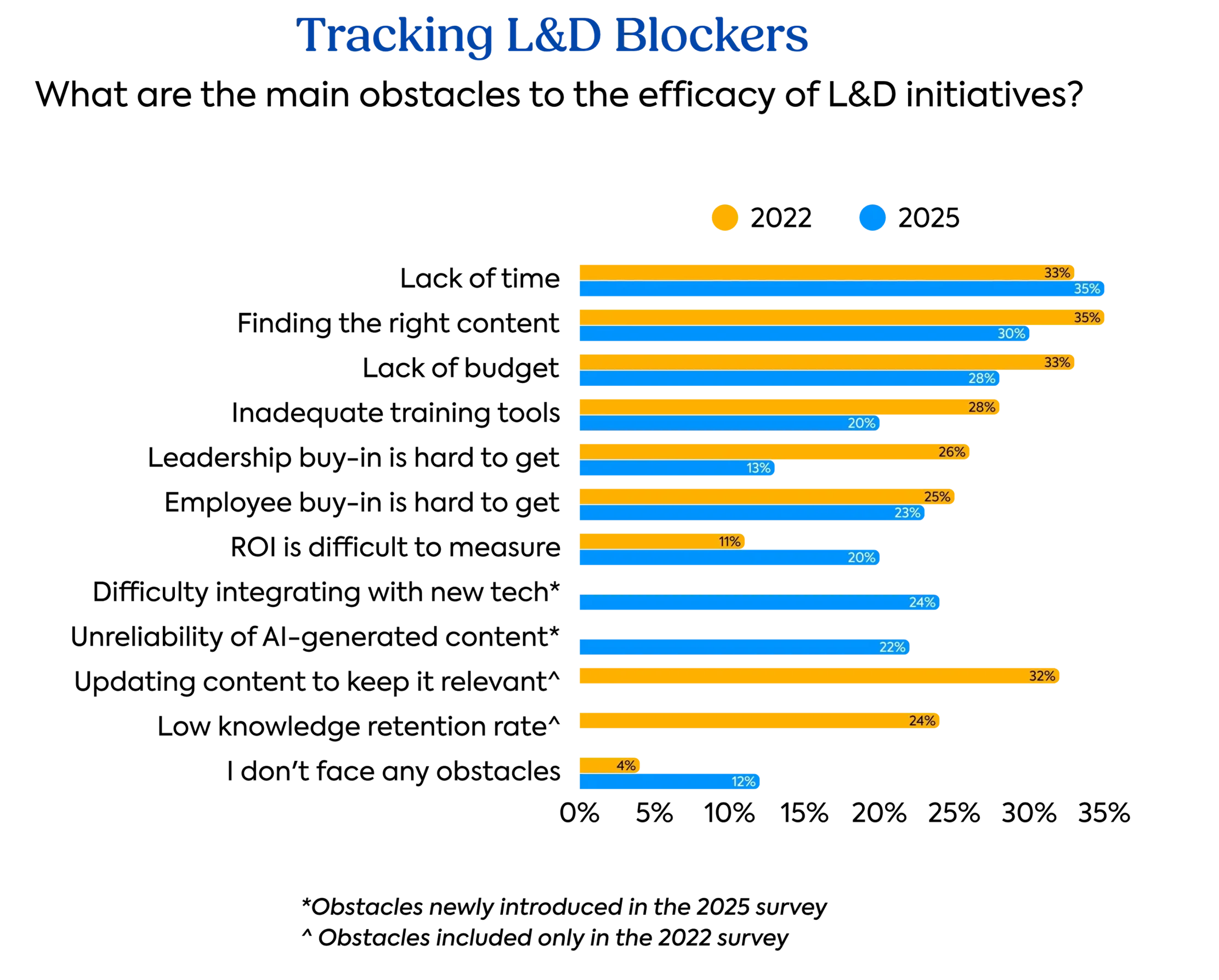
At the same time, several obstacles are losing ground. Getting leadership buy-in, for instance, dropped sharply from 26% in 2022 to 13% in 2025. That decline points to increased executive support toward learning. Similarly, “inadequate training tools” fell from 28% to 20%, reflecting better access to digital learning platforms and more mature tech stacks.
But as older challenges fade, new ones emerge. Nearly a quarter of HR managers (24%) now cite difficulty integrating new technologies, and 22% mention unreliable AI-generated content as a blocker.
TalentLMS Customer Voice
Create learning that’s as diverse as your people
“What stands out most from this year’s findings is how our learning challenges are becoming less about what to learn — and more about how people are able to learn.
In 2022, the biggest barrier for HR leaders was finding the right content. Today, it’s time—a resource that feels increasingly scarce for everyone. But when you look closer, that “lack of time” is really about people’s diverse needs. Employees are balancing different work styles, personal responsibilities, learning speeds, and even preferred modes of engagement. The one-size-fits-all training approach simply doesn’t fit anymore.
As HR professionals, our responsibility is to design learning that meets people where they are. Accessibility isn’t just about compliance — it’s about equity of opportunity. Whether an employee learns best through bite-sized microlearning, self-paced modules, or interactive group sessions, everyone deserves access to development that works for them.
That’s where a modern LMS like TalentLMS becomes essential. It empowers every learner—regardless of schedule, role, or ability—to access relevant, engaging training when it works best for them. For the organization, it provides structure and visibility. For the employee, it offers flexibility and inclusion. The upward trend in employee satisfaction—from 75% in 2022 to 84% in 2025—shows that when learning becomes accessible, flexible, and personalized, engagement naturally follows. People don’t just complete training; they connect with it.
As we move into 2026, our focus should be clear: create learning that’s as diverse as our people. When every individual can learn in a way that fits their time, their needs, and their goals, development becomes more than a program—it becomes part of the culture.”

How employee learning challenges are evolving
For the third year running, employees say lack of time is their top obstacle to training. Despite all the talk of flexible, in-the-flow-of-work learning, employees continue to struggle to fit it in.
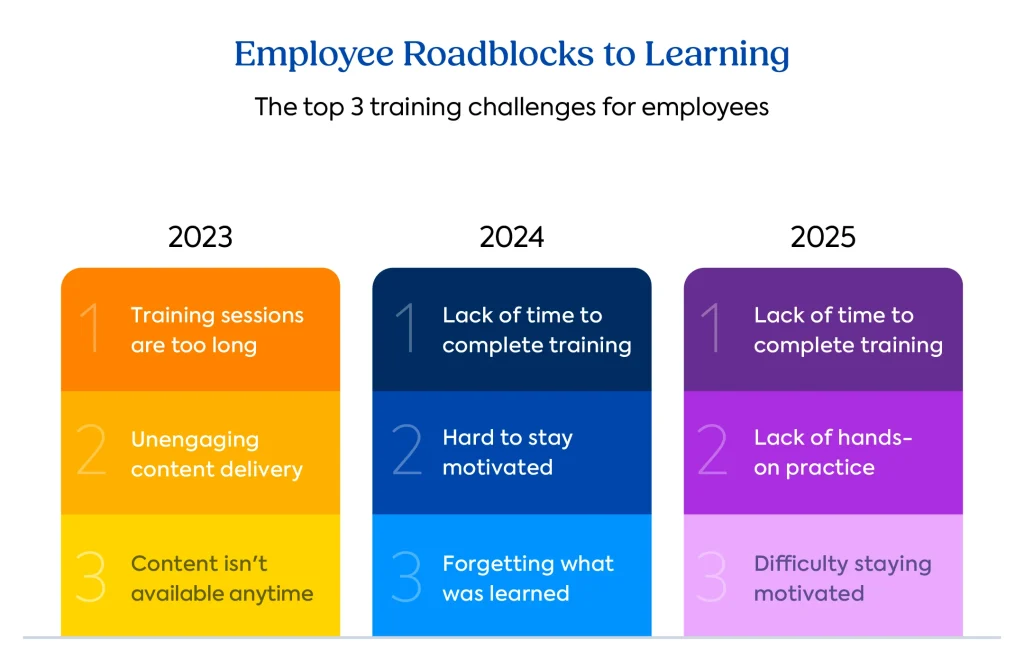
The second most common blocker for employees this year? Not enough hands-on practice. Nearly a third of employees said their training was too theoretical. This exposes a deeper flaw in corporate learning: Too much of it happens in the abstract. Employees don’t need more content; they need more practice.
Difficulty staying motivated rounds up the list of the top three challenges. Motivation drops when training feels irrelevant or doesn’t lead to real progress. For L&D teams, that means designing learning that earns attention, not demands it.
The underlying blockers: Heavy workloads, fragmented focus, and dated learning mindset
Beneath the practical obstacles of time, content, and budget lie deeper barriers that quietly hold learning back. Together, they reveal an imbalance between what companies expect from people and what they enable through learning. It’s an imbalance fueled by mounting pressure, divided attention, and a mindset that still treats learning as optional rather than integral to performance.
Shared frustrations: When development is a luxury
When it comes to how learning is experienced day to day, learning leaders and employees share the same reality: Workplaces are stretched so thin that development becomes a nice-to-have, not a must-have.

Half of HR managers and 53% of employees say high workloads leave little room for training, even when it’s needed. Sixty-five percent of employees say performance expectations have risen in 2025. And 45% report being pushed to deliver more at work, often or always. The result is a workforce working harder but learning less, because when every minute is spoken for, training slips off the agenda.
65% of employees say their company has increased performance expectations in the past year.
Workload is only part of the story. Beyond time constraints, perceptions of training bring to light a deeper problem rooted in corporate culture. Nearly half of employees (46%) and HR managers (49%) agree that their company views training as time away from ‘real’ work. This mindset presents learning as an interruption instead of an advantage. Pushing it even further to the margins.
Training is not a nice-to-have: Learning IS the work
“Isn’t it disappointing that in 2025, nearly half of employees and HR managers agree that their companies still see training as a nice-to-have, not the actual work? When a company does not invest in its people, it’s sending the message that it is ok not to grow. They are effectively agreeing to move backwards, as their competitors who do invest in learning for their colleagues are progressing and overtaking. Without the growth, innovation, creative and critical thinking that come from learning, companies cannot move on. When I advise organizations, I keep stressing the same point: learning IS the work. And anchoring people development to managers’ KPIs helps accountability around learning being the work.”

Together, these pressures create an environment where training is easy to postpone and hard to prioritize. Over time, that erodes both skill growth and morale. When learning keeps losing the race against the daily workload, employees stop viewing it as something that moves them forward.
Nearly half of employees (46%) and HR managers (49%) agree that their company views training as time away from ‘real’ work.
They start seeing it as an obstacle to performance. For organizations, that’s not just a missed chance to upskill. It’s a slow leak in capability, engagement, and retention.
The multitasking red flag: When learning loses focus
As workloads grow and focused learning time shrinks, employees are trying to do both at once: Work and train. The result is divided attention, where learning competes with messages, meetings, and unfinished tasks.

Multitasking during training has reached its highest level in three years, climbing to 70% in 2025 from 58% in 2024 and 64% in 2023. This means that even when employees make time for learning, their minds are elsewhere. And, with performance demands tightening, training sessions have to fight for attention amid the pressure to not only deliver, but achieve more.
In an era of constant disruption, organizations need to rethink how learning fits the rhythm of work, not compete with it.
Listening isn’t learning, and information dump isn’t design
“We are surrounded by distractions pulling our attention. It should be no surprise that employees are multitasking during training. When training is designed without opportunity for participants to actively practice and reflect on their practice, people will find something more meaningful to do. Listening is not training, nor is overwhelming people with content. Training must be designed around practice and performance, not just content delivery.”

Perception divide: Training satisfaction and AI learning support gap
Training satisfaction gap
Beyond shared challenges, the data also reveals where leaders and employees see things differently. Satisfaction with training is one area where opinions start to split. Eighty-nine percent of HR managers say they’re satisfied with their company’s training programs, compared to 84% of employees. A five-point gap may seem minor, but it tells a bigger story about perception.
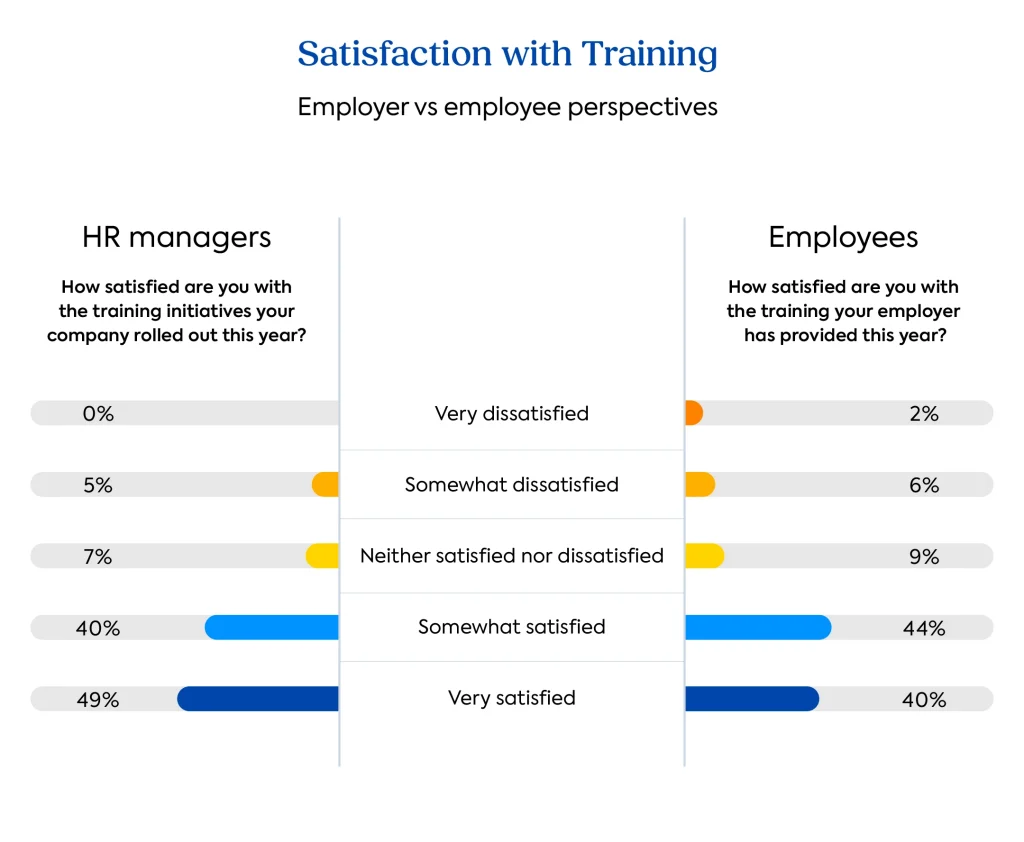
It’s a familiar theme in workplace learning: Those who design the programs often see progress, while those meant to benefit from them feel the friction. HR’s optimism speaks to intention and investment. Employees’ tempered enthusiasm reflects their day-to-day experience. But when confidence in training runs higher at the top than on the ground, that optimism becomes a blind spot. Programs are built on assumptions rather than feedback. And when employees feel unheard or unconvinced, participation turns into compliance.
AI learning support gap
The sharpest divide between learning leaders and employees appears around AI learning. Most HR managers (83%) believe their companies actively support people in learning how to use AI. But only 64% of employees agree. That’s a 19-point perception gap.
Other research underlines this gap. According to Accenture: “Executives often see their organizations as being highly supportive of employees experimenting with gen AI tools. They also believe they recognize that engagement. But employee perceptions lag by as much as 16 percentage points.”

The sticking point may lie in what “support” looks like. For HR leaders, it typically takes the form of structured initiatives. Such as curated resources, access to tools and platforms, and organized pilot programs. For employees, support feels tangible when it includes practical guidance, time to explore, and the chance to apply new tools in context. If those elements don’t connect, even genuine efforts can feel distant, leaving a gap between intention and experience.
10 data-backed interventions to turn learning into a growth engine
#1 Allocate and protect learning time
Employees and HR managers rank lack of time as the top obstacle to learning. Block and protect time for development. Eliminate friction and set outcomes to build accountability.
#2 Build learning around practice, not theory
A third of employees say their training is too theoretical. And 86% say they learn by doing. Make every course hands-on with real tasks and practice. Less reading and listening, more doing.
#3 Integrate learning into performance
Fifty percent of HR managers say high workloads leave no room for training. Build development into performance goals. Treat newly acquired skills as performance output.
#4 Set growth and development as a KPI
Only 37% of companies measure L&D by business impact. Tie team development goals to business KPIs. Hold managers accountable for growth, not just performance.
#5 Balance AI with human oversight
Twenty-two percent of learning leaders worry about the reliability of AI-generated content. Use AI to enhance content creation, not to replace instructional designers. People should always review and clean up AI outputs.
#6 Close the satisfaction gap with feedback loops
There’s a five-point satisfaction gap between HR and employees when it comes to training. Build bidirectional feedback into every learning cycle. Ask learners what works, what doesn’t, and act on it.
#7 Connect learning to internal mobility
Forty-four percent of HR managers say their company prioritizes external candidates over internal employees for new roles. Create internal movement paths and promote from within. Use skill data to map role readiness before hiring externally.
#8 Create content with learners, not for them
Getting training content right ranks as the second-biggest obstacle to learning. Stop designing training content in a vacuum. Bring learners into the process early so feedback shapes the content before it’s too late to fix.
#9 Turn skills into your new performance currency
Seventy-nine percent of HR managers say they’re adopting a skills-based approach to hiring and training. Map roles by skill clusters, not titles. Forget hierarchy and plan your workforce around capability.
#10 Guard against the capability drain
Thirty-six percent of employees say Generative AI tools are weakening their ability to solve problems on their own. Don’t let convenience replace capability. Design learning that keeps human problem-solving, critical thinking, and creativity active.
Future-proof your organization with skills-based training
Unlock your teams’ full potential with TalentLMS.
Sign up in seconds, test the platform forever, upgrade whenever.
Workforce readiness: Navigating skills gaps and future priorities
Mapping the shifting skills gap
With disruption becoming the norm, the conversation around workforce readiness has shifted from awareness to action. Companies aren’t just identifying skills gaps anymore. They’re racing to close them.
In 2025, 42% of HR managers report that their organization is grappling with a skills gap. That’s down nine percent from 2022. However, the problem is far from gone. Let’s examine why the gap looks smaller on paper than it feels in practice.
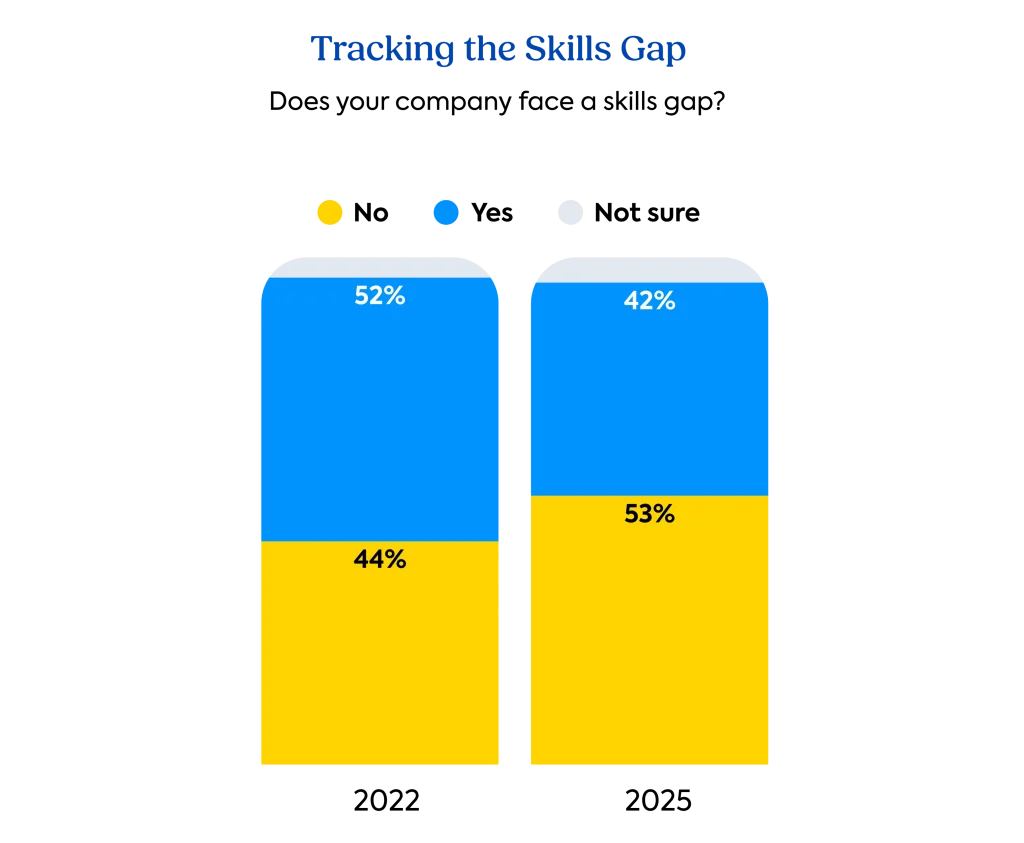
Across reports from the World Economic Forum, LinkedIn, and other leading sources, a new pattern has emerged: The skills gap is shifting, not shrinking.
As Generative AI automates more routine tasks, the demand for distinctly human skills (the skills that turn technology into progress) is rising. Employers have made progress in technical literacy. But shortages are deepening in strategic thinking, leadership, and adaptability, the higher-order capabilities that drive adaptability in a fast-changing market.
What’s emerging is a shift: The narrowing of the ‘old’ skills gap in tech literacy is now being replaced by a new gap in business-critical capabilities.
Inside the new playbook for closing skills gaps
Organizations are tackling skills gaps on several fronts, drawing on people strategies, technology, and new partnerships to accelerate progress. Upskilling or reskilling the current workforce is the most common approach, chosen by 64% of HR managers. Close behind, 62% are automating tasks with AI to bridge talent shortages and improve productivity. Hiring new talent remains a key lever as well, with 57% relying on external expertise. Notably, every company surveyed is taking action.
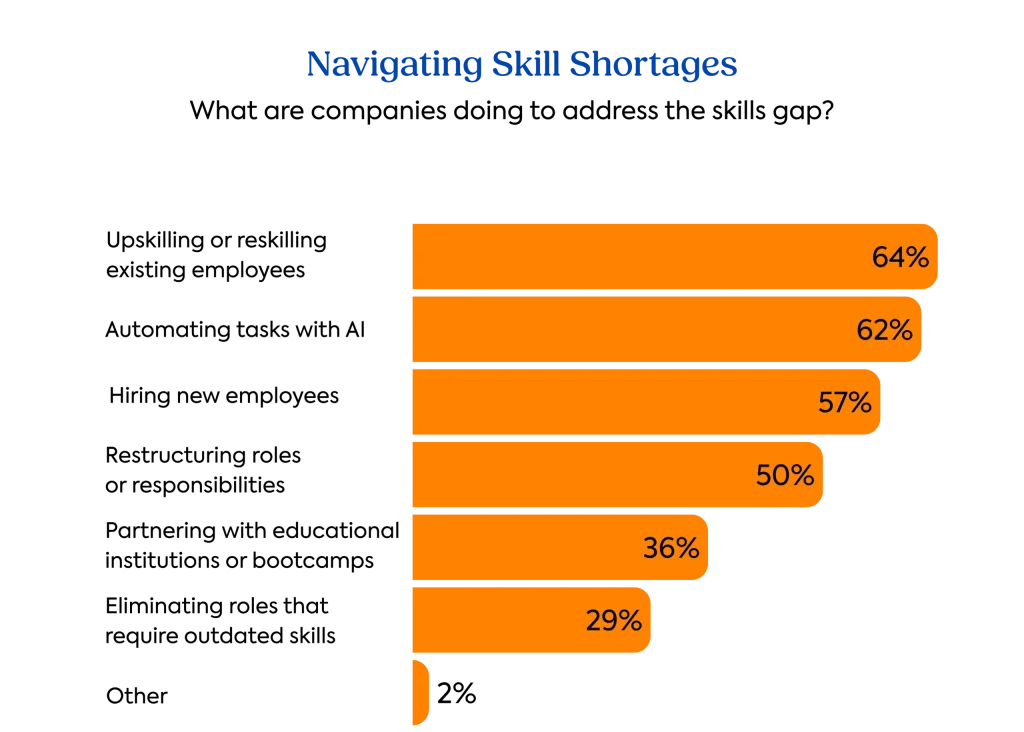
Companies are also rethinking existing structures to navigate the skills gap. Half are restructuring roles or responsibilities, and 29% are eliminating positions that rely on outdated skills.
What’s more, AI appears to be central to these strategies. Sixty-two percent of HR managers are already automating tasks with AI to address talent shortages. Another data point confirms the trend: 84% of HR managers believe GenAI will help close skills gaps.
84% of HR managers believe GenAI will help close skills gaps.
In short, companies aren’t waiting for skills gaps to close themselves. They’re combining upskilling, automation, and bold talent strategies to stay ahead of the curve.
Don’t ask ‘What can we automate?’ but ‘What will we elevate?’
“Automating to close skill gaps is like skipping the gym and buying smaller clothes. It hides the problem instead of solving it. The World Economic Forum estimates that 44% of workers’ skills will be disrupted in the next five years, yet most companies are responding by replacing tasks, not reimagining talent. When we automate around missing skills, we weaken our organizational learning muscle and creative capacity.
The real opportunity lies in using AI to amplify human potential and freeing people from repetitive, manual work so they can focus on judgment, innovation, and collaboration. The question every leader must ask isn’t ‘What can we automate?’ but ‘What will we elevate?’”

How employees build skills today
When it comes to developing capabilities, learning through doing is the top method for employees. Sixty-five percent say on-the-job experience is the top way to build the skills they need. Company training comes next at 47%, while 44% of employees point to guidance from their manager.
Employees are also resourceful in learning. Forty-two percent use external training, like online courses, to fill the gaps. Generative AI tools are starting to make a mark, too: 37% of employees say Generative AI tools help them develop new skills.
The bottom line: Most skill-building happens in the flow of daily work, not in formal training. In fact, 86% of employees say they pick up new skills or knowledge by figuring things out on the job.
Emerging skill priorities for 2026
The next wave of workforce development brings a new twist. Even as the digital skills gap narrows, demand for new and advanced digital capabilities is rising fast. Looking ahead to 2026, expanded digital skills are once again top of the priority list. Seventy-three percent of HR managers rank them as their main focus for the coming year.
This focus aligns with WEF’s Future of Jobs Report findings. These confirm that technological skills, especially AI and big data, are projected to grow in importance faster than any other category over the next five years.
Leadership training remains a close second for 2026. Sixty-four percent of HR managers we surveyed plan to make it a priority. Our data echoes Gartner’s 2025 survey findings, which pinpoint leadership and manager development as the number one HR priority for the third year in a row. Cross-functional upskilling (57%) and soft skills (50%) are next in line, with half of HR managers prioritizing their development. And 44% plan to prioritize reskilling for future roles, acknowledging that job requirements are evolving faster than ever before.
McKinsey’s Development in the Future of Work report reinforces this shift, confirming that two-thirds of global executives plan to prioritize human-centered capabilities: “Hiring for uniquely human skills is essential, especially those that enable organizational agility (problem-solving, adaptability, collaboration).”
Taken together, the data suggests that in 2026, the strongest organizations will be those that unite digital fluency (especially AI expertise) with human adaptability and strong, strategic leadership.
The rise of the skills-based organization
As work evolves faster than roles, organizations are realizing that the real unit of value isn’t the job role. It’s the skills that people bring and build. This shift is reshaping how companies think about talent, fueling the rise of skills-based organizations.
TalentLMS research data reflects this transformation. It found that nearly eight in ten HR managers (79%) say their company is adopting a skills-based approach to hiring, training, and career development. And more data points to this trend. LinkedIn highlights that skills-based hiring and internal mobility have become core strategies for organizations aiming to close talent gaps and build workforce agility.
79% of HR managers say their company is adopting a skills-based approach to hiring, training, and career development.
In the new talent economy, skills are the currency of continuity. And organizations that master this shift won’t just keep up with change, they’ll define it.
L&D in the age of AI: Design, deployment, and dilemmas
AI is fundamentally changing how knowledge is acquired. Our research found that 88% of HR managers expect Generative AI to reshape how employees access knowledge.
88% of HR managers expect Generative AI to reshape how employees access knowledge.
Right now, fully fledged AI-augmented learning is still aspirational. But there will come a point where AI moves from novelty to infrastructure. Only then will we realize its full impact.
To understand how deeply AI will reshape L&D, we asked HR leaders where they expect to see its impact, or the lack of it.
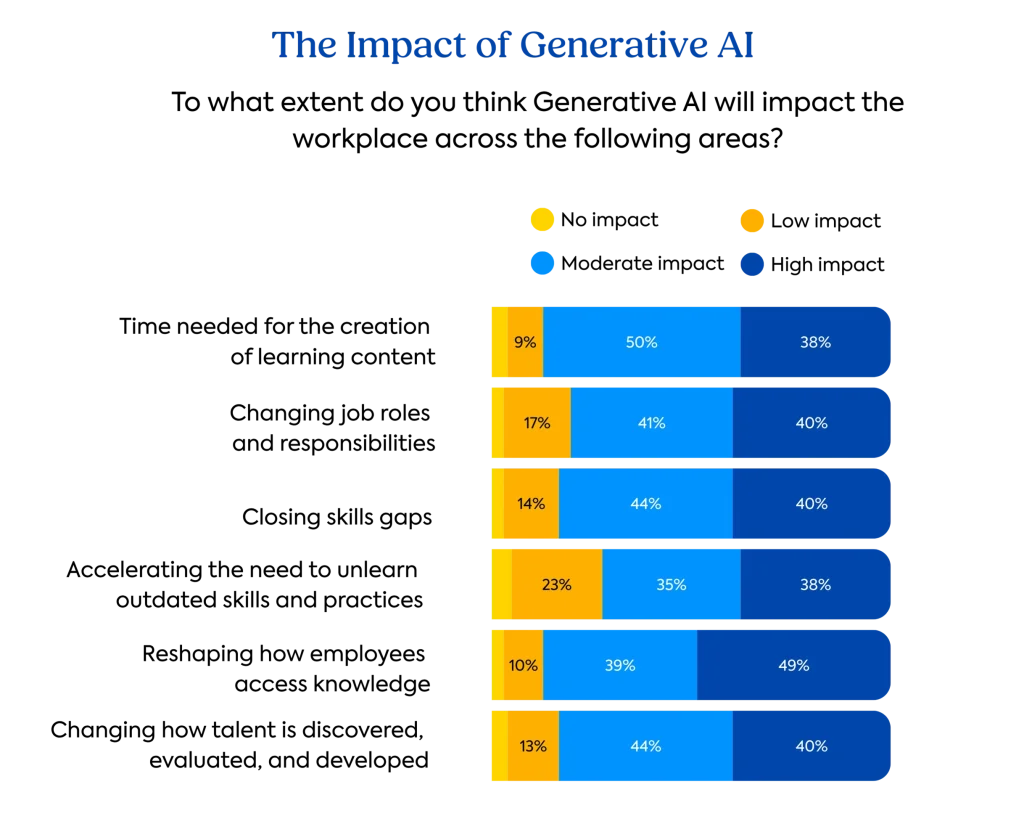
The responses show that the overwhelming majority of HR leaders see Generative AI as a catalyst for transformation. Across every area we examined, roughly eight in ten expect it to play a significant or moderate role in reshaping how learning happens, how people grow, and how organizations build capabilities
Still, a small but notable minority of HR managers (10–28%) remain skeptical about the scale of change ahead. But for the majority, the future of learning is powered by AI.
Let’s look more closely at the areas where GenAI is rewriting the rules.
Future of talent management
TalentLMS research revealed that GenAI is shaking up how companies identify and develop their people. Eighty-four percent of HR managers say AI will transform the way talent is discovered, evaluated, and developed.
Finding people with the right skills, matching them to the right roles, and mapping out their growth could all become faster and smarter with AI in the mix. Still, concerns about accuracy, fairness, and bias will shape the pace and direction of AI adoption in learning and talent development.
Redefining roles and responsibilities
AI isn’t just changing what people do at work. It’s changing what work is. The signs of this shift are already showing up. Our survey found that 81% of HR managers say GenAI will reshape roles and responsibilities, with four in ten predicting a major shift ahead. Old job descriptions and static hierarchies are giving way to more fluid, adaptive roles. Roles that are shaped by technology as much as by business needs.
But this shift is not only about learning new things. It’s also about letting go: 73% of HR managers believe GenAI will accelerate the need to unlearn outdated skills and practices. The future will reward teams who can adapt fast and drop habits that no longer fit. Those able to pick up new ways of working as the landscape changes. In practice, this means taking a step back before we can take a step forward.
73% of HR managers believe GenAI will accelerate the need to unlearn outdated skills and practices.
This transformation extends to L&D professionals themselves. Nearly nine in ten (88%) of HR managers expect GenAI to impact the time needed to create learning content. Meaning that the pace and process of creating learning content are about to shift.
Powered by AI: Learning in the flow of work
With AI-augmented learning, work and training no longer need to be two separate worlds. Instead of pausing work to look for answers or wait for a training session, employees can now get the information they need in real time, right inside their daily routines.
According to Accenture’s Learning Reinvented report, many organizations are using Gen AI to deliver just-in-time, contextual learning while employees are on the job. This approach directly tackles the ongoing challenge of limited time and bandwidth.
AI skepticism, blind spots, and emerging challenges
Still, not everyone is rushing headlong into the GenAI future. Across the survey, a consistent minority of HR managers expect little or no impact from AI on learning, roles, or talent strategies.
Their skepticism isn’t just noise in the data. It signals real barriers and blind spots (such as concerns over accuracy, unreliability, and bias) that could slow adoption. It also points to a deeper challenge of blending new technology into established learning systems.
36% of employees say AI tools are weakening their ability to solve problems on their own.
Evidence of these concerns is clear. Nearly a quarter of HR managers say integrating training with new technologies like AI is an ongoing L&D challenge. Another 22% are concerned about the unreliability of AI-generated training content. Finally, for employees, the effects aren’t just theoretical. Thirty-six percent say Generative AI tools are weakening their ability to solve problems on their own.
For L&D leaders, the challenge now is to balance GenAI’s potential with human judgment, upskill teams for responsible use, and integrate it smoothly with existing systems.
L&D’s role isn’t just creating content, it’s curating culture
“We shouldn’t be outsourcing our expertise to AI. At best, GenAI gives you generic, average content. It’s not a replacement for a well-honed methodology or deep instructional design. The opportunity isn’t to let AI lead—it’s to have it augment our work: to supply examples, generate options, and accelerate iteration. But this only works if the human stays in the loop. L&D has a critical role to play — not just as content creators, but as curators of context, culture, and credibility. We bring the intellectual property, values, and nuance that AI lacks. If 22% of HR leaders flag unreliable content as a challenge, and 36% of employees feel GenAI is eroding problem-solving, that tells us everything: AI is only as useful as the intentionality, literacy, and critical thinking of the people wielding it.”

Even as leaders focus on that balance, a deeper issue is unfolding. BetterUp Labs and Stanford Social Media Lab have called it “AI workslop.” Meaning that many companies are racing to look “AI-ready,” but few are seeing it create real value.
The result is a flood of polished content that may look good on the surface, but lacks substance or real usefulness. Left unchecked, AI workslop can undermine the quality and impact of L&D content.
AI training: Between promise and peril
As AI becomes embedded across workflows, companies are rethinking what training on AI tools is meant to achieve. For most, the goal is no longer awareness. It’s performance. AI learning programs are now designed with clear business outcomes in mind: Sharper efficiency, faster execution, and a workforce that can evolve as quickly as the tools they use.
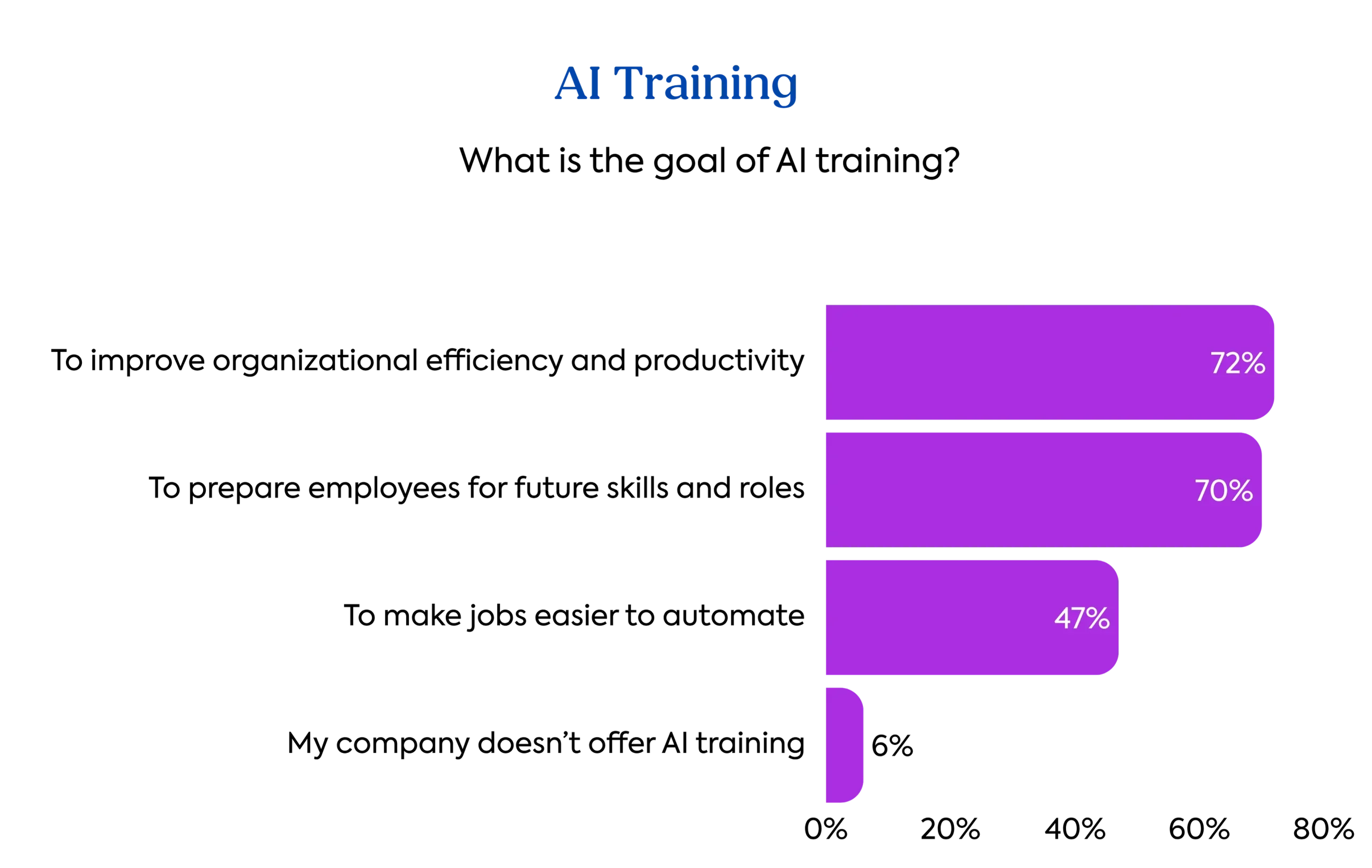
The data shown on the graph signals that AI training has shifted from experimentation to execution. Seventy-two percent of HR managers say its main purpose is to improve organizational efficiency and productivity. A slightly smaller share, 70%, sees AI training as a way to prepare employees for future-oriented skills and roles. This reflects a recognition that automation changes not only how work is done, but what kinds of work will matter.
Yet beneath the productivity narrative lies a quiet trade-off. Nearly half of HR managers (47%) say their company’s AI training is designed, at least in part, to make jobs easier to automate.
47% of HR managers say their company’s AI training is aimed at making jobs easier to automate.
For employees, that sends a mixed signal. AI training can prepare employees for future-oriented roles. But it can also mean employees are training AI to do their jobs. As automation accelerates, the line between learning for progress and learning for replacement is fading fast.
Yet the picture isn’t entirely bleak: 70% of HR managers plan to open new AI-related roles in the next year. That shows that automation is also creating opportunities, not just eliminating them.
Finally, only 6% of HR managers say their company doesn’t yet offer AI training. A figure that places AI learning firmly in the mainstream of corporate development. What began as a niche capability for tech teams has become a standard competency across roles and industries.
The question for L&D teams is no longer whether to train on AI, but how to balance efficiency with training that expands, rather than narrows, opportunities for people.
Are we teaching humans to disappear?
“When training is designed to make jobs easier to automate, we are effectively teaching humans to disappear. Deloitte research shows that only 24% of companies are focused on building the human capabilities that AI can’t replicate, like curiosity, empathy, and critical thinking. Efficiency training may lift quarterly results, but it erodes long-term resilience. Companies must pivot from automation training to augmentation training: helping employees think with AI, not just work around it. Automation can clear the runway, but innovation is what takes flight. The future of talent development is not about teaching people to keep up with machines. It’s about teaching them to ask the questions machines can’t.”
The gap between AI roles and AI readiness
“Creating new AI roles is the easy part. Creating readiness for them is where most organizations stumble. McKinsey reports that fewer than 40% of companies have a clear reskilling strategy, meaning most are opening positions their current workforce isn’t equipped to fill. This is the paradox of the AI era: we are hiring for the future while training for the past. Titles like ‘AI lead’ and ‘AI prompt engineer’ sound visionary, but without a foundation of digital fluency, ethical reasoning, and creative problem-solving, they are hollow. The winners won’t be the firms that hire the most technologists. They will be the ones that build adaptable learners who can think, create, and lead in partnership with AI.”
The anatomy of workplace learning: From training to trajectory
So far, we’ve looked at skills gaps, obstacles to training, and how learning fuels growth. But what does workplace training look like in practice? This chapter unpacks how it’s delivered, what employees are learning, and whether it’s making an impact.
Did employees receive enough training?
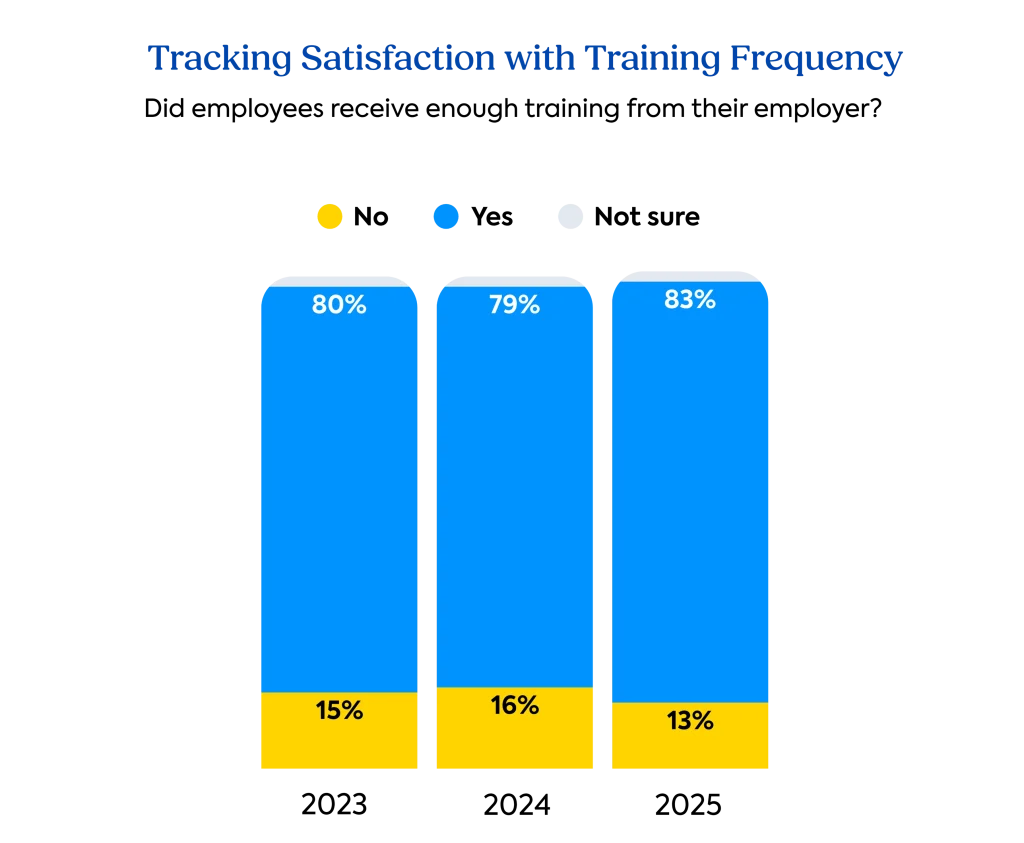
Access to learning not only remains strong, but is also improving. As the graph shows, in 2025, 83% of employees said they received enough training from their employer. That’s up from 79% in 2024 and 80% in 2023. Only 13% said they didn’t receive enough training this year, marking a steady improvement in training coverage year over year.
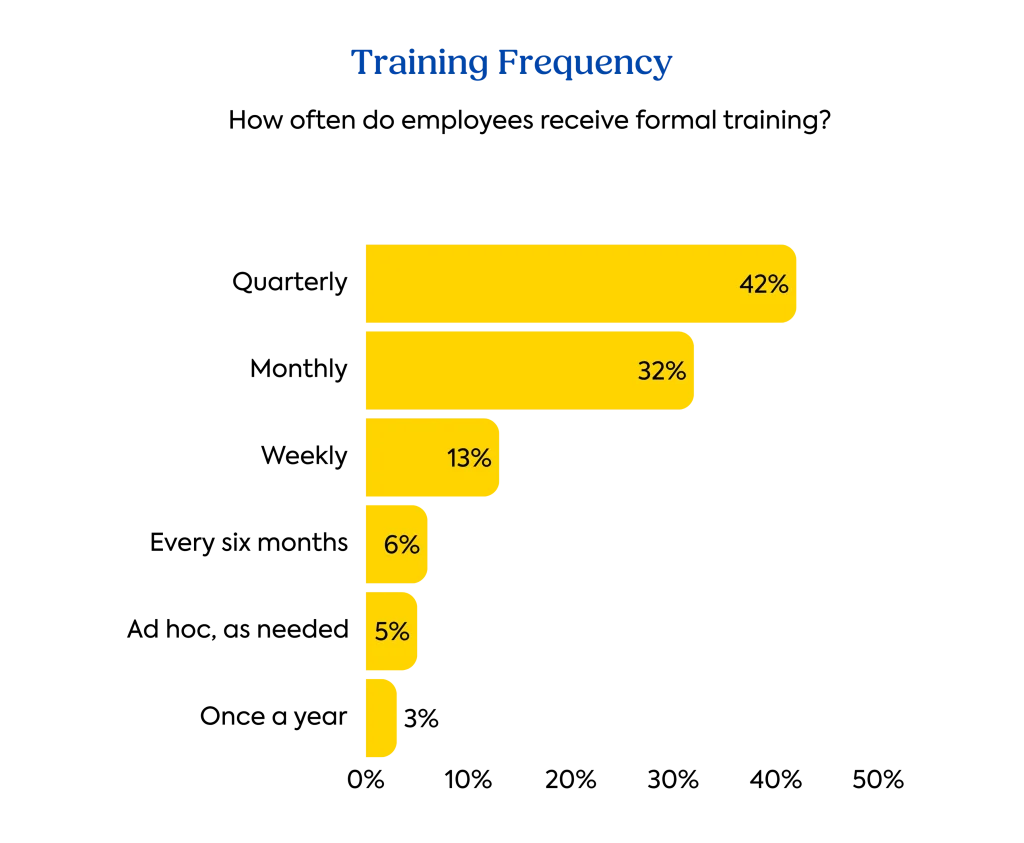
When it comes to training frequency, most HR managers report that learning isn’t an annual checkbox anymore. It’s a regular part of the work rhythm. Nearly nine in ten deliver formal training at least once a quarter, signaling continuous learning over one-off programs.
Four in ten HR managers (42%) say employees receive formal training quarterly, while another 32% deliver it monthly, and 13% run sessions every week. Only a small minority schedule training just once or twice a year.
The trend suggests that learning opportunities have become a standard expectation across organizations. Employees are getting the training they need. Now the focus shifts to whether it’s the kind that actually makes a difference.
Types of training employees received
Compliance training remains the most common training type, delivered to 66% of employees in 2025, holding steady after years of dominance. But other forms of learning are catching up. Upskilling now reaches 57% of employees, up from 50% in 2022, showing that more organizations are training for the future, not just for the rules.
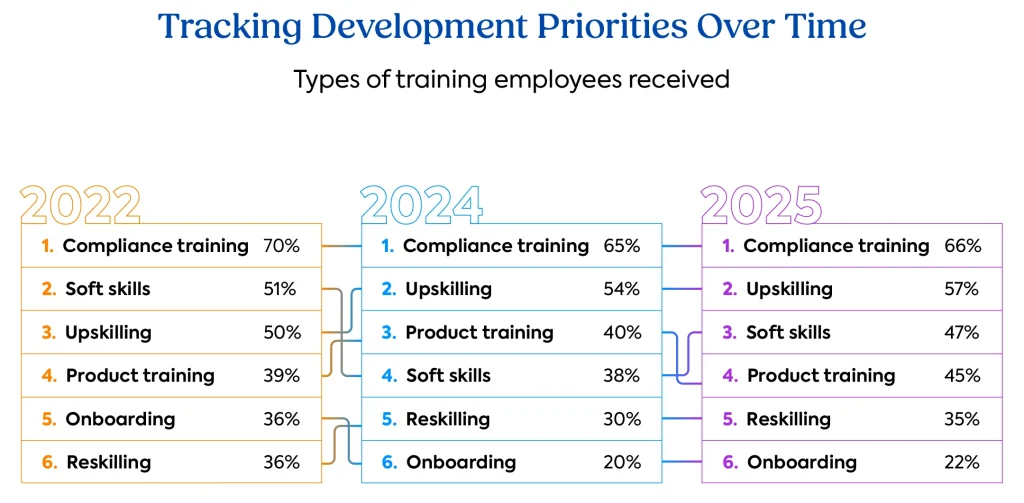
Soft skills training is also regaining its footing, jumping from 38% in 2024 to 47% in 2025 after a post-pandemic slump. That rebound reflects a renewed focus on communication, collaboration, and empathy.
Meanwhile, product training continues its quiet climb, reaching 45% this year, as companies push to keep pace with new launches and features. Reskilling (35%) and onboarding (22%) remain lower on the list.
Taken together, the data shows a workplace still balancing two priorities: Compliance and future-readiness. Training keeps people compliant first. But increasingly, it’s also helping them stay relevant.
Career-driven learning: Turning capability into career currency
Career growth benefits employees. But it also benefits businesses. LinkedIn’s research shows that organizations that make career growth a priority outperform others on key business metrics.
Learning and career progression are meant to move together. And most companies believe they do: 84% of HR managers say their L&D programs are linked to career progression. Yet inside many organizations, employees describe a slower reality. Learning may build skills, but it doesn’t always open doors.
To understand why, we looked at how learning actually links to growth inside companies. And whether the skills employees build actually move them forward.
66% of employees had a career-growth conversation with their manager this year.
The TalentLMS data shows how that plays out inside organizations. Forty-five percent of employees say training is clearly aligned with career growth. The same share (45%) say it’s only partly aligned, suggesting execution gaps rather than intent. Still, 69% feel their company’s training directly supports their career growth, showing that employees recognize the connection even when it’s imperfect.
From the HR side, the view is even more optimistic: 83% of HR managers say employees have clear paths for advancement in their companies. Showing that, on paper, the structure exists. But even more important, it’s showing up in behavior: 66% of employees had a career-growth conversation with their manager this year. That’s proof that learning and progression are meeting in everyday dialogue.
Internal mobility: Training builds skills, but mobility builds futures
Without visible paths to advancement, career growth remains a promise. The TalentLMS data shows some positive movement, but also limits when it comes to follow-through from within.
From the employee side, 58% said they were satisfied with promotion opportunities in their companies. A similar 56% felt positive about internal mobility.
Employees may see growth happening, just not always for them. And the reason becomes clear on the other side of the equation. Nearly half of HR managers (44%) say their company prioritizes external candidates over internal ones when filling open roles.
44% of HR managers say their company prioritizes external candidates over internal employees when filling open roles.
This finding points to a disconnect between development and opportunity. It suggests that learning may be valued as performance support, but not as a pipeline for promotion.
The reasons for this are complex. Many organizations default to external hiring not because it’s faster or safer, but because internal pathways aren’t always visible or prepared. Leaders may assume fresh hires bring new expertise or objectivity, especially when emerging roles demand skills that existing teams haven’t yet developed. But every time a company looks outward first, it sends an unspoken message inward. Growth doesn’t happen from within.
This mirrors a wider pattern. The Voxy 2025 Global L&D Benchmark Survey ranks “building internal career pathways” among the top five challenges facing L&D teams worldwide. At the same time, SurveyMonkey’s Workplace Culture & Trends research found that 43% of workers say they have few or no opportunities for growth in their current job.
The takeaway? Training builds skills, but mobility builds futures. Without both, growth stays incomplete.
3 macro trends shaping the next era of L&D
Drawing from TalentLMS research, external data, industry signals, and insights from HR and L&D leaders, we surfaced three macro trends in workplace learning. They’re still taking shape, but are clearly already setting the direction of L&D’s next chapter.
Trend 1: The emergence of learning debt
A quiet learning crisis is taking shape inside organizations. One that mirrors ‘tech debt.’ In software, developers can take shortcuts to deliver faster today, but pay the price later in fixes and rework. Now, we’re seeing the same thing in learning. As data from multiple sources show, work has become a treadmill of deliverables, leaving little or no space for learning or development. Employees are expected to use AI to increase their output, keep up with relentless priorities, and stay productive every minute of the day. Companies roll out a flood of training content, but most employees have no time or mental space to complete it. They don’t have time for going deeper, getting better, and building new skills and expertise.
Fast-forward, and the impact is visible. Knowledge and skill gaps widen. Innovation slows, rework rises, and confidence erodes. The long-term result? A workforce running on outdated know-how and organizations trapped in a cycle of short-term productivity at the expense of long-term growth. What begins as a time-saving compromise becomes a structural cost: A quiet debt that will inevitably come due, with interest.
Skip training today, carry the cost tomorrow
“When training isn’t made a strategic priority, high workloads will win out. But skipping necessary training doesn’t just impact productivity. It fuels employee disengagement and dissatisfaction when people are inadequately prepared for their jobs. Like a savings account, organizations must invest in training today to reap the rewards later. Ironically, avoiding this investment perpetuates the very workload problems that made training feel impossible in the first place.”
Trend 2: Work as a fast-lane learning engine
If the first trend showed the cost of work outpacing learning, this one shows the opposite. When work accelerates and employees have the structure — support, tools, and capacity — to make sense of that speed and avoid overwhelm, it stops being a drain on capability. Instead, it becomes a system where people learn faster because the work itself pushes them to stretch, solve harder problems, and get timely feedback. Paired with in-depth skill-building, this learning velocity doesn’t erode skills; it amplifies them.
In a future where work operates as a live learning system, every project becomes a stretch opportunity and every task a teachable moment. The workplace shifts from being the place where knowledge is applied to the place where new knowledge is created. But it’s important to remember that velocity doesn’t replace depth. Without the foundation of deliberate, in-depth development behind it, fast-lane learning slips into surface learning — helpful in the moment, but fragile over time.
Trend 3: From AI co-learning to self-perpetuating learning systems
If work has become a fast-lane learning engine, AI is now the co-driver. AI co-learning marks a new stage: A continuous loop where people and intelligent systems learn, adapt, and improve together. This isn’t about outsourcing thinking or offloading tasks. It’s about pairing human judgment with adaptive systems that elevate how organizations learn and perform.
As AI observes how teams plan, solve problems, and make decisions, it begins to mirror those patterns. Knowledge that once disappeared in handoffs or turnover instead gets captured and reused. Everyday work feeds a shared, evolving knowledge base that strengthens the organization over time. Finally, as co-learning takes hold, the role of L&D shifts from creating content to designing the ecosystem that keeps knowledge circulating. What emerges is a self-perpetuating cycle of learning, where every solved problem, every project completed, and every lesson learned become part of the organization’s long-term memory.
Conclusion
The picture that emerges from this year’s data exposes a growing asymmetry in the workplace.
Technology and AI are racing ahead, redefining what’s possible. But the ripple effects are reshaping priorities and sending shockwaves through the workforce.
The TalentLMS 2026 L&D Benchmark Report captures progress on many fronts. Satisfaction is rising. Budgets are stabilizing. Companies are building stronger links between learning, performance, and retention. And, even as challenges mount and uncertainty grows, trust in learning remains high: 73% of employees feel more prepared for the future of work because of the training they received. That’s higher than in 2024 (68%), and in 2023 (71%).
Yet, the fundamentals are showing cracks. Time for learning is sidelined. Focus is fragmented. Performance demands and workloads are intensifying. And learning, too often, has to fight for its place in the workday and at the strategy table.
There’s more content, training, and learning tech than ever. But the conditions that enable learning to take root are eroding.
At this inflection point, the mandate for L&D is shifting from designing more training to creating the capacity for learning and restoring balance. The next leap won’t come from adding. It will come from subtracting. From clearing the noise, reducing friction, and designing environments where learning isn’t an interruption, but a built-in mechanism.
For L&D, that means it’s time to:
- Make learning visible.
- Make it valued.
- Make it part of the everyday.
Because progress means little if people can’t grow with it — and learning should be the flywheel of change, not its casualty.
About the survey
This research comprises two surveys conducted in September 2025. We polled two groups:
Sample 1: 101 HR managers in the U.S., with over half of respondents (55%) managing L&D programs directly, while another 45% are involved to varying degrees without full ownership.
Sample 2: 1,000 U.S.-based full-time employees who received training from their current company in the past 12 months.
Minor discrepancies in total figures may exist due to rounding.
Research team
Ana Casic, Eri Panselina, Giota Gavala, Fiona McSweeney
Dive deeper into original research by TalentLMS


Bring out the best in your teams.
Get started with the most versatile and affordable employee training platform, no credit card needed.