

A few years ago, work changed almost overnight. Battling a pandemic, offices emptied and dining tables became desks. At the same time, organizations learned (many for the first time) that large parts of their workforce could function without a shared physical space.
Signalling a sharp shift from the pandemic-era embrace of remote work, a majority of Fortune 100 employees are now subject to a full-time return to office or RTO mandate. Of those companies, 54% were fully in office in Q2 of 2025, compared to just 5% in Q2 2023. On top of that, the average weekly requirement of in-office days has risen from 2.6 to 3.9 days.
Yet the picture isn’t as simple as “everyone back to the office now.” Despite a change in policies and processes, real-world data and workplace behavior tell a more nuanced story.
Here, we look at return to office trends, explore what RTO mandates are, and unpick what they mean for employers and employees. We also share some practical tips to address the challenges faced by both.
What you’ll find in this article:
- Return to office trends
- How RTO mandates differ for enterprises and SMBs
- 5 challenges to RTO mandates
- What RTO failures reveal
- 6 solutions for RTO success
- Training for RTO success
- A design challenge, not directive
- FAQs
Return to office trends
Employers are rejecting a wholesale remote environment and leaning toward a fully in-office or structured or hybrid work for perceived benefits of in-office work. These include:
- Collaboration. Many believe in-person interaction is crucial for creative brainstorming and stronger team collaboration.
- Workplace Culture. Some organizations have concerns that remote work challenges weaken culture and identity, making it harder to attract and retain talent.
- Performance. At-home distractions and lack of structure can make people less productive. Closer contact is often considered better for accountability.
- Logistics. There are employers who feel that in-person training and onboarding run more smoothly on-site.
- Security. A physical presence in the office can be considered better for security, improving control over sensitive information.
How RTO mandates differ for enterprises and SMBs
When it comes to an RTO mandate, company size doesn’t dictate values. But it does shape what’s feasible.
According to the Q3 2025 Flex Index Report, smaller businesses are far more likely to embrace flexibility. Sixty-nine percent of companies with under 500 employees offer flexible options in terms of location. This compares to just 11% of large enterprises (those with over 25,000 employees).
There’s a practical logic around this.
With fewer layers of governance and less need for uniformity across roles and regions, many SMBs are able to offer location flexibility more easily. For these employers, hybrid or remote options often function as a practical way to compete for talent, particularly when they lack the brand recognition or compensation leverage of larger firms.
Large enterprises face a different set of constraints. With thousands of employees spread across teams, functions, and locations, consistency becomes a priority. As a result, many opt for standardized hybrid models that set clear expectations around a minimum number of in-office days per week. These approaches are designed to support coordination, collaboration, and operational cohesion at scale.
That structure, however, comes with trade-offs. Rigid or inconsistently enforced mandates can amplify frustration, particularly when in-office requirements feel disconnected from day-to-day work. This is why the real divide isn’t between organizations that “value” workplace flexibility and those that don’t. It’s between those that can design, communicate, and manage workplace flexibility at scale, and those that can’t. When that capability is missing, return to office mandates risk becoming a source of tension rather than a tool for coordination.

5 challenges to RTO mandates
Despite required in-office time rising by 12% between Q1 2024 and Q3 2025, actual attendance has increased by only 1 to 3%. What this tells us is that policy is shifting far faster than practice. The question is, why?
After several years of distributed work, organizations are no longer navigating a simple shift from remote to in-office. Instead, they’re managing a complex mix of expectations, work patterns, and constraints that vary by role, team, and location. Here are some of the main obstacles you might face when trying to issue formal RTO mandates:
1. Lack of clarity and consistency
One of the most common issues with RTO mandates is not opposition, but confusion.
Employees may hear that their organization supports hybrid work, but witness individual managers enforcing different interpretations of what that means in practice. Some teams are expected in the office three days a week. Others operate with more flexibility. Exceptions are made informally, often without clear criteria.
This inconsistency can undermine trust faster than a strict but transparent return to office policy. When employees perceive RTO mandates decisions as arbitrary or unevenly enforced, it raises concerns about fairness and favoritism. It also makes it harder for people to plan their work and personal lives with confidence.
2. One-size-fits-all policies in a non-uniform workforce
RTO mandates are typically designed at an organizational level, but their impact is felt locally.
Roles differ in how much in-person collaboration is required. Employees differ in their commuting burden, caregiving responsibilities, and access to suitable workspaces. Teams may also be distributed across regions or time zones, making “office presence” uneven by design.
When mandates fail to account for these differences, they can create friction without delivering meaningful benefits. The result? Employees may comply physically while disengaging psychologically.
3. Manager readiness and enforcement gaps
Managers sit at the front line of organizational change, translating high-level policy into everyday expectations and behaviors. Without clear guidance and training, that responsibility can lead to uneven enforcement and strained team dynamics. It places managers in a difficult position and often makes them the focal point of employee frustration, even when decisions originate elsewhere.
4. Engagement, retention, and employer brand risk
Flexibility and work-life balance have become baseline expectations for many employees, not a temporary perk.
Mandates that significantly reduce autonomy can affect morale, employee engagement, and retention. This is particularly true when employees don’t see a clear connection between in-office presence and better outcomes.
A tight labor market and tougher economic backdrop may temporarily reduce incidents of “rage quitting” in response to return to office mandates. Over time, however, significant shifts in workplace flexibility will go on to shape how an organization is perceived by both current employees and prospective candidates.
Importantly, the risk isn’t simply that employees will leave. It’s that those who stay may start to quietly disengage.
5. Skill shifts, not skill loss
Remote work hasn’t diminished employee capability, but it has changed how skills are expressed.
Seasoned remote workers may need support adjusting to more synchronous collaboration, spontaneous interactions, and shared physical environments. This isn’t about relearning how to “be in an office,” but about navigating different modes of work effectively.
Without support, these transitions can feel exhausting rather than energizing, reinforcing skepticism about the value of returning to the office in the first place.
From mandates to management: What RTO failures reveal
When return-to-office mandates struggle, it’s easy to frame the issue as employee resistance or shifting attitudes toward work. But the challenges above point to a different conclusion: Many RTO failures are symptoms of deeper management and coordination gaps.
Return-to-office policies don’t operate in a vacuum. They expose how work is managed day to day. Specifically, how expectations are set, how decisions are made, and how consistently those expectations are reinforced across teams. In that sense, RTO acts less as a cause of dysfunction and more as a stress test for team culture and existing management practices.
Over the past few years, business leaders have asked managers to absorb significant change without always updating the systems, training, or norms that support them. As a result, RTO mandates often surface long-standing issues around alignment, accountability, and collaboration that were easier to overlook in fully remote or fully in-office environments.
Seen this way, RTO isn’t failing because flexibility went “too far” or because employees are unwilling to adapt. It falters when organizations rely on directives without investing in the capabilities needed to make new ways of working sustainable.
That’s why successful return-to-office strategies focus less on attendance rules and more on aligning expectations, supporting managers, and deliberately redesigning how work gets done.
6 solutions for RTO success
Once the underlying challenges are clear, the focus shifts from defining policy to making it work in practice. The following strategies are design to support the successful shift to RTO working.
1. Start with clarity and apply it consistently
Uncertainty around enforcement is one of the fastest ways to undermine an RTO mandate. Organizations should clearly define what in-office expectations look like in practice. For example, how many days, for whom, and why. And then apply those expectations consistently across teams. Clear guidance helps employees plan their work and reduces the burden on managers to interpret policy on the fly.
2. Build flexibility into structure, not exceptions
Rather than relying on informal workarounds, effective RTO strategies define where flexibility is appropriate by role, function, or task. This makes flexibility intentional and predictable, reducing friction between teams operating under different constraints. The goal isn’t maximum flexibility, but clarity around how and when flexibility applies.
3. Equip managers to lead new RTO policies
Because managers are responsible for translating RTO policies into daily practice, targeted training is essential. Support should focus on setting clear expectations, reinforcing attendance and performance standards consistently, and addressing employee concerns constructively during the transition. In organizations operating hybrid models, this also includes ensuring fair participation and visibility across different work arrangements. When managers are equipped to lead through RTO change—regardless of the specific model—execution becomes more consistent, and employee trust is easier to maintain.
4. Redesign collaboration, not just location
Office presence alone doesn’t improve collaboration. Organizations should revisit how meetings are run, how decisions are documented, and how work flows between synchronous and asynchronous modes. Clear norms around when in-person interaction adds value—and when it doesn’t—help make time in the office more purposeful, particularly in hybrid environments.
5. Create feedback loops and review regularly
RTO should be treated as an evolving practice, not a fixed endpoint. Regular feedback through surveys, manager check-ins, and performance indicators helps organizations identify what’s working and where adjustments are needed. Acting on that feedback reinforces that RTO is a shared process, not a one-way directive.
6. Support the transition with targeted training
Finally, organizations should acknowledge that shifting work patterns require adjustment. Training can help employees navigate different work modes, rebuild collaboration habits, and manage focus and well-being in shared environments. This support signals investment in long-term effectiveness, not correction or control.
Together, these approaches help address the less visible risks of RTO—declining employee engagement, quiet disengagement, and long-term employer brand erosion—by focusing on how work is experienced day to day.
5 practical tips for implementing RTO mandates
- Explain the “why,” not just the rules. Employees are more likely to engage when they understand what office time is meant to achieve.
- Train managers before enforcing change. Don’t ask them to carry RTO expectations without guidance on hybrid leadership.
- Design in-office time intentionally. Reserve office days for collaboration, onboarding, and connection—not solo work.
- Make flexibility explicit. Define where it applies so it doesn’t depend on informal exceptions.
- Review and adjust regularly. Use feedback and performance signals to refine your approach over time.
Training for RTO success
Return-to-office mandates introduce new expectations, But expectations alone don’t change behavior. Training plays a critical role in helping both managers and employees navigate the shift from distributed work to more structured, in-office or hybrid models.
For managers, this means developing the skills needed to lead hybrid teams effectively. Setting clear expectations, running inclusive meetings, balancing visibility between remote and in-office employees, and addressing concerns constructively all require deliberate practice. Without this capability, even well-designed RTO strategies can break down at the point of execution.
Training also supports the redesign of collaboration itself. Teams benefit from shared norms around when in-person presence adds value, how decisions are documented, and how synchronous and asynchronous work fit together. These capabilities help reduce coordination friction and make office time more purposeful.
Finally, organizations should recognize that shifting work patterns require adjustment at every level. Training focused on focus, well-being, and adaptability can help employees navigate new routines without framing the transition as a loss of autonomy.
When treated as part of broader change management—not a one-off intervention—training becomes a stabilizing force that helps RTO strategies translate into sustainable ways of working.
Where to focus training during an RTO transition
To support RTO implementation in practice, organizations should focus training on a few high-impact capability areas. These don’t replace broader L&D strategies. Rather, they reinforce them during a period of change.
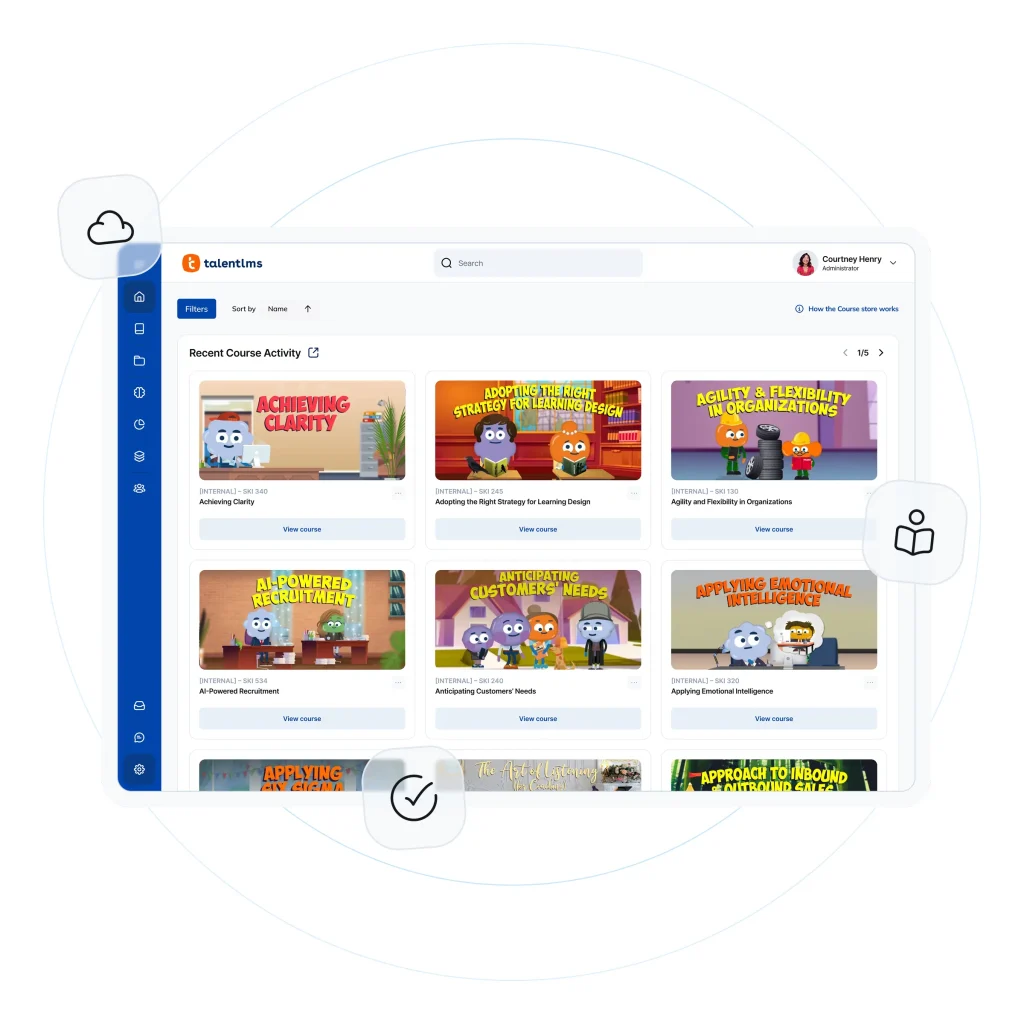
- Communication and collaboration: Supporting effective in-person, hybrid, and asynchronous work. Courses could also include office etiquette and social dynamics.
- Managing expectations and performance: Helping managers reinforce standards consistently as work patterns shift.
- Time management and focus: Enabling employees to stay productive in shared or busier office environments.
- Adaptability and change resilience: Building confidence in navigating new routines and ways of working.
- Leadership during transition: Equipping managers to address uncertainty, pushback, and team dynamics constructively. Also how to lead hybrid teams and address remote work challenges.
- Well-being and sustainability: Helping people during periods of adjustment though stress management and work-life balance training.
Conclusion: RTO as a design challenge, not a directive
Return-to-office mandates are often framed as a question of compliance around office attendance: Who shows up, how often, and whether the rules are followed. But organizations that treat RTO as a simple enforcement issue tend to miss the deeper challenge.
What’s really at stake is how work is designed how to maintain company culture.
After years of distributed work, employees are more conscious of how—and where—they do their best work. At the same time, organizations are grappling with coordination costs, uneven collaboration, and the limits of remote management at scale. RTO sits between those realities, forcing difficult trade-offs that no single policy can resolve on its own.
The most successful approaches recognize this. They prioritize clarity over rigidity, consistency over symbolism, and dialogue over decree. They invest in training managers to lead hybrid teams effectively, support employees through change, and adapt policies as real-world friction becomes visible.
Done poorly, RTO can damage trust and employee satisfaction, and accelerate attrition. Done well, it can become an opportunity to intentionally redesign collaboration, strengthen connection, and create a more resilient way of working—one that reflects what organizations have learned rather than what they’re trying to restore.
Return to the office isn’t about going back. It’s about deciding, deliberately, what comes next.
FAQs
What are RTO mandates?
Return-to-office (RTO) mandates are formal policies that define when and how employees are expected to work from a physical office location. These mandates can range from full-time, five-day in-office requirements to structured hybrid models that specify a minimum number of in-office days per week.
Are RTO mandates the same as ending remote work?
Not necessarily. While some organizations require employees to return to the office full time, others adopt hybrid approaches that combine in-office and remote work. The defining feature of an RTO mandate is clarity around expectations—not the elimination of flexibility.
Do RTO mandates apply equally to all roles?
In practice, many organizations tailor RTO expectations by role, function, or business need. Roles that rely heavily on collaboration or in-person interaction may have different requirements than those that can be performed independently.
How does office space factor into RTO mandates?
Office space plays a major role in return-to-office decisions, especially as organizations reassess long-term real estate commitments made before remote and hybrid work models became common. For many employers, the challenge isn’t simply bringing people back—it’s making better use of expensive office space that no longer matches how teams work.
When RTO policies are introduced without rethinking how office space is used, employees may return to crowded, inefficient, or underutilized environments. Aligning RTO expectations with the purpose and design of office space helps ensure that in-office time feels valuable rather than symbolic.