New research reveals:
Do U.S. employees feel protected at work?
71% of employees feel safe at work, yet most still deal with unwelcome behavior. From fear of retaliation to favoring high performers, new TalentLMS research reveals how workplace protection breaks down into a paper shield. And how organizations can forge real protection.

Highlights
Power and favoritism break protection
- 62% of employees say misconduct is overlooked for top performers or leaders.
- 47% say managers discourage escalation of harassment or discrimination complaints.
- 45% have seen people get promoted even after mistreating others.
Fear, futility, and retaliation keep employees mum
- Fear of retaliation is the second most common reason employees don’t report incidents, with 36% staying silent to avoid consequences.
- 16% reported misconduct to their employer, but nothing was done.
- 56% didn’t report an incident because they didn’t think it’d make a difference.
Compliance training: Impactful but disconnected
- 60% of employees say compliance training has improved behavior at work.
- 45% of employees say training is disconnected from real workplace situations.
- 36% of employees believe better compliance training would reduce misconduct in the workplace.
- Introduction
- What unfair treatment looks like at work
- Are employees speaking up?
- Why employees stay silent
- Where employers deliver and where they fall back
- Where protection breaks
- A snapshot of employers' fault lines
- The pulse of safety
- 6 interventions to stop workplace misconduct
- Compliance training: Impact, gaps, and readiness
- The DEI pullback
- The compliance readiness gap
- Conclusion
- About this research
Introduction
Unfair and unwelcome treatment at work is spiraling. Gallup reports that respect at work is in a tailspin, hitting a record low in 2025. That decline shows up in hard outcomes. In 2024, the Equal Employment Opportunity Commission (EEOC) won a record $700 million for victims of workplace discrimination.
New TalentLMS research uncovers the lived reality behind these trends, and the systemic failures that sustain them. Based on a survey of U.S. employees, it captures how workplace protection is experienced on the ground.
The data tells two conflicting stories. While 71% of surveyed U.S. employees feel protected at work, only 38% didn’t witness any workplace misconduct or mistreatment. That gap reveals a troubling contradiction. Protection is uneven and, as further findings show, fragile when tested.
71% of surveyed U.S. employees feel protected at work, yet only 38% didn’t witness any workplace misconduct or mistreatment.
That fragility becomes clear when incidents are reported. Only 27% of employees who spoke up say action was taken. Another 16% reported misconduct, but say no action was taken as a result. This inconsistency reveals a workplace where misconduct is seen but not addressed.
Against that backdrop, this report investigates the most common forms of misconduct at work and why it often goes unchecked. It reveals how accountability breaks down and offers data-backed interventions for employers to rebuild a genuine culture of protection.
The scale of workplace misconduct: What employees see and experience
The data shows that workplace misconduct is widespread. Unfair and unwelcome treatment, it appears, is not the exception.
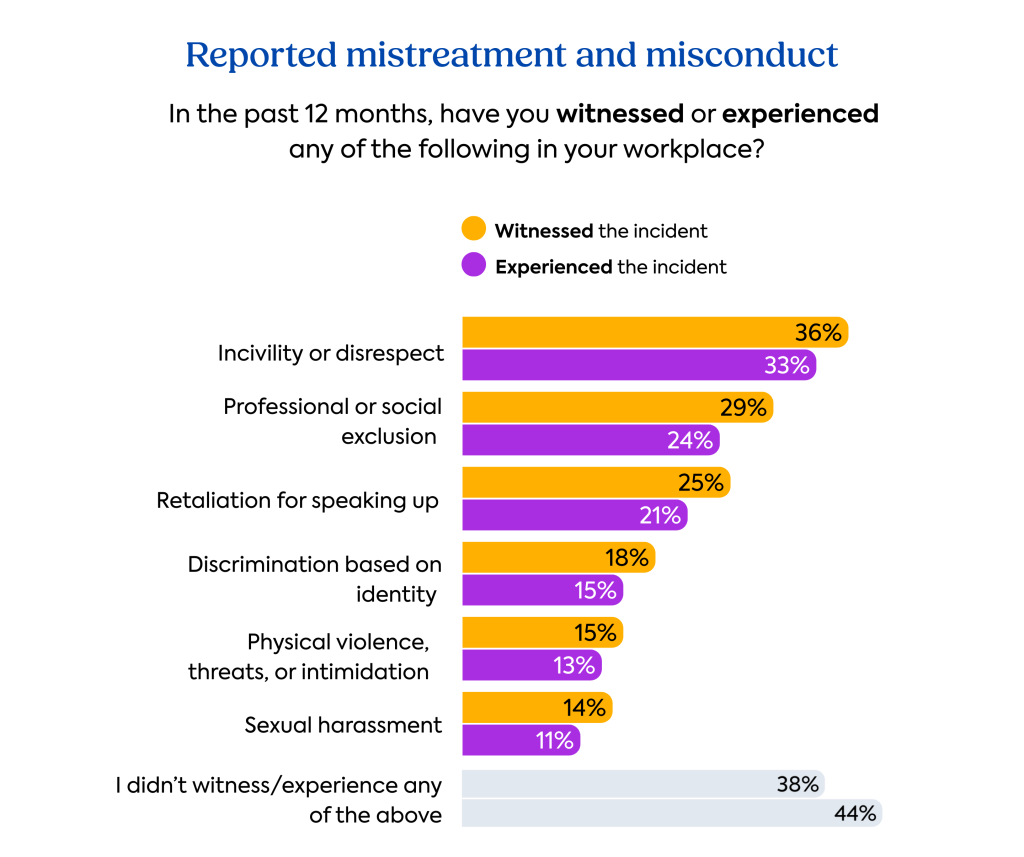
Only 38% of surveyed U.S. employees said they didn’t witness any mistreatment at work, and just 44% said that they didn’t experience it. That leaves us with a majority of employees reporting some level of exposure to unwelcome workplace behavior.
Let’s take a closer look at the specific forms of unfair and unwelcome treatment employees encounter most often.
Patterns of misconduct: What unfair treatment looks like at work
The most common form of workplace misconduct is incivility or disrespect. Thirty-six percent of employees say they’ve witnessed it, and 33% report experiencing it firsthand.
Professional or social exclusion ranks as the second most frequent form of mistreatment. A subtle but harmful dynamic, it shapes who gets heard, who advances, and who quietly falls behind. Twenty-nine percent of employees witnessed professional or social exclusion, and 24% report experiencing it.
Retaliation for speaking up follows closely behind. One in four employees (25%) has seen a colleague sidelined or punished for raising concerns, while 21% say they’ve experienced retaliation themselves.
36% of employees say they’ve witnessed unwelcome treatment at work, and 33% report experiencing it firsthand.
Identity-based discrimination remains a persistent problem. Eighteen percent of employees say they’ve witnessed this form of discrimination at work, with 15% experiencing it.
The data also reveals serious breaches of conduct that cut directly against the promise of workplace safety. Fifteen percent of employees have witnessed physical violence, threats, or intimidation at work, and 13% have experienced it. Sexual harassment is similarly prevalent: 14% of employees say they’ve witnessed it, and 11% report enduring it themselves.
Taken together, these findings tell a consistent story with real consequences for employees. Behaviors often dismissed as minor — such as incivility or exclusion — create conditions in which more serious violations can take root.
Discrimination undermines the very idea of workplace equity, while retaliation teaches employees that speaking up carries personal risk. And the prevalence of violence and sexual harassment exposes a profound gap between the promise of safety and the reality many employees face.
For a disturbingly large number of employees, mistreatment isn’t an abstract HR concept. It’s their reality. Acknowledging the scale of this is an uncomfortable, but essential first step toward building workplaces where protection is a universal reality, not a selective privilege.
Are employees speaking up?
In theory, addressing misconduct follows a clear process: report, investigate, resolve. In reality, that sequence breaks down. For employees, the decision to report is a high-risk gamble. The data exposes the broken links in the chain.
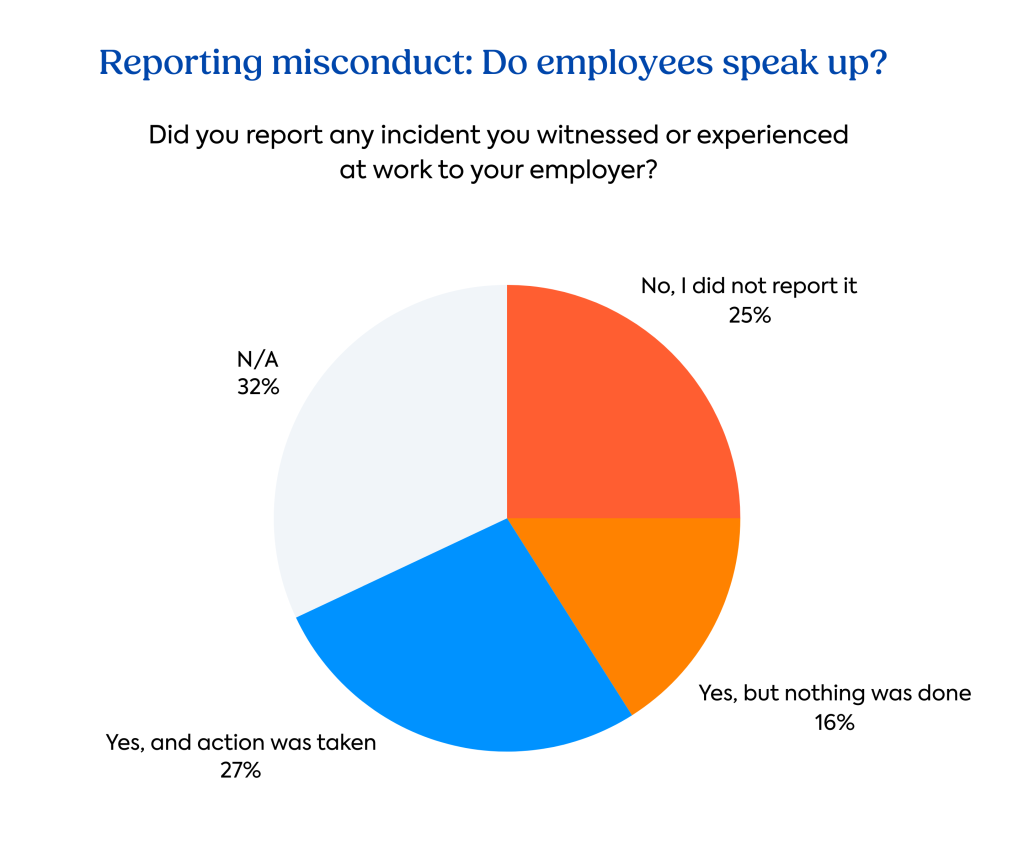
The findings show that 27% of those who report misconduct see a response from their employer. For those employees, the machinery of accountability moves. Their report triggers a visible response. And action is taken. This figure shows that the process for combating misconduct can work in practice.
But that’s not the case for 16% of employees, who reported an incident they witnessed or experienced in the workplace, but nothing was done. The system failed them. They took the same formal step, filing a report to their employer, and received no outcome. No investigation, no follow-up, no consequence. This absolute inaction is more damaging than a slow response. It’s a clear, institutional signal that speaking up is a futile act.
Some choose silence from the start: 25% of employees who witness or experience misconduct never report it. The issue stays off the record.
25% of employees who witness or experience misconduct never report it.
These figures expose friction and an inconsistent link between reporting and follow-through. For a substantial portion of the workforce, the reporting system does not reliably translate concerns into outcomes. This gap between input and resolution can create a vacuum of trust. The cost is a workforce that learns to endure problems, not report them.
Why employees don’t speak up
If so many employees encounter misconduct, why do so few speak up? To find out, we asked the employees who didn’t report the incident why they stayed silent.
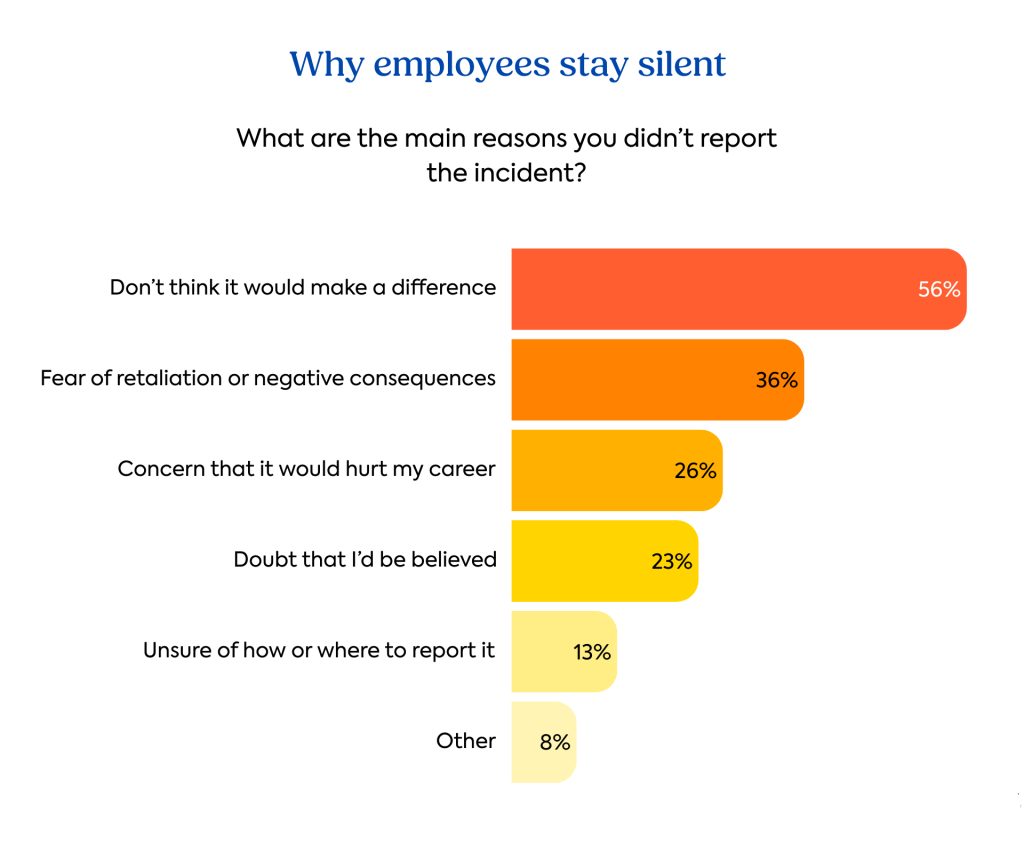
The majority of employees are silent for one overwhelming reason: Futility. A dominant 56% didn’t report misconduct because they believed speaking up wouldn’t make a difference.
This futility is then cemented by fear. Over 1 in 3 employees (36%) kept quiet because they feared direct retaliation. Another 26% were convinced it would harm their career.
Distrust then takes its toll. Nearly a quarter (23%) of employees doubted they would be believed. Completing the breakdown, 13% didn’t even know how to report misconduct.
56% of employees didn’t report an incident they witnessed or experienced at work because they didn’t think it would make a difference. And 36% stayed silent because they feared retaliation.
Reputational risk amplifies employees’ reluctance to speak up. In another question, 42% of employees said they worry that speaking up at their company would get them labeled “difficult.” For them, the risk isn’t only formal retaliation. There are informal, but equally serious consequences, too. Such as being sidelined, stigmatized, or treated as a troublemaker rather than a whistleblower.
Employees don’t arrive at silence by accident. They learn it. When reporting carries perceived risk, yields inconsistent outcomes, or feels opaque, staying quiet becomes the safer option.
The picture is stark, but it is not irreversible. Once we examine the employer’s fault lines in the next chapter, we will dive into the evidence-based interventions required to rebuild trust and make protection a reality.
Mapping protection: Where employers deliver and where they fall back
Employees don’t describe a workplace that’s outright unsafe. But they don’t describe a fully protected one either. To make sense of that tension, we’ll zoom in on where employers create assurance, and where accountability and trust break down.
Where protection breaks: Status, favoritism, and unequal accountability
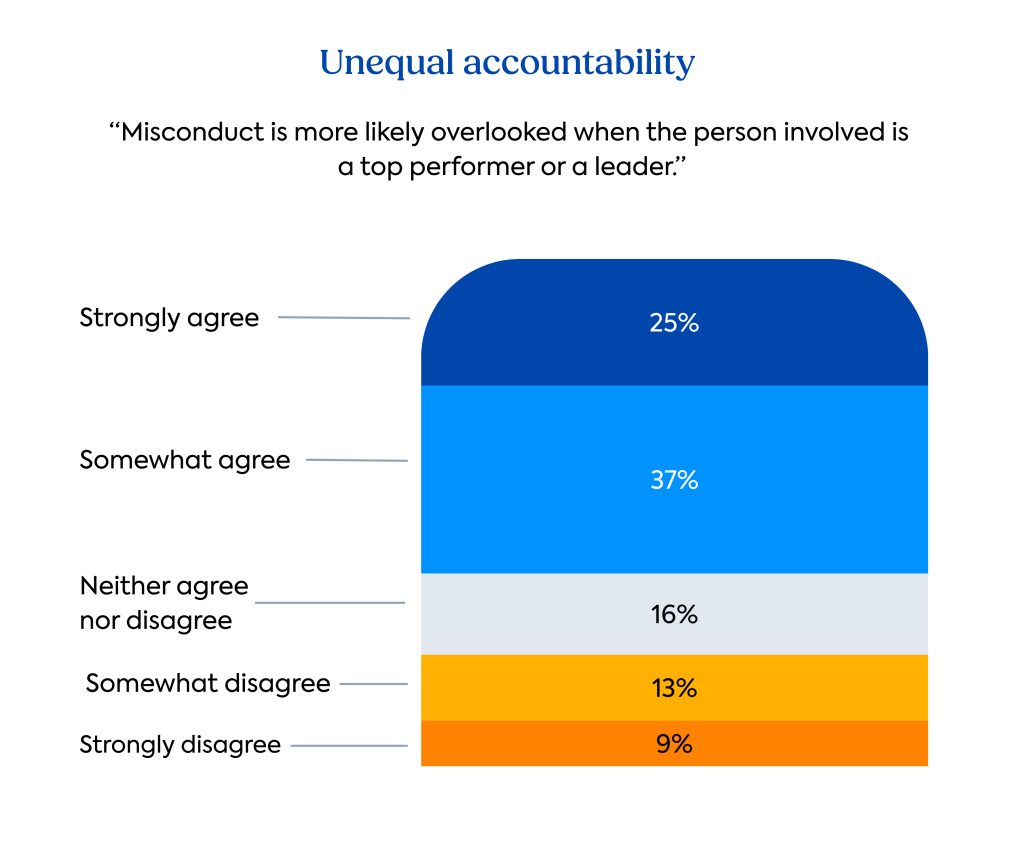
Protection, it seems, isn’t applied evenly. Nearly two-thirds of employees (62%) believe misconduct is more likely overlooked when the person involved is a top performer or a leader.
This creates a chilling effect. Why speak up when accountability depends on who’s involved?
45% of employees have seen people in their company get promoted even after mistreating others.
The message is reinforced by another troubling finding: 45% have seen individuals promoted after mistreating others. When employees see people get promoted despite misconduct, it proves that the system does not penalize bad behavior. This destroys trust and teaches the workforce that misconduct carries no cost.
A snapshot of employers’ fault lines
- Uneven accountability: Many employees believe misconduct is more likely ignored when it involves top performers or leaders.
- Muted escalation: Nearly half say managers discourage reporting harassment or discrimination up the chain.
- Status-based protectionism: Employees report seeing people promoted despite mistreating others.
- Silence as self-defense: A majority don’t report incidents because they don’t expect action, or fear the fallout.
- Trust under strain: When speaking up is equated with being labeled “difficult,” protection starts to feel conditional.
The pulse of safety: Where employers are delivering
The story that emerges isn’t one of total breakdown. We’ve seen that 71% of employees feel protected at their workplace. This indicates that the majority of employees recognize meaningful effort from their employers in preventing incivility, harassment, and discrimination.
Another finding reinforces that perception. An equal share of employees, 71%, agree their employer takes sufficient action to prevent harassment and discrimination. Policies exist. Expectations are communicated. And in many workplaces, preventive measures are visible enough and recognized by employees.
71% of employees agree that their employer takes sufficient action to prevent harassment and discrimination in the workplace.
Support also extends beyond misconduct. Sixty-eight percent of employees say their employer provides meaningful help when someone faces a personal crisis. That kind of support signals more than compliance. It reflects a workplace that acknowledges employees as people, not just roles or output.
Protection is present in many workplaces. The challenge is making sure it’s applied consistently, not selectively. Not doing so has real consequences: 77% of employees are more likely to consider leaving their job if they don’t feel protected at work.
Confronting unfair treatment at work: Six interventions to stop workplace misconduct
Misconduct isn’t an inevitable side effect of doing business. It’s a byproduct of guardrails that don’t hold. This chapter explores how to rebuild those guardrails and establish genuine accountability.
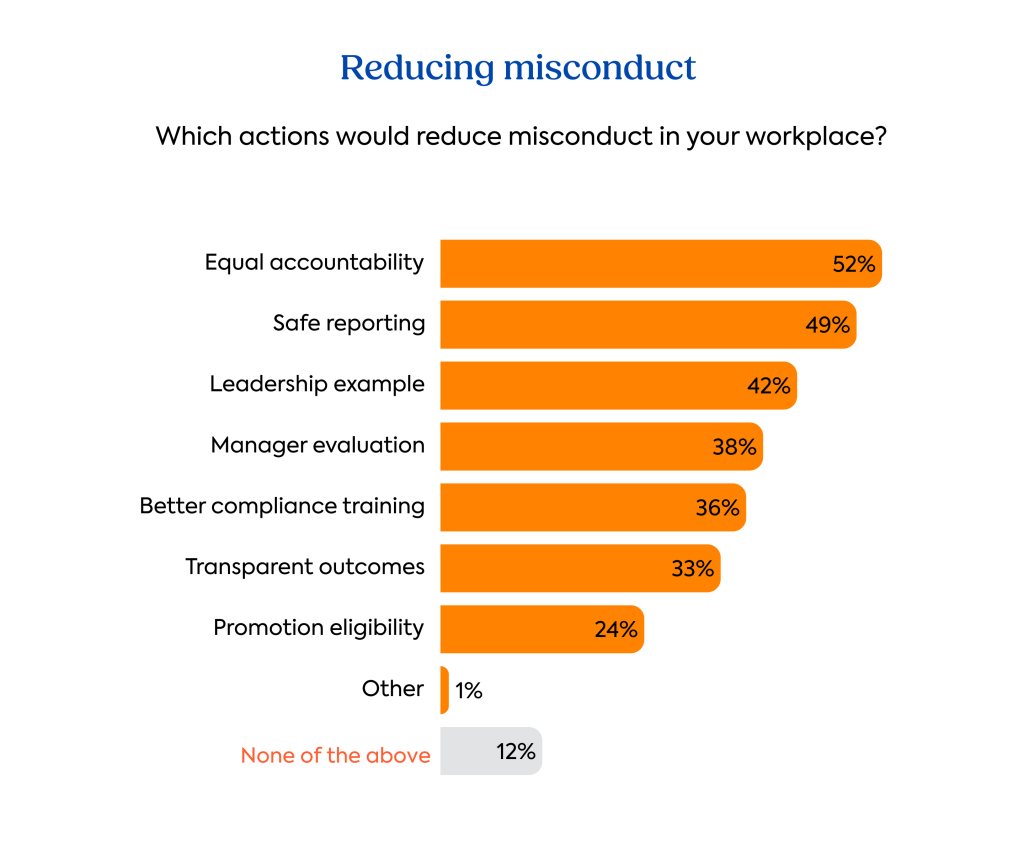
To understand which interventions matter most, we surveyed employees on the actions they believe would reduce misconduct. The answers outline a clear blueprint for change.
#1 Accountability: Same consequences apply to everyone
Accountability is the first link in the chain. The majority of employees point to equal enforcement as the most effective way to reduce misconduct. That means applying the same consequences of misconduct to everyone. Tying internal advancement to conduct also matters here. If people can move up despite mistreating others, then results outweigh behavior. Equal accountability resets that math.
#2 Reporting: Safe to raise concerns, transparent outcomes
Reporting only works when it’s safe and credible. Employees won’t speak up when they know negative consequences will follow. Which makes providing protection from retaliation a must-have. But safety from retaliation is only the first step. Transparency must follow. Employees need to see that reporting leads to action. Without this visibility, even a safe process can feel like a black hole.
#3 Leadership example: Signals that set the tone
Employees rank leadership example as one of the top three ways to reduce misconduct. Leaders shape what is tolerated at work. And what’s tolerated then becomes the standard. When misconduct is ignored at the top, it spreads. When it’s addressed consistently, this becomes the new norm. Leadership behavior defines the line between what’s written in policy and what actually happens at work. In short, leaders should model respectful behavior and speak up about issues.
#4 Manager evaluation: Measuring psychological safety and respect
Policies don’t enforce themselves. Managers do that. Many of the breakdowns employees describe don’t happen at the policy level. They play out in everyday managerial decisions, shaping what gets addressed, what gets ignored, and what behaviors are encouraged or quietly suppressed. Evaluating managers on team behavior and psychological safety directly targets that gap. This evaluation directly ties a manager’s success to their team’s well-being.
#5 Better compliance training: Practical skills for real-life moments
Thirty-six percent of employees say better compliance training can reduce misconduct. In this context, “better” means training grounded in realistic scenarios that teach practical skills rather than just focusing on legal requirements. For example, how to recognize early warning signs, how to intervene without escalating a situation, and how to respond when something doesn’t feel right. This type of training closes the gap between knowing the rules and knowing what to do.
#6 Early intervention: Stopping misconduct at the gateway
Our survey shows that incivility and disrespect are the most common forms of misconduct. Exclusion is also widespread. But severe incidents, while they still occur, are less frequent. That pattern tells a story. Minor behaviors set the tone. When rudeness, incivility, or exclusion go unaddressed, they normalize disrespect. Over time, that creates space for more serious violations. Early intervention breaks that progression and promotes accountability before harm escalates.
Compliance training: Impact, gaps, and readiness
Compliance training is meant to be a first line of defense for a safe, ethical, and legally compliant workplace. Yet in practice, it often becomes a hollow formality — a legally mandated box-ticking exercise.
Despite this reputation, compliance training does have a positive, measurable impact on employee conduct. Our research found that 60% of employees say it has directly improved behavior in their workplace.
60% of employees agree that compliance training has improved behavior in their workplace.
In that sense, compliance training delivers on its original purpose by translating policy into daily practice and shaping the behaviors that define a safe culture. But in some areas, it falls short.
Let’s examine where compliance training lands and where it cracks.
Beyond box-checking: Compliance training that delivers
When compliance training lands, it has real impact — leading to more respectful behavior at work. Sixty percent of employees say it improved behavior, and 36% say better compliance training would reduce misconduct in their workplace.
That combination matters. It shows a direct line between the training employees complete and a tangible, positive change in conduct. When executed well, compliance training translates policy into practice. It clarifies norms. It defines clear behavioral standards. And it equips employees to recognize and intervene in misconduct early.
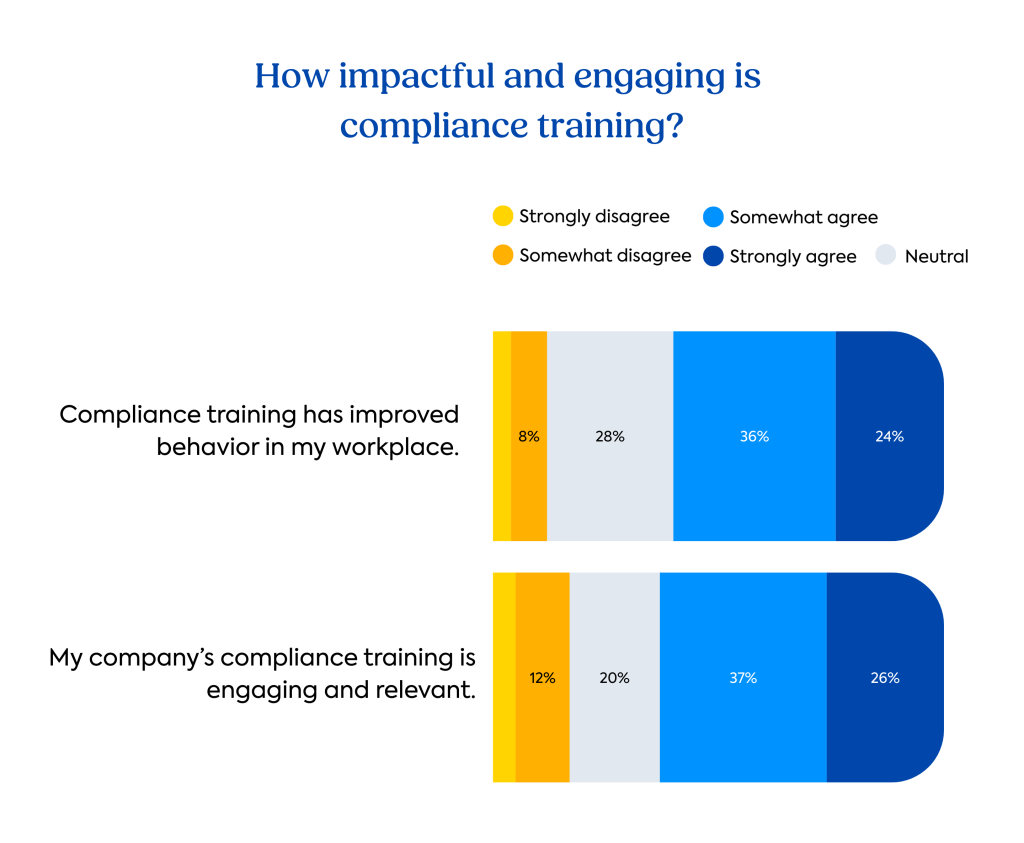
That impact is reinforced when training feels worth employees’ time. And the findings say it is. Nearly two-thirds of employees, 63%, say their company’s compliance training is engaging and relevant.
Engagement is a prerequisite for behavioral impact. Training only works if employees pay attention. Disengaged training may satisfy legal requirements, but it rarely changes how people act.
The high level of engagement reported here helps explain why compliance training can influence behavior. And it challenges an entrenched narrative. Compliance training isn’t just a checkbox, and employees aren’t inherently resistant to it. When training is done well, people pay attention to it and apply what they learn in real-world situations.
Where compliance training misses the mark
The problem isn’t whether compliance training can work, it’s where and why it falls short. The data highlights two key obstacles: A disconnect from real workplace situations and friction in how training is delivered.
Forty-five percent of employees say compliance training feels disconnected from the situations they face at work. That’s not a marginal concern. It suggests that, for many employees, training doesn’t reflect the nuanced interactions, power dynamics, and ethical gray zones that define real-life situations.
45% of employees agree that compliance training is disconnected from real situations employees face at work.
The issue isn’t whether policies are explained. It’s whether scenarios mirror lived experience closely enough to be useful when judgment is required.
Delivery adds a second layer of friction. One-third (33%) of employees report running into technical or access issues when completing compliance training. At that scale, friction becomes structural. It interrupts completion, creates uneven exposure across teams, and weakens consistency.
The evidence is clear. The limiting factor for impactful compliance training isn’t employee resistance. It’s whether it aligns with real workplace conditions and shows up reliably when employees need it.
Types of compliance training employees received in 2025
The TalentLMS report reveals that compliance training coverage in 2025 is uneven. And in some cases, it’s absent. Twenty percent of U.S. employees report receiving no compliance training at work in the past 12 months. That could be a legal ticking time bomb for U.S. employers operating under mandatory training requirements.
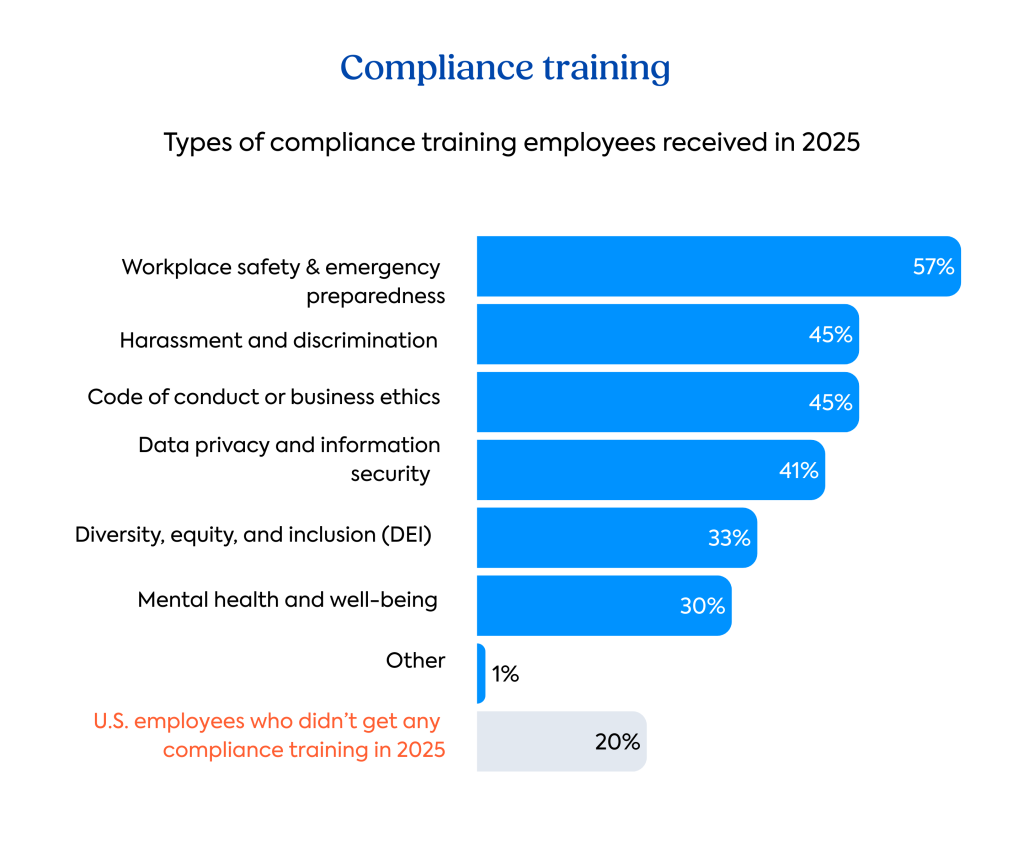
As the graph above shows, training is most consistent where risk is visible and procedural. It’s less consistent where behavior, power dynamics, and judgment are involved.
DEI training sits at the lower end of the compliance training stack and reaches only a third of employees. This positioning may reflect recent shifts in the U.S. regulatory and political landscape that have led many employers to reassess or scale back DEI-related initiatives.
Before moving on, it’s worth pausing to examine the DEI pullbacks.
The DEI pullbacks and the impact on employee protection
Changes in policy have shifted the ground under DEI. In early 2025, the U.S. federal government moved to roll back DEI across federal programs through executive orders. This signaled tougher scrutiny of DEI practices. Companies have responded by reframing or scaling back DEI language, programs, and disclosures.
That broader shift is now visible inside workplaces. Employees aren’t just reading headlines; they’re seeing changes play out in real time. Over a quarter of respondents say their company has pulled back from DEI initiatives. This is a sign that the retreat isn’t just public messaging, but something employees can feel on the ground.
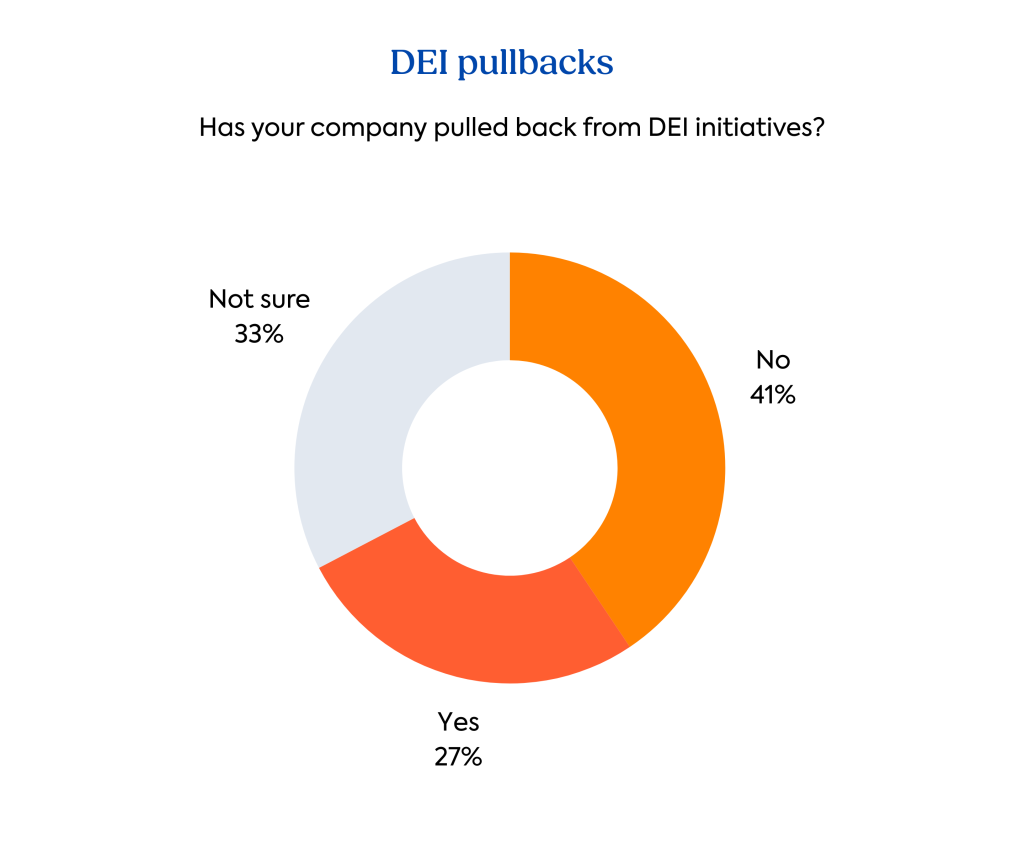
Just as telling is the uncertainty. A third of employees aren’t sure whether their company has pulled back or not. That ambiguity points to a quieter pattern: DEI isn’t always formally rolled back. It’s often diluted, deprioritized, or quietly folded into other initiatives, leaving employees to read between the lines.
The next question is how these pullbacks affect how protected employees feel at work.
Among employees who say their company has pulled back from DEI, 31% feel less protected as a result. For these employees, DEI pullbacks don’t land as a minor shift in messaging. They signal weaker commitment to fair treatment and less confidence that concerns will be addressed.
At the same time, the pullback doesn’t land as a loss for everyone. Thirty-one percent of employees feel no change. And 38% feel more protected. So the same organizational move leaves one group feeling exposed, another unmoved, and a larger group more at ease.
The compliance readiness gap
Across organizations, compliance training prepares employees unevenly for the risks they face at work. Training efforts are concentrated on procedural safety, not interpersonal conduct. While 57% of employees receive safety training, only 45% get harassment prevention and code of conduct training, and just 33% receive DEI training.
The result is a risky asymmetry. Employees are drilled for the rare emergency but left unprepared for the common conflict. They’re strong on safety, but weak on everyday conduct. This gap between the training provided, and the risks encountered, leaves both people and organizations exposed.
Closing the compliance training gap
To address this gap, TalentLMS has expanded its compliance ecosystem. A new compliance course bundle is now available: HR Compliance with EasyLlama and TalentLMS. Built specifically for U.S. HR compliance, this bundle is offered exclusively on TalentLMS.
Together, TalentLMS and EasyLlama enable organizations to pair people development with U.S.-specific compliance readiness. Helping employees feel protected not just in policy, but in practice.
Ready-to-use HR Compliance bundle
A complete, state and federal HR Compliance course bundle for U.S. businesses, created by EasyLlama and available only on TalentLMS.
Conclusion
Our research uncovered a protection paradox: The majority of employees feel protected, yet most still see misconduct. In practice, protection is often a paper shield.
Ultimately, organizations should decide which carries more weight: Protecting the untouchable “rainmaker” or protecting trust in workplace fairness. When employees see high performers get a free pass, values statements quickly lose credibility.
Fixing this requires radical transparency. To break the cycle of silence, organizations must open the “black box” and provide visible evidence of accountability.
True protection is a practice, not a policy. It becomes real only when accountability is equal and outcomes are visible. Anything less is policy without credibility.
About the survey
This TalentLMS survey was conducted online in November 2025 with 1,000 U.S. employees across industries. Minor discrepancies in total figures may occur due to rounding.
Research team
Ana Casic, Giota Gavala, Fiona McSweeney
Dive deeper into original research by TalentLMS



Bring out the best in your teams.
Get started with the most versatile and affordable employee training platform, no credit card needed.