

Soft skills are the secret to success in many jobs.
In an era when automation and artificial intelligence (AI) are changing industries, unique human qualities are assets.
Because of recent major changes, soft skills in the workplace have gone from mere “add-on” traits to core competencies. They are the catalysts that propel people to thrive in 2026 and beyond, and they ultimately contribute to a business’s success.
35 top soft skills examples in 2026
Let’s review the most relevant top soft skills for employees in 2026.
1. Critical thinking
Example: A data analyst who interprets datasets, spots trends, and provides insights.
2. Creativity
Example: An advertising pro who creates compelling campaigns that grab attention and set the brand apart.
3. Emotional intelligence (EQ)
Example: A manager with high emotional intelligence who can understand and motivate their team to reach their goals through active listening and empathy.
4. Adaptability
Example: A digital marketer who adapts to new digital trends and platforms to better reach target audiences and make communications more effective.
5. Innovation
Example: A product designer who develops a unique, user-friendly product feature that stands out in the market.
6. Collaboration and teamwork
Example: A software team that works well together leans on each other’s strengths, solves problems, and delivers quality projects on time.
7. Communication skills
Example: A sales rep who delivers a clear and concise presentation to senior management that effectively communicates the key findings and recommendations from a recent project.
8. Time management
Example: A project manager who shows good time management skills by using the Agile methodology with 2-week sprints and daily standups, allowing the team to complete the project 20% ahead of schedule.
9. Leadership
Example: Winning workplace leadership experts who lead a team through a challenging project by setting clear goals, providing continuous feedback, and fostering a supportive environment that encourages innovation and accountability.
10. Continuous learning
Example: A software developer who continuously learns new programming languages and technologies to stay relevant and contribute to cutting-edge projects.
11. Persistence
Example: Entrepreneurs who overcome setbacks, learn from failures, and succeed.
12. Resilience
Example: After a project setback, an employee remains motivated and works diligently to meet the revised deadline.
TalentLibrary – Skills that matter, courses that deliver
With TalentLibrary, you set the foundation for a strong, aligned workforce—soft skills, compliance, and workplace essentials, from day one (and beyond).
13. Work ethic
Example: An employee who consistently meets deadlines and maintains high-quality work standards, even when faced with tight schedules and high-pressure situations.
14. Decision-making
Example: A business analyst who evaluates the potential risks and benefits of a new market entry strategy, then makes an informed decision that leads to significant business growth.
15. Negotiation
Example: A CEO who successfully negotiates a partnership deal that benefits both companies by finding common ground and creating a win-win situation for both parties.
16. Empathy
Example: An HR rep who understands a colleague’s workload and offers assistance or emotional support during stressful periods, thereby strengthening team cohesion and morale.
17. Conflict resolution
Example: A team lead who mediates a dispute between team members by identifying the root cause of the conflict and facilitating a constructive dialogue to resolve the issue amicably.
18. Interpersonal communication
Example: A customer success manager who builds strong relationships with clients by actively listening to their needs and concerns, leading to increased client satisfaction and loyalty.
19. Flexibility
Example: A product manager who adapts work schedules to accommodate last-minute changes in project deadlines without compromising the quality of work.
20. Dependability
Example: A performance marketer who consistently delivers results on time, thereby earning the trust and reliability of colleagues and supervisors.
21. Public speaking
Example: An L&D expert who engages an audience during a conference by delivering a compelling and well-structured speech that highlights key industry trends and insights.
22. Problem-solving
Example: A content strategist who identifies a critical bottleneck in content creation and implements a solution that improves efficiency and reduces costs.
23. Active listening
Example: An employee who participates in team meetings, acknowledges and building upon others’ ideas, leading to more productive and inclusive discussions.
24. Attention to detail
Example: An employee reviews a client proposal multiple times to catch typos and inconsistencies, ensuring a polished and professional submission.
25. Positive attitude
Example: A team lead approaches a tight deadline with enthusiasm, motivating the team and ensuring the project is completed successfully.
26. Patience
Example: An employee patiently addresses a customer’s concerns, leading to a positive resolution and customer satisfaction.
27. Cultural competence
Example: A manager adapts their communication style to effectively lead a multicultural team, fostering inclusivity.
28. Organization
Example: An employee organizes their workload to meet all project deadlines ahead of schedule.
29. Growth mindset
Example: An employee receives constructive feedback on their presentation skills and proactively enrolls in a public speaking workshop to improve, demonstrating their commitment to self-improvement.
30. Networking
Example: An employee attends industry events and builds a network of contacts, leading to new business partnerships.
31. Vulnerability
Example: A senior developer admits during a retrospective that their technical approach cost the team a week, opening up an honest conversation that makes the next sprint run smoother.
32. Accountability
Example: A team lead who misses a campaign deadline flags it to stakeholders, explains what went wrong, and presents a revised plan, earning more trust by owning the outcome than deflecting it.
33. Giving constructive feedback
Example: A manager notices a report’s presentation lacks structure but frames feedback around impact — “Your insights were strong; structuring them around three key takeaways would land better with leadership” — making the next version significantly sharper.
34. Self-reflection & self-awareness
Example: After a tense client call, a project manager recognizes they dominated the conversation and didn’t leave room for the client’s concerns and adjusts their approach for the next meeting.
35. Curiosity
Example: A customer support rep notices the same complaint appearing weekly and, instead of just resolving tickets, digs into the product data to find the pattern, surfacing a UX issue the product team hadn’t spotted.
 Marialena Kanaki
Strategic Content Marketing Leader with a strong record of shaping brand narratives and driving growth through creative storytelling. Experienced in managing high-performing teams, building impactful content strategies, and bridging business goals with authentic, human-centered communication. Dedicated to turning vision into execution and empowering others to achieve success with clarity and impact.
Expert Tip: Why Soft Skills Are the Hardest Skills to Improve
Most people think they already have strong soft skills. That’s exactly what makes them so hard to develop. You won’t improve your communication if you believe you’re already a good communicator.
- The real starting point is self-awareness. You don’t improve a soft skill gap you don’t believe you have. You improve it the moment you realize a conversation went sideways because of you, not the other person. That uncomfortable recognition is where growth actually begins.
- Hard skills are simpler to train for a reason. There’s a clear path: learn the tool, practice, get certified. Soft skills don’t work that way. They require you to question habits you don’t even know you have — and then choose to change them.
- Soft skill gaps often go unaddressed because they’re harder to name. A manager can point to three errors in a report. Telling someone their tone shuts down collaboration? That feels subjective, so sometimes it doesn’t get said. The result: technical mistakes get corrected quickly, but interpersonal patterns persist for years.
Takeaway: Soft skills development starts with honesty — from the individual and from the people around them. The employees who grow fastest are the ones willing to look at themselves first, supported by managers willing to have the uncomfortable conversation.
Can you train soft skills?
Contrary to popular belief, soft skills are not innate personal qualities that are hard to teach or acquire. Soft skills training can help employees grow these strengths.
While soft skills training for employees can be done alone, it’s more efficient to do so with a carefully crafted training program. Many companies now offer soft skills training programs as they see the value it has for both employees and employers.
These programs work best when practiced in person rather than through a book. Unlike technical skills, they may take more time and practice to develop.
Some practical techniques include:
- Instructor-led training (ILT)
- On-the-job training (OTJ)
- Role-playing
- Coaching and mentoring
For example:
Employees can improve their active listening skills using reflective listening techniques. In these sessions, they rephrase what the speaker said to gain a better understanding and build empathy.
To build conflict resolution abilities, they could experiment with simulated scenarios.
Techniques like mindfulness meditation and cognitive-behavioral training are also growing more popular. They can help manage emotions, reduce stress, and react better in tough times.
Another strategic approach is to combine soft skills training with existing professional development programs or leadership training programs. This way, employees can practice job-related soft skills in a similar setting.
The beauty of this approach is that you can simply adapt what you have (things like employee training software) to what you want to train. Plus, it is much easier than reinventing the wheel.
Bear in mind that soft skills development is an ongoing process. You need to support your employees in reflecting on their soft skills and their journey.
What soft skills are employers looking for?
93% of employers cite soft skills as a deciding factor when it comes to hiring. But this should not be exclusive to hiring alone. It should also apply to current employees whom they might want to upskill or reskill.
With that in mind, here are some of the top soft skills in the workplace that employers look for:
- Communication skills
- Creative thinking
- Collaboration
- Critical thinking
- Adaptability
- Emotional intelligence
- Leadership and influence
- Time management skills
- Organization
Which skill is most in-demand?
According to many expert surveys and reports, analytical thinking is the soft skill in the highest demand right now.
Analytical thinking refers to a set of cognitive skills that help a person analyze a problem, engage in critical thinking about it, and find a solution. Examples include problem-solving, brainstorming, troubleshooting, and data analysis.
Employees who lack critical thinking skills may find it difficult to keep up with the pace of workplace shifts like AI. They may also have trouble making quick decisions needed to prevent costly delays.
While it may be one of the most in-demand soft skills, creative thinking is the fastest-rising skill in demand.
The WEF predicts that the demand for creative thinking will rise to 73% in five years, outpacing analytical thinking.
Creativity at work means thinking differently about a problem. It’s about finding new solutions that others may not have thought of. It also means being open to ideas from your coworkers, even if you disagree with them.
Creative thinking can help solve problems or create new things. For example, it can help teams come up with fresh ideas to solve problems and become more resilient.
Therefore, soft skills training is essential to empower employees.
Can you assess the soft skills of new hires?
Soft skills often determine how well someone will perform in a role. Good management (a hard skill) requires many soft skills, such as leadership, empathy, and innovation.
Yet when it comes to recruiting, businesses typically focus mostly on hard skills and not enough on soft skills. They primarily hire based on technical skills and expertise, while soft skills come as a second priority. On the other hand, when it comes to evaluating performance, soft skills are equally prioritized, creating a gap between expected and actual performance.
Leveraging soft skills-based hiring (even slightly) means you:
- Widen your candidacy pool
- Hire people who fit your culture
- Find employees with potential and not just knowledge
- Choose employees with strong cognitive abilities who can and want to grow
In contrast to qualifications, education, and hard skills, soft skills are difficult to evaluate and quantify. Looking at someone’s CV alone doesn’t show if they can manage their time well and communicate effectively.
Interestingly, it seems to be a common problem. 60% of hiring managers find it challenging to assess candidates’ soft skills. In that case, simple resume examples can help present these skills more clearly.
However, it doesn’t necessarily need to be like this.
There are some effective methods to evaluate soft skills in potential hires:
- Behavioral interviews: Shed light on how they have applied these skills in real situations.
- Role-playing exercises: Show how they handle challenges, interact with others, and think on their feet.
- Group activities: Give you a window to evaluate teamwork skills, work ethic, and how they contribute to team dynamics.
- Work samples or case studies: Let you see how they approach the task, their critical thinking process, and their solutions.
Hire and train top talent with the most in-demand soft skills
Success in today’s fast-paced environment requires a commitment to adaptability and lifelong learning. To maintain a competitive edge and achieve sustainable growth, it’s essential to stay informed and invest in the ongoing development of in-demand soft skills for your employees.
Emphasizing skills-based hiring and targeted training should be at the forefront of your HR and L&D strategies. With TalentLMS, you can effortlessly customize your learning and development efforts, ensuring your team is equipped for success. This approach not only helps you attract and retain top talent but also strengthens your team’s capabilities, driving exceptional performance and sustainable growth for your organization.
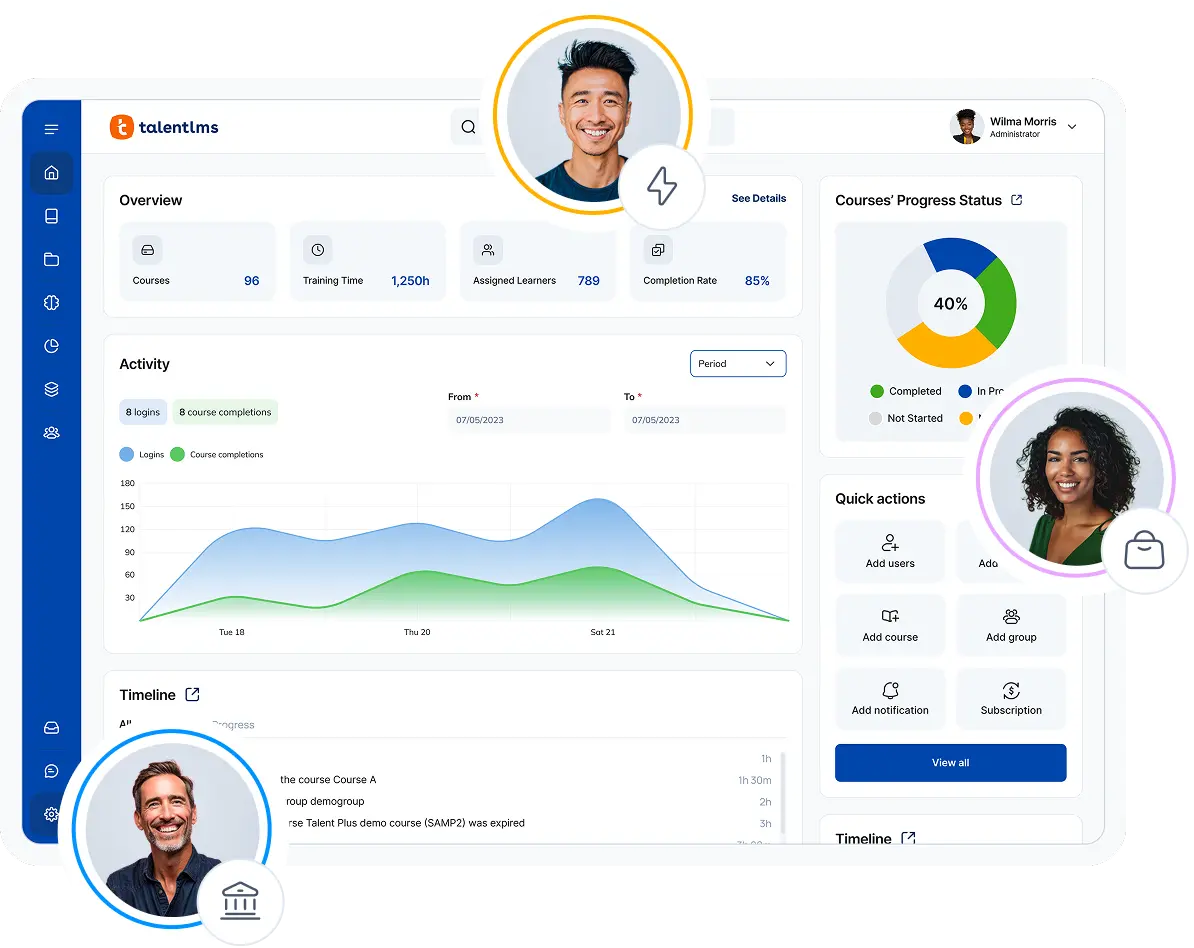
Want to cover your team’s soft skills training needs? With TalentLMS, you can set them up for success with the most in-demand soft skills for 2026 and beyond.
FAQs on soft skills
1. What are soft skills?
Soft skills — sometimes called “people skills” — are non-technical abilities that shape how you work and interact with others. Think communication, problem-solving, emotional intelligence, and adaptability. Unlike hard skills (coding, data analysis, design), they’re harder to measure but often determine how well someone actually performs in a role. Some develop naturally through experience; others benefit from deliberate training.
2. Why are soft skills important in the workplace?
Research suggests 85% of job success comes from well-developed soft skills. They drive better communication, stronger collaboration, and higher productivity — and they’re difficult to automate, making them increasingly valuable as AI handles more technical work.
3. What is soft skills training?
Structured development — through workshops, role-playing, coaching, or e-learning — designed to strengthen how people communicate, collaborate, and handle challenges. Unlike technical training, it takes more than knowledge transfer; it requires willingness to reflect and change.
Originally published on: 15 Aug 2018 | Tags: Soft Skills Development