
Imagine you are trying to fill a massive, ever-expanding swimming pool with water, but all you have is a tiny garden hose.
That pool represents all the new skills employees need today, and the garden hose is the traditional training methods. It’s just not fast enough.
That gap between the new skills and old training methods is what we call learning debt. It also happens when an organization adopts new technologies and moves forward faster than its employees can build the skills needed to keep up.
If you don’t pay off that debt by upskilling your team, it compounds and eventually slows the whole business down.
On top of that, workplace learning is incredibly important. In fact, according to The TalentLMS 2026 Annual L&D Benchmark Report, 95% of HR managers agree that training and skill development are key to keeping employees from quitting.
This is exactly where AI in L&D can successfully step in to save the day. It helps close that gap by making training:
- Faster to create
- Easier to personalize
- Measurable
What is AI in L&D?
AI in learning and development is like giving every employee their own highly attentive, data-driven personal tutor while simultaneously giving the HR team a powerful assistant.
Instead of having everyone sit through the same static slide deck, AI creates adaptive learning environments. It specifically uses artificial intelligence to:
- Personalize the learning experience for each individual.
- Automate the heavy lifting of creating and managing courses.
- Analyze where employees are falling behind (skill gaps).
- Deliver real-time support right when an employee gets stuck.
Why AI is becoming essential for L&D
AI is becoming essential for L&D because it’s the only way to close the learning debt. It closes that gap by making training faster to build, easier to tailor to each person, and, most importantly, measurable.
This directly supports the shift from checkbox training to training that drives real business impact. Since AI tools are a major driver of this debt, they can also play a key role in reducing it.
6 Key use cases of AI in L&D
Next, let’s explore how to use AI in L&D to close learning gaps, accelerate course creation, and enhance training business impact.
1. Personalized learning paths
Traditional training is very static. Everyone gets the exact same course regardless of what skills you already have, what you might lack, or what might suit your role best.
AI, on the other hand, allows you to be more dynamic. It constantly recalculates based on your employees’ specific skills and destination.
AI in L&D successfully achieves this by actively analyzing a learner’s:
- Behavior: How they interact with past training.
- Skills: What they already know.
- Goals: Where they want their career to go.
By crunching this learner data, the AI recommends relevant, custom-fit training for that specific employee.
For example:
- Instead of a generic “Management 101” course, an employee showing leadership potential gets a custom program focusing exactly on their weak spots, like conflict resolution or delegation.
- A new sales rep and a new software engineer get completely different day-one training paths tailored to what they actually need to do their jobs.
- The AI proactively suggests modules like AI training for employees who work with AI tools.
Because when the training is relevant to the employee, it leads directly to higher engagement and faster skill growth.
2. AI-powered course creation
Instead of an instructional designer staring at a blank screen for hours, generative AI helps L&D teams create training content faster. It does the heavy lifting by generating things like:
- Course outlines (building the skeleton of the lesson)
- Quizzes and assessments (automatically generating questions to test knowledge)
- Training scenarios (writing realistic role-play situations)
- Microlearning modules (creating short, bite-sized lessons that take just a few minutes to complete)
Because of how much time it saves, this is actually one of the most common uses of AI today in the L&D world.
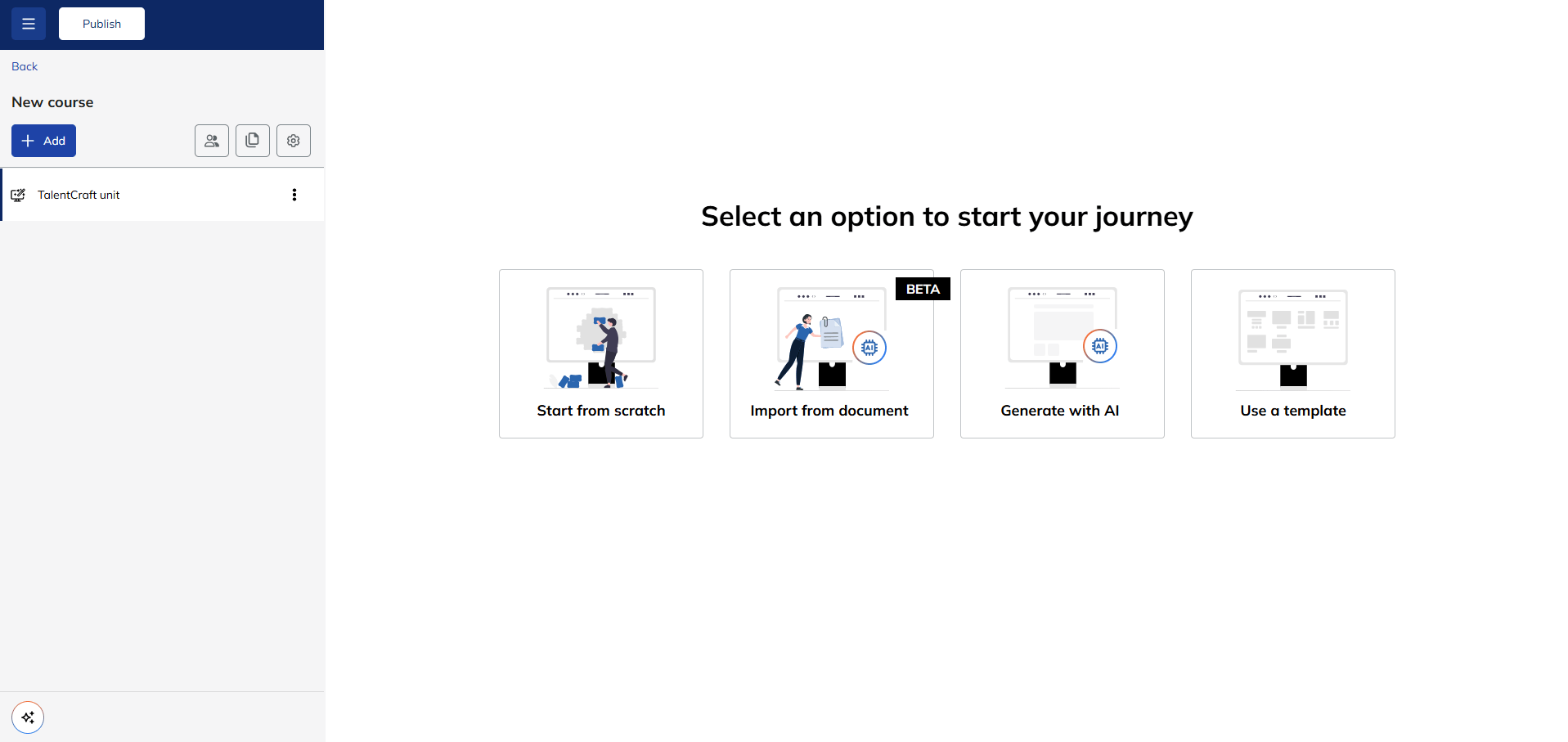
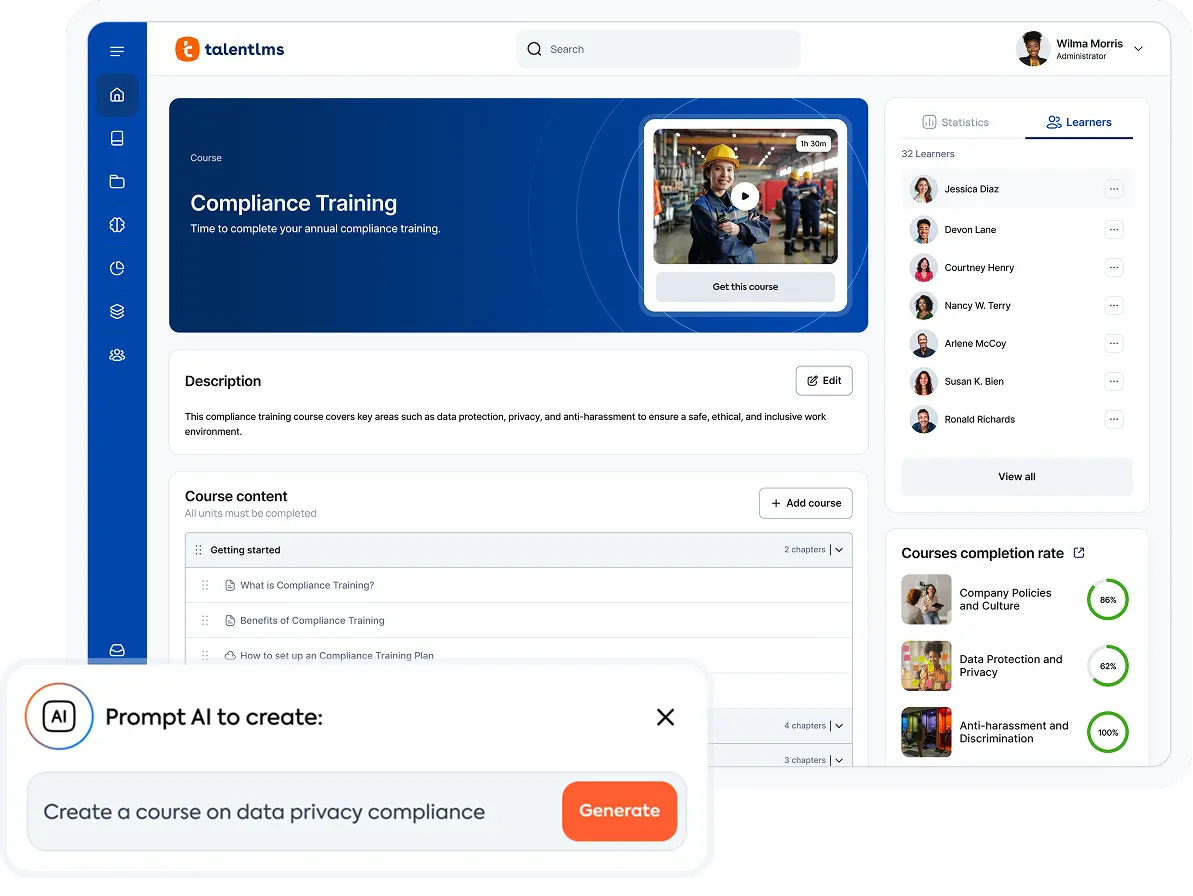
A perfect example of this is TalentCraft from TalentLMS. Creators can simply describe what they want, and the AI creates text, images, and even interactive elements. It’s like having a co-author who never gets writer’s block.
3. Skills mapping and workforce intelligence
Most managers don’t actually know what skills their employees have beyond their basic job title.
AI in L&D flips that dynamic and gives you thorough data on the skills beyond a job title.
AI in learning and development analyzes data like resumes, project history, and performance reviews to identify:
- Current skill gaps: Where are employees currently falling short?
- Emerging skill needs: What new skills will the company need in 6 months to stay competitive?
- Training priorities: Who needs to learn what right now?
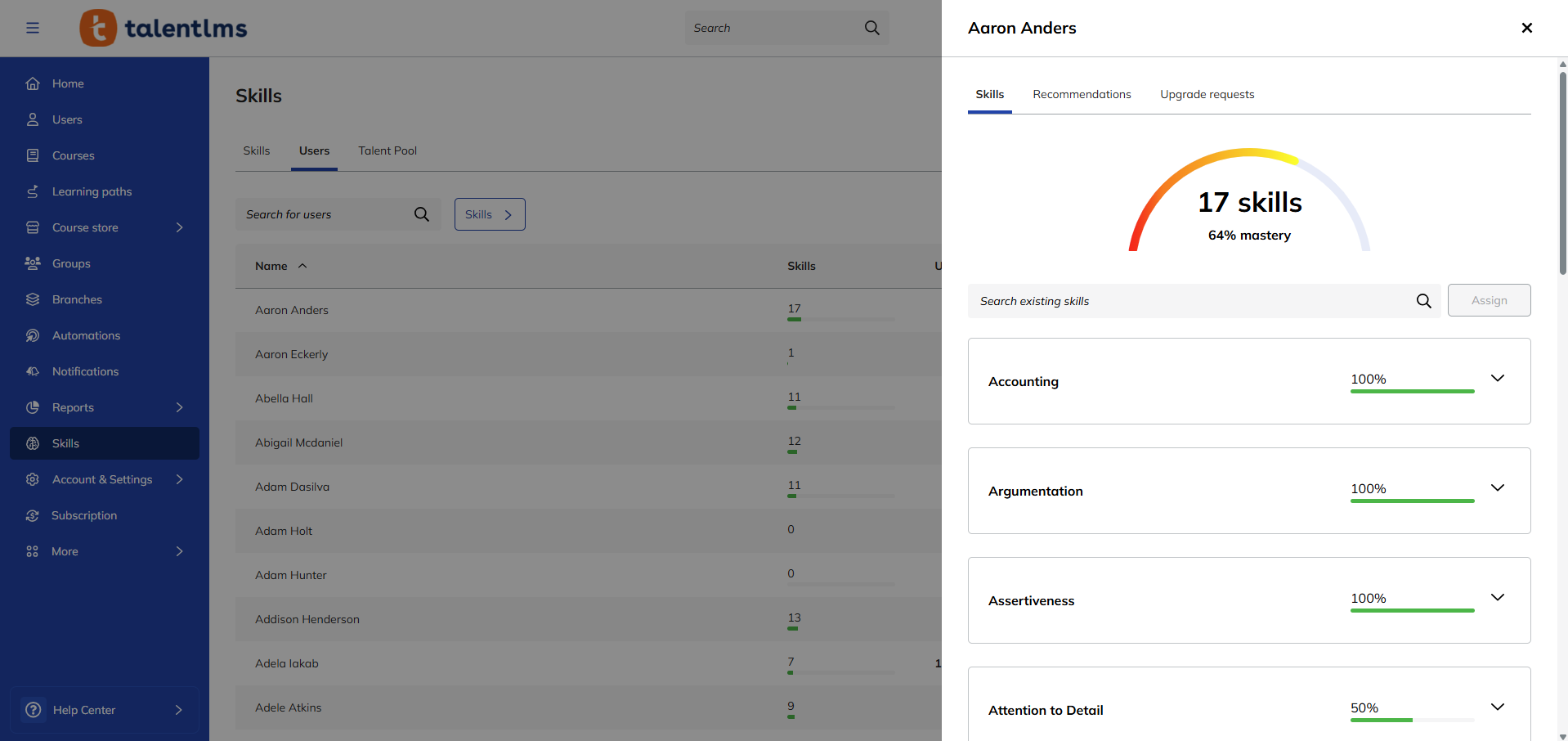
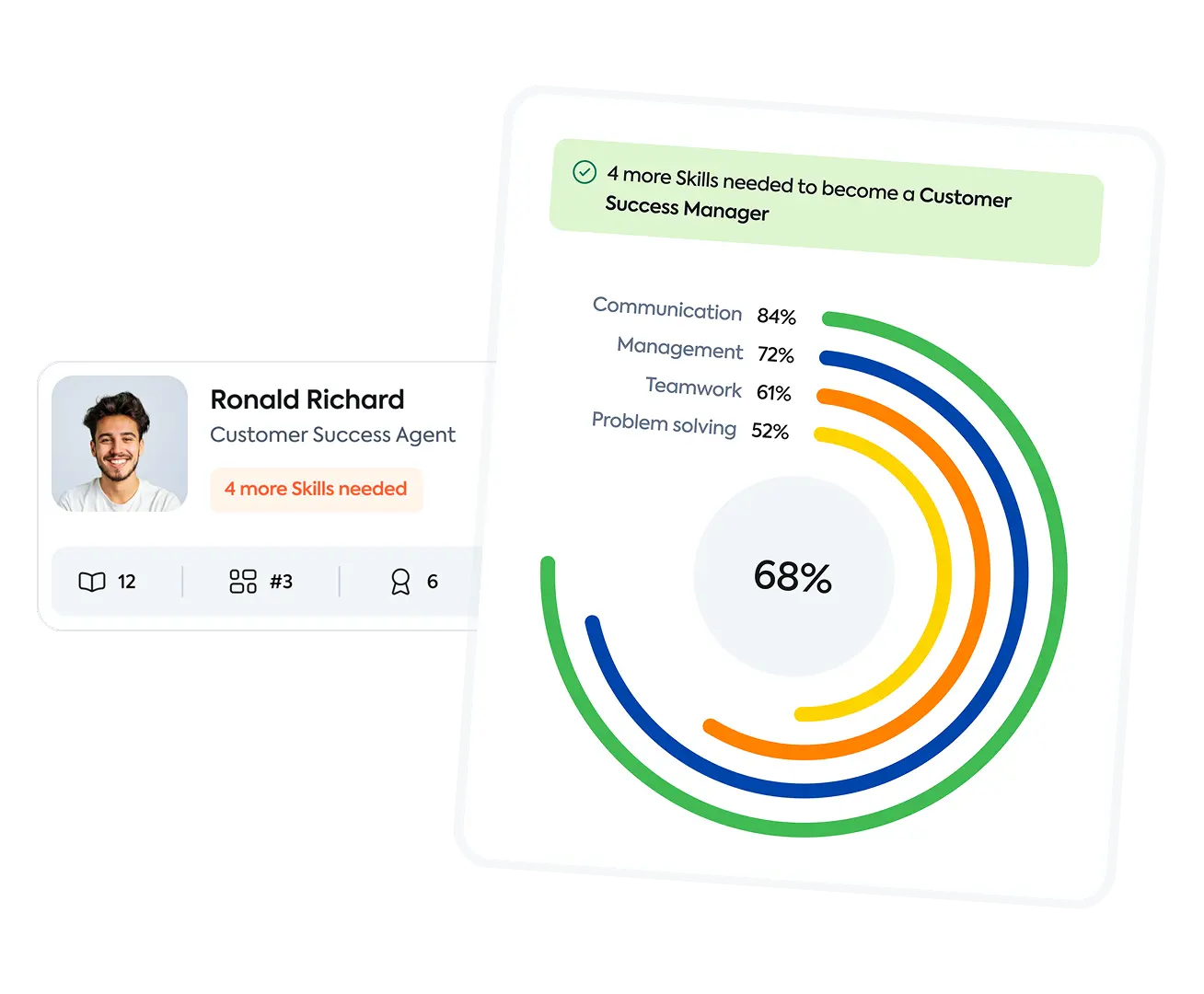
The Skills feature from TalentLMS automatically helps companies track and visualize these exact metrics across their entire workforce.
4. AI learning assistants and coaching tools
One major roadblock employees often have with learning is being stuck on a task without expert guidance on what to do. Not only is this a waste of time, but it also disengages them.
AI-powered learning assistants act as on-demand, 24/7 coaches. These tools can:
Answer learner questions instantly
Guide employees step-by-step through complex training
Even simulate role-play scenarios (for example, practicing a difficult sales pitch with an AI customer before trying it on a real one).
It’s like having a mentor who has read every book in the world and never gets tired.
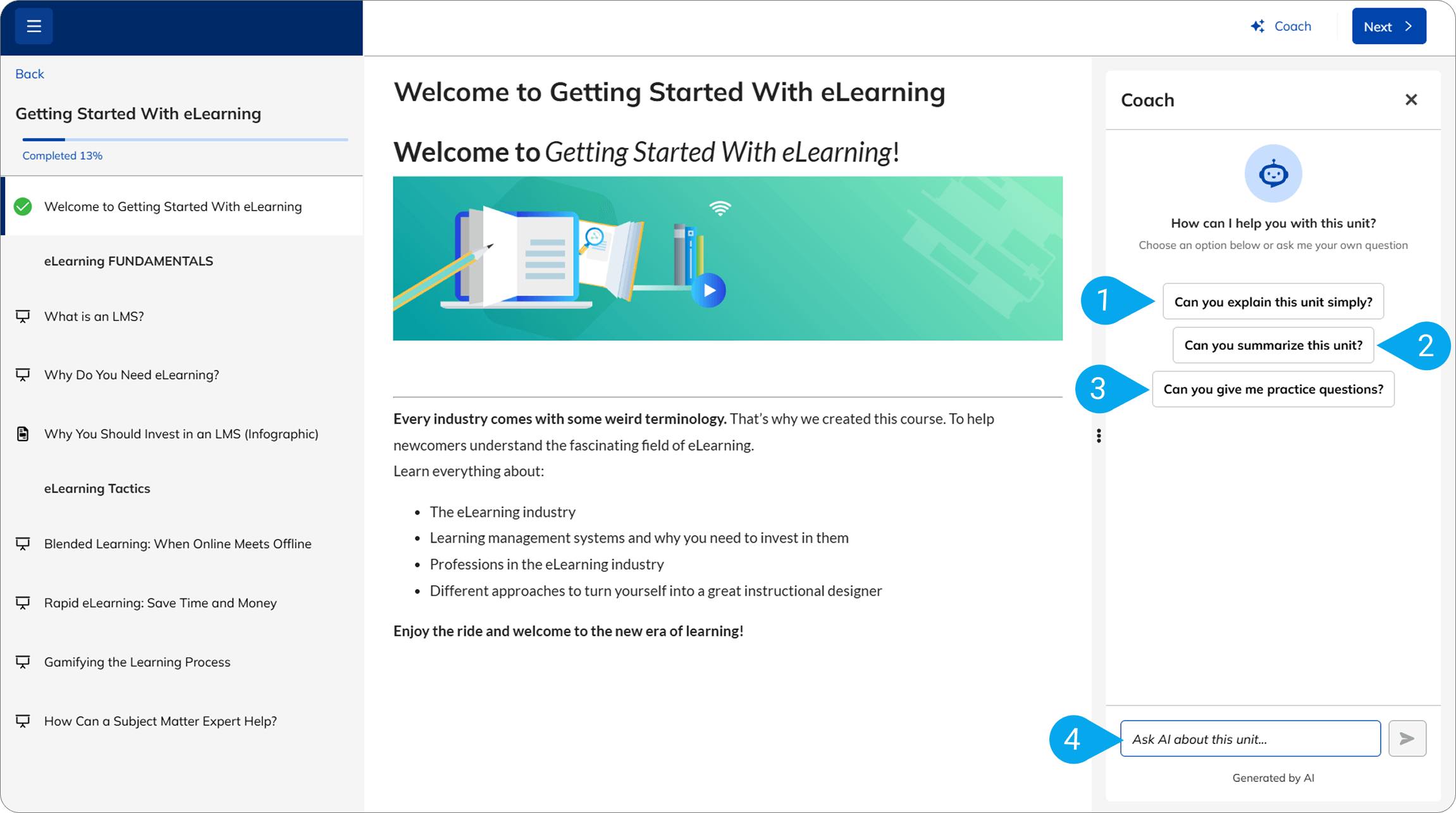
As Donald Taylor noted in a recent TalentLMS podcast on AI in 2026, this is huge because learners can get immediate support without having to wait for a human instructor to become available. A perfect example of this is the AI Coach feature from TalentLMS that helps learners understand content through simple explanations, key summaries, practice questions, and on-demand answers.
5. Learning analytics and impact measurement
One of the biggest advantages of AI technology is that it gives organizations a crystal-clear picture of what’s actually working through improved learning analytics.
Instead of just tracking who clicked complete, an AI LMS helps companies:
- Measure training effectiveness: Is this course actually teaching people what it’s supposed to?
- Track skill progression: How fast is an employee moving from a beginner to an expert?
- Link learning to performance: Did taking that sales negotiation course actually lead to the employee closing more deals?
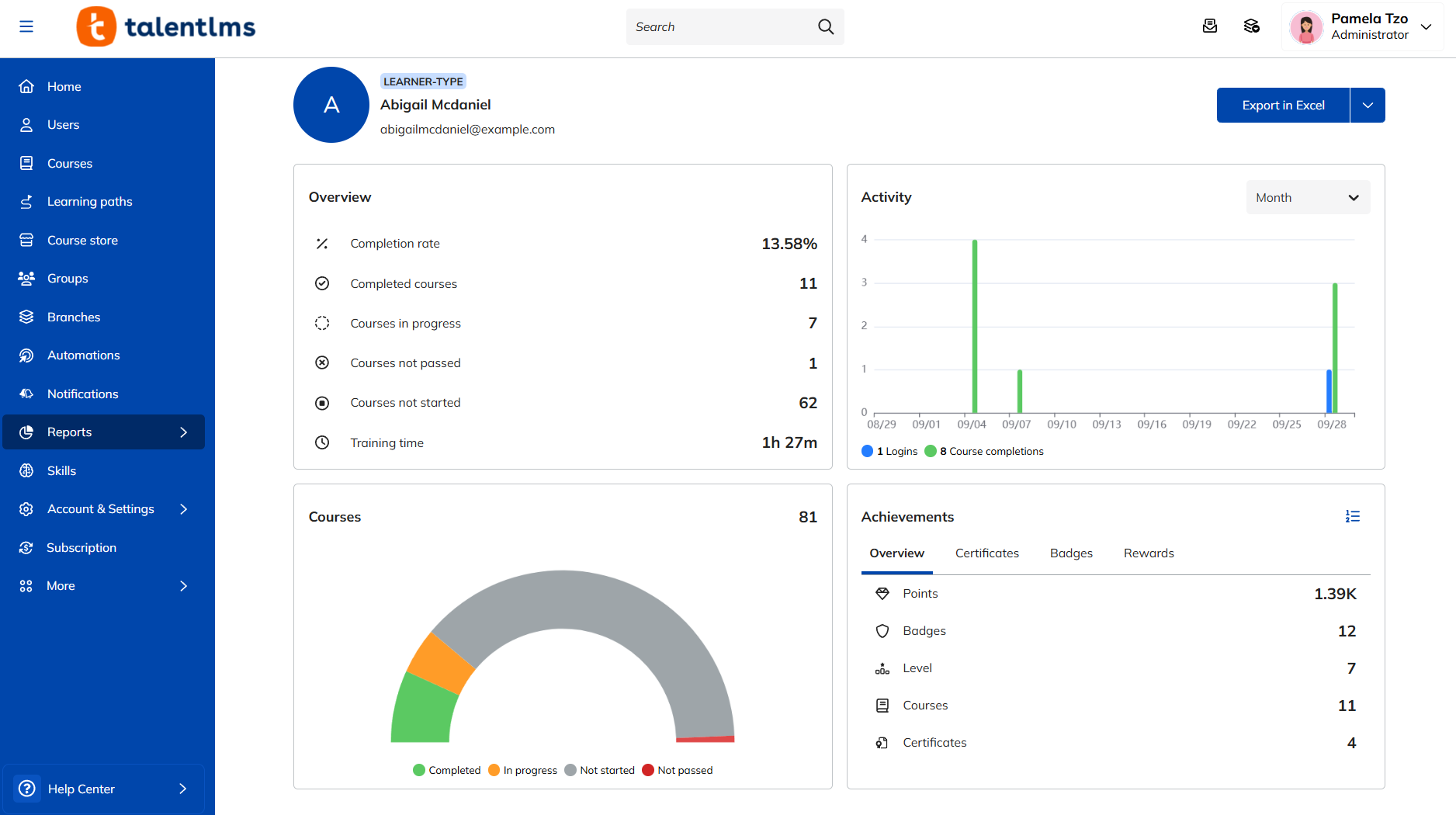
This is a massive shift because it aligns perfectly with the broader business push to prove training ROI. It proves that L&D is driving measurable business impact. With TalentLMS’s Reporting features, it’s easy to turn your training data into clear, actionable insights.
6. Learning in the flow of work
Historically, taking a training course meant stopping your actual work, logging into a separate system, and sitting through a module. It was disruptive.
AI in learning and development makes it incredibly easy to embed training directly into an employee’s daily workflow.
Instead of having to go find the information your employee needs, the exact data just appears right there where they are working. That’s learning in the flow of work.
Here are a few examples of what this looks like:
- Collaboration tools: Getting AI-driven micro-learning recommendations right inside Slack or Microsoft Teams.
- Contextual training: A software platform popping up with a quick, customized 30-second tutorial right as you click on a new feature you’ve never used before.
- Just-in-time support: An AI tool instantly gives you a quick refresher on a process right when you start that specific task.
This drastically reduces the friction between learning something and actually doing it.
Benefits of AI in L&D
When a company implements AI in L&D like the use cases we just talked about, they reap some major rewards.
Here are the five biggest benefits:
- Personalized learning experiences: Because training is tailored to individual needs, employees actually pay attention. This results in much higher engagement and much stronger knowledge retention.
- Faster training development: AI in L&D slashes the time it takes to build courses. What used to take weeks of storyboarding and writing can now be drafted in hours.
- Better visibility into workforce skills: Thanks to AI analytics, companies are no longer flying blind. They know exactly what skills their employees currently have and exactly what they need to learn next.
- Scalable global training: AI-powered systems make it incredibly easy to scale and deliver consistent, translated, and localized training to large, distributed teams without needing a massive army of instructors.
- Stronger connection between learning programs and business outcomes: One of the biggest benefits is the shift toward measurable impact. Instead of just tracking course completion rates, organizations can track real business metrics, career growth, and overall effectiveness. In fact, a massive 75% of HR managers say their learning strategy is now successfully aligned with business KPIs (Key Performance Indicators).
5 AI trends shaping L&D in 2026
Now let’s look at the AI trends that are shaping L&D for 2026.
1. Hyper-personalized learning at scale
We talked earlier about personalization, but in 2026, it’s already on a whole new level.
Think of it this way: basic personalization is like a barista remembering your usual coffee order.
Hyper-personalization at scale is like having a barista who knows you didn’t sleep well last night, sees you have a big presentation in 20 minutes, and automatically hands you a double-shot espresso with a calming lavender pastry.
And it can do this for all 5,000 employees in your company at the same time.
What makes these AI LMS platforms so powerful is that they are dynamic. These personalized learning paths will adapt in real-time based on:
- Skill progress: Did you ace that last quiz? Great, the AI will skip the next beginner module and jump you straight to advanced concepts.
- Performance data: If your manager notes in your performance review that you are struggling with client presentations, the system automatically weaves presentation training into your flow.
- Career goals: If you update your profile to say you want to be a VP in 3 years, the system immediately recalculates your entire curriculum to get you there.
2. AI copilots for learners and L&D teams
Right now, AI is being used as a constant copilot. What’s unique about this current phase is that these copilots are supporting both sides of the learning equation simultaneously.
Here is how these AI assistants are actively working today:
- For L&D teams: They assist with course design and training workflows. Instead of an L&D manager manually assigning courses and sending reminder emails, the copilot handles the logistics and content creation.
- For learners: They provide active learner guidance. If a learner gets confused mid-course, the copilot is right there on the screen to clarify concepts or provide extra examples on the spot.
3. Skills-based learning ecosystems
For decades, companies hired and trained people based on their job titles. But job titles are becoming a bit outdated because the real tasks people do change so quickly.
Now, organizations are shifting from job-based training to skills-based development.
Instead of looking at an employee as a job title, AI looks at them as a collection of skills. AI in L&D helps map these skills across the entire workforce. This creates a learning ecosystem where:
- A graphic designer with strong coding skills can be pulled into a web development project.
- Training is assigned to fill specific skill gaps across the company, rather than just checking a box for a specific department.
4. Learning embedded in everyday work tools
We are seeing a massive shift where training is increasingly happening inside daily workflows rather than in separate, standalone learning platforms.
That means training happens inside tools like Slack, Microsoft Teams, Salesforce, or whatever software the employee is already using all day. The AI learning platform becomes practically invisible to the user.
5. Responsible AI and governance
Because AI in learning and development is now everywhere, companies have to take the rules very seriously. Organizations are actively prioritizing:
- Data privacy: Keeping employee learning and performance data secure.
- Algorithm transparency: Making sure we understand why the AI is recommending certain paths or identifying specific skill gaps.
- Ethical AI practices: Ensuring AI tools are unbiased and fair to all employees.

How L&D’s role is evolving in the age of AI
With AI instantly generating course outlines and acting as a 24/7 tutor, you might wonder: What do the human L&D professionals actually do now?
The short answer: They stop being content creation factories and start being strategic business partners.
In a great TalentLMS podcast episode called “The 3 Strategic Roles L&D Can Play in the Age of AI,” industry expertmade a brilliant point. He suggested that the future of learning and development isn’t about becoming a tech genius who knows every single AI tool perfectly. Instead, it’s about using AI to solve real, measurable business problems.

Taylor outlines three new strategic roles that modern L&D teams are stepping into:
- The human skills authority: They are no longer just tracking who finished a course. They are the experts responsible for identifying exactly what skills the company has today and what skills it needs to survive tomorrow.
- The enablement partner: Instead of working in a silo, L&D works shoulder-to-shoulder with business leaders (like the VP of Sales or Head of Engineering) to directly boost employee performance and productivity.
- The adaptation engine: The business world changes fast. L&D acts as the engine that helps the entire organization quickly pivot, adapt, and reskill when new challenges arise.
Should L&D teams invest in AI?
The short answer is yes. But with a very important asterisk: only with a clear strategy.
AI in learning and development works best when it is deployed to solve real, specific learning problems. Organizations should start with targeted use cases rather than trying to do a massive AI transformation all at once.
So how do you decide what the key steps are in adopting AI for L&D?
We recommend that you match the problem to the investment:
- Problem: Course creation is agonizingly slow. > Investment: Generative AI for drafting (like TalentCraft).
- Problem: Employees are bored, and learner engagement is low. > Investment: AI recommendation engines for personalized learning paths.
- Problem: The company has no idea if training is working. > Investment: AI-powered learning analytics.
The Resident used TalentLMS as a strategic learning platform to solve their specific scale and training challenges. They were able to improve audit readiness and raised audit scores from 74% to 95%.
How L&D professionals can upskill in AI
If L&D is changing from simply building courses to strategically guiding the business, the people running L&D need a new set of tools in their toolbelt.
To stay relevant and effective, modern L&D professionals are building AI skills by focusing on four key capabilities:
- AI literacy: This is the foundation. It means understanding the basics of how AI works, what it is incredibly good at, and, just as importantly, what its limitations are.
- Prompt engineering: AI is incredibly smart, but it’s also very literal. Prompt engineering is the skill of learning how to talk to the AI, giving it the exact right instructions and context to get the highest quality output.
- AI-assisted instructional design: This is knowing how to seamlessly blend human creativity with AI-generated content. It’s knowing when to let a tool like TalentCraft draft a module and exactly how to edit it so it sounds perfectly human and fits the company culture.
- Data interpretation: Because AI systems give companies massive amounts of data on employee skills and knowledge gaps, L&D pros need to know how to read those dashboards, spot the trends, and translate that data into actionable business advice.
The best of both worlds
For decades, L&D professionals were treated like order-takers, trapped in a cycle of building generic slide decks and tracking mandatory compliance modules. AI finally breaks that cycle.
The future of workplace learning isn’t a dystopian landscape where robots teach robots. Instead, L&D becomes the central nervous system of a company. Learning leaders are evolving into architects of adaptability, using AI to make sure their people are always ready for whatever the market throws at them tomorrow.
FAQs
What is AI in learning and development (L&D)?
AI in learning and development is the use of artificial intelligence technologies in corporate training to automate course creation, deliver personalized learning experiences, identify employee skill gaps, and provide real-time learning support within an AI-powered LMS.
How does AI in L&D help close the skills gap and reduce learning debt?
AI in L&D helps close the skills gap and reduce learning debt by using data-driven insights to identify skill gaps, deliver personalized training programs, accelerate content creation, and enable continuous upskilling aligned with business needs.
What are the most common use cases of AI in corporate training and L&D?
Common AI use cases in corporate training and learning and development include personalized learning paths, AI-powered content creation, skills mapping and workforce analytics, AI learning assistants, training impact measurement, and learning in the flow of work.
What are the key benefits of AI in employee training and development?
The key benefits of AI in employee training and development include personalized learning at scale, faster course development, improved learning analytics, better visibility into workforce skills, scalable global training delivery, and stronger alignment between training programs and business outcomes.
What are the top AI trends in learning and development for 2026?
Top AI trends in learning and development for 2026 include hyper-personalized learning experiences, AI copilots for learners and L&D teams, skills-based learning ecosystems, embedded learning in workplace tools, and increased focus on responsible AI, data privacy, and governance.
Originally published on: 23 Jul 2024 | Tags: AI,artificial intelligence,learning and development