

Most L&D, HR, and management teams want that lively learn-it-all culture where curiosity drives innovation. But the gap between wanting a learning culture and building one is often filled with emails, deadlines, and the daily grind.
According to The TalentLMS 2026 L&D Benchmark Report, organizations are currently facing a phenomenon called learning debt. Just like technical debt in software, this happens when the speed of work outpaces our development. We are running so fast to meet today’s goals that we are borrowing against our future capability.
The report mentions three massive roadblocks standing in the way of a healthy learning culture:
- The time trap: This is the big one. 53% of employees (and half of learning leaders) report that high workloads leave little room for training, even when they know they need it. When your team is in a permanent sprint, reflection gets sidelined.
- The content conundrum: It’s not just about having training. It’s also about having the right training. HR leaders rank getting training content right as their second-biggest obstacle. Meanwhile, nearly one-third of employees feel that current training programs are too theoretical.
- The budget balancing act: While investment is stabilizing (with most companies spending between $1,000 and $3,000 per employee), budget restrictions remain a top-three barrier.
The good news? These aren’t impossible walls. They are just hurdles. If we can solve the equation of time + relevance + resources, we can turn that learning debt into a growth engine.
What is a learning culture in the workplace, and why is it important?
A learning culture in the workplace is an environment where continuous learning, curiosity, and knowledge sharing are actively encouraged and rewarded.
It relies heavily on psychological safety, which is the belief that you won’t be punished or humiliated for speaking up with ideas, questions, concerns, or mistakes. It also embraces a growth mindset, where skills are seen as things that can be developed, not fixed traits.
Andy Lancaster explicitly lists five key benefits in Supercharging your workplace learning culture:
- Sharing knowledge: “No one of us is as smart as all of us.” It prevents knowledge from being trapped in one person’s head.
- Spearheading practice: It creates guilds where people refine their craft and get better at their specific jobs.
- Solving problems: He mentions that wicked problems (complex issues) are best solved through socialized methods like hackathons.
- Innovation: He cites that “small groups innovate well,” using Apple’s start in a garage as an example.
- Supercharging development: It is a natural, human way to learn (like animals learning to hunt), which accelerates personal growth.
12 ways to create a learning culture in your organization
Creating a workplace learning culture requires a multifaceted approach that takes into account employee needs. The following strategies can guide your learning organization on this transformative journey.
1. Build psychological safety
To build a skyscraper, you need a solid foundation. For a true learning culture, that foundation is psychological safety.
Coined largely by Harvard researcher Amy Edmondson, psychological safety is the shared belief that the team is safe for interpersonal risk-taking.
Think of it like a trapeze act:
- No safety net (low psychological safety): Employees hide mistakes, stay quiet during meetings, and stick to “the way we’ve always done it.”
- With a safety net (high psychological safety): Employees admit errors (so others can learn from them), ask “dumb” questions, and challenge the status quo.
How to build psychological safety:
- Frame work as a learning problem: Instead of saying, “We need to execute this perfectly,” say, “We haven’t done this before. Let’s treat this as an experiment and see what we discover.”
- Replace blame with curiosity: When things go wrong, ask, “What in our process failed?” rather than “Who messed up?”
2. Build a growth mindset
Now that we have the safety net, we need the engine. This is the growth mindset, a concept popularized by Dr. Carol Dweck.
A growth mindset is all about embracing that potential and believing that you can always learn and improve, no matter where you’re starting from.
Research by Dr. Dweck has shown that people with this mindset are more likely to embrace challenges, persist in the face of setbacks, and achieve higher levels of performance.
How to cultivate a growth mindset in a team:
- Praise effort and business strategy, not just talent: Instead of “You’re a genius,” say “I love how you tried three different approaches to solve that bug.”
- Add the word “Yet”: If an employee says, “I can’t run this report,” correct them: “You can’t run this report yet.”
- Normalize “The Dip”: Remind learning teams that the struggle period when learning something new is normal, not a sign of incompetence.
- Leaders must champion this mindset: They must acknowledge their own learning journeys, encouraging risk-taking, and celebrating both successes and failures as opportunities for growth.

3. Lead by example
To create a culture where people can learn on their own, you need more than just guidance and motivation. You also need strong leadership and a commitment to living the values you want to teach.
However, there’s often a disconnect between how senior leaders perceive themselves and how their employees view them.
A TalentLMS 2024 research report on Growth Mindset in the Workplace reveals that while 96% of executives believe they have a growth mindset, only 45% of employees agree. This gap shows that leaders and managers need to learn the skills and behaviors to truly show they are willing to grow.
As Lancaster states, “We’ve got to rewire the organization, and I’ve never been able to do that without getting managers and leaders involved with that one. And you know how a really good way is to challenge managers and leaders to be in a socialized group themselves.”
4. Enable learning
If you tell people to be curious but give them 60 hours of work to do in a 40-hour week, you don’t have a learning culture; you have a burnout culture. Leaders must put their money and their calendar where their mouth is.
How to operationalize time and budget:
- The no-meeting learning block: Implement a company-wide rule where a specific time slot (e.g., Friday afternoons from 2-4 PM) is a no-meeting zone dedicated strictly to development. If everyone does it at once, no one feels guilty for not answering emails.
- Use-it-or-lose-it budgets: Give every employee a stipend for books, courses, or conferences. To motivate them more, make it expire at the end of the year.
- Microlearning integration: Don’t just rely on day-long workshops. Encourage 15-minute team or independent learning sprints. Tools like LinkedIn Learning or internal wikis work well here.
5. Promote learning in the flow of work
Enabling learning goes hand in hand with learning in the flow.
Your team is already collaborating, problem-solving, and tackling new challenges every day. Why not make that a learning opportunity?
According to Lancaster, “[…] if we’re looking at learning in the flow of work, which essentially communities often are, it’s grabbing time in the moment or is connecting with people when it’s relevant.”
David Kelly, in L&D in 2026: Learning debt, AI, and transformation, perfectly captures how learning the flow should look and feel: “That’s the mindset shift that we have to go into in L&D, and we have to get out of our own ecosystem and find, it’s not a matter of just finding the resource in the course. It’s a matter of finding the resource in the work and finding ways that we can play more in that space.”
Here are some ways to do that:
- Communities of interest: Help create communities of interest (communities that gather together around a theme in an informal way) where people can connect and learn from each other.
- Normalize growth and asking questions: Build a culture where asking questions and seeking developmental feedback is encouraged.
- Plan time for problem-solving: Extend lunch hours to allow for informal problem-solving and relationship-building opportunities.
 Stelios Sergis
Specialized in talent development, skills-based learning, and growth culture, Stelios helps organizations empower their people to learn, adapt, and thrive in an AI-driven workplace.
Expert tip: Building a learning culture that delivers results
A strong learning culture isn’t built on more training, but on how closely learning is woven into everyday work and individual growth.
1. Treat learning as part of the job, not time away from it
When learning only happens in courses or dedicated time blocks, its impact on skill development and business outcomes can be limited. Embedding learning into everyday work means designing experiences that align with employee needs, and offering support at the moment challenges appear, so growth feels expected, not extra.
2. Reward application, not just completion
A learning culture isn’t built on finished courses. It’s built on people applying new skills in real situations and sharing their insights. Design learning around real tasks so progress shows up in performance, not checkmarks.
3. Make growth paths visible and actionable
Learning cultures thrive when people see where effort leads. Clear skill paths and next-step roles turn learning from a nice-to-have into a shared expectation for growth.
Key takeaway: When learning is embedded in real workflows, supports people at the moment of need, and is clearly linked to progression, it stops feeling like an add-on task and starts driving real performance.
6. Offer mentorship opportunities
Mentoring is a powerful way to accelerate learning, build strong relationships, and create a sense of community.
Pair up experienced employees with those who are just starting out, and watch the sparks fly. Mentees get valuable guidance and support, while mentors get to share their expertise and develop their leadership skills. It’s a win-win that benefits everyone across the board.
7. Create socialized learning communities
Lancaster goes on to discuss how social learning has become one of the most important ways of implementing a culture of learning. Specifically, the majority of teams now support that learning together is critical and boosts great work culture.
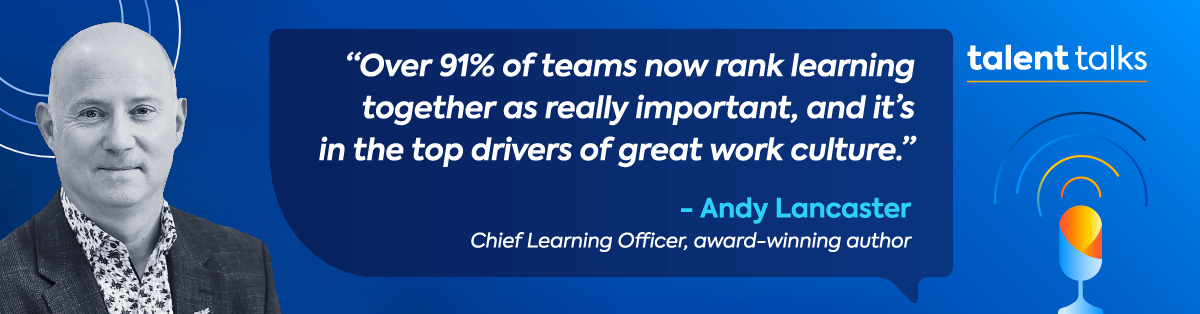
In a socialized and collaborative learning environment, employees can share their experiences, ask questions, and get feedback from their peers. It also helps build a sense of community within the organization, which can improve employee engagement and morale.
One way to create a socialized learning community is to use Andy Lancaster’s 7 Cs model.
This model identifies seven key elements that together create a recipe for success:
8. Build systems for knowledge management
Learning and innovation are great, but you also need a library. If someone solves a tough problem but doesn’t document it, the next person has to solve it all over again.
Make knowledge accessible and searchable.
How to build the infrastructure:
- The “Wiki” culture: Move away from emailing answers. If someone asks a question in chat, write the answer in a shared learning document (like Notion, Confluence, or Google Docs) and link it.
- Rule of thumb: If you have to answer the same question three times, write a guide for it.
- Searchability is king: Ensure your internal documents are tagged and searchable. If it takes more than 2 minutes to find a process document, people will just guess (and make mistakes).
- Use a Learning Management System (LMS): These can house courses about tough problems team members have already solved and provide the employees learning it with fun ways to learn, rather than reading heavy documents.
9. Invest in an LMS
While behavior and leadership are the soul of an organization’s learning culture, employee training software is the skeleton that holds it up. Without a centralized system, learning becomes scattered, unmeasured, and forgotten.
An AI LMS directly tackles the barriers of time, personalization, and accessibility that we discussed earlier.
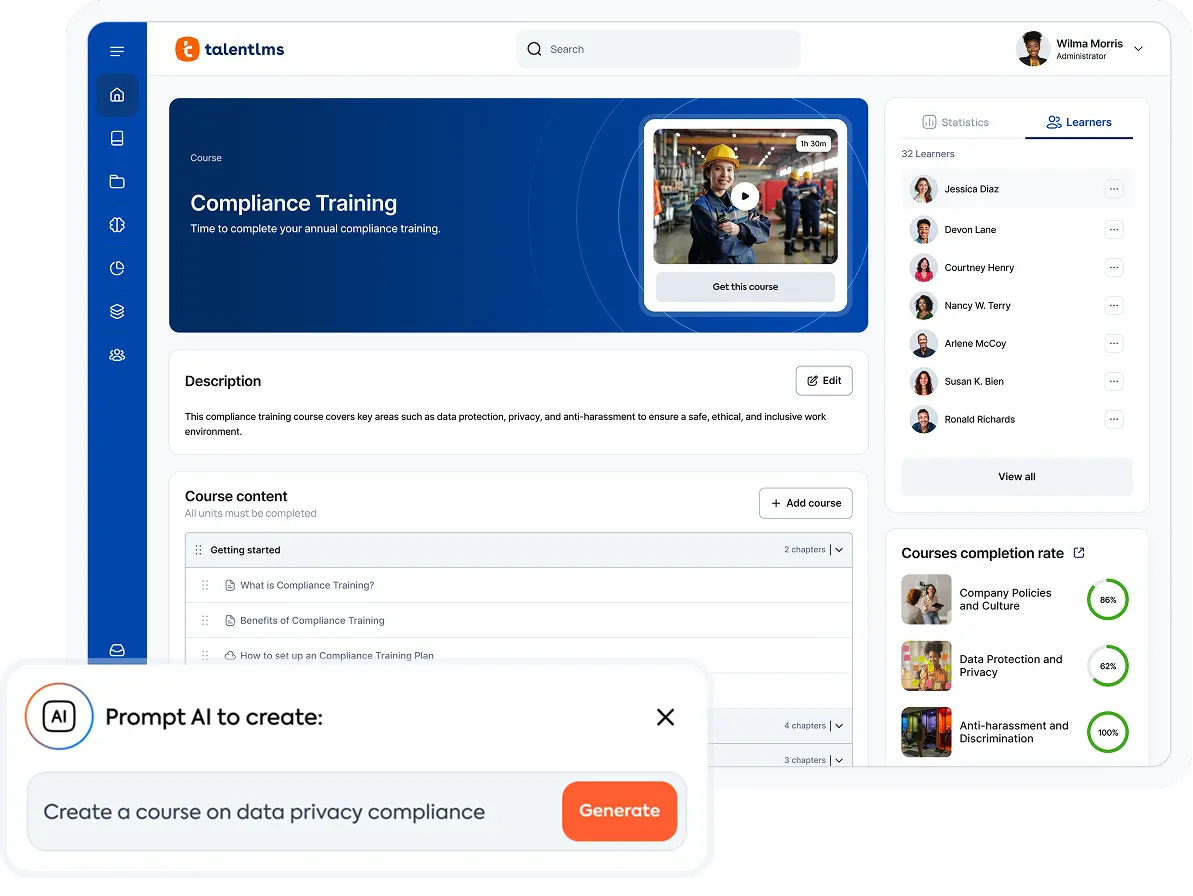
Here is how modern platforms use technology to supercharge culture:
AI-powered efficiency (solving the no-time problem):
- AI Course Creator: Subject matter experts can use AI to instantly turn their notes or documents into engaging courses, cutting administrative time drastically.
- AI Coach: An AI Coach can provide instant support and answer questions in the flow of work, so people don’t get stuck waiting for help.
- AI Skills: The system analyzes an employee’s role, identifies skills-based learning opportunities, and serves up the exact training they need to close those gaps.
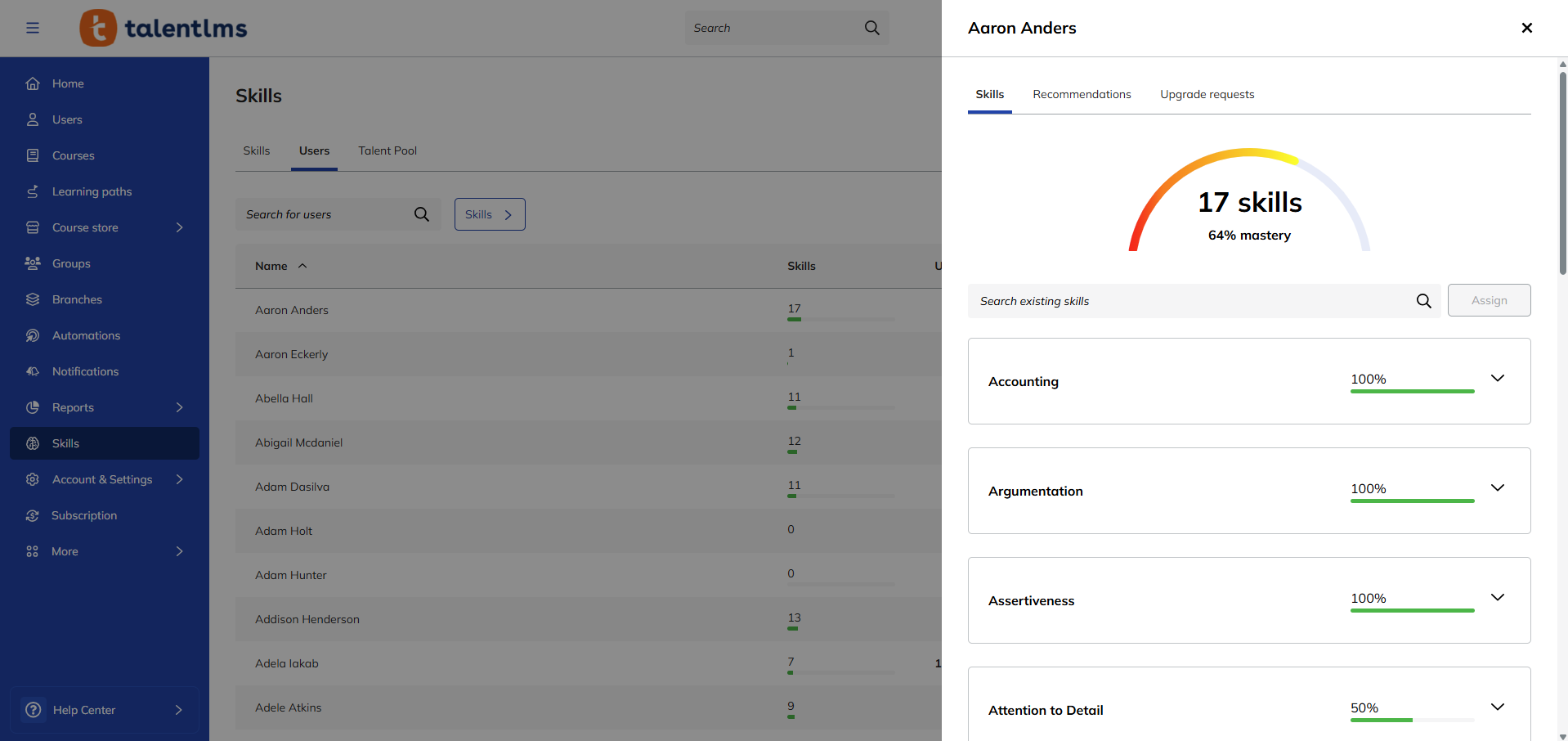
An LMS also solves the silo problem via Integrations. Instead of jumping between five different apps, modern LMSs integrate with your existing HRIS (Human Resources Information System) and content libraries like LinkedIn Learning. This creates a single ‘source of truth’ for all development, making learning seamless and part of the daily workflow.
10. Reward learning
Recognizing and rewarding learning achievements reinforces positive behaviors and shows that the organization is committed to employee development.
LMS gamification features like badges and points can be a fun and effective way to acknowledge learning milestones and encourage friendly competition.
But rewards don’t have to be limited to virtual trophies.
Consider giving tangible incentives like cash bonuses, extra days off, or opportunities for professional development.
These rewards not only show appreciation for employees’ efforts but also create a tangible link between learning and career advancement.
11. Hire for a learning culture
You can’t force someone to be curious if they aren’t. Therefore, the easiest way to build a learning culture is to hire agile learners.
When interviewing, stop obsessing over “Have you done this exact job before?” and start asking “How do you learn?”
Interview questions to test learnability:
- “Tell me about something you taught yourself in the last 6 months that wasn’t required for work.” (Look for passion and self-direction).
- “Tell me about a time you realized you were wrong about something significant. What changed your mind?” (Tests intellectual humility).
- “If I gave you a task in a software you’ve never used, how would you approach it?” (Tests their strategy for self-directed learning).
12: Sustain the culture
Finally, how do we keep this from fizzling out after 6 months?
You can:
- Measure return on learning: It’s hard to measure the ROI of a single book, but you can measure retention and innovation. The metric to monitor should look like this: “What % of our open roles are filled internally?” (Shows people are upskilling).
- Exit interviews: When people leave, ask, “Did you feel you grew professionally here?” If the answer is no, you have a culture leak.
- Regularly kill old, outdated training: Nothing kills the vibe faster than a mandatory video from 2012 that references old-fashioned software.
Real-life learning culture examples
We’ve covered the theory and the roadmap. Now let’s see how it looks in real life with a few examples of a learning culture.
Case study 1: ShopGoodwill.com—learning as shared ownership
ShopGoodwill.com is an eCommerce platform for Goodwill organizations. Their challenge? Keeping a dispersed workforce aligned.
Instead of a top-down approach where HR dictates everything, they democratized the process. They used decentralized content creation, letting subject matter experts within the team create training materials.
They implemented monthly updates, turning learning from a once-a-year seminar into a regular operational rhythm.
This is a perfect execution of social learning and autonomy. When they encourage employees create content, they signal that everyone is an instructor.
Case study 2: Position Green—learning that scales with growth
Position Green provides sustainability software. In a high-growth tech environment, if your people don’t grow, your product fails.
To succeed, they integrated learning directly into their mission success. By aligning everyone around what the company stands for, they ensured that every employee could articulate the company’s core mission and value proposition.
This approach means that as the company scales, the culture doesn’t blur. It creates a unified language across the organization.
Case study 3: The Resident—learning that drives engagement and performance
The Resident (a hotel group) faced the challenge of maintaining high service standards.
To solve this, they moved away from ad-hoc training to structured learning paths. This means a new hire can see exactly what they need to learn to get from Role A to Role B.
By tying these paths to measurable results, they transformed training from an isolated event into an embedded performance routine.
This validates rewarding learning. When employees see a clear path for progression and understand how it impacts their performance metrics, learning becomes tangible and rewarding rather than abstract.
From learning debt to learning engine
More courses don’t equal a learning culture. It requires you to weave curiosity into the daily grind. As the TalentLMS report warns, we are racing against learning debt. To win, we must stop viewing training as time away from work and start treating it as work.
Whether through psychological safety, leadership modeling, or AI support in the flow of work, the goal is to make growth inevitable.
Start small, celebrate the best mistakes, and remember the strongest learning organizations aren’t the ones that know the most. They’re the ones who learn the fastest.
Who is responsible for building a learning culture in your organization?
Building a learning culture is a shared responsibility between L&D, leadership, and employees.
How can managers and leaders demonstrate a learning culture?
Managers demonstrate a learning culture best by learning loudly and protecting their team’s development time. They must publicly admit when they don’t know an answer, share their own recent learning struggles, and vigorously defend learning blocks on the calendar against urgent but less important meetings.
What does a culture of learning look like?
A true culture of learning at work looks like an environment where questions challenge the status quo without fear, solutions are proactively shared through wikis or casual sessions, and mistakes are analyzed as data for improvement rather than reasons for criticism.
Originally published on: 12 Nov 2024 | Tags: Learning culture,OR Best practices,Strategies