New research:
Habit hugging: When old habits block new ways of working
New TalentLMS research reveals the rise of “habit hugging.” Its signs are hiding in plain sight: 42% of employees still use tools or processes their managers think have been replaced. Discover why legacy practices quietly survive and what it takes to break the grip.

Highlights
In the grip of habit
65% of employees agree that letting go of an old habit is harder than learning a new one.
The adoption illusion
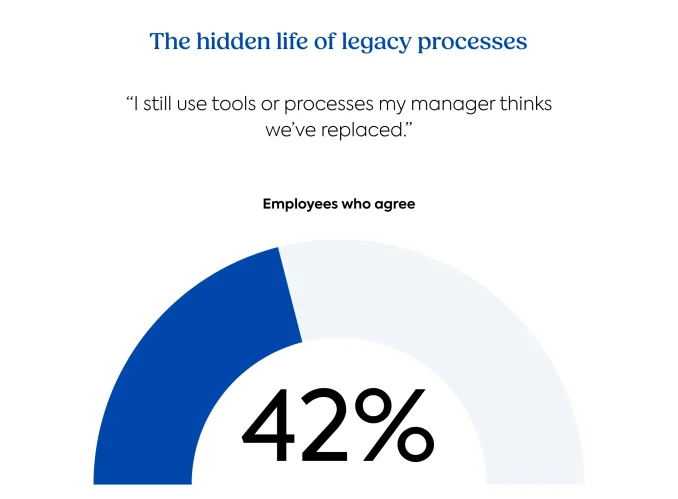
42% of employees agree that they still use tools or processes their manager thinks have been replaced.
Post-training fallout
Only 41% of employees consistently use the new way of working after they’ve been trained on it.
- Executive summary
- Are employees adopting new ways of working?
- New ways arrive, but old ways remain
- Replaced on paper, still used in practice
- Adoption isn’t a switch
- Why muscle memory beats new ways of working
- Meet “habit hugging”
- When learning the new is easier than letting go of the old
- Familiarity and speed beat change
- When expertise becomes a barrier to change
- When delivering results takes priority over new ways of working
- The blind spot between training and doing
- The reality of putting AI to work: Why trained employees hold back
- AI training doesn't guarantee AI adoption
- Trust and rework are the top barriers to consistent AI use
- Six strategies for lasting behavior change
- Conclusion
- Methodology
- Published
- Author
- Ana Casic
- Research team
- Ana Casic, Elena Koumparaki, Fiona McSweeney, Giota Gavala
- Expert contributor
- Carolina Caro
Executive summary
Companies are racing to tool up and put AI to use. But as new tech, practices, and expectations roll in, old ways of working are proving hard to shake.
Sixty-five percent of employees say letting go of an old habit is harder than learning a new one. And some of those old habits are hiding in plain sight: 42% of employees still use tools or processes their managers think have been replaced.
These are among the key findings from a new TalentLMS research report examining what it takes to leave old ways of working behind and adopt new ones.
Software can be updated overnight, but human muscle memory can’t. What’s more, employees aren’t starting with a blank slate. New tools and processes come on top of routines employees already know, trust, and rely on to get things done.
Technology moves at the speed of an update. Work moves at the speed of habit. That’s why learning the new is only half the challenge. The other half is unlearning the old.
But there’s a catch.
65% of employees say letting go of an old habit is harder than learning a new one.
Companies are unintentionally reinforcing the legacy practices they’re trying to change. Six in ten employees say results matter more than how the work gets done in their workplace. At the same time, 48% feel rushed to adopt new ways of working. The result is a mixed message: change how you work, but keep delivering and don’t slow down. Facing that squeeze, employees fall back on muscle memory.
This friction gives rise to what we call “habit hugging”: holding on to familiar ways of working as jobs keep changing, expectations rise, and AI rewrites how work gets done.
In the following pages, our research breaks down:
- What keeps yesterday’s ways of working alive
- How managers make or break adoption
- What companies miss once training ends
- How to move from learning to habit
Between the old and the new: Are employees adopting new ways of working?
Let’s start with the central question of our research: How does training translate into changes in the way employees work?
The findings show just how persistent old ways of working can be. And the challenge isn’t limited to what happens after training. According to Gartner, 36% of business leaders say their teams are more likely to hesitate and wait to see whether changes will stick before adopting them.
New ways arrive, but old ways remain
We asked employees what happens after they complete training on a new way of working. Their responses were telling.
Only 41% of employees consistently use the new way of working after they’ve been trained on it. More than half (52%) report following the new way but sometimes fall back on old habits. And 8% don’t adopt the new way at all, continuing to work as before.
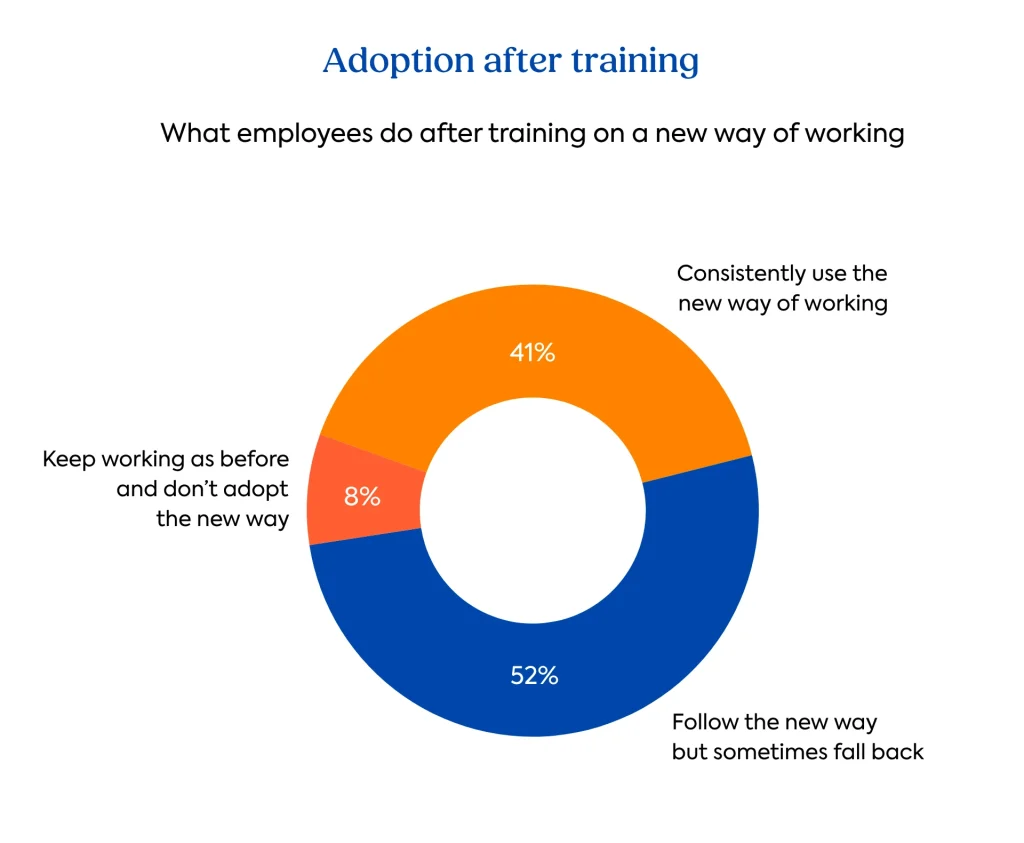
So, while training may introduce a new way of working, consistent adoption doesn’t always follow. For many employees, the old way remains part of how they work. Another finding reinforces this pattern: 73% of employees mix old and new ways of working to get the job done.
What this tells us: Adoption isn’t a clean shift from the old way to the new. Instead, the two coexist in day-to-day work.
Replaced on paper, still used in practice
There’s the official way of working. And then there’s how work actually gets done. Our research reveals a striking gap between the two: 42% of employees say they still use tools or processes their manager thinks have been replaced.
42% of employees agree that they still use tools or processes their manager thinks have been replaced.
Previous TalentLMS research points to a similar gap between managers’ perceptions and employees’ experiences. In the Skills Visibility Report, 90% of managers say they understand their team’s skills, while only 69% of employees agree. Our new findings reveal a related pattern, this time in how work gets done. A tool or process may be replaced on paper while employees continue using it in practice.
Adoption isn’t a switch
Even when employees adopt a new way of working, the transition takes time. Among employees who consistently use the new way after training, 64% say it takes one to three months to feel natural. Only 28% say it feels natural right away.
The shift doesn’t happen overnight, even for employees who stick with the new way of working. They may be using the new way regularly while still needing time for it to feel natural.
In addition, support doesn’t always translate into consistent adoption. 67% of employees say their company gives them the support they need to turn training into everyday practice. Yet only 41% consistently use a new way of working after training.
Across the research, one pattern is clear: Training on a new way of working doesn’t mean the old way disappears. Learning something new doesn’t automatically mean unlearning what came before.
The findings that follow take a closer look at what keeps pulling employees back.
The invisible pull: Why muscle memory beats new ways of working
Introducing new ways of working is one thing. Getting employees to use them consistently is another. In this section, we’ll examine what stands in the way of adoption.
Meet “habit hugging”
In addition to analyzing our own data, we combed through the latest workplace research and expert analysis. One pattern stood out. Under the weight of constant disruption and rising expectations, employees seemed to be holding tight to familiar ways of working. We called this phenomenon “habit hugging.”
Habit hugging: Holding on to familiar ways of working as jobs keep changing, expectations rise, and AI rewrites how work gets done.
Just as job hugging describes employees holding tightly to their jobs, habit hugging describes employees holding tightly to familiar ways of working. This tendency persists even after organizations introduce new tools, processes, or practices.
So what’s keeping old habits alive, even after employees learn new ways of working? The data point to a mix of workplace pressures, entrenched routines, and gaps in how companies support adoption.
When learning the new is easier than letting go of the old
Sixty-five percent of employees say letting go of an old habit is harder than learning a new one. That difficulty is reflected elsewhere in the data: an equal share (65%) say they sometimes default to old ways of working out of habit.
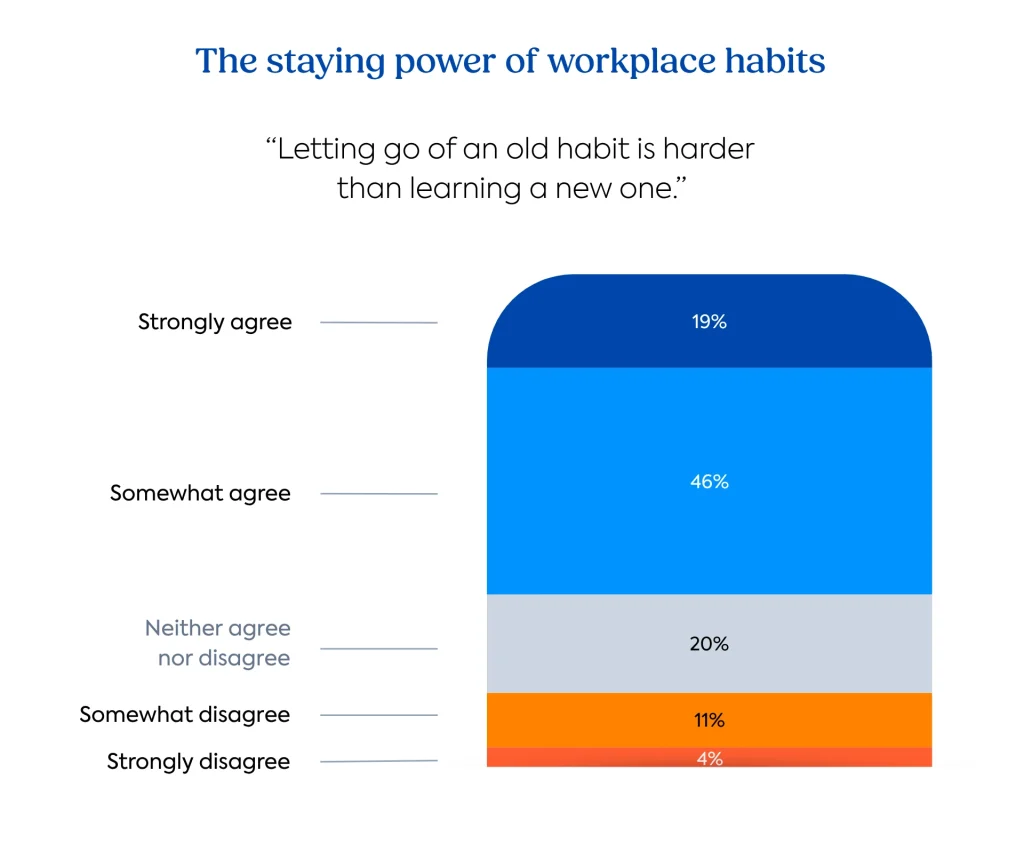
The findings reveal that the challenge isn’t just knowing what to do differently. It’s unlearning established ways of working to make room for new ones. Employees may have relied on these practices for years, and they can’t be replaced overnight.
The same difficulty emerges in another finding.
The biggest challenge when adopting a new way of working is changing old habits, according to 29% of employees. Other top challenges are learning the new tool or process (25%) and figuring out how to apply it to everyday work (23%).
Familiarity and speed beat change
To understand what pulls employees back to old ways of working, we looked specifically at those who continue to work as before or sometimes fall back after training.
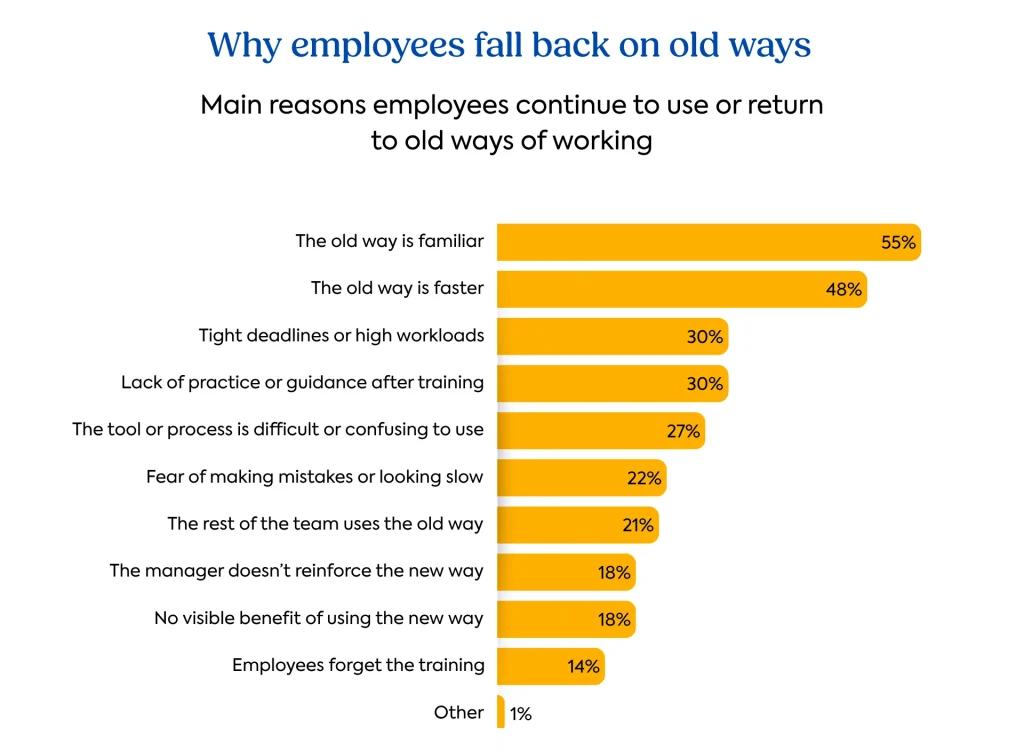
Among employees who continue to use or go back to the old way of working, the top reason is that the old way feels more familiar (55%). The second most common reason is speed, with nearly half (48%) saying the old way is faster.
These findings show some of the appeal of sticking with established habits: employees know the routine and, for many, it’s quicker. Other reasons for falling back on old ways of working include tight deadlines or high workloads (30%) and a lack of practice or guidance after training (30%).
Twenty-seven percent of employees say the new tool or process is difficult or confusing to use, while 22% fear making mistakes or looking slow. Twenty-one percent say their team still uses the old way. Meanwhile, 18% of employees say they don’t see the benefit of using the new way.
When expertise becomes a barrier to change
Beyond why employees fall back on old ways of working, we also looked at when they’re most likely to do so. The responses revealed the most common scenario: doing something employees have already mastered.
Thirty-seven percent of employees say they frequently or always fall back on old ways of working when doing something they already know how to do well.
37% of employees say they frequently or always fall back on old ways of working when doing something they already know how to do well.
But falling back isn’t limited to familiar tasks. It also happens in more demanding situations.
Around three in 10 employees say they frequently or always fall back when they’re under stress (29%) or when the new way requires more effort (29%). Twenty-seven percent do so during high-stakes or highly visible tasks, while 25% say the same when dealing with a complex task.
Gaps in use may play a role, too. Twenty-five percent of employees say they frequently or always fall back on old ways of working when they haven’t used the new way for a while.
When delivering results takes priority over new ways of working
Sixty percent of employees agree that at their company getting results matters more than using the new way of working. That puts the earlier finding on speed into sharper context: 48% of employees who continue to use or go back to old ways of working say they do so because the old way is faster.
When results take priority over how the work gets done, sticking with a new approach may become harder.
The blind spot between training and doing
After training, employees say their companies are more likely to track completion than actual use. Forty-one percent say their company checks whether training was completed, compared with 36% who say it checks whether employees are actually using what they learned. Only 34% say their company assesses whether employees understood the training.
More than half of employees (54%) say their company asks them for feedback on how the new way is working. But feedback offers a different signal from checking whether employees are actually putting what they learned into practice. Meanwhile, 10% say their company does none of the post-training follow-up activities we asked about.
These findings point to a training-to-adoption gap. Completion confirms that training happened. Looking at what happens afterward helps determine whether learning is making its way into the workday. When visibility stops at completion, a gap can open between what employees learn and what they actually do.
The reality of putting AI to work: Why trained employees hold back
AI is one of the most visible new tools being used in the workplace today. According to PwC’s Global Workforce Hopes and Fears Survey 2026, nearly two in three workers (64%) report using AI at work in the past 12 months. But as AI moves into everyday work, it faces a familiar challenge. Our findings show that learning to use a tool doesn’t necessarily mean employees will consistently use it.
AI training doesn’t guarantee AI adoption
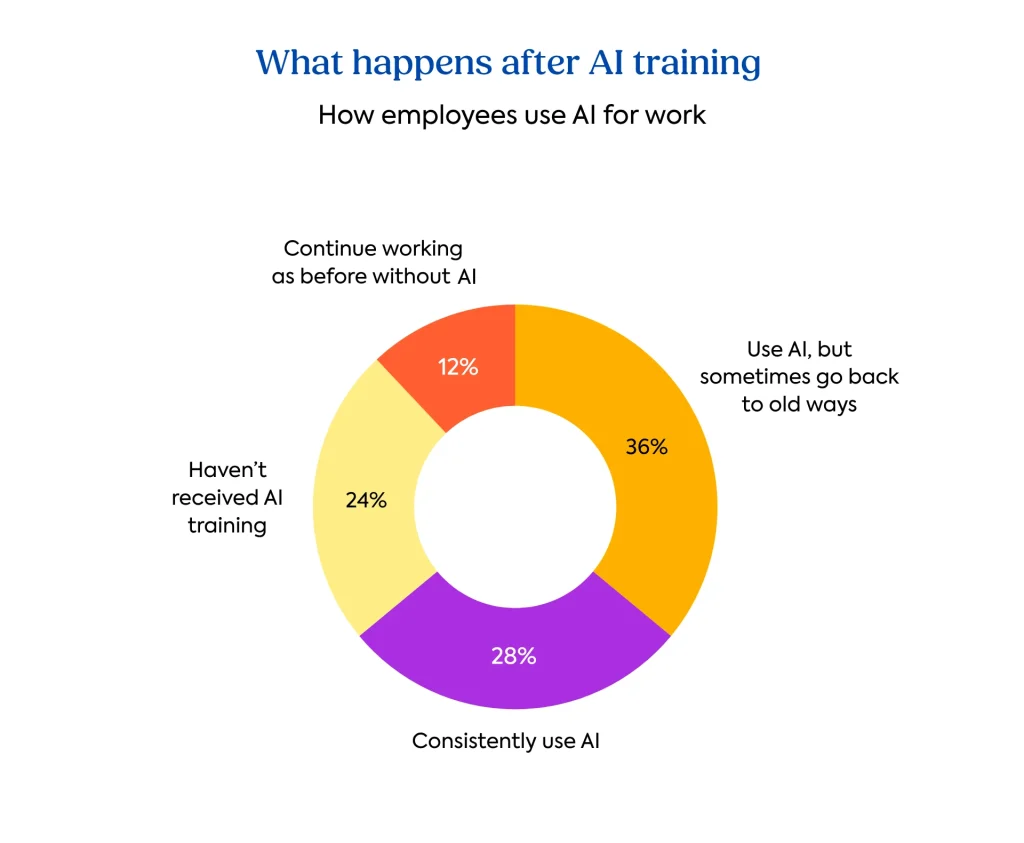
Nearly half of employees (48%) we surveyed have received AI training but don’t consistently use AI afterward: 12% continue working without it, while 36% use AI but sometimes go back to their old ways of working. Only 28% consistently use AI after training.
Meanwhile, one in four employees (24%) say they haven’t been trained to use AI for work tasks at all.
Trust and rework are the top barriers to consistent AI use
We asked employees who don’t consistently use AI after training what prevents them from using it regularly. The main reason is that they don’t trust AI for high-stakes tasks (32%). The second biggest barrier is that they spend too much time checking or reworking AI’s output (25%).
32% of employees who don’t use AI consistently say the main reason is they don’t trust it for high-stakes tasks.
Other barriers include being unsure when AI use is acceptable (15%) and forgetting to use it (15%). Together, these findings suggest that training employees to use AI doesn’t necessarily remove concerns about relying on it in practice.
From learning to habit: 6 strategies for lasting behavior change
Training is only one part of adopting a new way of working. What happens afterward matters, too. When the muscle memory of old habits pulls employees back to familiar ways of working, companies can take practical steps to make new behaviors easier to sustain.
Here are six strategies for doing that.
#1 Build new ways into the workflow and reinforce them through practice
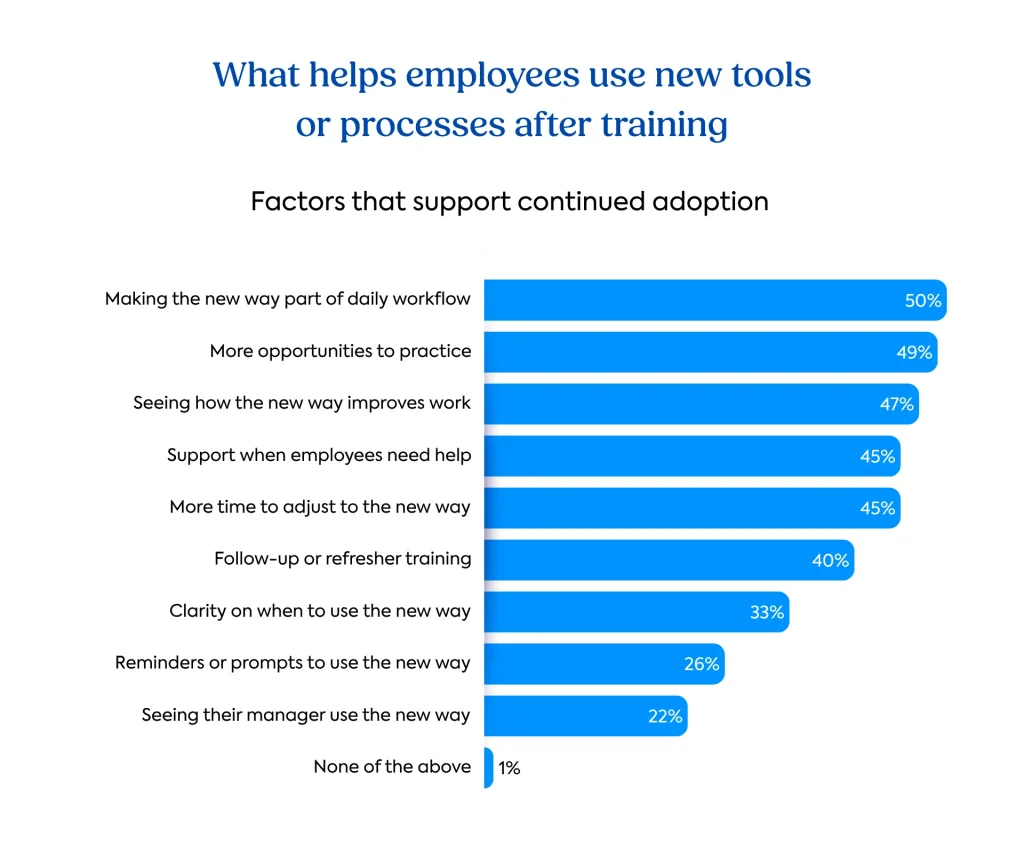
Employees say the biggest help in using a new tool or process more consistently after training is making it part of their everyday workflow (50%). More opportunities to practice rank second (49%), closely followed by seeing how the new way makes their work easier or better (47%).
The takeaway is clear: Make it routine. Let employees practice. Show them it works. Build new ways of working into the day-to-day workflow rather than leaving them in the training environment. Make the benefits of the new approach visible and give employees opportunities to build confidence.
TalentLMS’s Learning Playground, for example, gives employees a space to experiment and practice before applying new skills at work.
#2 Encourage employees to speak up about what isn’t working
Forty-five percent of employees have avoided questioning a new way of working that wasn’t working well because they didn’t want to seem resistant. Thirty-eight percent say they’ve hidden how uncomfortable they are with a new tool or process. And 39% of employees agree that they’ve stayed quiet about an outdated process because changing it would make their job harder.
38% of employees agree that they’ve hidden how uncomfortable they are with a new tool or process.
Yet the findings also show that companies are creating chances for employees to speak up. Forty-three percent of employees say their company supports them in adopting new ways of working by giving them opportunities to share feedback or raise issues.
When concerns go unspoken, companies may miss issues that get in the way of adoption. Providing opportunities to speak up is one part of the picture. But employees also need to feel comfortable speaking up and confident that doing so will make a difference.
Give employees clear ways to flag problems with new tools and processes. Make it clear that speaking up is encouraged, and show them what happens with their feedback.
#3 Move faster when employees ask for better tools or suggest new processes
The most common response to employees requesting a new tool or process is for their company to act, but slowly (40%). Only 25% of employees say their company acts quickly. Ten percent say their company doesn’t act at all, while 9% say the request gets held up by internal approvals.
Some employees may not speak up: 16% say they rarely or never raise the need for a new tool, process, or way of working.
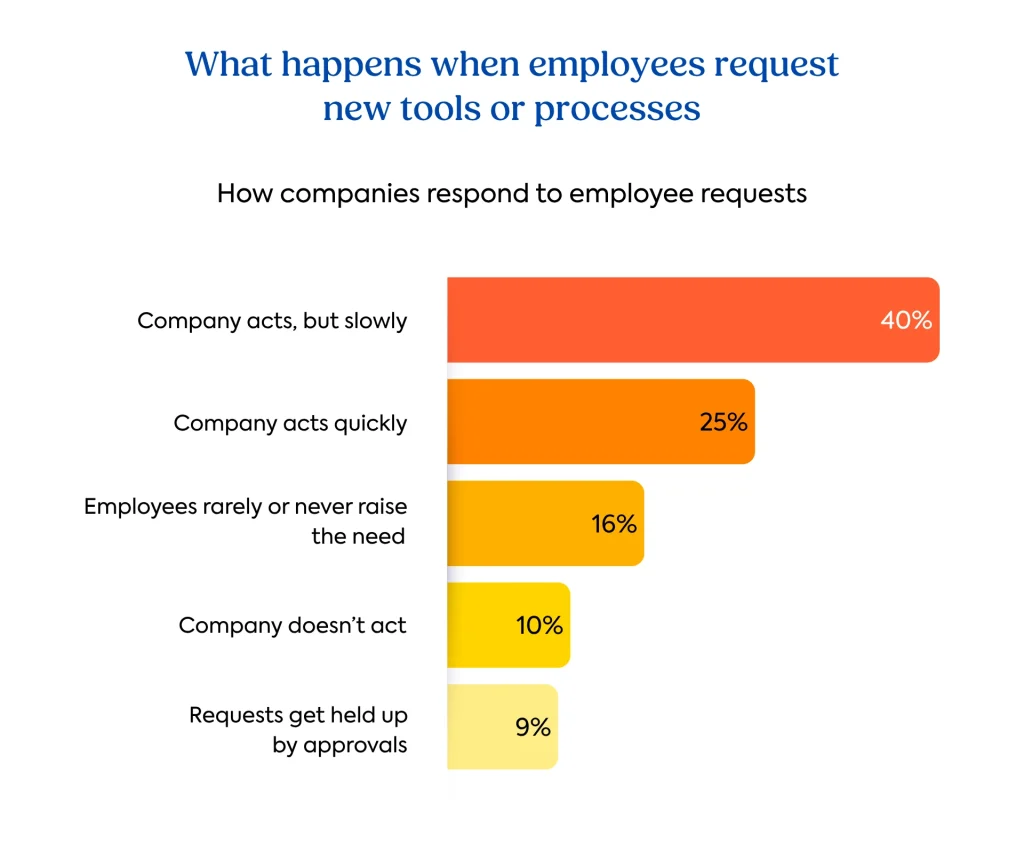
Slow or unanswered requests may discourage employees from making future suggestions. To avoid that, set a clear process and timeline for responding to employee input. Even if a new tool or process can’t be approved immediately, acknowledge the request, explain what happens next, and keep employees updated.
Where feasible, test promising ideas through small pilots before a wider rollout. Most importantly, close the loop. Even a quick, transparent “not now” is better than silence.
#4 Make room for the learning curve
Forty-eight percent of employees agree that they feel rushed to adopt new ways of working. But only 41% of employees say they’re given room to be less productive while learning a new way of working.
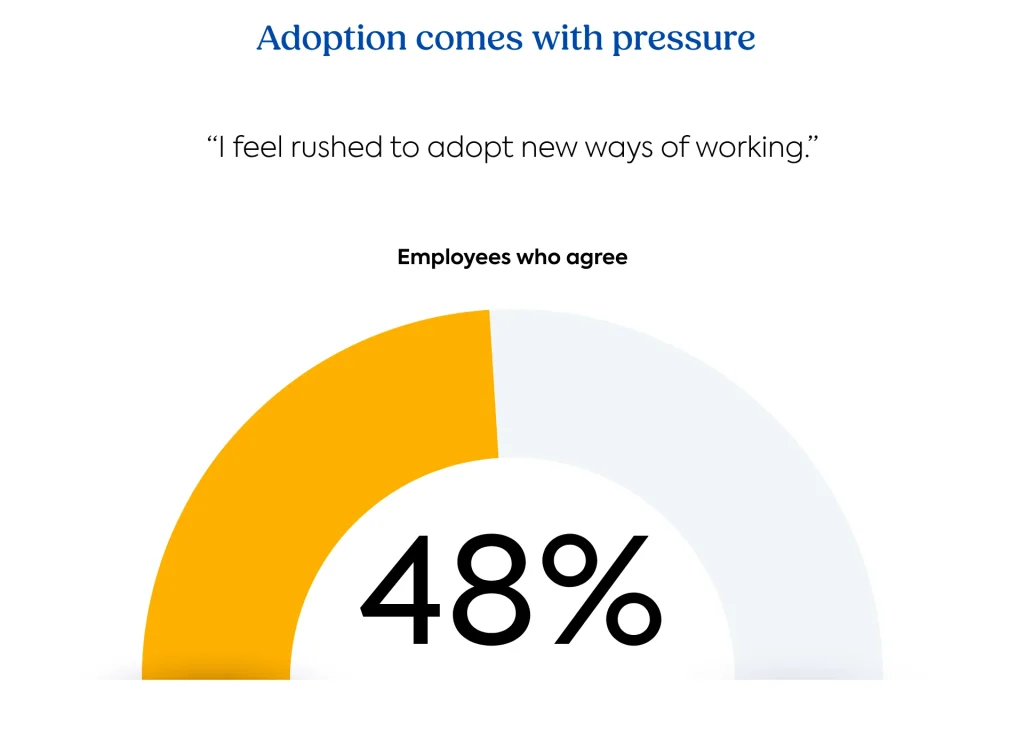
The picture isn’t entirely one-sided, though. Forty-nine percent of employees say their company gives them time to learn and adjust to help them adopt new ways of working. Nearly as many (46%) say their company provides support or guidance when needed.
Taken together, these findings suggest that providing support doesn’t necessarily remove the pressure employees feel while adapting. Giving employees time to learn and adjust is one part of the equation. They may also need breathing room as they put new ways of working into practice, including some flexibility around their pace of work.
To make room for that, build the learning curve into your rollout plan. Temporarily adjust productivity expectations, workloads, or deadlines while employees get used to a new tool or process. Track progress during this period and give employees time to practice without expecting immediate results.
#5 Check whether new tools and processes are being used
Twenty-nine percent of employees agree that their company is investing in tools they’ve quietly stopped using. Forty-two percent of employees say they still use tools or processes their manager thinks they’ve replaced.
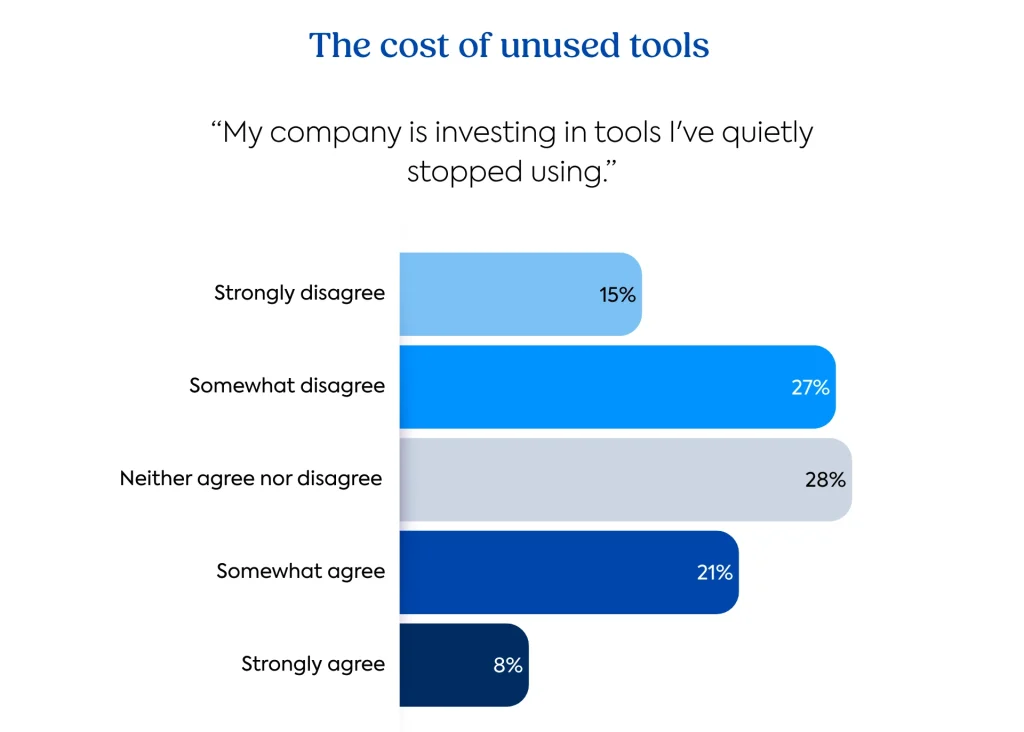
These findings point to a potential blind spot. The tools and processes managers think employees are using may not always match how work actually gets done.
Check adoption after rollout instead of assuming a new tool or process is being used. Ask employees what tools and processes they’re still relying on and why. Use those insights to address adoption barriers before investing in the next solution. And make these checks an ongoing practice rather than a one-off exercise.
#6 Train managers to model new ways of working
Sixty-eight percent of employees say their manager uses the new ways of working they expect employees to use. But 13% say their manager doesn’t.
Consistent use of new ways of working is more than twice as common among employees whose managers use them too: 49% vs. 22%.
“When people return to old ways of working, I call this Identity Inertia: the pull toward what is familiar, even when we’ve learned something new. One practical way managers can interrupt it is to model the new behavior themselves and make their own moments of reversion visible. They can ask themselves, “When did I use the new behavior, and where did I revert to the old way?” That way, they pay attention not only to what they did, but to the beliefs, embodied reactions, and narratives that continue to perpetuate the default behavior. When we learn what’s getting in the way, we can unlearn what no longer serves us, create space for what’s next, and open up different possibilities and outcomes.“

That 27-percentage-point difference signals a clear link between managers modeling new ways of working and employees consistently using them.
Make managers active participants in the change. Train them on new tools and processes first, expect them to use the same workflows as their teams, and encourage them to share their own learning curve. What managers model should match what they ask employees to do.
Conclusion
Rollout comes with a date, a budget and a plan. Adoption, it appears, comes with a hope. And hope is not a strategy. That’s the imbalance this research brings to light.
Summing up, here are four key takeaways:
- The rise of habit hugging: Employees bring years of familiar routines to every new tool or process. Those routines don’t disappear just because a better way has been introduced. Especially when the workplace rewards speed over change.
- The hidden cost of failed adoption is lost technology ROI: Companies invest in new technologies expecting better productivity, efficiency, and ways of working. But those depend on employees actually changing how they work. When old ways persist under the radar, as our research shows they do, the investment doesn’t pay off. No adoption, no ROI.
- AI is where habit hugging gets costly: Companies are betting big money on AI productivity gains. But when employees don’t trust AI with work that matters, or spend too much time reworking its output, the productivity promise remains just that: a promise.
- Adoption spreads with leaders walking the talk: Breaking old habits can’t be left to employees alone. Leaders need to change their own routines too. As this research uncovered, adoption is more than twice as high when managers lead by example.
New tools will keep arriving, and AI will keep raising expectations. What decides whether they pay off is what happens after the rollout. Companies that plan for adoption as carefully as they plan for launch, with time to practice, managers who lead by example and a check on what is actually in use, will turn training into new habits.
Machines learn by adding. People can’t keep adding without letting go.
The next leap in learning may begin with unlearning.
Methodology
The findings in this report are based on a survey of 1,500 full-time employees across industries in the United States. All respondents had received training on a new tool or technology, a new process or way of working, or both within the previous 12 months. The survey was conducted online in September 2026, and respondents were between the ages of 25 and 64. The sample consisted of 49.6% men and 50.4% women.
Percentages may not total 100% due to rounding.
The term “habit hugging” was coined by the TalentLMS research team.
Dive deeper into original research by TalentLMS



Bring out the best in your teams.
Get started with the most versatile and affordable employee training platform, no credit card needed.