New research:
Speed-to-skill: The race against skill decay
New TalentLMS research unpacks speed-to-skill as the race most organizations don’t know they’re losing. Find out where workforce readiness breaks down and walk away with a roadmap for building skills at the speed of work.

Highlights
Skills age fast
- 47% of respondents say that some of their job skills have become outdated within the last five years.
One step behind
- 38% of managers agree that it’s difficult to predict which skills their team will need in the next year.
The practice gap
- 70% of respondents agree that employees need faster ways to practice skills as job demands are changing.
- Executive summary
- Companies aren’t building skills fast enough
- Future skill needs are getting harder to predict
- Employees need faster ways to practice new skills
- Barriers to efficient skill-building
- How employees actually build skills
- Improving speed-to-skill: 6 strategies
- Conclusion
- About this research
Executive summary
Work is moving faster than the skills needed to do it. Roles are shifting in real time. AI is rewriting task lists. But skill-building hasn’t caught up.
The new TalentLMS Speed-to-Skill Report reveals a gap between how quickly work evolves and how quickly organizations build capability. Seven in ten respondents say employees need faster ways to practice skills as job demands change. Nearly half of respondents say some of their job skills have become outdated within the last five years.
These findings build on the TalentLMS Skills Visibility Report, published in April 2026, which showed that many organizations struggle to clearly understand the skills they have.
Turning hidden skills into visible, measurable capability is critical. But skills visibility is only the first step. Knowing which skills matter doesn’t equal building or applying them fast enough.
The next step is known as speed-to-skill.
Speed-to-skill is how fast a company can spot a new needed skill, build it, and put it to use.
Speed-to-skill is critical because it’s the difference between identifying a gap and actually closing it while it still matters.
This new report explores how employees and managers experience speed-to-skill across the workforce. It shows how progress slows when managers struggle to predict future skill needs and employees lack opportunities to practice skills quickly enough. It also reveals what happens when learning becomes disconnected from daily work and training lags behind changing job demands.
Throughout the report:
- ‘Employees’ refers to individual contributors (non-managers)
- ‘Managers’ refers to people managing at least one employee
- ‘Respondents’ refers to both groups
Companies aren’t building skills fast enough
The workforce is running on skills that don’t last, and nearly half of them are already feeling the shift.
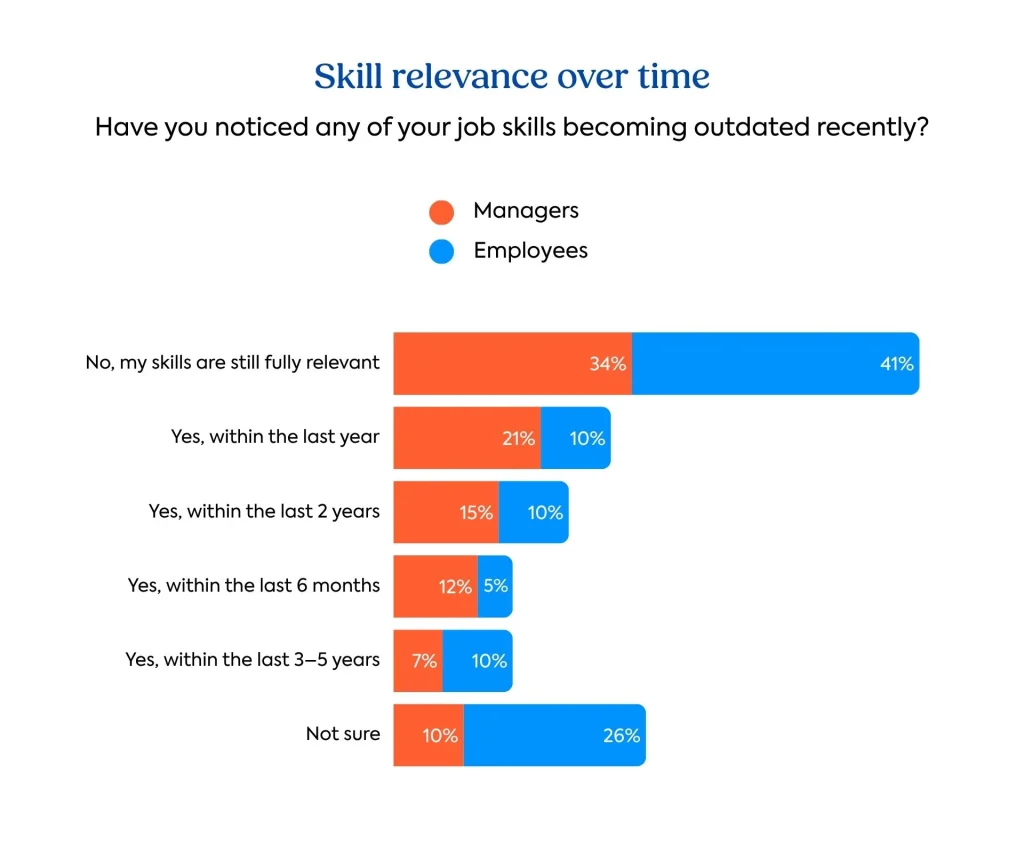
47% of respondents say some of their job skills have become outdated within the last five years.
Skills are becoming outdated within the workforce
Forty-seven percent of respondents say some of their job skills have become outdated within the last five years.
At the same time, 36% of respondents say their skills are still fully relevant, while 16% aren’t sure. Together, these responses tell a clear story. As skill needs continue shifting, workforce capability becomes harder to track and easier to misjudge.
The pace of change isn’t experienced equally across the organization. Managers are more likely to notice skills becoming outdated. They also notice it sooner.
- Twenty-one percent of managers say their skills became outdated within the last year, compared to 10% of employees.
- Twelve percent of managers say this happened within the last six months, versus just 5% of employees.
Employees, meanwhile, are more likely to feel uncertain about where their skills stand. More than one-quarter (26%) of employees say they’re not sure whether their skills are still relevant, compared to 10% of managers.
That skills visibility gap matters. Managers are seeing skill shifts happen in real time, while many employees are left guessing.
Future skill needs are getting harder to predict
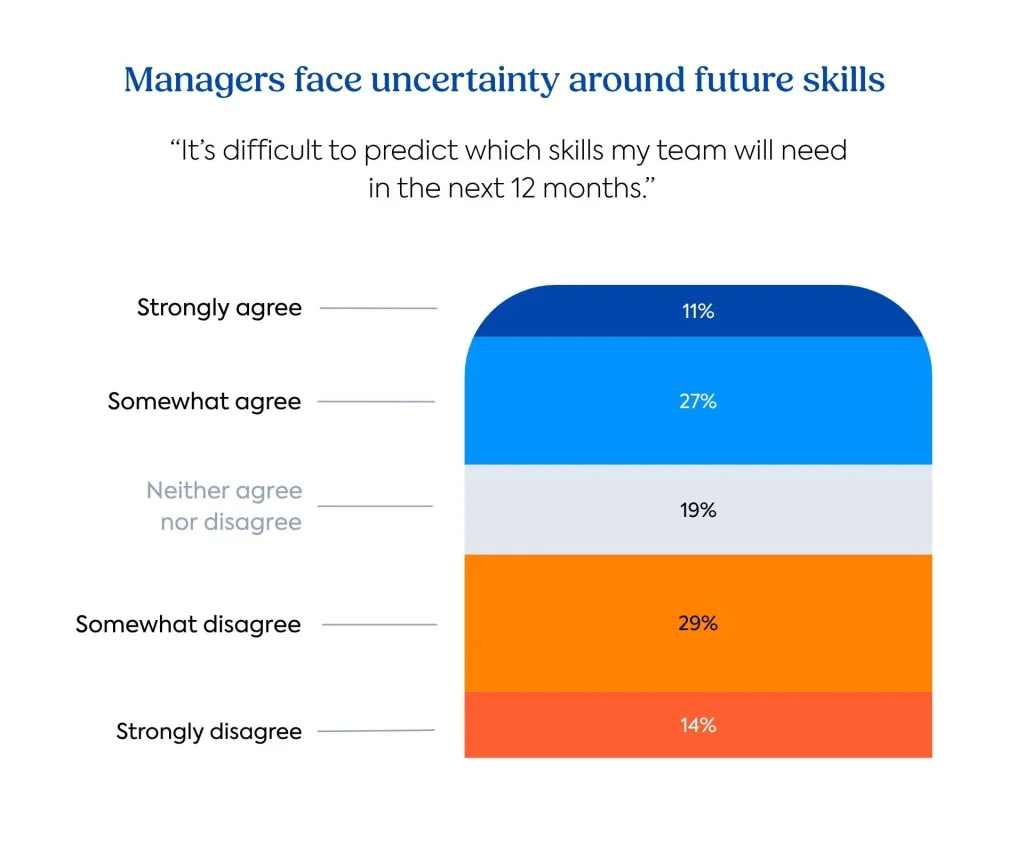
Building skills is one challenge. Knowing which skills to build next is another. Thirty-eight percent of managers say it’s difficult to predict which skills their team will need in the next 12 months.
That uncertainty reflects a broader shift in how work evolves today: less in steady steps, more in sudden turns. As skill needs shift faster, long-term workforce planning becomes harder for managers to stabilize.
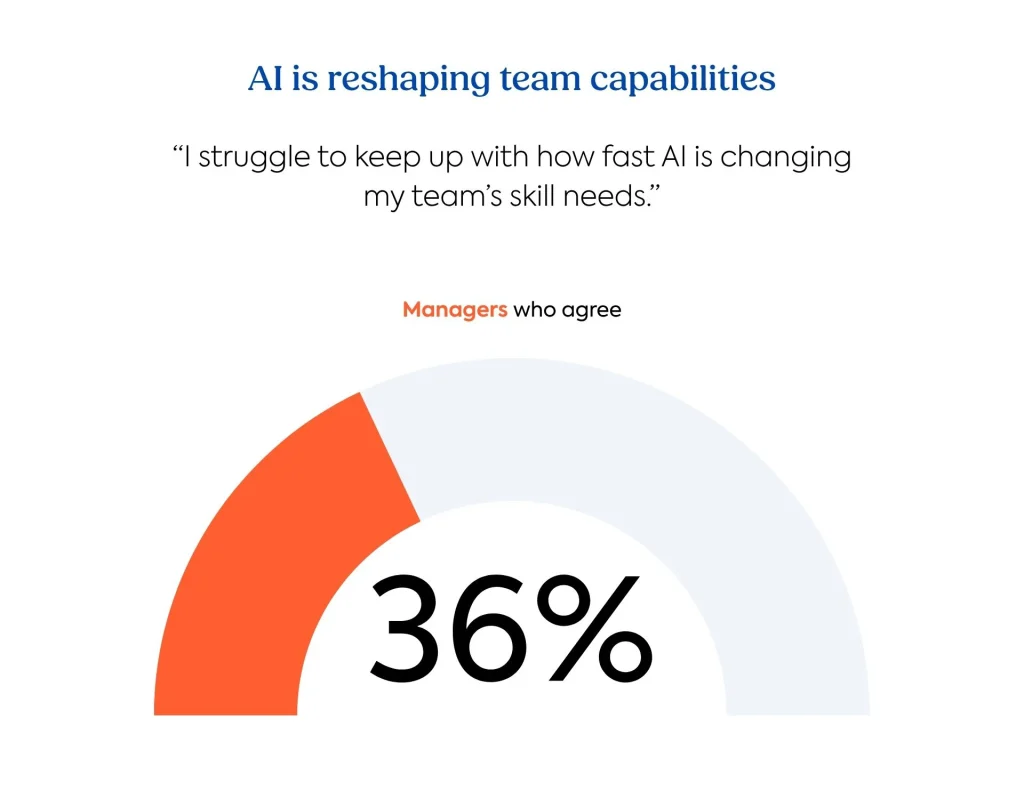
AI is a major force behind that instability. More than one-third of managers (36%) say they struggle to keep up with how quickly AI is changing their team’s skill needs.
“The challenge with predicting future skills is that the pace of change has outgrown the traditional planning cycle. Managers are being asked to prepare their teams for work that may shift dramatically before the next development plan is even finalized. That doesn’t mean skill-building should become reactive. It means organizations need to build more adaptive learning systems that align with where skills conversations are ongoing, are more connected to the flow of work, and are informed by what the business and its people are actually trying to accomplish.”

That pressure is already visible across organizations. Currently, 82% of enterprise leaders say their organization provides some form of AI training, yet 59% report an AI skills gap. Analysts also predict that by the end of 2026, more than 90% of global organizations will experience skills shortages.
In this environment, skills planning starts to look less like a roadmap and more like a moving target. Teams aren’t just closing gaps; they’re chasing them.
Employees need faster ways to practice new skills
Even when organizations identify the right skills, turning learning into real capability at speed becomes a different challenge.
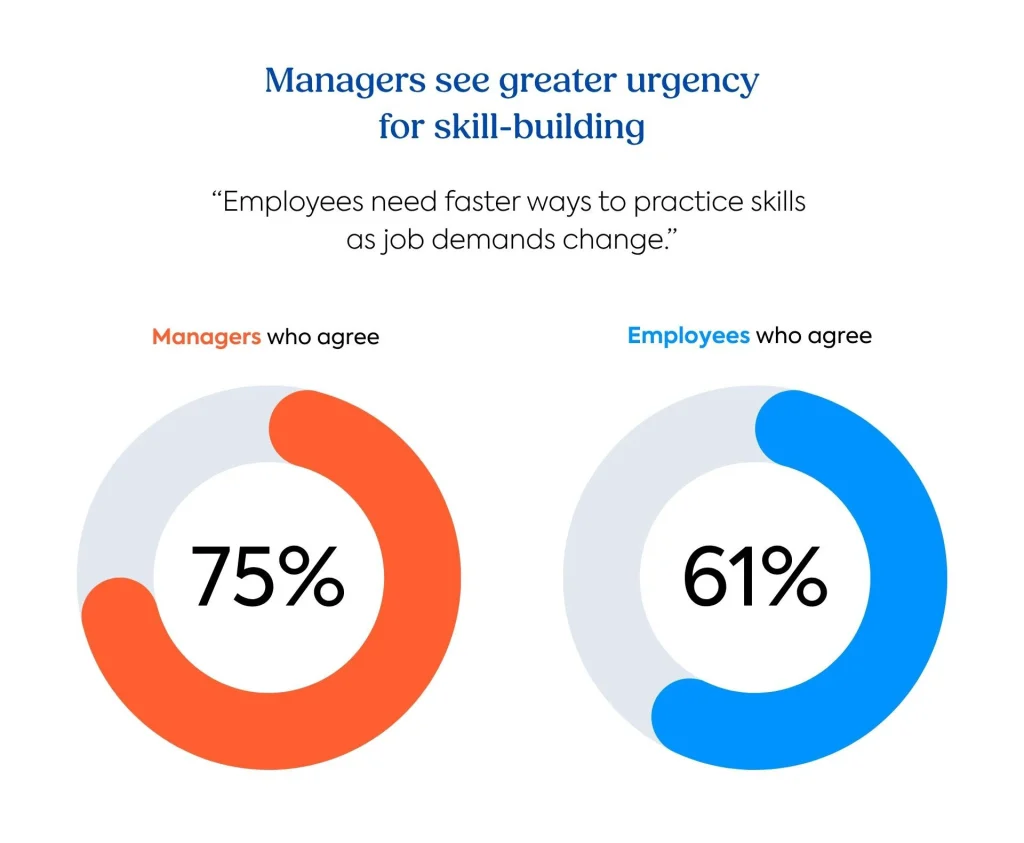
Our data shows that responsive skill-building is the exception, not the norm. Seventy percent of respondents say employees need faster ways to practice skills as job demands change.
Managers feel this pressure even more strongly. Seventy-five percent of managers agree that employees need faster ways to practice skills as job demands change, compared to 61% of employees.
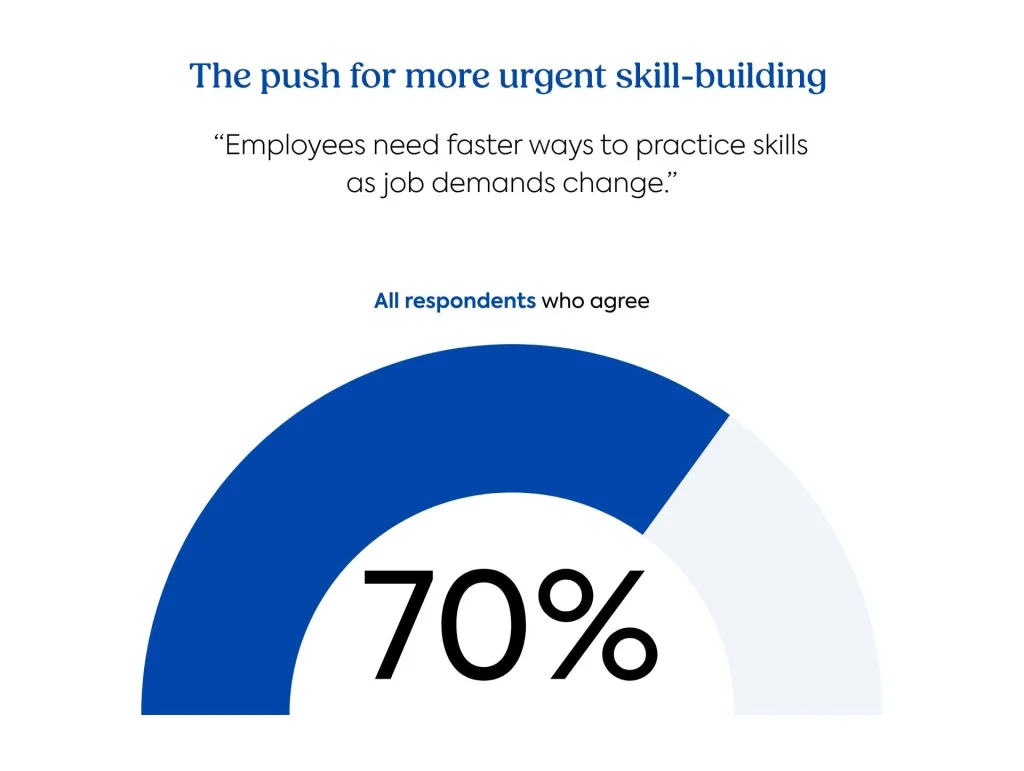
This variation may reflect how closely managers work to performance outcomes. They see where skill-building stalls. Not in training, but in the transition from learning to doing.
This is where many organizations slow down. Training exists. Content is available. But the path from learning to real-world use is often unclear, delayed, or inconsistent.
And that delay comes at a cost. As skill needs continue to shift, the value of newly learned skills starts to decay before they’re fully applied.
What does that mean for companies?
Skills are changing faster than organizations can respond. Future needs are harder to predict. And even when the right skills are identified, many employees still lack fast ways to practice and apply them. In other words, the challenge is no longer identifying skill gaps alone. It’s closing them before they shift again.
But speed-to-skill doesn’t break down at the point of learning alone.
Barriers to efficient skill-building
Fast skill-building is the exception, not the norm. Only 16% of respondents say skill-building happens quickly whenever new needs arise in their company. Everyone else points to friction.
Only 16% of respondents say skill-building happens quickly whenever new needs arise in their company.
There are several bottlenecks. Skill-building doesn’t fail in a single place. It slows down across the system. In how work is structured, how training is designed, and who owns the outcome.
Work priorities sideline learning
On-the-job pressures are one of the biggest barriers to responsive skill-building.
Forty-four percent of respondents say work priorities are pushing learning aside. Managers and employees are closely aligned on this. This suggests a shared reality across the organization: when work piles up, learning is the first thing to drop.
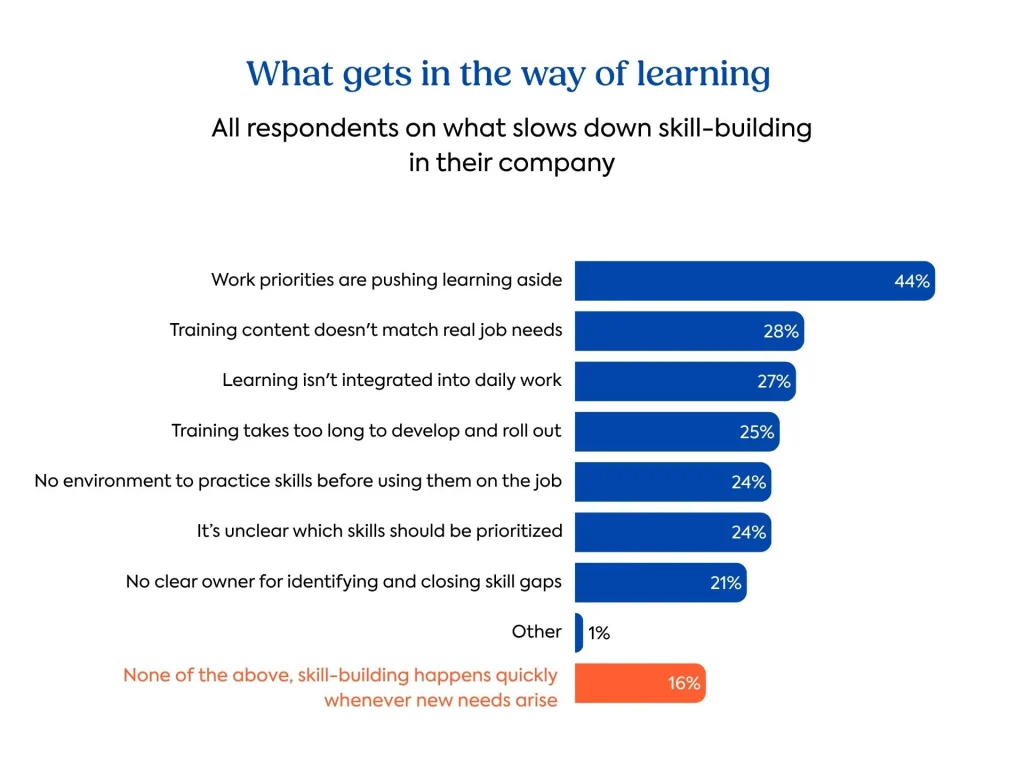
But the issue goes deeper than competing priorities. Twenty-seven percent of respondents say learning isn’t integrated into daily work.
Together, these findings point to a structural disconnect. Employees are expected to build new skills, but the workday isn’t designed to support them. Learning sits outside the flow of work. It’s something to fit in, rather than something built in.
“When work priorities push learning aside, it is usually a sign that learning is still being treated as something separate from work. Skill-building cannot depend solely on people finding extra time in already full schedules. The opportunity for L&D is to make learning easier to access in the moments people need support, while also helping leaders see development as part of getting the work done, not a competing priority.”
Training doesn’t match skill needs
Even when time is carved out, training itself often misses the mark.
Twenty-eight percent of respondents say training content doesn’t match real job needs, making it the second most common barrier to skill-building. A quarter (25%) say training takes too long to develop and roll out. While 24% of respondents say it’s unclear which skills should be prioritized.
28% of respondents say training content doesn’t match real job needs.
This creates a compounding effect. By the time training is ready, the need may have already shifted. And when priorities aren’t clear to begin with, training risks solving the wrong problem.
In that environment, slow or misaligned training becomes irrelevant.
Skill practice isn’t keeping up with changing job demands
There’s another point where skill-building breaks. And this is practice.
Nearly one in four respondents (24%) say the lack of a safe environment to practice skills before using them on the job slows progress down. That matters because learning alone isn’t enough. Skills only take hold when they’re applied.
Without space to test and refine new skills, employees are pushed straight from theory to performance. The result is hesitation, inconsistency, or avoidance, especially when the stakes are high.
This connects directly to what we saw in the first chapter. Employees only having access to learning doesn’t do the trick. They need faster ways to practice and apply skills while they’re still relevant and the space to try out these skills.
Responsibility for skill-building is unclear
Twenty-one percent of respondents say there’s no clear owner for identifying and closing skill gaps in their company. In those environments, upskilling becomes a shared responsibility in theory. But in practice, it falls through the cracks.
Only 16% of respondents say skill-building happens quickly whenever new needs arise in their company.
When ownership is unclear, action is slow. Skills are identified, but not prioritized. Training exists but isn’t followed through. And progress depends more on individual initiative than on structured support.
How employees actually build skills
When skills expire fast, employees can’t afford to wait for a structured path.
Research from the TalentLMS Speed-to-Skill Report suggests many employees are already adapting their learning habits in response. They learn in the moment through work, through others, and through whatever tools are available. Skill-building becomes flexible, multi-channel, and shaped by immediate need rather than formal design.
In practice, that means most learning happens outside traditional training and follows the rhythm of work itself.
Learning by doing is the new default
Hands-on experience is the most common way employees build new skills.
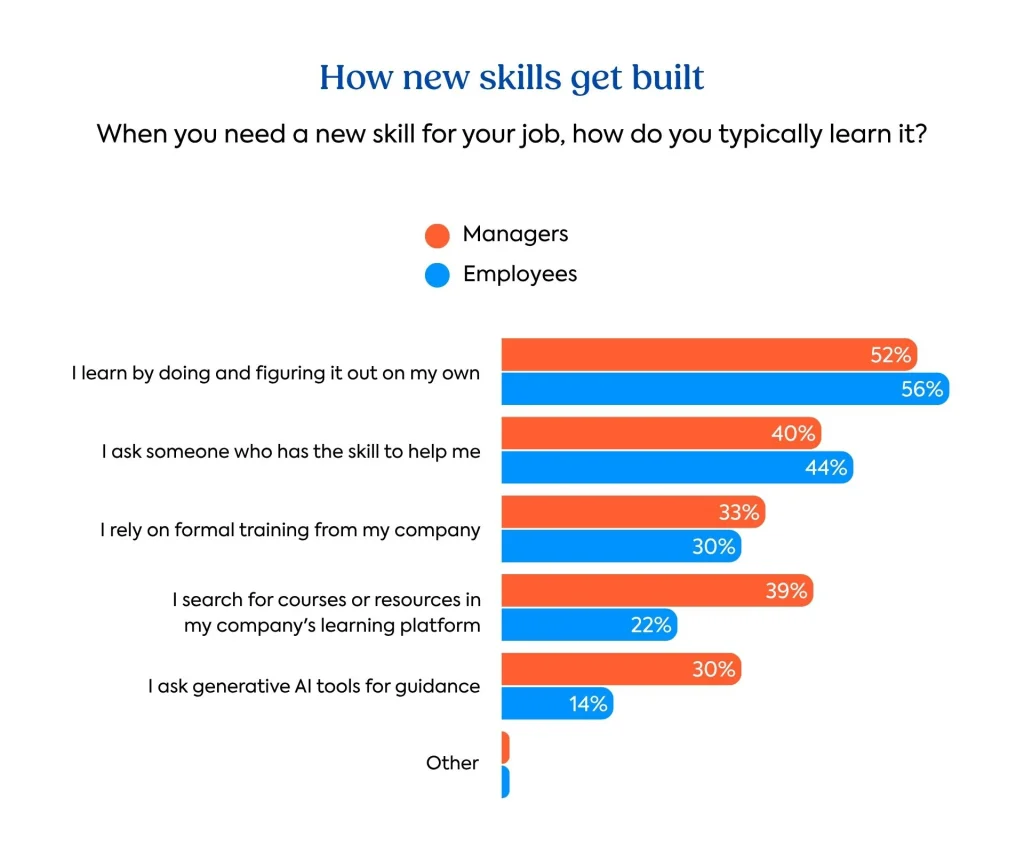
Over half (53%) of all respondents say they learn new skills by doing and by figuring them out on their own.
This approach is a practical reaction to a fast-changing environment. It allows employees to test skills, adjust their approach, and improve performance as they work. It also means they can respond quickly when new demands appear, without waiting for structured training to catch up.
It also ties learning directly to real outcomes. Skills are built in context, shaped by actual tasks, and reinforced through use.
Company learning platforms and formal training still play a key role
Structured learning channels still have an important role in skill-building.
One-third (33%) of all respondents use their company’s learning platform to search for courses or resources. Thirty-two percent (32%) of all respondents rely on formal employee training when building new skills.
These channels provide consistency, direction, and a foundation for developing skills in a more structured way. They also offer something other methods don’t. A way to scale learning across the organization and align it with broader business goals.
As skill needs become more complex, these structured approaches help ensure that development is not only fast but also focused.
47% of respondents say some of their job skills have become outdated within the last five years.
Peer learning fills the gaps formal learning leaves behind
Peers play a central role in fast skill-building across organizations.
Forty-two percent of all respondents say they ask someone who already has the skill to help them learn it. In practice, this creates informal learning networks where knowledge moves through teams in real time.
This kind of peer-to-peer support is immediate and practical. It allows employees to solve problems quickly, learn from experience, and apply new skills with more confidence and less risk.
Managers and employees build skills differently
While learning by doing is the top approach for both groups, managers are more likely to combine it with structured and supported learning methods.
- Thirty-nine percent of managers use their company’s learning platform, compared to 22% of employees.
- Thirty-three percent of managers rely on formal training, versus 30% of employees.
- Thirty percent of managers turn to generative AI tools for guidance, compared to 14% of employees.
Different responsibilities and day-to-day pressures shape how employees and managers build skills and where they turn for support. Managers, in particular, may engage more with learning resources and newer tools like AI because their roles often require them to stay ahead of changing skill needs.
Additional analysis: Gender differences in speed-to-skill
While the overall patterns are consistent across genders, the data reveals some notable differences in how men and women experience and approach skill-building.
Women are more likely to feel uncertain about the relevance of their current skills. Eighteen percent of women say they are not sure whether any of their job skills have become outdated, compared with 14% of men. This gap suggests that skills visibility isn’t experienced equally across the workforce.
Those differences carry through to how employees build new skills. Women are more likely to rely on peer support: 45% say they learn new skills by asking someone who already has the skill to help them, compared with 39% of men.
Men, meanwhile, are more likely to turn to generative AI tools for guidance. Twenty-nine percent of men ask generative AI tools for guidance when learning a new job-related skill, compared with 19% of women.
Also, men are more likely to hold managerial roles, which may shape how they view changing skill needs. Nearly three-quarters of male respondents (73%) manage at least one employee, compared with 54% of female respondents.
Together, these findings suggest that employees are not only building skills through different channels but may also require different types of support to build confidence and adapt to changing skill demands.
Improving speed-to-skill: 6 strategies
Improving speed-to-skill means reducing the distance between identifying a skill need and applying that skill in practice.
The findings suggest many companies already have elements of the process in place.
Learning exists but isn’t always connected to real work. Practice is expected but not always supported. And ownership is often unclear. The challenge is connecting them in ways that move skills from identification to application more effectively.
To do this, faster-moving companies tend to focus on several key areas.
#1 Make skill-building part of the work
When learning moves with work, speed follows. Employees are already building skills through their day-to-day tasks. The opportunity is to make that process more intentional by embedding development into their workflows.
Learning paths and flexible training features help companies connect skills directly to roles and responsibilities so development happens in context. Other strategies used by leading teams include:
- Turning daily tasks into guided learning moments
- Building feedback and iteration into day-to-day execution
- Providing real-time coaching and support
- Aligning skill development with actual responsibilities
#2 Build more responsive skill planning
One of the biggest delays in skill-building happens before learning even starts. Speed-to-skill improves when companies stop relying on static planning and continuously respond to skill needs as work evolves.
Making skills visibility actionable means:
- Capturing real-time input from managers on emerging needs
- Reassessing which skills matter most right now
- Adjusting learning priorities as business demands change
#3 Shorten the path from learning to practice
This is where speed-to-skill most often slows down. Learning happens, but application lags. Skills sit in the space between understanding and real-world use.
The missing piece is practice. The faster employees can test and apply new skills, the faster those skills become usable. Companies can support this through:
- Simulations and scenario-based learning
- Hands-on exercises tied to real tasks
- Interactive video
- An AI-powered Learning Playground where employees can try, fail, and improve in a safe environment.
#4 Make training more dynamic
Traditional training cycles are often too slow and rigid for a fast-moving environment. By the time content is developed, reviewed, and rolled out, the need has already evolved.
Speed-to-skill requires training that adapts as quickly as work does. For example:
- Modular content that can be updated quickly
- Relevance over completeness
- Alignment with current tools, tasks, and workflows
#5 Give clear ownership for speed-to-skill
Skill-building stalls when responsibility is unclear. When no one owns the process end-to-end, progress fragments.
Organizations that move faster treat speed-to-skill as a shared system with clear roles:
- Managers define needs and track team capability
- L&D provides structure, tools, and guidance
- Employees actively build and apply skills
#6 Measure skill application
Most organizations are still measuring training activity. For example, courses completed, hours spent, modules finished.
But speed-to-skill is about how quickly learning turns into demonstrated capability. That requires looking at a different set of signals, such as:
- How fast does learning follow a newly identified need?
- How quickly do employees apply what they’ve learned?
- Are managers seeing changes in performance?
- Do employees have opportunities to practice and refine skills?
Conclusion: Skill-building at the speed of work
Organizations lack speed in how they build and apply skills.
Skills are identified, training exists, and employees are learning, but it all moves slower than the work itself. As a result, outdated practices linger, training loses relevance, and capability falls behind.
Speed-to-skill is a structural challenge. It depends on how work, learning, practice, and ownership connect. The companies that win will treat skill-building as part of the job and close the gap between learning and doing.
The real advantage isn’t knowing what to learn. It’s how fast you can make it work.
About this research
This report is based on the same March 2026 TalentLMS survey of 1,500 U.S. respondents used in the Skills Visibility Report, including 964 managers and 536 employees. It explores additional findings from the dataset, looking at what helps teams build and apply skills faster. Minor discrepancies in total figures may occur due to rounding.
Research team
Ana Casic, Giota Gavala, Elena Koumparaki, Fiona McSweeney
Dive deeper into original research by TalentLMS



Bring out the best in your teams.
Get started with the most versatile and affordable employee training platform, no credit card needed.