New research:
Skills visibility report: Companies are sitting on talent they can’t see or unlock
New TalentLMS research reveals a widespread blind spot inside organizations: 90% of managers say they understand their team’s skills, but only 69% of employees agree. Read the report to learn how to turn hidden skills into measurable capability.

Highlights
Hidden talent, hard business cost
- 49% of employees say their company underutilizes their skills.
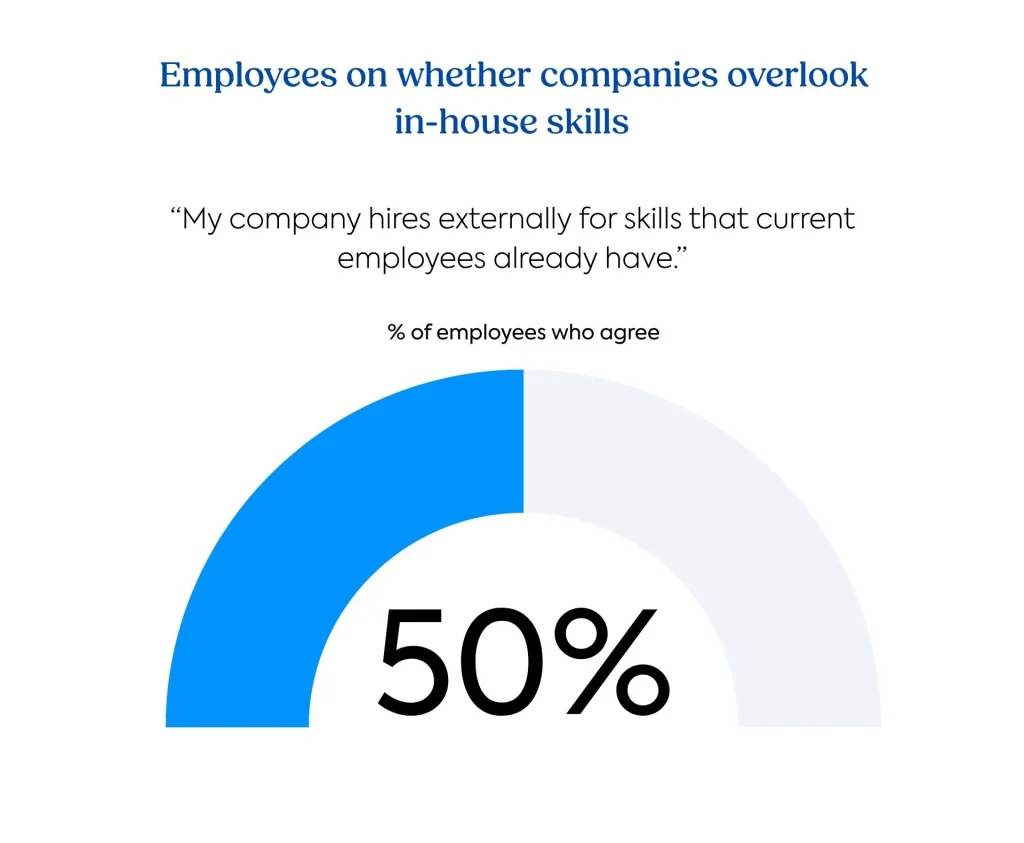
- 50% of respondents say their company hires externally for skills that current employees already have.
- Only 12% of respondents say their company doesn’t have skills visibility issues.
- 31% of employees are asked to do tasks that don’t match their skills.
Manager confidence, employee doubt
- 90% of managers say they have a good understanding of their direct reports’ skills, but only 69% of employees agree.
- 75% of managers say their team’s skills are fully utilized, but 49% of employees say their company underutilizes their skills.
- 90% of managers say they support their team’s skill development, but only 60% of employees agree.
Overlooked skills, stalled careers
- 56% of employees say their career growth is held back at least sometimes because their skills go unnoticed.
- 40% of respondents say it’s easier to find a new job than a new role within their own company.
- 31% of employees would consider leaving their company due to a lack of skill development opportunities.
- Executive summary
- A structural blind spot for companies
- Where skills visibility breaks down: 3 critical gaps
- Invisible skills, visible cost: From hard ROI to human capital
- What gets in the way of skills visibility: 4 systemic obstacles
- The fix: How to improve skills visibility
- #1 Make skills measurable with regular audits
- #2 Equip managers to see and track skills consistently
- #3 Connect skills to career growth
- #4 Use systems to capture skills continuously
- #5 Turn visibility into action with the right tools
- Bonus: Five steps to improve skills visibility in your company
- Conclusion
- About this research
Executive summary
Forget the skills gap. Skills aren’t missing. They’re invisible. And this is where skills chaos begins.
New data from the TalentLMS Skills Visibility Report reveals a widespread blind spot inside organizations. Just 12% of respondents say their organization doesn’t have skills visibility issues. For many, skills remain hidden.
External research underscores the scale of the problem. Only 8% of organizations have reliable data on workforce skills.
TalentLMS findings also expose a sharp tension at the core of the issue. Nine in ten managers say they know their teams’ skills. Yet only 69% of employees agree.
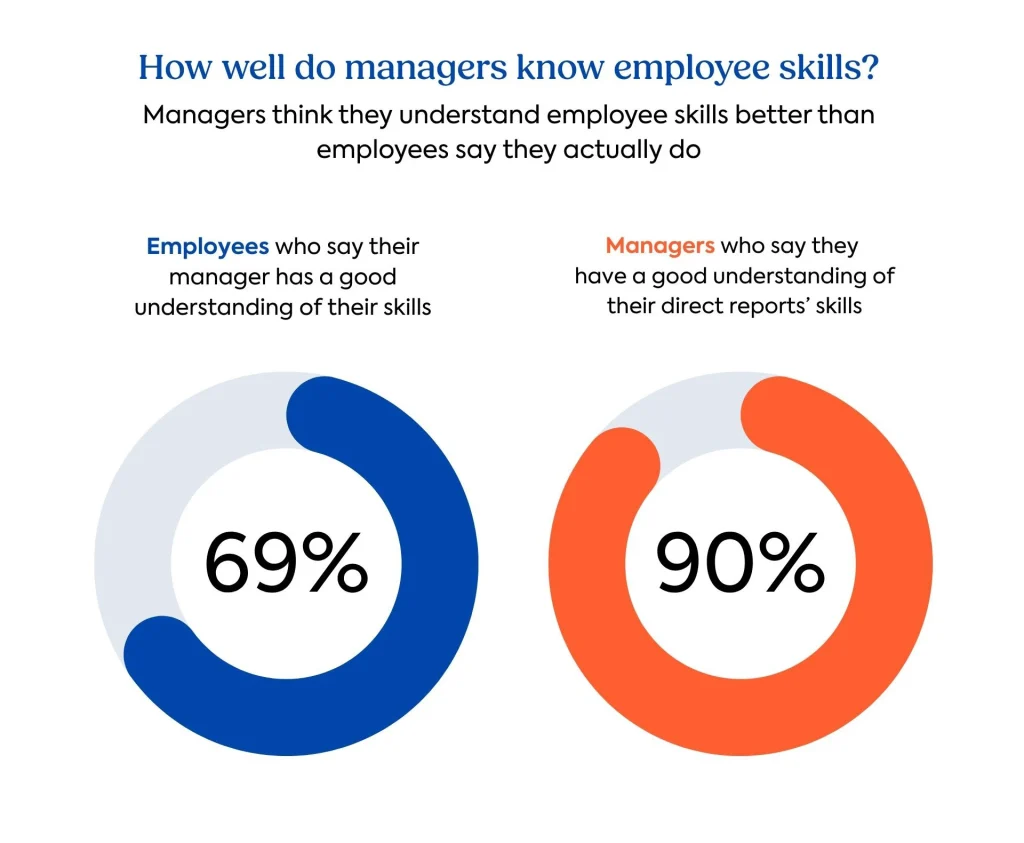
This 21-point perception gap comes at a cost. Half of the respondents say their organizations hire externally for skills that already exist in-house. Meanwhile, available skills remain underused and underdeveloped.
Taken together, the picture is clear: the conversation has shifted. For years, the focus has been on the skills gap, the idea that critical capabilities are missing from the workforce. But TalentLMS data points to a different reality: companies aren’t short on talent. They’re short on skills visibility.
The report examines what this means for companies looking to move from skills chaos to business clarity:
- Where does skills visibility break down?
- How does it impact performance and development?
- What does it take to turn hidden skills into measurable capability?
How to read the report:
- Employees: individual contributors (non-managers)
- Managers: people managing at least one employee
- Respondents: both groups
The skills visibility gap: A structural blind spot for companies
From missing talent to invisible talent
Skills gaps have dominated the agenda for good reason. Seventy percent of the skills used in most jobs are expected to shift in the coming years. Faced with this pace of change, 63% of employers say skills gaps will remain a major barrier to transformation through 2030.
But inside organizations, the issue isn’t just about a shortage of talent or building new skills. It’s about visibility into the skills that already exist.
Skills visibility means knowing what skills are already in place across an organization, who has them, how strong they are, and where they’re needed.
With skills gaps, talent is missing. The skills visibility gap is different. The talent’s already there, but those skills are often hidden, scattered, or unverified.
When skills are difficult to see, they’re harder to use. Organizations can’t measure, develop, or deploy them. As a result, decisions rely on instinct instead of data.
That’s where the visibility gap starts to show up.
Where skills visibility breaks down: Three critical gaps
Our data reveals a breakdown across three areas: how organizations understand skills, how they develop them, and how they use them. Across all three, a consistent gap emerges between how managers see skills and how employees experience them.
1. The clarity gap: Managers think they see skills clearly. Employees don’t fully agree.
Ninety percent of managers say they have a good understanding of their direct reports’ skills. Only 69% of employees agree that their manager understands their skills.
What looks like clarity at the top doesn’t always hold up on the ground. Managers rate their understanding of employee skills far more favorably than employees do. And that misalignment has consequences.
90% of managers say they have a good understanding of their direct reports’ skills. But only 69% of employees agree that their manager understands their skills.
When managers overestimate what they can see, they assign the wrong work, overlook hidden strengths, and miss critical gaps. The result is inefficiency, frustration, and missed opportunities to match the right people to the right work.
2. The development gap: Managers believe they support growth. Employees see missed opportunities.
Ninety percent of managers say they support their teams in developing new skills. Only 60% of employees feel they receive that support.
90% of managers say they support their teams in developing new skills. Only 60% of employees feel they receive that support.
The intent is there. Managers think they’re developing skills. But employees don’t always experience it that way. That gap means growth opportunities don’t always reach the people who need them most.
When it persists, employees feel stuck, engagement drops, and critical skills fail to evolve at the pace the business demands.
3. The application gap: Managers see full capacity. Employees see untapped potential.
Seventy-five percent of managers say their teams’ skills are fully used. Only 49% of employees feel their skills are put to work. Managers see full capacity. Employees experience something different. Skills may exist across the workforce, but they’re not always applied where they matter most.
75% of managers say their team’s skills are fully utilized, but 49% of employees say their company underutilizes their skills.
When this gap persists, employees feel underutilized and start to disengage or look elsewhere. At the same time, organizations miss out on innovation, productivity gains, and the full return on their talent.
Invisible skills, visible cost: From hard ROI to human capital
Skills visibility often goes undetected, and the cost is real. When companies can’t clearly see what their people can do, the impact goes beyond L&D. It shows up in hiring decisions, team performance, and ultimately, whether people stay or leave.
The consequences are felt across the business and by employees themselves:
| Business costs | People costs |
| Hidden talent → wasted potential Internal skills go unused, while companies hire externally. | Missed opportunities → slower growth Employees avoid stretch opportunities and skill-building. |
| Misalignment → lower performance The wrong people do the wrong work, slowing teams down. | Invisible skills → stalled careers Lack of recognition limits progression and drives attrition. |
| Higher spend → lower impact Inefficient hiring and unfocused L&D drain resources. | Unclear paths → lost trust Ambiguous promotion criteria weaken engagement. |
Business cost 1: Underused internal capabilities
Half of respondents say their company hires externally for skills that already exist internally. At the same time, nearly half of employees (49%) say their own skills are underused. Managers see this too, with 57% identifying underused skills as the top consequence of poor skills visibility.
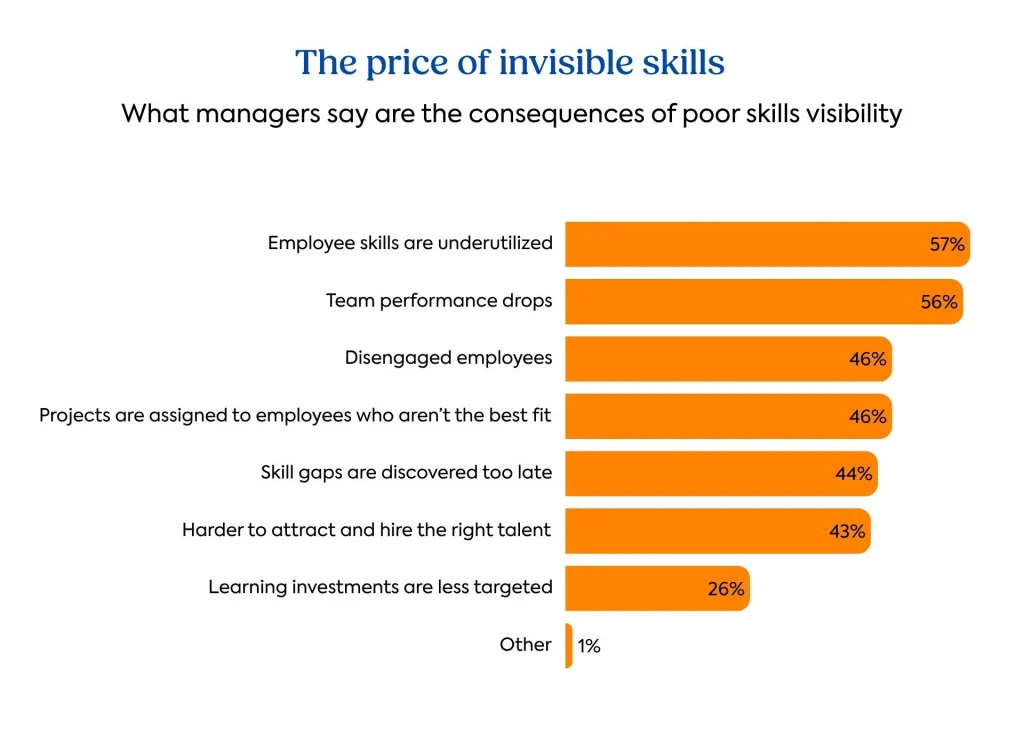
This isn’t just inefficiency. It’s a missed opportunity at scale. When skills aren’t clearly visible, they’re difficult to put to work. And when they’re not used, value is left on the table. Companies default to hiring instead of redistributing or developing talent internally.
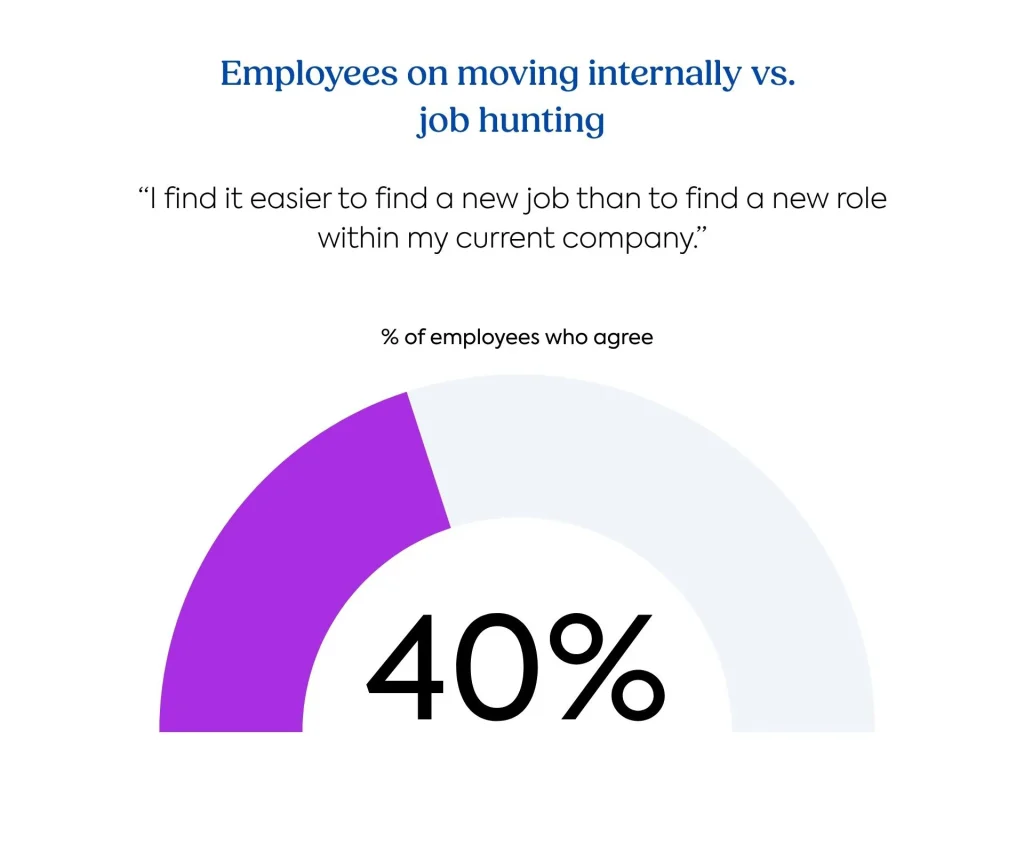
The same issue shows up in internal mobility. Four in ten respondents say it’s easier to find a new job elsewhere than a new role within their own company. In practice, employees often leave not because they lack skills, but because those skills aren’t recognized or matched to opportunities.
Retention is a leadership choice: Make skills visible, make people stay
“When it’s easier to leave than to grow, that’s not a retention issue—it’s a leadership one. Employees aren’t just looking for jobs; they’re looking to feel seen, valued, and connected to work that matters—and to know they matter within it. Too often, internal mobility is slowed by rigid structures, unclear pathways, or leaders who hoard talent instead of developing it. While growth doesn’t require a new title, it does require access, advocacy, and attention. When leaders actively help people stretch, connect, and contribute in new ways, they make staying the most compelling option.”

Business cost 2: Weaker team performance
Skills visibility doesn’t just affect who gets hired. It shapes how work is assigned and how well it gets done.
More than half of managers (56%) say poor skills visibility leads to lower team performance. Nearly as many managers (46%) point to poor project fit as a direct consequence, with projects assigned to employees who aren’t the best fit.
Employees experience that misalignment directly. Nearly one-third of employees (31%) say they’re asked to take on tasks that don’t match their skills. That mismatch slows progress and makes it harder for people to do their best work.
At a high level, most respondents (64%) believe their organizations match skills to roles well. But that number masks a clear divide.
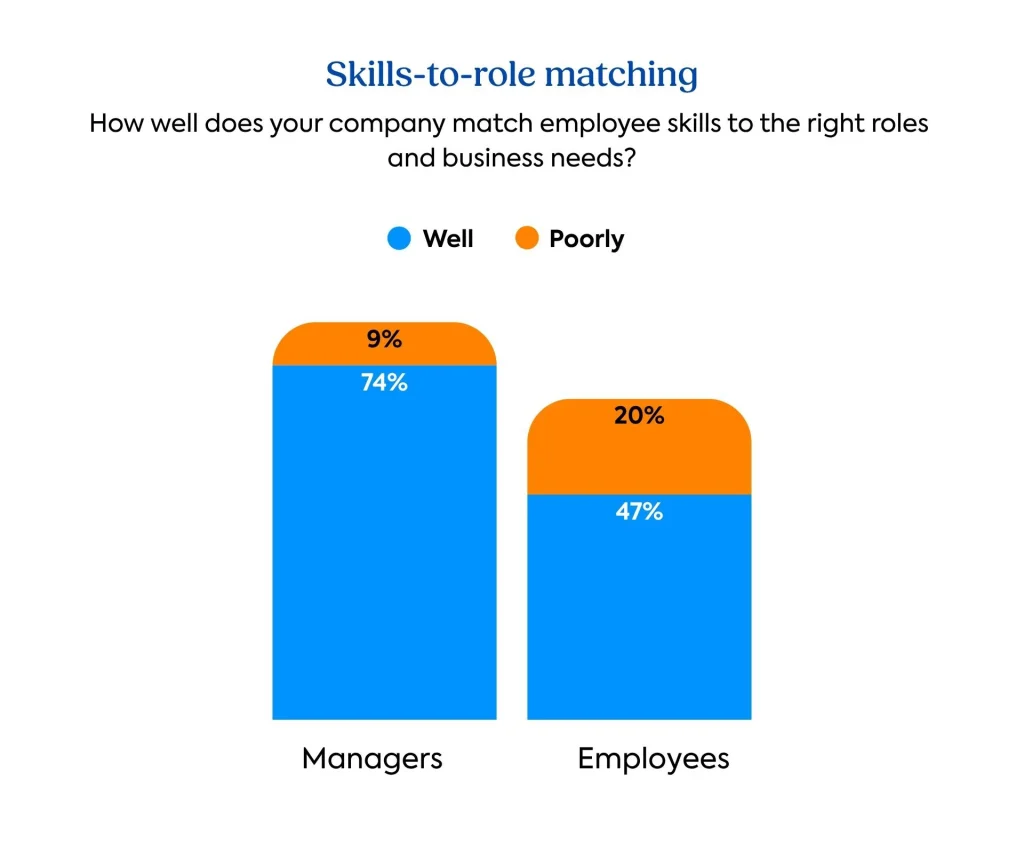
Nearly three-quarters of managers (74%) believe skills are well matched to roles, compared with just 47% of employees. Employees are also more than twice as likely to rate skills-to-role matching poorly (20% vs. 9%).
So while alignment looks strong in theory, day-to-day experience suggests otherwise.
Business cost 3: Spending more, getting less
Poor skills visibility drives up costs while reducing impact. More than a quarter of managers (26%) say poor visibility leads to less targeted learning investments.
26% of managers say poor skills visibility leads to less targeted learning investments.
Instead of focusing on the skills that matter most, organizations spread resources more broadly, with less measurable impact.
Hiring is affected too. Forty-three percent of managers say poor skills visibility makes it harder to attract and hire the right talent. Without a clear view of internal capabilities, it becomes harder to define what’s actually needed from the market.
The result is a clear pattern: more spending, more effort, and less insight into what’s working.
People cost 1: Leadership growth stalls
When people don’t have a clear view of their skills—or don’t feel those skills are recognized—they’re more likely to hold back.
One in three respondents avoided projects because they didn’t feel they had the required skills. Managers are even more likely to step back from opportunities for this reason (38% vs. 27%).
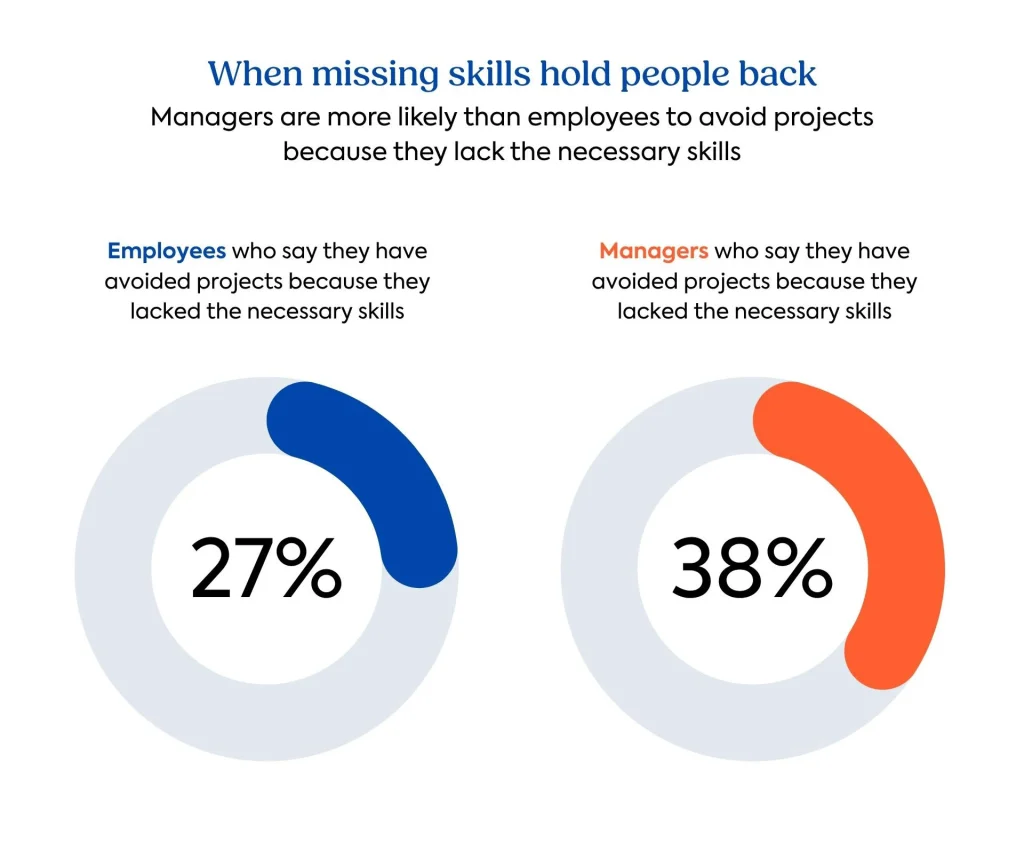
Uncertainty and fear play a role here too. A third of respondents (33%) say fear of making mistakes holds them back from building new skills, with managers again slightly more affected (35% vs. 29%).
When this hesitation persists, people are less likely to take on stretch opportunities or invest in new skills. Over time, that slows individual growth, leadership development, and team progress.
People cost 2: Unseen skills hold employees back
Employees feel the cost of invisible skills in their day-to-day growth. More than half (56%) of employees say their career progression is held back at least sometimes because their skills go unnoticed. For nearly one in five, this happens frequently or all the time.
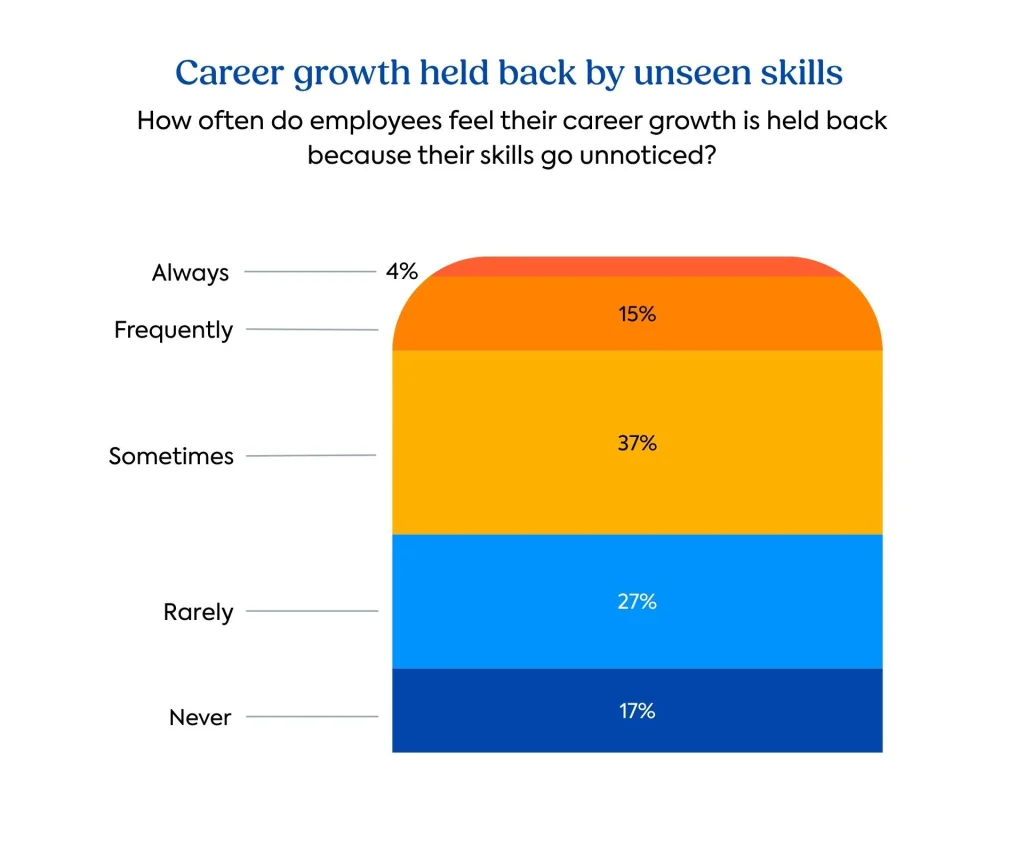
The impact goes beyond recognition. It influences access to opportunities, development, and progression.
When that access feels limited, employees start to reconsider their options. Nearly one-third (31%) say they would consider leaving their company due to a lack of skill development opportunities. Managers see the effects too, with 46% identifying disengagement as a top consequence of poor skills visibility.
When people can’t see a path forward, they stop investing in the one they’re on.
People cost 3: Promotion becomes a black box
Promotion is one of the clearest signals of how organizations value skills. But visibility here is uneven. Seventy-four percent of respondents say they understand the skills required to get promoted. But that confidence isn’t shared equally.
Managers are more likely to say they understand the requirements for promotion (80%), compared with 63% of employees.
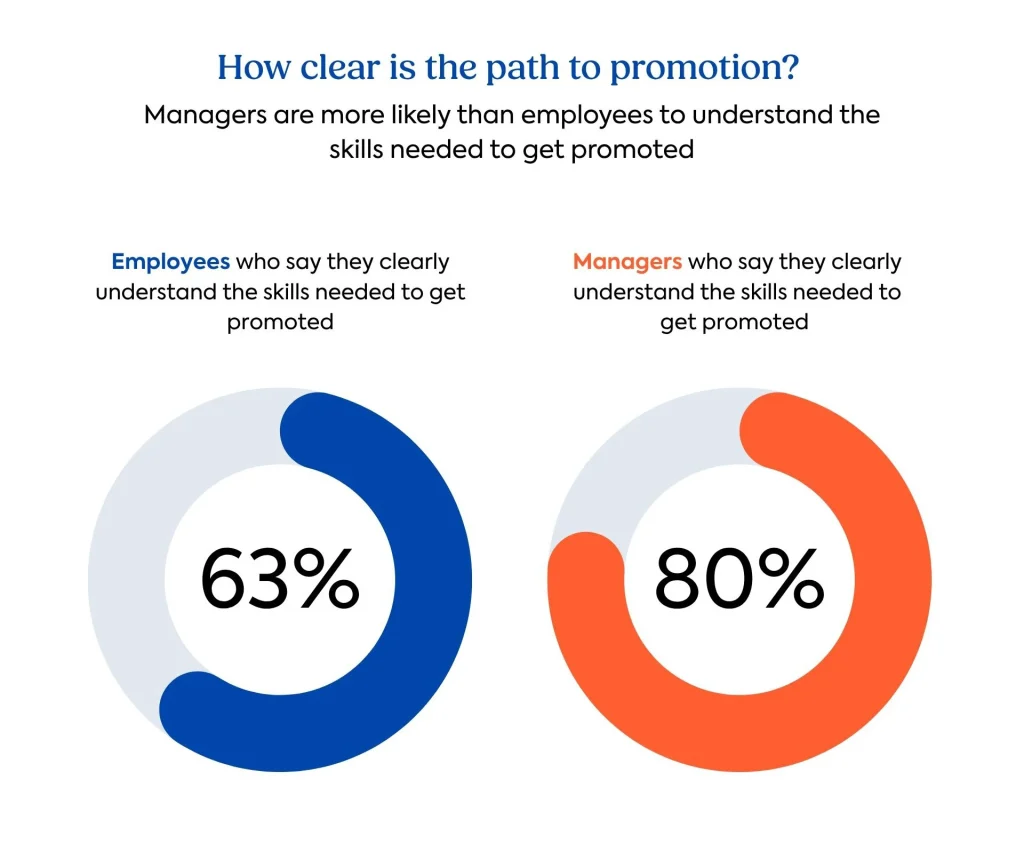
What’s clear to those who define the criteria isn’t always as clear to those working toward them. For many employees, promotion can feel like a black box. They can see who gets promoted, but not always why.
When expectations aren’t clearly visible, progression becomes harder to navigate. Without that clarity, employees are more likely to look elsewhere. Separate research finds that 82% of people and reward leaders cite lack of clarity around career progression and promotion paths as their top retention challenge, ranking above compensation.
What gets in the way of skills visibility: Four systemic obstacles
Behind every visibility gap is a tracking gap. Without reliable systems, visibility is difficult to build and even harder to maintain.
How companies track skills today
Organizations use a range of methods to track skills—but few rely on a single, consistent system. This mix creates an approach that’s difficult to scale and even harder to trust.
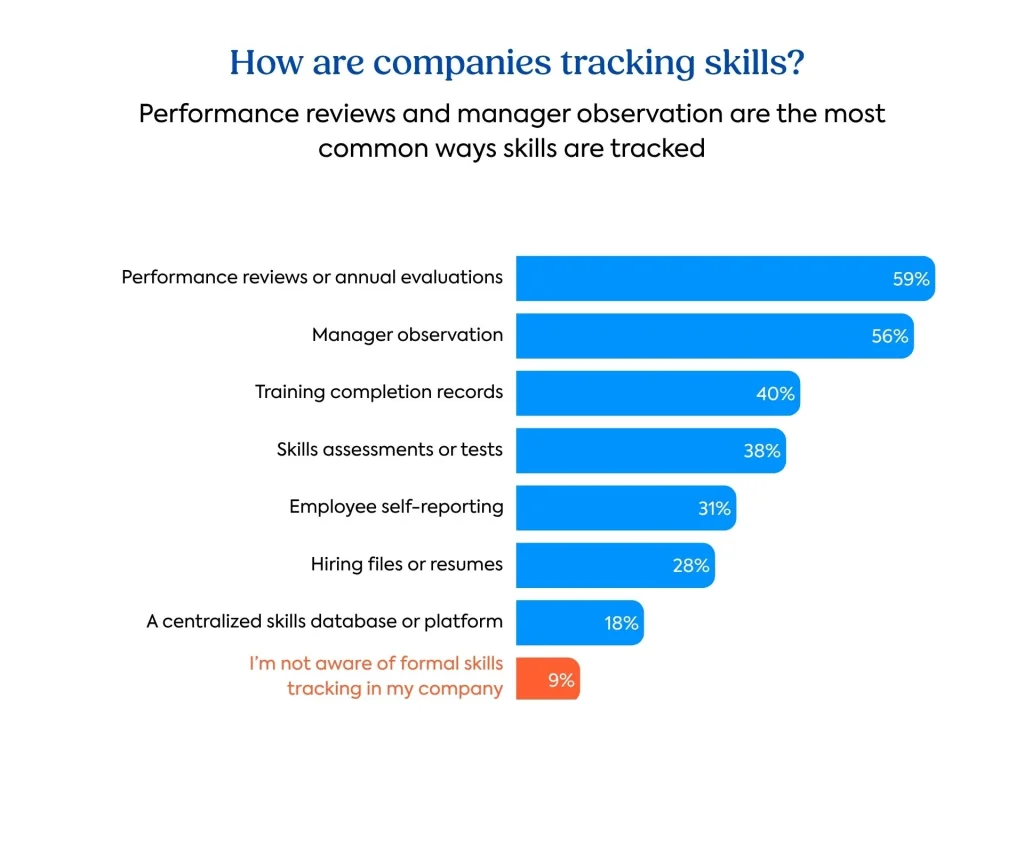
In most cases, skills tracking relies on indirect signals rather than dedicated systems. It draws on a mix of performance reviews, manager input, training records, and other disconnected sources instead of a centralized, real-time view of capability. As a result, skills data is often incomplete and difficult to act on.
This fragmented approach creates a set of systemic obstacles to skills visibility.
Obstacle 1: Skills tracking is manual and fragmented
Despite the growing focus on skills, structured tracking is still the exception.
Nearly one in ten respondents say they’re not aware of any formal skills tracking in their company. Even when tracking does exist, it’s rarely centralized. Only 18% of respondents report their company is using a dedicated skills database or platform.
Only 18% of respondents say their company uses a centralized skills database or platform to track skills.
Instead, many organizations rely on manual or fragmented inputs. Nearly a third (31%) say skills are tracked through employee self-reporting, which is one of the least reliable ways to build a clear picture of capability.
The result is a system that depends on scattered data points rather than a single source of truth. And when skills data isn’t centralized, it’s difficult to keep it current, consistent, or actionable.
Obstacle 2: Skills visibility depends heavily on managers
In practice, managers are the primary lens through which skills are assessed.
Performance reviews (59%) and manager observation (56%) are the two most common skills tracking methods. Other approaches, such as training records (40%) and formal assessments (38%), add additional signals but don’t provide a complete or consistent view of skills.
This is a subjectivity trap.
Manager input is valuable. But managers assess skills differently. Some have a clear view of their team’s capabilities. Others rely on limited interactions or outdated information.
Over time, that inconsistency turns into a visibility gap. Skills become tied to perception rather than proof, making it difficult to build a consistent, organization-wide view.
Obstacle 3: Skills ownership falls on employees
In most organizations, employees are left to take ownership of their development.
More than six in ten respondents (61%) say employees are expected to keep their skills up to date on their own. Managers and employees are closely aligned on this point (62% vs. 59%).
61% of respondents agree that in their company, employees are expected to keep their skills up to date on their own.
Many employees also lack clear visibility into how their skills are assessed and how they connect to career progression. Over half say their progression stalls because their skills go unnoticed.
Without clear guidance, ownership becomes guesswork. Instead of proactive development, employees are left to navigate skill-building alone—reinforcing the gaps organizations are trying to solve.
Obstacle 4: Skill gaps are addressed too late
If skills aren’t tracked consistently, problems only become visible after they’ve already affected performance.
More than four in ten employees (42%) say their manager only addresses skill gaps when performance issues arise. Managers recognize this too. Forty-four percent of managers say that discovering skill gaps too late is a direct consequence of poor skills visibility.
42% of employees agree that their manager only addresses skill gaps when performance issues arise.
By that point, the focus shifts from development to correction. Instead of building skills proactively, organizations are reacting to gaps under pressure. When timelines, outcomes, and performance are already at risk.
The fix: How to improve skills visibility
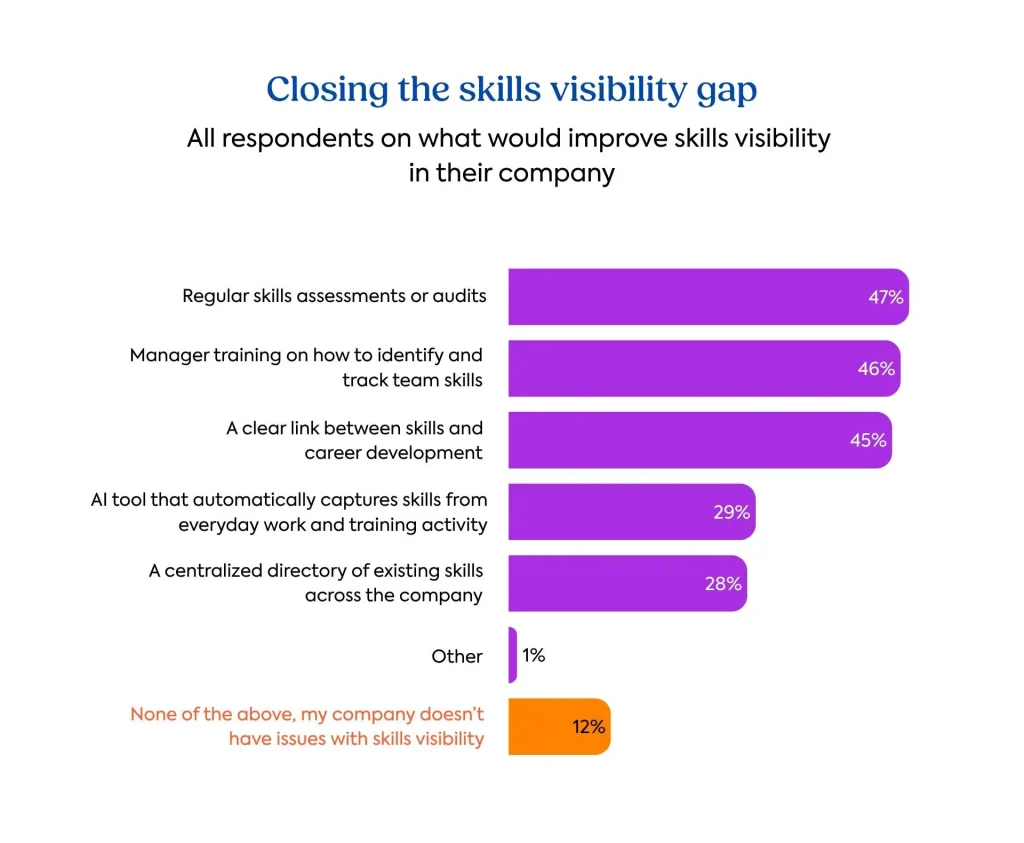
Improving skills visibility requires more than adding training. When asked what would improve it, respondents pointed to a clear set of priorities: more structure, better support, clearer application, and systems that make skills easier to track and use.
Fix #1: Make skills measurable with regular audits
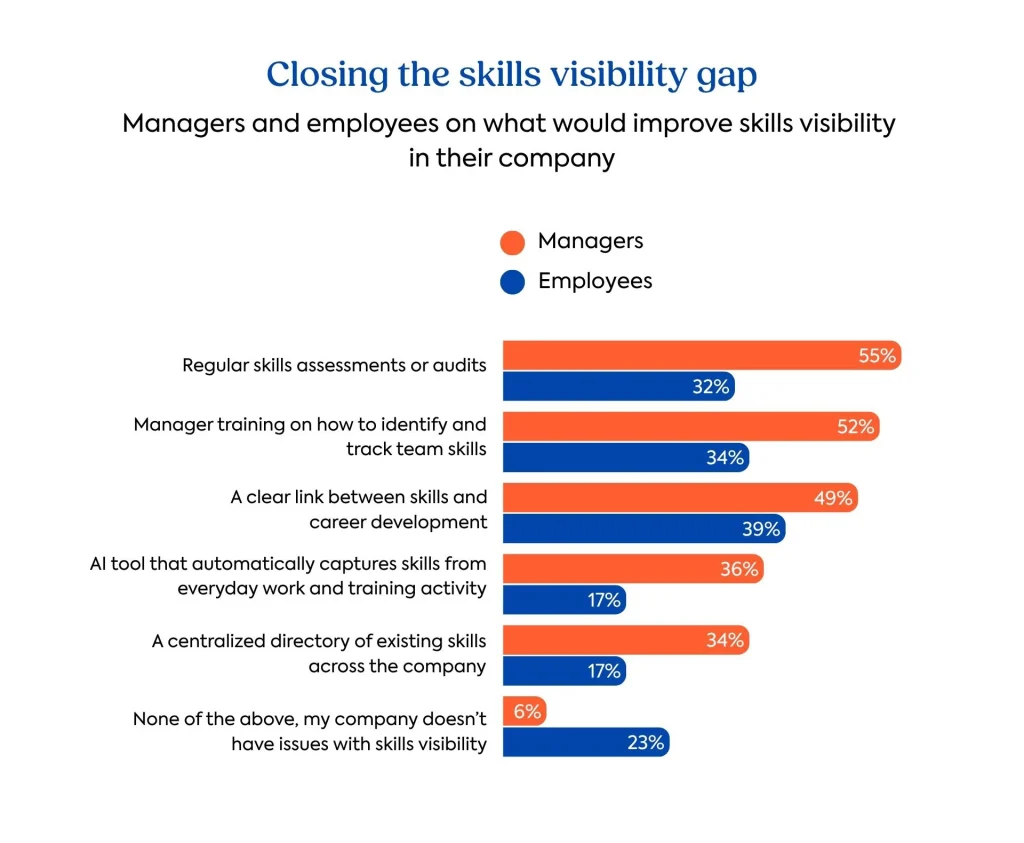
Nearly half of respondents (47%) say skills visibility would improve with ongoing skills assessments or audits. Among managers, that rises to 55%, making it their top priority. That’s a clear signal that visibility starts with measurement.
Without regular check-ins, skills data quickly becomes outdated. Roles evolve, people learn on the job, and capabilities shift. Annual reviews alone can’t keep up.
Skills audits create a more current, shared view of capability that moves beyond assumptions and toward proof.
Fix #2: Equip managers to see and track skills consistently
Nearly half of respondents (46%) say manager training would improve skills visibility. This reflects the central role managers play in how skills are tracked. But as we’ve seen, that reliance also introduces subjectivity.
With the right employee training, managers can better identify, objectively assess, and consistently track skills. And make skills visibility and development more consistent across teams.
Don’t assume managers are ready: Support leadership with the right training
“In general, we don’t do a great job at equipping managers to give effective feedback or develop their direct reports. We assume these are skills they possess upon promotion. However, most managers are promoted because they excel at their work, not at leading people, which requires a completely different skill set. For this reason, moving into leadership is more like a career change than a promotion. Additionally, leadership flows vertically, meaning the team generally reflects its leader. If upper leadership is poor at giving feedback or developing people, that deficiency translates down the line. Managers desperately need intentional skill building and mentoring for the sake of employee performance and experience.”

Fix #3: Connect skills to career growth
Skills visibility must connect to something that matters. For 45% of respondents, a clear link between skills and career development would improve visibility.
When employees understand how their skills translate into progression, visibility becomes actionable.
We saw earlier in the report that more than half of employees (56%) say their career progression stalls at times because their skills go unnoticed. This reflects a broader divide. Managers prioritize measurement, while employees prioritize outcomes. Employees focus less on how skills are tracked and more on what those skills lead to.
Fix #4: Use systems to capture skills continuously
Around three in ten respondents (29%) say an AI tool that captures skills from everyday work would improve visibility. A similar share points to a centralized skills directory across the company (28%).
With the right systems, organizations can reduce manual tracking and bring skills data into one place, creating a more complete, up-to-date view of capability. But technology alone isn’t enough. It only works when supported by clear structure and a shared understanding of what’s being measured and why.
Fix #5: Turn visibility into action with the right tools
Our findings point to a clear starting point: improving skills visibility begins with understanding what already exists.
Tools like Skills by TalentLMS help organizations move from fragmented signals to a clearer, more consistent view of workforce capability. Instead of relying on reviews, observation, or self-reporting alone, teams can map skills in one place and keep them up to date.
This enables organizations to identify internal talent, match people to opportunities, and support development with greater confidence. At the same time, employees gain visibility into how their skills connect to career growth and what they need to build next.
It also connects learning to real outcomes. Organizations can track skill development, recommend targeted learning, and build progression based on what people can actually do.
The result is the shift highlighted throughout this report. Moving from hidden skills to visible capability and from training activity to skills that drive impact.
Bonus: 5 steps to improve skills visibility in your company
To improve skills visibility, start with a few clear steps focused on turning scattered information into shared, usable insight. Here’s what you can do:
Step 1: Identify the skills already in your workforce
Start with what you already have.
Most organizations already sit on a wealth of skills data. This exists across performance reviews, training records, resumes, and manager knowledge. Bringing these sources together helps build an initial picture of workforce capability.
You don’t need a perfect inventory from the start. Focus on creating a realistic view of what people can do today. And don’t just include what’s documented but also what’s demonstrated in practice.
Step 2: Document skills in a central, shared system
Once identified, skills need a single place to live.
A centralized system makes skills visible across teams and creates a shared source of truth for managers, HR, and employees. Without it, data remains fragmented. And opportunities to use those skills are often missed.
Step 3: Verify skills to move beyond assumptions
Skills visibility depends on accuracy.
Validate skills through assessments, real work, or demonstrated performance to move from assumption to verified capability. When skills are validated, they become reliable inputs for decision-making.
Step 4: Connect skills to roles and business needs
Skills data only becomes valuable when it’s used.
Map skills to roles, projects, and business priorities to make that connection clear. This helps organizations match people to the right work, identify gaps earlier, and plan development with purpose. This is where visibility turns into impact.
Step 5: Keep skills data current as roles evolve
Skills don’t stay still, and neither should skills data.
As roles evolve and new capabilities emerge, visibility depends on regular updates. Whether through assessments, learning activities, or day-to-day work. Without updates, even the best systems become outdated. With them, skills visibility remains relevant and reliable.
Conclusion: From blind spot to business asset
Organizations are sitting on untapped talent they can’t see, can’t develop, and can’t deploy. So the risk isn’t a lack of skills but a lack of visibility.
People aren’t matched to the right work. Hiring fills gaps that aren’t actually gaps. Development happens but doesn’t always lead to meaningful progress. And employees feel their growth depends more on perception than on proof.
Over time, it adds up to missed opportunities, slower execution, and talent that doesn’t reach its full potential.
Without visibility, organizations can’t plan, deploy, or develop skills effectively. Decisions become slower, less precise, and harder to scale.
But once organizations start improving skills visibility, they invest in building a shared, up-to-date pool of capability. And this connects people’s skills to real work, real development, and real growth.
That’s how organizations move from skills chaos to business clarity: by turning what they already have into something they can actually use.
About the survey
The TalentLMS Skills Visibility Report is based on a March 2026 survey of 1,500 U.S. respondents, including 964 managers and 536 employees. Minor discrepancies in total figures may occur due to rounding. A follow-up report featuring additional findings from the same dataset will look at what it takes to build and apply skills faster.
Research team
Ana Casic, Giota Gavala, Elena Koumparaki, Fiona McSweeney
Dive deeper into original research by TalentLMS



Bring out the best in your teams.
Get started with the most versatile and affordable employee training platform, no credit card needed.