New research:
Learning debt: The hidden cost of slow learning in a fast-moving workplace
New TalentLMS research uncovers the rise of learning debt and its consequences: Employees falling behind on learning are nearly 6x more likely to make preventable mistakes. Discover what’s driving learning debt and how organizations can spot and reduce this hidden liability.

Highlights
Fast work, slow learning
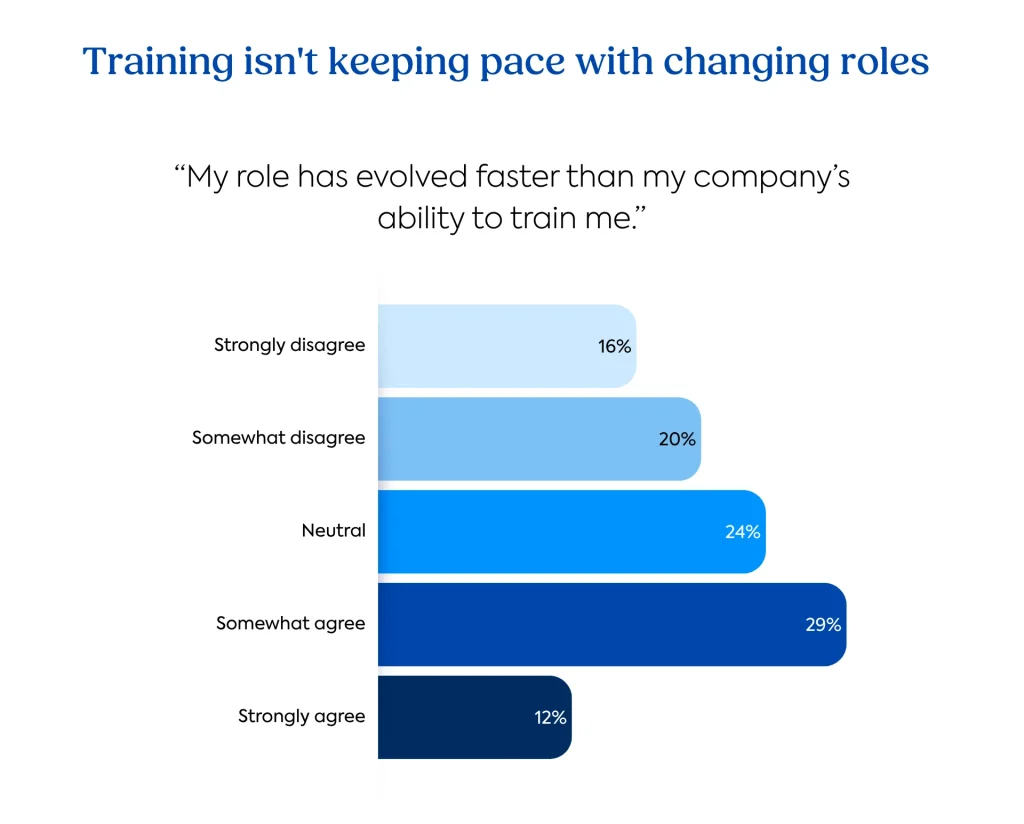
- 41% of employees say their role has evolved faster than their company’s ability to train them.
Artificial competence
- 37% of employees say AI tools have made them appear more competent at work than they actually are.
Hidden learning gaps
- 47% of employees say they have stayed quiet about not knowing how to do something related to their job.
- Executive summary
- The rise of learning debt
- When roles evolve faster than training
- The business toll of learning debt
- Why learning debt stays hidden
- The workaround economy
- The AI cover-up
- When appearances silence learning
- The culprits of learning debt
- When new tools and processes arrive without training
- When learning can’t keep pace with work
- When workplace norms discourage learning
- Breaking the cycle of learning debt: What organizations can do next
- #1 Make learning part of the job
- #2 Surface learning debt earlier
- #3 Reward openness, not appearances
- #4 Make it safe to ask questions
- Conclusion: Invisible debt, visible cost
- About this research
Executive summary
The modern workplace runs on constant adaptation. New tools. New processes. New expectations. On paper, things work. Employees adjust, projects move forward and the business keeps moving. But there’s a catch. Beneath that progress, the learning needed to sustain it isn’t always happening.
41% of employees say their role has evolved faster than their company’s ability to train them.
The TalentLMS Learning Debt Report explores what happens when workplace learning can’t keep up with workplace change. Our findings reveal the scale of the challenge: four in ten employees (41%) say their role has evolved faster than their company’s ability to train them. This creates learning debt: learning that should have happened but didn’t.
Like any debt, learning debt compounds. But unlike a skills gap, which can be measured and seen, learning debt stays hidden. Instead of visibly falling behind, employees adapt in ways that mask the problem.
Nearly two-thirds of employees (62%) use workarounds when they lack the skills or training needed to complete a task. More than a third (37%) say AI has made them appear more competent than they actually are. And nearly half (47%) of employees have stayed quiet about not knowing how to do something at work.
These behaviors keep work moving in the short term, but they can’t replace the capability organizations need for long-term success.
This report explores why learning debt often hides in plain sight. And what organizations can do to identify it early, reduce its impact, and build a workforce that’s ready for what’s next.
The rise of learning debt
According to recent Gartner research, only 7% of HR leaders say their workforce is ready for the future. TalentLMS’s L&D Benchmark Report 2026 points to one reason why: half of learning leaders and 53% of employees say heavy workloads leave little room for learning, even when it’s needed.
Evidence of a growing learning debt is mounting. And this report indicates that the impact is already being felt.
Learning debt is the growing backlog of learning that accumulates when work evolves faster than employee training and learning can happen.
When roles evolve faster than training
As work changes, training isn’t always keeping pace. Four in ten employees say their role has evolved faster than their company’s ability to train them.
♀♂ Gender insight: Men are more likely to say their role has evolved faster than their company’s ability to train them (47% vs. 33%).
The effects are visible in employees’ own assessment of their learning. Just over half (51%) of employees say they’re fully caught up on the learning required for their role. But the rest report some level of learning backlog. Forty-two percent of employees need to catch up on learning to keep up with their role, and 8% say they’re falling behind.
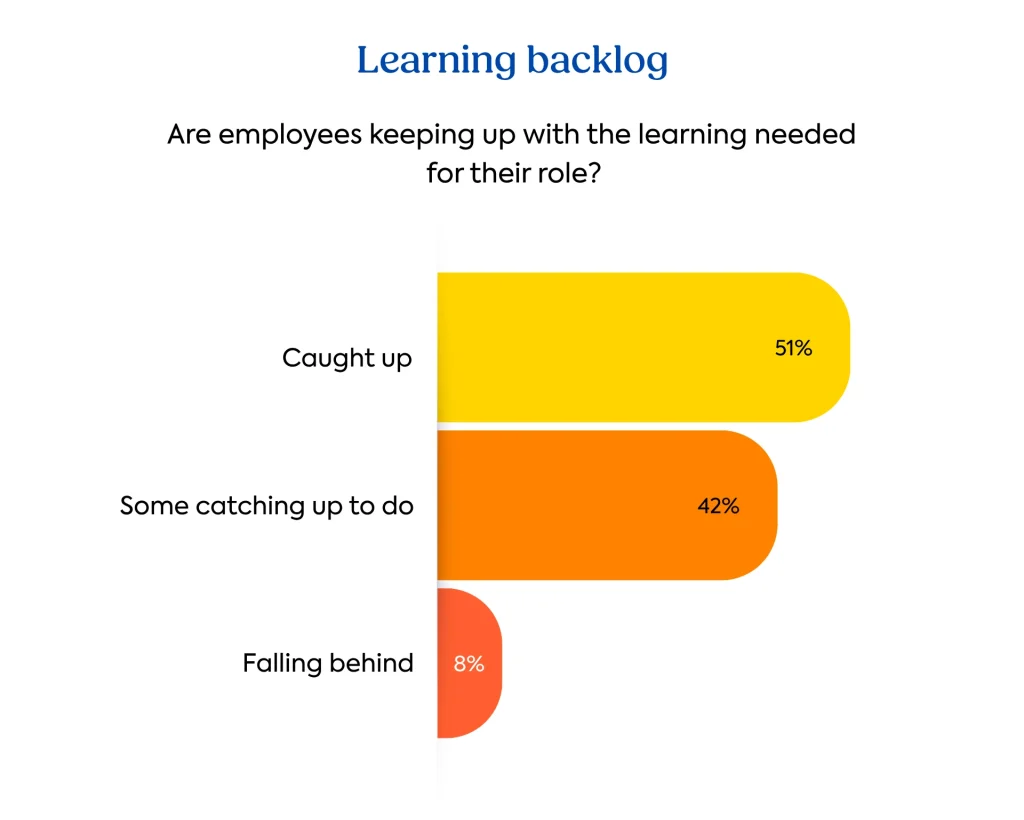
♀♂ Gender insight: Male employees are twice as likely to say they’re falling behind on learning: 10% compared with 5% of women.
Combined with Gartner’s finding, the picture becomes clear: organizations are struggling to keep learning aligned with changing roles and business needs. As a result, learning debt continues to build.
The business toll of learning debt
Learning debt often stays hidden. But its consequences don’t. The impact eventually shows up in the work.
An early warning sign: Preventable mistakes
Avoidable errors are one of the clearest signs that learning isn’t keeping pace with the demands of work. More than half of employees (54%) experience mistakes at work that proper training could have prevented at least sometimes. Specifically, one in seven (14%) say they often make mistakes, while 40% say it happens sometimes. By comparison, 46% say they rarely or never make mistakes that proper training could have prevented.
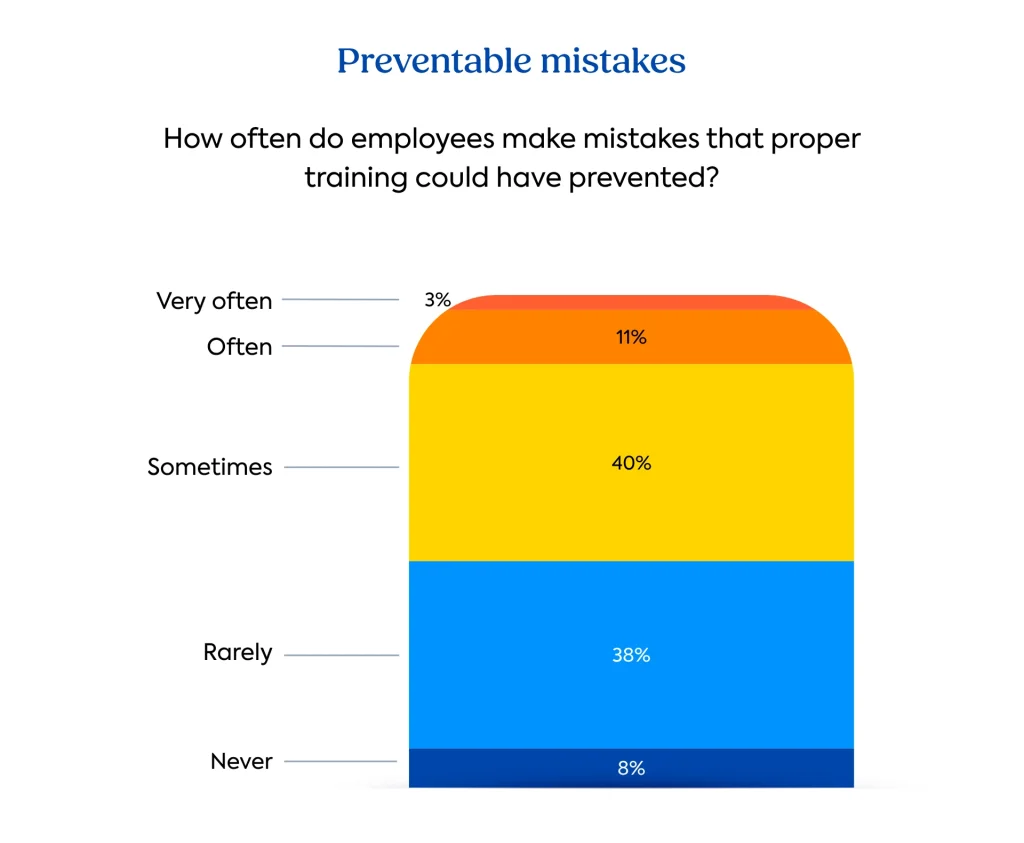
The gap widens sharply among employees playing L&D catch-up. Employees falling behind on skill development are nearly six times more likely to make preventable mistakes than those keeping up with learning (47% vs. 8%).
The impact on day-to-day business performance
Avoidable mistakes may seem minor at the time. But they can quickly become broader business challenges if left unaddressed. Only 5% of employees believe that falling behind on skill development has no negative impact on key business outcomes.
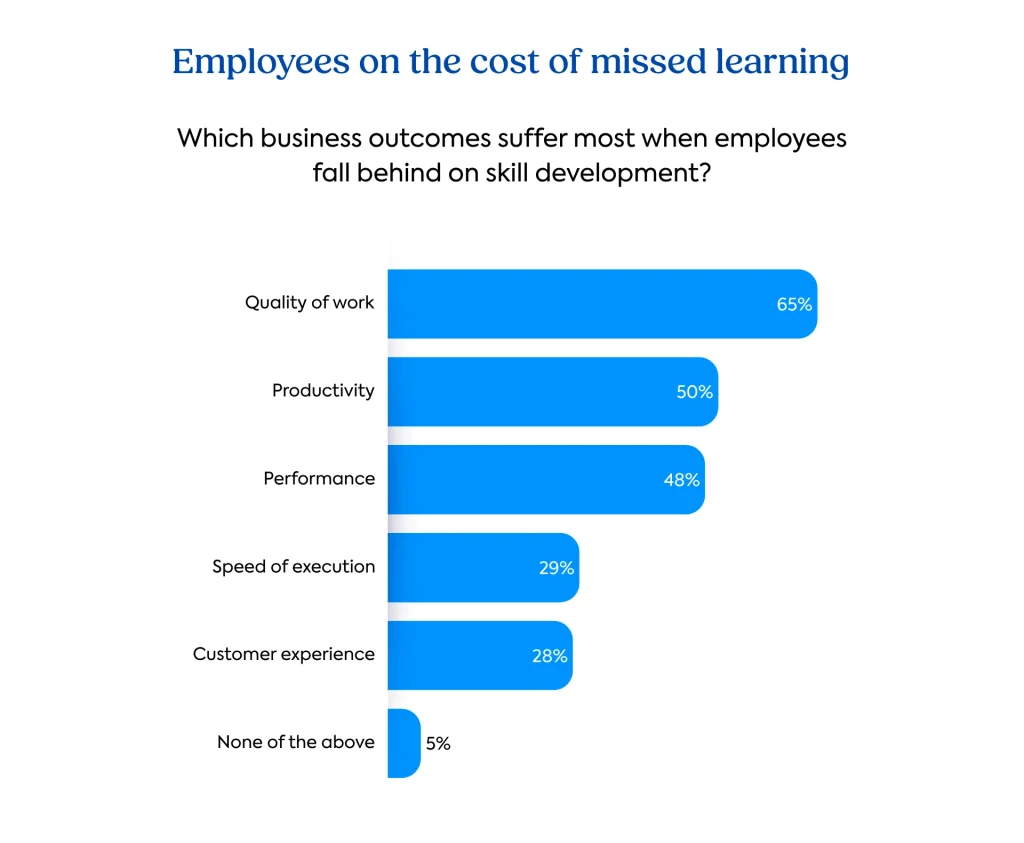
Sixty-five percent of employees say that work quality is the top business outcome that suffers when employees fall behind on skill development. Half of employees say productivity suffers, while 48% point to weaker performance.
More than half of employees (54%) experience mistakes at work that proper training could have prevented at least sometimes.
Together, these findings suggest the hidden cost of slow learning extends well beyond individual mistakes. It’s already affecting the quality, consistency, and effectiveness of everyday work.
Why learning debt stays hidden
You can’t fix what you can’t see. Learning debt persists because employees adapt rather than fall behind. These adaptations keep deadlines on track. But they also don’t allow the underlying gap to surface.
The workaround economy
Sixty-two percent of employees say they use workarounds when they lack the skills, knowledge, or training needed to complete a task.
62% of employees rely on workarounds when they don’t have the skills, knowledge, or training needed to complete a task.
Not all workarounds are problematic. Asking a colleague, searching for information, or learning through experimentation are effective ways to build knowledge. The issue arises when shortcuts become a substitute for learning rather than a path to it. And when compensating for a gap rather than closing it becomes the default behavior.
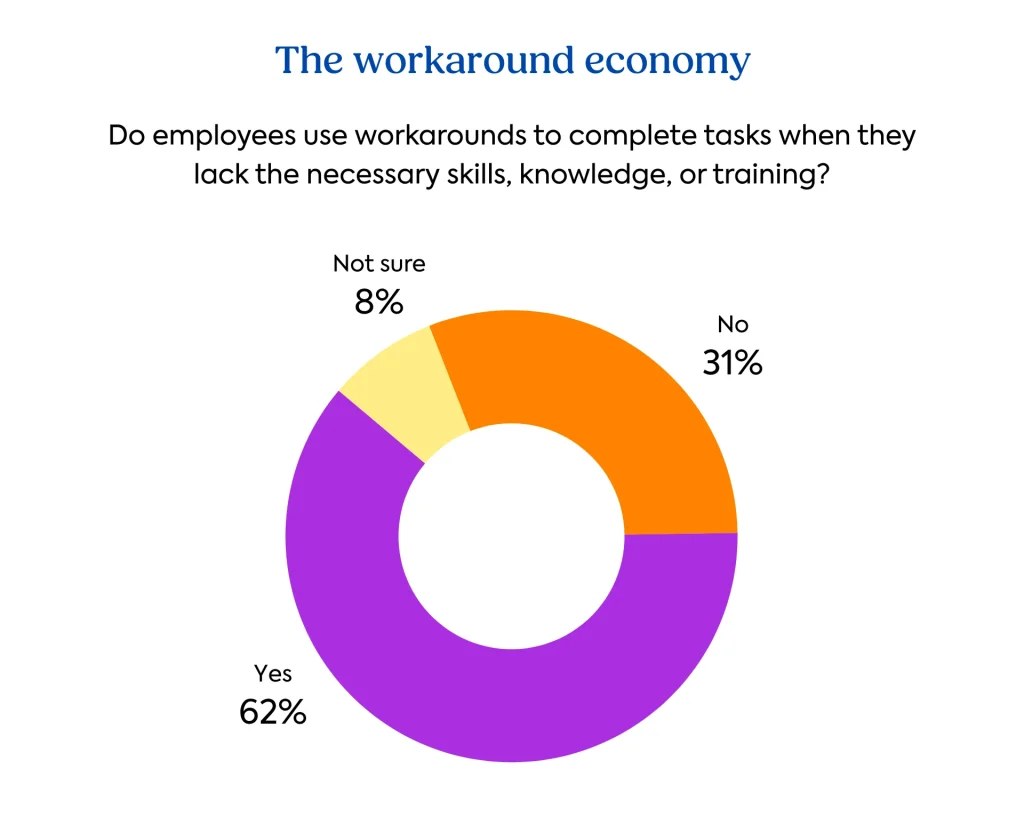
What’s more, nearly three in ten employees (29%) say they’ve delivered work they couldn’t fully explain if asked how they did it.
♀♂ Gender insight: Men are more likely than women to rely on workarounds (66% vs. 57%).
For employees who are falling behind on learning, workaround use rises to 78%. For those who are fully caught up, it drops to 51%. The further behind employees fall, the more they depend on shortcuts to keep pace.
The AI cover-up
When employees encounter tasks they haven’t been trained to do, turning to AI tools is their most common response, narrowly ahead of asking for formal training (36% vs. 35%).
In addition, more than a quarter (28%) say they frequently or always use AI for tasks they weren’t trained to do. Another 31% sometimes do so. That means that 59% report at least some use of AI for tasks they weren’t trained to do. The data suggests that AI isn’t just helping employees work; it’s helping them conceal unmet learning needs.
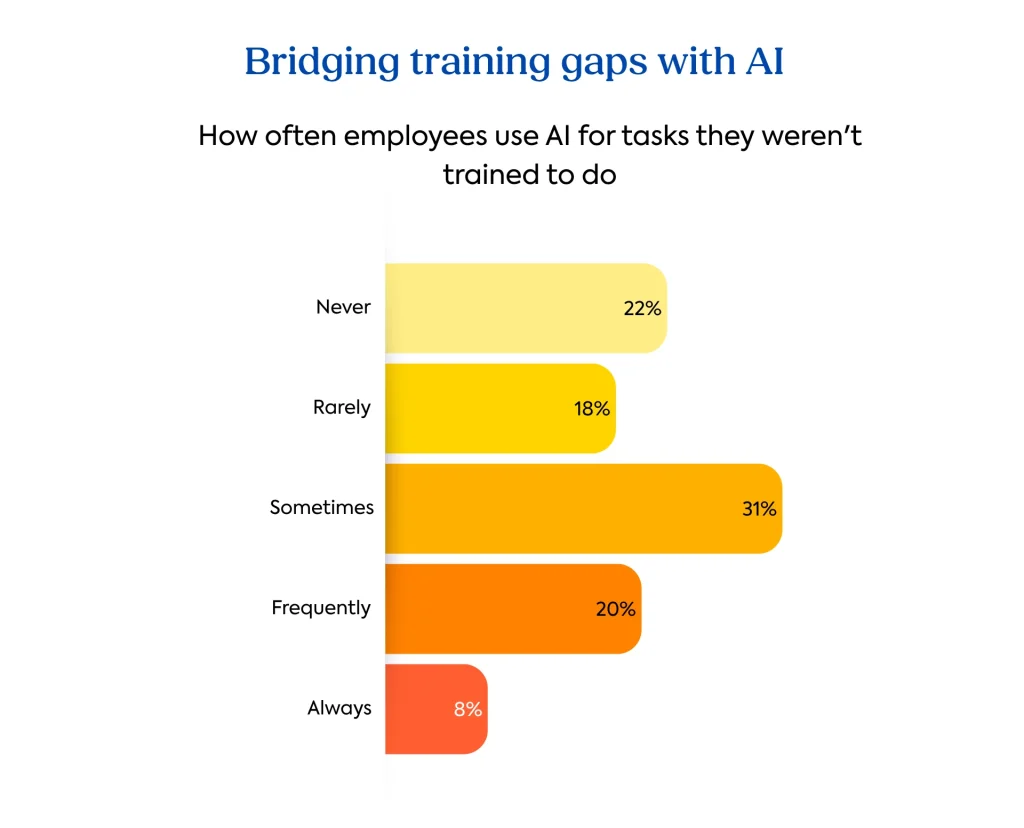
Further findings reveal the extent of the problem. Half of employees agree that AI helps them complete tasks even when they don’t understand the process behind them. And 37% of employees say AI tools have made them appear more competent at work than they actually are. The result is a workplace where performance doesn’t reflect capability.
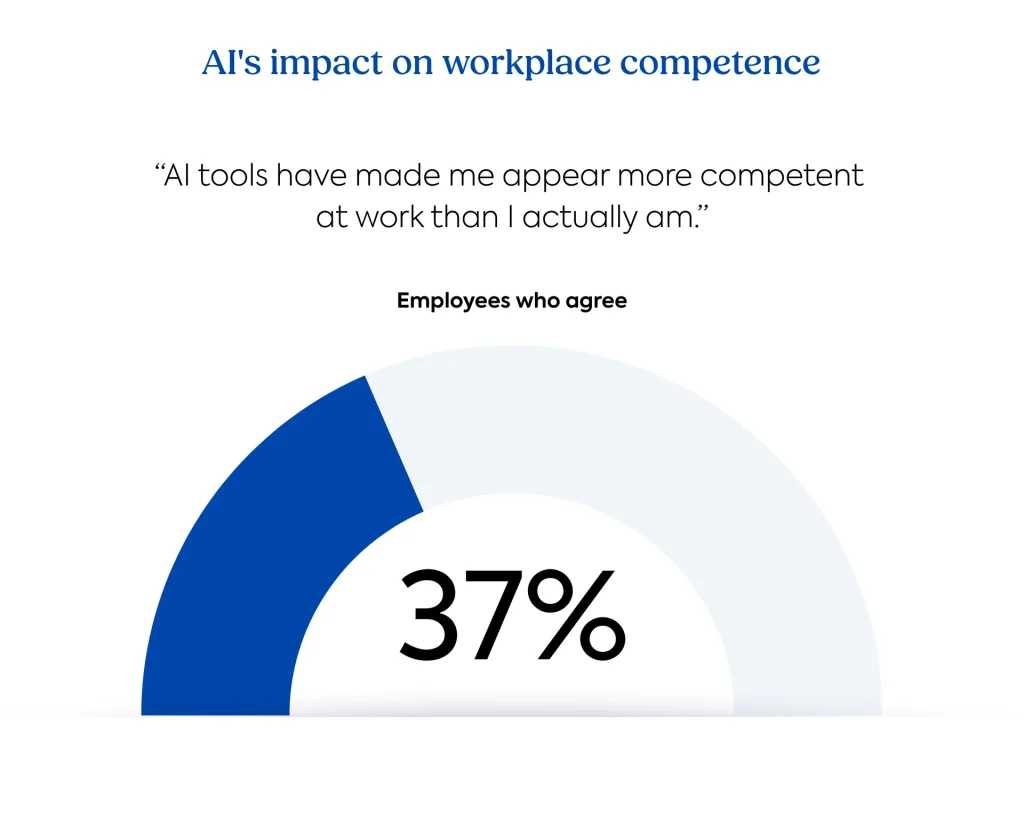
Employees falling behind on learning are more than twice as likely to use AI for tasks they weren’t trained to do than those who are fully caught up (52% vs. 24%). They’re also more than twice as likely to say AI has made them appear more competent than they are: 66% compared with 29% of employees who are fully caught up.
♀♂ Gender insight: Men rely on AI more for untrained tasks: 33% of men use AI tools frequently or always, compared with 25% of women.
50% of employees use AI to complete tasks even when they don’t understand the process behind them.
According to McKinsey, employees are three times more likely to be using generative AI than their leaders expect. That gap between adoption and awareness matters here. If leaders don’t know how much their teams rely on AI, they’re also unlikely to know why.
Taken together, these findings suggest AI may be creating a new visibility challenge. As employees use AI to bridge capability gaps, learning debt becomes easier to live with but harder to see. AI is often positioned as a way to help employees get ahead. Our findings suggest that, for some employees, it’s playing a different role. It’s helping them keep up. Over time, organizations risk relying on AI to sustain performance while underlying learning needs remain unaddressed.
When appearances silence learning
When asking questions feels risky, silence becomes the default. Nearly half of employees (47%) say they’ve stayed quiet about not knowing how to do something related to their job. And 29% did so because they didn’t feel safe admitting it.
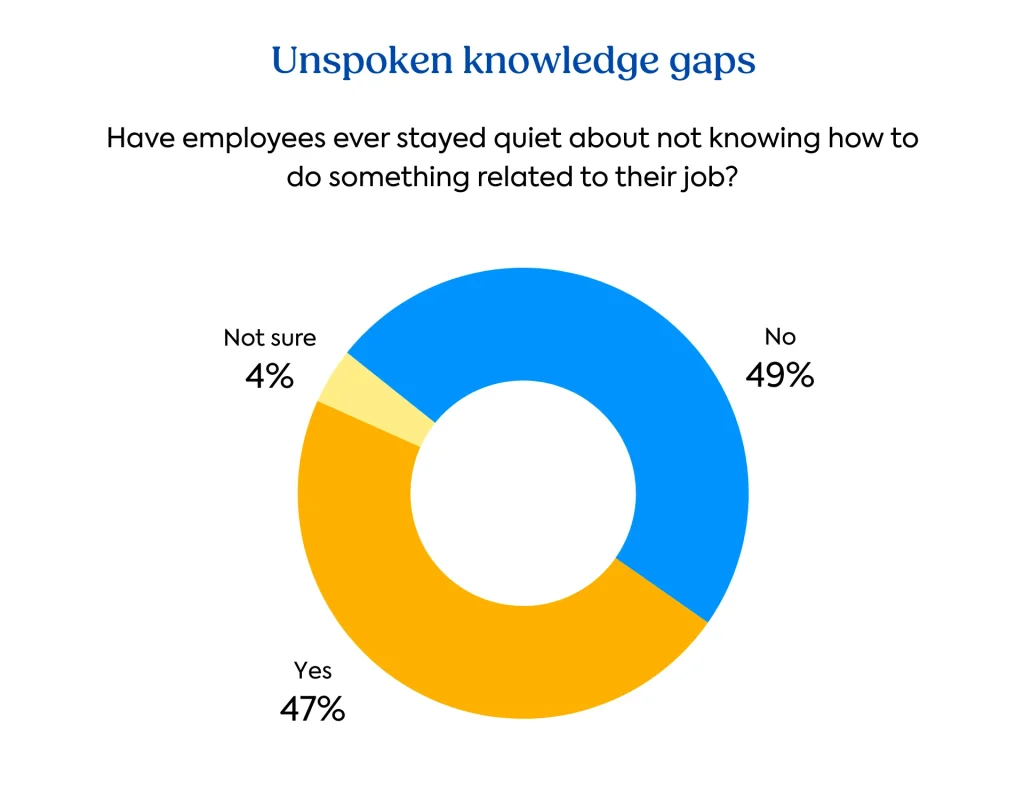
And the data shows why.
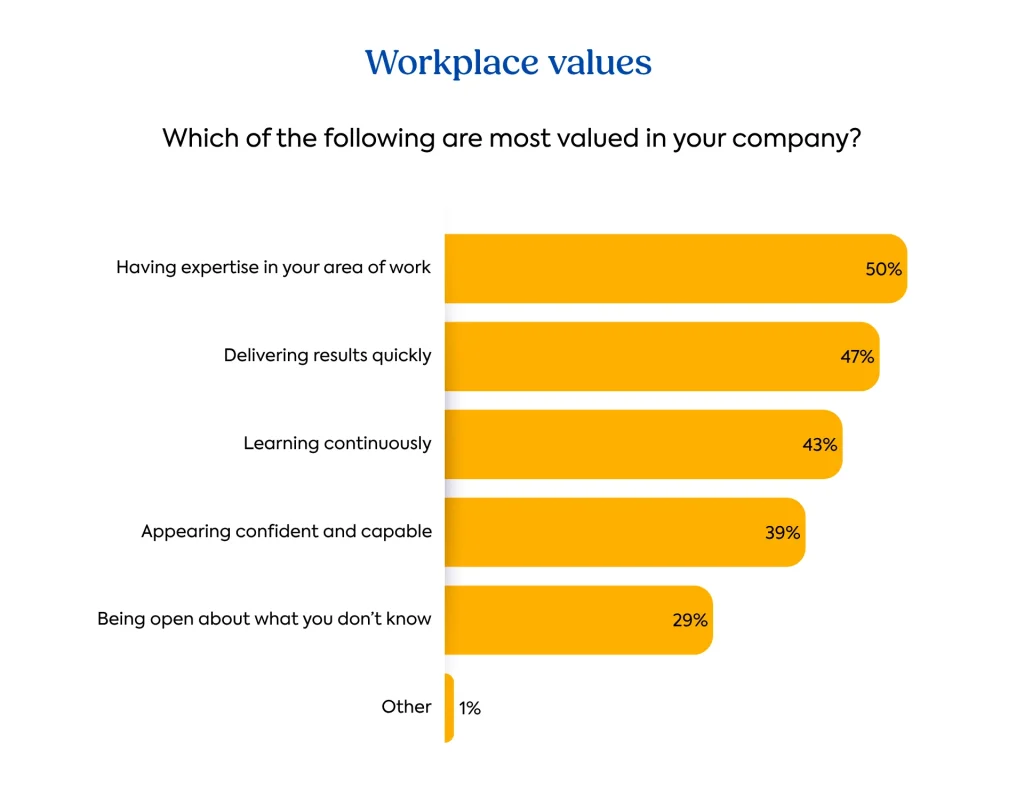
Of those who chose to stay quiet, 49% did so because they didn’t want to appear incompetent. Plus, 39% of employees say appearing confident and capable is one of the most valued attributes in their company. By comparison, just 29% of employees say their company values being open about what they don’t know.
Among employees who are falling behind on learning, 76% have stayed quiet compared with 31% of those who are fully caught up. Employees with the largest learning backlog are more than twice as likely to stay silent about it.
These findings suggest a workplace culture where appearing capable matters more than admitting uncertainty or being open about what you don’t know. When being open about what you don’t know ranks as the least valued workplace attribute, learning needs are less likely to be surfaced before they become larger problems.
When we asked employees which values their company prioritizes, half said having expertise in an area of work is one of the most valued attributes. Delivering results quickly (47%) and learning continuously (43%) also rank highly. As mentioned, being open about what they don’t know ranks last, selected by just 29% of employees.
The culprits of learning debt
Learning debt doesn’t accumulate by default. Our findings point to three underlying causes: employee training that doesn’t keep pace with change, learning that’s squeezed out by the demands of work, and workplace cultures that make it difficult to admit when support is needed.
When new tools and processes arrive without training
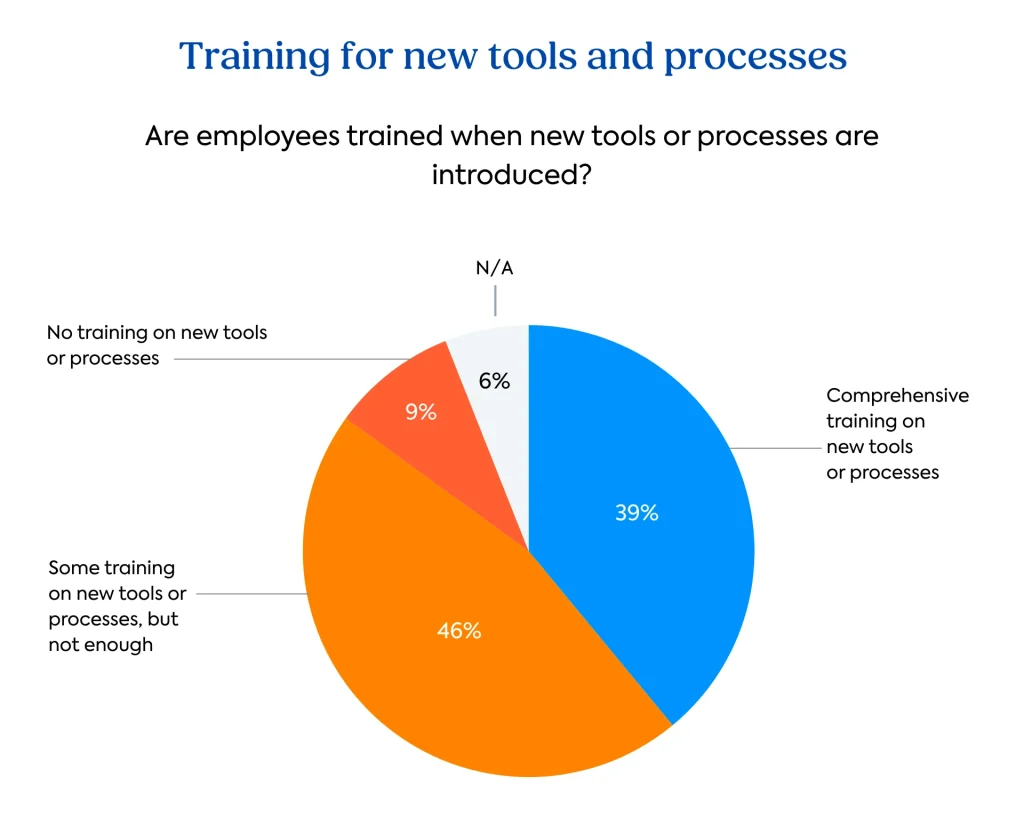
Forty-six percent of employees say they receive some training when new tools or processes are introduced, but not enough to fully prepare them. Only 39% say they get comprehensive training. Nearly one in 10 employees (9%) receive no training at all when new tools or processes are introduced.
The impact is measurable. Employees who receive no training when new tools or processes are introduced are nearly three times as likely to report falling behind on learning (17%) as those who receive comprehensive training (6%).
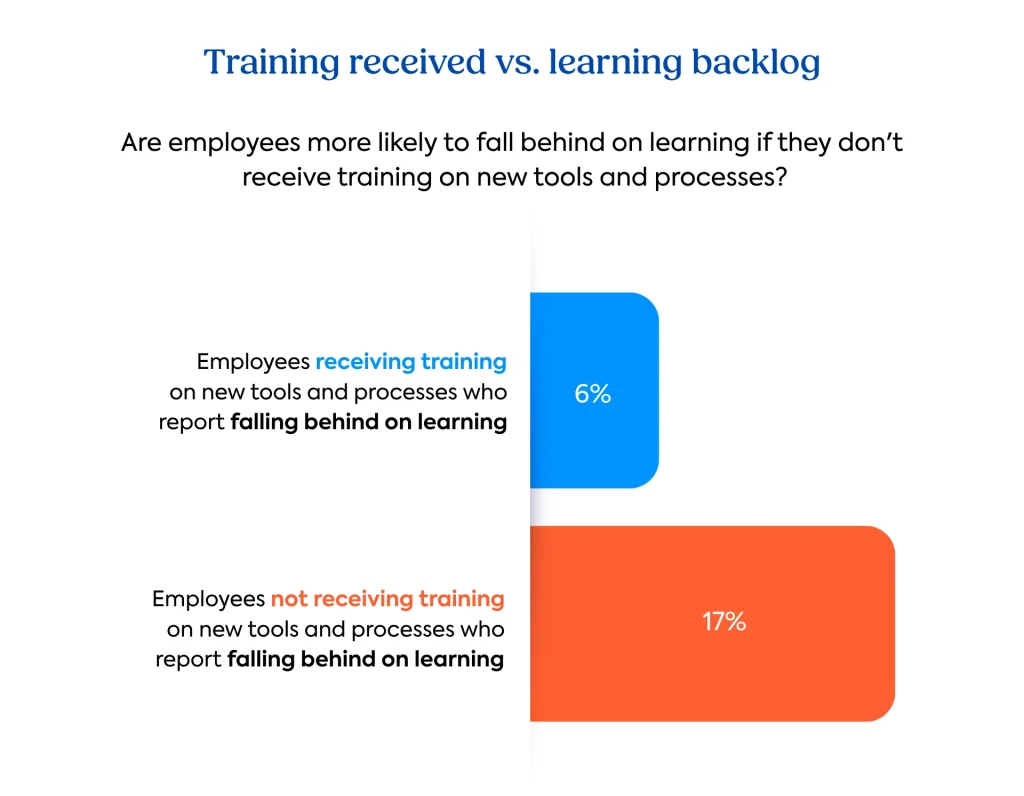
As companies continue to introduce new technologies and workflows, the timing and quality of training become critical. Employees who aren’t adequately prepared are significantly more likely to fall behind, creating the conditions for learning debt to build.
When learning can’t keep pace with work
As established earlier in this report, 41% of employees say their role has evolved faster than their company’s ability to train them. And nearly half the workforce reports some level of learning backlog. Forty-two percent of employees have catching up to do, and 8% are falling behind.
This is the defining characteristic of learning debt. Work is changing faster than organizations can prepare employees for it. The issue isn’t that employees aren’t willing to learn. It’s that learning opportunities aren’t keeping up with the demands of work.
The consequences extend beyond L&D. According to Deloitte’s 2026 Global Human Capital Trends report, 70% of business leaders say their organization’s survival over the next three years depends on being fast and nimble. Organizations can’t stay agile or build workforce readiness if learning continually falls behind business needs.
When workplace norms discourage learning
Four in ten employees (41%) feel pressured to appear knowledgeable even when they’re unsure how to complete a task. More than a third (34%) of employees feel stressed by expectations to perform tasks they weren’t trained for.
41% of employees feel pressured to appear knowledgeable even when they’re unsure how to complete a task.
These findings suggest that learning debt isn’t driven by training alone. Workplace culture also shapes whether employees feel able to ask for help when they need it.
Among employees who have stayed quiet about not knowing how to do something related to their job:
- 50% say they were expected to figure things out on their own
- 49% say they didn’t want to appear incompetent
- 29% say they didn’t feel safe admitting they didn’t know
The reasons employees stay quiet point to a cultural issue rather than an individual one. When workplace expectations discourage employees from asking for help, learning needs are more likely to remain hidden.
“When employees feel they must ‘figure it out themselves,’ learning debt compounds quickly. Silence about skill gaps is rarely an employee problem—it is often a signal that managers have not created the psychological safety needed for people to ask for help. Performance enablement requires ongoing manager-employee conversations focused on removing barriers, providing guidance, and connecting employees to the resources they need to succeed. Organizations that normalize help-seeking and reward learning agility will outperform those that mistake unsupported independence for effectiveness.”

Breaking the cycle of learning debt: What organizations can do next
Learning debt isn’t inevitable. But it won’t resolve on its own if the behaviors that keep work moving also keep learning debt hidden. The evidence in this report points to four practical ways to break the cycle.
#1 Make learning part of the job
Forty-six percent of employees say they receive some training when new tools or processes are introduced, but not enough to fully prepare them. Another 9% receive no training at all.
This finding is reinforced by the 2026 TalentLMS L&D Benchmark Report, which reveals that for the third year running, employees say lack of time is their top obstacle to training.
Learning can’t compete with deadlines when it’s treated as something separate from work. For training to keep pace with how quickly roles are changing, it needs to be embedded into the flow of work. This starts by:
- Delivering learning closer to the moment of need
- Introducing training alongside new tools and processes
- Making learning shorter, more targeted, and easier to access during the working day
#2 Surface learning debt earlier
More than a quarter of employees (28%) say their manager doesn’t know how often they struggle with the skills needed for their job.
TalentLMS’s skills visibility research points to a broader disconnect: while 90% of managers say they understand their team’s skills, only 69% of employees agree.
Managers play a critical role in identifying learning debt early, but they can only act on what they can see. The challenge isn’t whether managers care about development. It’s whether they have the tools, data, and processes needed to make learning needs visible.
Organizations can improve learning visibility by:
- Building skills conversations into weekly one-on-ones, not just annual reviews
- Making skills data easily accessible to both managers and employees
- Using learning and skills data to identify and track emerging capability gaps
- Reviewing learning needs whenever roles, technologies, or responsibilities change
- Treating surfaced skills gaps as valuable intelligence, not poor performance
#3 Reward openness, not appearances
Employees are more likely to say their company values appearing confident and capable (39%) than being open about what they don’t know (29%).
This perception has consequences. Previous TalentLMS research found that 44% of managers say skills gaps are discovered too late. The culture organizations create shapes whether employees feel able to admit what they don’t know. Rewarding openness alongside expertise encourages honest conversations about learning instead of hiding knowledge gaps. Over time, this builds confidence that’s grounded in learning rather than the appearance of having all the answers.
Creating a culture where employees feel able to speak up starts with:
- Reframing not knowing as the starting point for learning, not a sign of poor performance
- Recognizing employees who ask questions and seek feedback
- Encouraging managers to model curiosity by sharing what they’re still learning
- Treating mistakes as opportunities to learn rather than reasons to assign blame
#4 Make it safe to ask questions
Employees who stayed quiet about not knowing something most commonly said they were expected to figure things out on their own (50%), didn’t want to appear incompetent (49%), or didn’t feel safe admitting they didn’t know (29%).
These findings suggest psychological safety plays a critical role in whether learning needs are surfaced or stay hidden. This aligns with broader research on psychological safety. Harvard Business Review identifies it as one of the strongest predictors of team success. PwC’s 2025 Global Workforce Hopes and Fears Survey found that employees experiencing high levels of psychological safety are 72% more motivated than those who feel the least psychologically safe.
Together, these findings suggest the challenge isn’t simply encouraging employees to speak up. It’s about creating the conditions where speaking up feels both safe and worthwhile.
Building psychological safety requires:
- Training managers to respond constructively when employees ask for help or raise capability concerns
- Removing formal and informal penalties for admitting what someone doesn’t yet know
- Creating channels for employees to ask questions and discuss learning needs
- Normalizing learning conversations at every level
- Making it clear that admitting uncertainty is an expected part of learning and growth
- Providing safe environments where employees can practice new skills, experiment, and build confidence, including AI-powered practice spaces such as TalentLMS’s Learning Playground when appropriate
Conclusion: Invisible debt, visible cost
The findings in this report reveal a workforce that’s adapting faster than it’s learning. Half of employees report some level of learning backlog. Nearly two-thirds use workarounds to bridge training gaps. More than a third say AI has made them appear more competent than they are. And nearly half have stayed quiet about what they don’t know.
Learning debt isn’t just the learning that didn’t happen. It’s the learning organizations don’t realize they’re missing. This lack of visibility is what makes learning debt more than an L&D concern. It’s a business challenge.
The risk isn’t that employees will stop performing. It’s that organizations won’t see the gap until it shows up in the work as preventable mistakes, declining quality, and lost capability. By the time learning debt becomes visible, it’s already affecting performance.
The good news is that learning debt isn’t inevitable. Organizations can reduce it by making learning more visible. That means making learning part of everyday work, creating cultures where employees feel safe admitting what they don’t know, and giving managers the visibility to spot learning needs before they become business problems. The organizations that do this will identify learning needs sooner, respond faster, and build workforces that are better prepared for change.
Because the first step to closing learning debt isn’t more learning. It’s making the learning that isn’t happening visible.
About this research
The findings in this report are based on a survey of 1,200 full-time employees in the United States, conducted online in June 2026. Respondents were between the ages of 25 and 64. The sample consisted of 52% men and 48% women. Gender analyses in this report are limited to respondents who identified as “man” or “woman.”
Percentages may not total 100% due to rounding.
Research team
Ana Casic, Giota Gavala, Elena Koumparaki, Fiona McSweeney
Dive deeper into original research by TalentLMS



Bring out the best in your teams.
Get started with the most versatile and affordable employee training platform, no credit card needed.