
- What is DEI training?
- What DEI training isn’t
- Why is DEI training important?
- The 5 key goals of DEI training
- 6 types of DEI training programs
- Why some DEI training programs fall short
- What makes a DEI training program effective?
- The role of AI in DEI training
- Beyond completion rates: Measuring the impact of DEI training
- DEI training as part of a broader system
Companies face growing pressure to prove that training leads to real change. Time is tight. Budgets are tighter. And leaders increasingly view learning that looks complete on paper but doesn’t shift behavior across the entire organization as wasted effort.
DEI training sits right at the center of that tension. Done well, it helps create an equitable workplace, strengthens workplace culture, and reduces real risk. Done poorly, it becomes a compliance checkbox that’s ticked, reported, and quickly forgotten.
In today’s environment, that gap between intent and impact matters more than ever.
This guide breaks down what DEI training actually is, why it’s still so critical, and where DEI initiatives often fall short. But, most importantly, it shows how to design DEI training programs that work in practice, not just in theory.
What is DEI training?
DEI training helps employees and leaders build awareness, skills, and behaviors that support a more inclusive and equitable workplace.
Broken down, DEI is shorthand for diversity, equity, and inclusion. Many organizations introduce DEI training during employee onboarding and reinforce it through mandatory compliance training, typically on an annual basis. While the scope and depth vary by role and region, core DEI-related training is commonly required for all employees. It focuses on raising awareness of unconscious bias, understanding different backgrounds and experiences, and developing the skills needed for respectful, fair interactions at work.
Done well, DEI training for employees changes not just how people think, but how they act, make decisions, and work together. This goes on to reduce discrimination, improve collaboration, support stronger employee engagement, and minimize organizational risk.
Strong diversity, equity, and inclusion training connects all three of these components:What does DEI stand for?
What DEI training isn’t
DEI training isn’t successful just because it exists. If the intent doesn’t lead to impact, it simply ticks a box without changing behavior. Worse still, it can cause long-term damage to both employees and businesses. Because DEI doesn’t just live in policy. It sits at the intersection of culture, compliance, and risk. And when DEI training fails to address bias or challenge hidden assumptions, the consequences often show up in decision-making, trust, and employee engagement.
DEI training: Common misconceptions
Why is DEI training important?
In 2026, many organizations increasingly view DEI as a business-critical capability, particularly for managing diverse teams, navigating risk, and sustaining performance. DEI training for employees matters because it directly impacts both the employee experience and business outcomes. It shapes how work gets done, how safe and fair the workplace feels day to day, and the culture that ultimately takes hold. All of this, in turn, influences performance, retention, and risk—three key factors that directly affect the bottom line.
Let’s break this down.

Improves employee engagement, well-being, and belonging
When implemented well, DEI training shapes how employees experience work day to day.
Psychological safety, well-being, and trust aren’t “soft” outcomes. They all influence collaborative working, performance, and retention across inclusive teams.
When employees feel included and valued, they enjoy a high level of mental well-being and employee engagement. They’re also naturally more productive.
According to Gallup, the combined behaviors of highly engaged business units result in a 23% increase in profitability. Employees are also more likely to stay with companies that recognize and celebrate diverse ethnicities and identities.
Boosts employer branding and recruitment
DEI initiatives that nurture engagement and belonging also shape how an organization is perceived externally. When organizations reinforce inclusion and equity through meaningful training, they help build a reputation as a company that takes fairness seriously. Not just in policy, but in practice. This has a direct impact on recruitment, not just retention. Over half (53%) of U.S. workers say diversity, equity, and inclusion (DEI) is a key factor when considering a company for employment.
Helps address bias at work
Bias shows up in everyday ways:
- Who receives feedback
- Who gets stretch opportunities
- Whose ideas are taken seriously.
It can be conscious or unconscious.
Conscious bias refers to deliberate, aware judgments or preferences people hold about others. These are often based on beliefs, values, or stereotypes they recognize.Conscious vs unconscious bias
Unconscious bias refers to the automatic, unintentional assumptions people make about others, shaped by background, culture, and experiences.
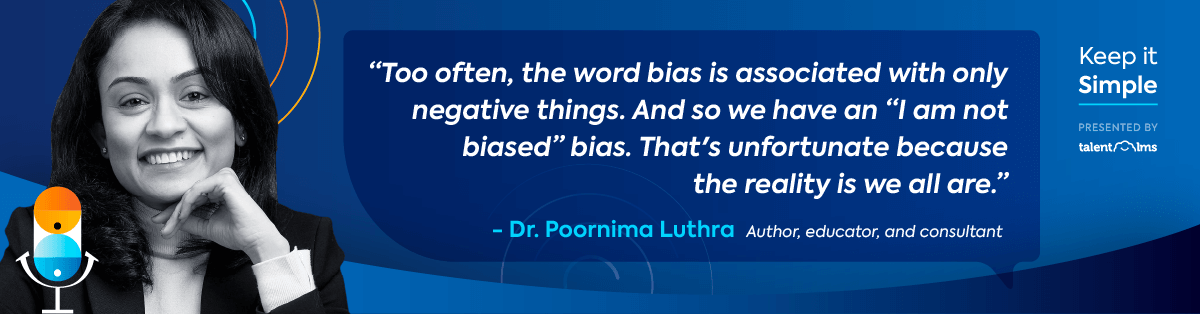
Importantly, bias itself is not evidence of bad character. As Poornima Luthra notes in TalentLMS’s Keep it Simple podcast, people often frame bias ss purely negative. But we all have biases. The problem isn’t having them; it’s failing to recognize how they influence decisions.
Effective DEI training reflects this reality. Rather than relying on guilt or blame, it focuses on building practical skills that help employees spot patterns, question assumptions, and make more deliberate decisions in the moment.
Supports equity and fair decision-making
DEI training helps HR professionals, managers, and leaders design processes that lead to more consistent outcomes, especially in:
- hiring and promotions
- access to development
- performance evaluations
Consistency reduces frustration and risk while supporting diversity goals.
Strengthens culture and performance
Many organizations now view DEI as a business-critical capability that builds sustainable performance and resilience, rather than a standalone initiative. When DEI efforts stall, the impact goes beyond perception. Trust erodes, retention suffers, and exposure to real workplace risk increases, especially for employees from marginalized groups.
This aligns with broader findings from McKinsey, which show that organizations with stronger diversity, equity, and inclusion are more resilient and more likely to outperform their peers.
Reduces workplace risk and harassment
At its best, DEI training also plays a role in reducing workplace harassment—an issue that costs businesses millions of dollars each year through lost productivity, turnover, and legal risk.
According to the 2026 TalentLMS Workplace Misconduct Report, sexual harassment remains prevalent: 14% of employees say they’ve witnessed it, and 11% report experiencing it themselves. At the same time, only 45% of employees say they receive harassment prevention or code of conduct training.
This gap between risk and readiness highlights why DEI training needs to be treated as a core capability, not an optional initiative.
Increases innovation through learning
Diverse teams bring different perspectives and ways of thinking. That diversity of experience fuels learning, sparks new ideas, and helps teams solve problems more creatively than homogeneous groups.
The 5 key goals of DEI training
The ultimate goal of effective DEI training is to create a more inclusive culture. At its core, DEI training should deliver on five different levels. These equate to 5 practical goals that show themselves, not in slogans or in statements of intent. But in real outcomes that impact how work gets done.
The key goals of effective DEI training include:
- Building awareness of bias and difference
Employees learn to identify unconscious bias, understand cultural dynamics, and spot how assumptions influence everyday actions. - Developing inclusive behaviors
People gain practical tools to communicate clearly, give fair feedback, and act when exclusion or harm occurs. - Supporting fair and consistent decision-making
Hiring, performance, and promotion processes become more equitable and transparent across the organization. - Creating safer, more inclusive workplaces
Teams foster psychological safety, reduce harm, and build environments where people feel genuinely respected. - Reducing organizational risk
Teams surface and resolve issues early, before they lead to disengagement, attrition, or formal complaints.
Having clear goals like these makes DEI training easier to design, measure, and improve. And are far more likely to deliver lasting impact.
6 types of DEI training programs
Generally speaking, modern DEI training prioritizes active participation over passive listening to achieve lasting behavioral change. Rather than relying on one-way presentations, effective programs engage employees through discussion, reflection, and real-world scenarios.
Many L&D teams also consider microlearning an effective model. Delivering short sessions, microlearning ensures better knowledge retention compared to annual workshops. Combining these approaches, effective DEI training programs usually target the following specific behaviors and outcomes.
- Bias awareness and mitigation
Often delivered as unconscious bias training, this helps employees recognize implicit bias and challenge biases shaped by social conditioning - Inclusive leadership and inclusive management
Focuses on how leaders and managers influence inclusive behaviors, psychological safety, and fairness through daily actions. Not just as value statements from the C-suite. - Equity and inclusion
Supports fairer processes in hiring, promotions, performance reviews, and access to opportunities that help level the playing field. - Allyship and bystander intervention
Gives employees tools to respond to workplace harassment or exclusion and reinforce positive behaviors without escalating conflict. - Psychological safety and belonging
Strengthens trust, voice, and participation so people feel valued in an inclusive work environment. - Inclusive communication and cultural competence
This focuses on the interpersonal skills people need to work respectfully across differences. It typically includes:
-
- Skills-based diversity training
Builds practical skills such as communication, empathy, and perspective-taking to support everyday collaboration. - Cultural competence and sensitivity
Helps employees understand and navigate cultural differences, including religious beliefs, sexual orientation, and social norms, to support respectful dialogue across a diverse workforce. - Religious sensitivity training
Encourages employees to be aware, respectful, and accepting of all religions and belief systems, helping prevent exclusion or misunderstanding. - Microaggressions awareness
Helps employees recognize subtle behaviors or language that can marginalize others, even when no harm is intended. - Anti-oppression and allyship
Explores historical and systemic forms of oppression and equips employees with tools to act as allies in everyday situations
- Skills-based diversity training
Why some DEI training programs fall short
Despite the importance of DEI training, 2026 TalentLMS workplace misconduct research shows that 27% of employees say their company has pulled back from DEI efforts, and 31% say they feel less protected at work as a result.
This lack of sustained commitment is concerning. But the relationship between investment and impact isn’t always linear. Most DEI training programs don’t fail because of bad intent. They fall short because of how they’re designed, supported, and reinforced over time. Here are some examples of common pitfalls.
One-off or checkbox-based training
Single sessions rarely lead to sustained change across an organization.
Mandatory training can also backfire when it’s rolled out without context or support. When people feel forced through DEI training without understanding the purpose, defensiveness and resistance increase. That reaction doesn’t mean training isn’t needed; it means the approach needs to focus on learning, relevance, and psychological safety.
Low skill transfer
People may build awareness but struggle to apply it in real situations without practice and reinforcement.
Training without context or relevance
Generic scenarios don’t translate into the real decisions managers and co-workers face every day.
No measurement or follow-through
When success is measured only by attendance, training stops at completion instead of driving capability.
What makes a DEI training program effective?
A DEI training program doesn’t have to be complicated, but it does require intention. Here are five strategies designed to deliver DEI training that makes a difference to day-to-day behavior and decision-making. As well as long-term culture change and company performance.
Start with a DEI audit to identify real challenges
Effective DEI training for employees starts with understanding what’s actually happening inside your organization.
A DEI audit helps identify specific cultural challenges, gaps in representation, and decision points where bias or inequity may show up. Without this context, training risks staying generic and missing the issues employees face day to day.
When training is shaped by real data—not assumptions—it’s more relevant, more credible, and far more likely to change behavior.
Design DEI training as a continuous system
A meaningful commitment to DEI needs to be an ongoing practice in any organization. This should be reinforced through systems, leadership behavior, and accountability over time, not limited to a single training moment.
Anchor learning in real roles and scenarios
People are more likely to develop inclusive behaviors when training reflects their responsibilities. Generic examples rarely translate into real behavior change. When learning is grounded in familiar scenarios, people can see what inclusive action looks like in practice, not just in theory.
Tailor DEI training by role and responsibility
Effective DEI programs are strongest when they reflect the influence people have on others and outcomes.
For individual employees, focus training on communication, collaboration, and everyday conduct.
For managers, prioritize training that supports fair feedback, evaluation, and team dynamics.
For leaders, inclusivity training for those in senior roles needs to center around commitment. This translates to modeling inclusive culture and reinforcing DEI initiatives through decisions and accountability.
Integrate DEI learning into workplace systems
Organizations see the greatest impact when DEI learning is reinforced by everyday systems and processes. Aligning learning with company values, performance reviews, leadership expectations, and other initiatives helps turn inclusion from a concept into a consistent way of working.
The role of AI in DEI training
AI isn’t a shortcut to inclusion. But it can help remove some of the biggest barriers to effective DEI training: time, scale, and relevance.
Supporting learning at an individual pace
People absorb sensitive or complex topics differently. AI-enabled learning can support reflection by allowing employees to engage with content at their own pace, revisit concepts when needed, and explore scenarios without pressure.
This flexibility helps reduce defensiveness and supports a deeper understanding, especially when learning involves topics like bias, inclusion, or difficult workplace situations.
Scaling DEI learning across the organization
Traditional DEI training often struggles to scale. Live sessions can be time-intensive, inconsistent, and difficult to repeat.
Organizations see the greatest impact when AI supports learning experiences across teams, locations, and time zones without lowering quality. This makes it easier to reinforce DEI principles over time, rather than relying on one-off initiatives.
Making DEI training more relevant
One of the greatest challenges with DEI training is relevance. Generic examples and one-size-fits-all content rarely translate into real behavior change.
AI can help tailor training to different roles, responsibilities, and contexts—so employees engage with scenarios that reflect the decisions they actually face. This makes learning feel practical rather than theoretical, increasing the likelihood that new behaviors stick.
Beyond completion rates: Measuring the impact of DEI training
Tracking the right metrics over time is essential to ensure DEI training is driving real organizational change, not just participation. Attendance alone doesn’t show whether training worked.
Pre- and post-assessments can help measure shifts in employee attitudes, confidence, and knowledge toward DEI, especially when paired with behavioral indicators. Used well, assessments don’t just prove learning happened. They also highlight where reinforcement or follow-up is needed.
Other meaningful signals include:
- improvements in employee engagement
- consistency in people decisions
- participation and voice
- reductions in complaints or incidents
DEI training as part of a broader system
DEI training works best when it’s treated as part of a broader system, not a one-off solution.
The goal isn’t to check a box. It’s to build capability that holds up under pressure.
In a world of constant change and growing scrutiny, training that doesn’t work isn’t neutral anymore. It’s worse than that. It creates risk, reinforces inconsistency, and undermines trust. And DEI training is no exception.
This isn’t just about proving learning’s value to the business. It’s about making sure training truly serves the people it’s meant for—especially in areas like DEI, compliance, and leadership. Because when learning drives real change, it doesn’t just improve outcomes. It improves experiences, confidence, and culture. And that’s the kind of impact that matters.
Originally published on: 25 Feb 2022