
Your employees already have strengths that could help your business perform better. The harder question is, can you see them clearly enough to put them to work?
That’s a bigger challenge than many managers realize. TalentLMS research found that 90% of managers say they understand their direct reports’ skills. But only 69% of employees agree that their manager understands what they can do.
When employee strengths stay hidden, development gets harder. Managers may assign the wrong work. Learning and development (L&D) teams can end up training for assumed gaps. And existing capabilities may be overlooked just as the business needs them.
In this guide, we’ll look at common employee strengths and, more importantly, how managers, HR, and L&D teams can identify and develop them. You’ll get practical ways to assess strengths, address development needs, and help employees build capabilities that keep pace with changing roles and business priorities.
TL;DR
The strengths of employees are the talents, skills, and capabilities they consistently apply well at work.
But before you can develop those strengths, you need to know how to spot them. And once you know what someone does well, you need to turn that insight into action.
For managers, HR, and L&D teams, that means making strengths part of an ongoing development process rather than a once-a-year performance review. A simple four-step approach can help:
- Identify: Use performance data, employee conversations, assessments, feedback, and observation to understand existing employee strengths.
- Develop: Match learning, coaching, peer support, and stretch assignments to specific capabilities.
- Apply: Give employees meaningful opportunities to use and extend their strengths at work.
- Review: Revisit strengths and development needs as roles, technologies, and business priorities change.
What are employee strengths?
Employee strengths are talents, learned skills, and capabilities that employees show consistently and effectively at work. They can include technical abilities, such as data analysis or project management, and soft skills, such as communication skills, critical thinking, adaptability, and emotional intelligence.
A capability becomes particularly valuable when an employee can apply it consistently to produce useful outcomes.
For example, someone might know how to use project management software. That’s a technical skill. Their ability to combine that knowledge with organizational skills, communication, and problem-solving to keep a complex project moving is a broader workplace strength.
Examples of essential employee strengths
What counts as an essential employee strength depends on the role. A support specialist working in a customer service department and a software developer in IT won’t have identical requirements.
But some key employee strengths are valuable across many roles. The examples below aren’t a checklist for every job. The strengths that matter most should reflect the employee’s responsibilities, team goals, and the capabilities the business needs.
| Employee strength | What it looks like at work |
| Communication | Shares information clearly, listens well, and adapts communication to the audience. |
| Adaptability | Responds constructively and maintains a positive attitude when priorities, tools, or processes change. |
| Teamwork | Shares knowledge, collaborates, and works toward team goals. |
| Critical thinking and problem-solving skills | Assesses information, identifies problems, and makes reasoned decisions. |
| Emotional intelligence | Recognizes emotions and responds appropriately in workplace interactions. |
| Time management | Organizes work and meets deadlines without losing sight of priorities. |
| Initiative | Takes useful action without needing constant direction. |
| Learning agility | Learns from experience and applies new knowledge to unfamiliar situations. |
| Leadership | Gives direction, builds trust, and helps others perform well. |
| Dependability and accountability | Follows through on commitments and takes responsibility for outcomes. |
| Project management | Coordinates people, tasks, resources, and deadlines toward an agreed outcome. |
| Technical skills | Applies role-specific knowledge and tools effectively and consistently. |
For a more comprehensive list of workplace strengths, see our guide to 31 work-related strengths.
How to identify employee strengths
Knowing where employee strengths lie isn’t always straightforward. Performance data can show what someone delivers, but it may not reveal all the skills behind those results.
And, as the TalentLMS research we mentioned earlier shows, managers and employees don’t always have the same view of existing skills. That visibility gap is another reason to look at employee strengths from several angles.
Performance and outcomes are a good starting point. But combining them with employee input, skills assessments, feedback, and observation builds a far fuller picture of what employees do well. And where they could develop further.
Here are five ways to build that picture.
Review performance and outcomes
Start with evidence.
Look across projects, goals, performance reviews, customer feedback, and other relevant results. You’re looking for repeated performance, rather than one memorable success.
Ask:
- What does this employee consistently do well?
- Where do they produce strong outcomes?
- What do colleagues regularly rely on them for?
- Which capabilities appear across different tasks or projects?
Then connect the strength to its impact. “Good communicator” is vague. “Explains technical problems clearly enough for nontechnical customers to take action” is useful.
Ask employees where they perform and learn best
Employees can surface strengths that performance data doesn’t capture.
Use regular 1:1s to ask where they feel most effective. Which tasks come naturally? What work gives them energy and job satisfaction? What do colleagues ask them for help with? What would they like to do more of?
These conversations can also reveal capabilities that an employee’s current role doesn’t give them many opportunities to show.
Use skills assessments
Skills assessments add structure to what can otherwise become a subjective process.
Use assessments to establish current proficiency, confirm known strengths, and spot development needs. Depending on the capability, that could mean a knowledge test, practical assignment, scenario, simulation, or role-specific assessment.
Don’t treat an assessment score as the whole answer. Combine it with performance, employee input, and evidence of how the skill is applied at work.
Skills gap assessments and surveys can measure technical skills, communication skills, and problem-solving abilities.
A skills gap analysis template can help you bring this information together, compare the skills your team has with the ones it needs, and identify where development is most important.
Gather peer and 360-degree feedback
Managers only see part of an employee’s work.
Peers, direct reports, project leads, and other collaborators can reveal employee strengths that appear in different situations. A colleague might notice who keeps a project calm under pressure. A direct report may have a clearer view of someone’s coaching skills.
Ask for constructive feedback from colleagues who work closely with your team to gain a well-rounded perspective.
Look for patterns across sources. 360-degree feedback reduces the risk of one person’s assumptions becoming the final verdict. The same behavior appearing repeatedly across feedback, outcomes, and observation is a much stronger signal.
Observe strengths in action
Some employee strengths are easiest to spot when work gets difficult.
Watch what happens during a tight deadline, an unfamiliar project, a customer problem, or a sudden change in priorities. Who creates clarity? Who adapts? Who asks the questions that uncover the real problem? Who brings other people with them?
Observation also helps distinguish between knowing something and being able to apply it.
How managers can develop employee strengths
Identifying employee strengths creates visibility. Development turns that visibility into capability the business can use.
Many employee strengths can be learned, practiced, and improved. A targeted L&D strategy can help employees build on what they already do well, build related skills, and apply those strengths where they can make a difference.
But development shouldn’t wait for the next annual review. As roles, technology, and business needs change, managers need to keep learning opportunities relevant and responsive.
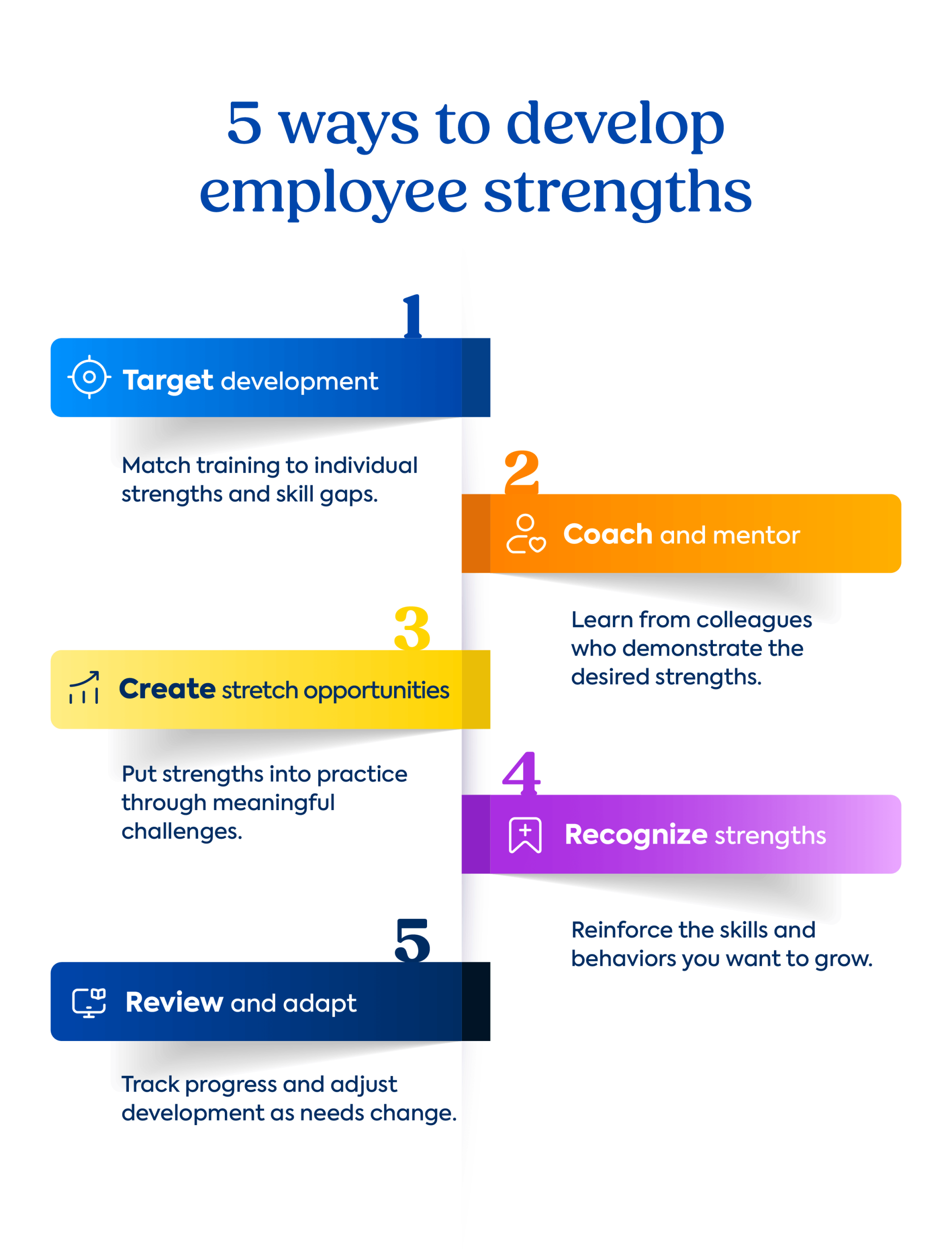
Here are five practical ways to develop employee strengths as those needs evolve:
Create targeted learning and development
Start with the strength or development need you’ve identified, then work backward to the right learning.
Avoid assigning generic courses simply because they’re available. Consider whether the employee needs to build skills or knowledge, strengthen an existing capability, or gain more opportunities to put it into practice.
If an employee has strong technical expertise but needs to communicate that expertise to customers, for example, focus development on presentation, listening, and audience-specific communication.
Structured learning paths can connect individual courses and practice to a defined capability. They also make structured development easier to repeat across teams as the business grows, rather than creating a new training plan from scratch every time.
The aim is targeted training with a clear purpose: What should this person be able to do differently or better afterward, and where will that make a difference?
Use coaching, mentoring, and peer learning
Not every employee strength needs a course.
Pair employees with colleagues who already demonstrate the capability you want to develop. Mentoring, job shadowing, peer feedback, and coaching give people the chance to see how a strength works in context.
They also make existing expertise easier to share across the organization while supporting employees’ personal and professional growth.
Give employees stretch assignments
Training creates opportunities to learn. Work creates opportunities to prove and extend that learning.
Give employees projects where they can use an existing strength at a higher level. Someone with strong communication skills might lead a stakeholder presentation. An employee showing leadership potential could coordinate a cross-functional project.
The stretch matters. So does support. The goal isn’t to throw someone into an unfamiliar situation and hope for the best.
Recognize and reinforce strengths
When employees use their strengths effectively, acknowledge it. Recognition helps reinforce the behaviors and capabilities you want people to keep developing and applying.
Be specific about what the employee did well and the impact it had. Instead of encouraging employees by saying “Great job!” explain what they did and why it mattered. For example, “You simplified a complicated issue, which helped the customer make a decision quickly.”
Specific recognition shows employees which behaviors are worth repeating. It also connects personal strengths with team and business outcomes.
Recognition doesn’t always need to be formal. Simple employee appreciation ideas, from timely praise to celebrating contributions with the wider team, can help boost employee morale and encourage them to keep building on what they do well.
Review progress and adapt development
Strengths aren’t static because work isn’t static.
TalentLMS’s 2026 Speed-to-Skill research found that seven in ten respondents say employees need faster ways to practice skills as job demands change. Thirty-eight percent of managers also say it’s difficult to predict which skills their team will need in the next 12 months.
So revisit development regularly.
Ask what’s changed. Which strengths have grown? Which need more practice? Are new responsibilities creating new development needs? Keeping an eye on in-demand employee skills can also help you spot capabilities that may become more important.
Questions like these help build training at the speed of growth: development that’s responsive and ready when the business is, rather than a plan created once and left untouched.

Lilith Christiansen is founder of HumanGenuity, an HR consulting firm helping organizations design employee experiences, from onboarding to everboarding, that unlock potential and improve performance.
Expert Tip: How Managers Can Identify and Nurture Employee Strengths
Managers can spot employee strengths by watching where energy and excellence intersect.
Three practical actions help:
First, notice when someone lights up while solving a problem and consistently delivers strong results.
Second, ask in one-on-ones when they feel most energized and what tasks they complete effortlessly, then encourage them to share these skills with colleagues.
Third, create a ‘colleague feedback loop’ where team members highlight each other’s standout contributions in weekly check-ins.
To nurture strengths, give stretch assignments in these areas and place employees on projects where their talents are visible. Reinforce with timely feedback and connect contributions to team goals. This turns natural talents into lasting capabilities that benefit both employee and organization.
Why developing employee strengths matters
Developing employee strengths has benefits beyond individual growth. It can improve performance and engagement, help teams work more effectively, and give businesses more capability to draw on as priorities change.
Better performance and productivity
Gallup reports that incorporating strengths into how teams work can increase productivity by up to 18%
When managers understand what people do well, they can match work more closely to existing capability and target development where it’s needed most. That can support a more productive workplace, where employees can put their strengths to use while continuing to build the capabilities their roles require.
Greater engagement and retention
Employees are more likely to see a future inside an organization that incorporates strengths into their workplace approach. According to Gallup, this leads to 23% higher employee engagement and 72% lower turnover. TalentLMS research highlights the other side of that picture: 31% of employees would consider leaving because of a lack of skill-development opportunities. prob
Stronger collaboration
Understanding employee strengths gives teams a clearer view of who can contribute what. When that visibility extends across the entire organization, it becomes easier to find expertise, share knowledge, and bring complementary capabilities together.
That can improve how work is distributed, where colleagues seek expertise, and how complementary capabilities come together on projects.
Greater adaptability and problem-solving
A business can’t respond quickly to change if it doesn’t know what capabilities it already has.
Better visibility makes it easier to find existing expertise, build missing capabilities, and move people toward emerging priorities.
Employee strengths and weaknesses: What’s the difference?
Employee strengths are capabilities someone demonstrates effectively and consistently. Employee weaknesses are areas where their skills, knowledge, behaviors, or confidence need further development.
Weaknesses can highlight opportunities for growth. Identifying the ones that matter most and creating a development plan can help employees close important gaps and, where relevant, build new strengths.
The same capability can look very different from one employee to another:
| Strength | Corresponding development area | Development action |
| Time management | Procrastination or missed priorities | Planning practice, clearer priorities, and regular check-ins |
| Communication | Unclear or overly complex communication | Feedback, presentation practice, and audience-focused training |
| Adaptability | Resistance to changing processes | Supported exposure to change, coaching, and reflection |
| Delegation | Holding onto too much work | Coaching plus gradual delegation of meaningful tasks |
| Teamwork | Difficulty collaborating | Peer projects, feedback, and conflict-management practice |
Don’t assume every weakness needs to become an employee strength.
Start by identifying the behavior and understanding the gap. Then agree on a relevant development goal, provide opportunities to learn and practice, and review progress.
A highly effective data analyst doesn’t need to become an exceptional public speaker unless presenting analysis is important to their role.
Development works better when there’s a reason behind it.
Make employee strengths part of ongoing development
Employee strengths shouldn’t be a once-a-year performance-review conversation.
Use a simple cycle: Identify. Develop. Apply. Review.
Identify what employees consistently do well and where capability needs to grow.
Develop those capabilities with targeted learning, coaching, mentoring, and practice.
Apply strengths through meaningful work, new responsibilities, and stretch assignments.
Review the evidence and adapt as roles and priorities change.
Then repeat.
That last step matters. Skills can lose relevance, responsibilities expand, and new technology changes what good performance looks like.
Training that keeps pace responds to those changes. Instead of waiting for an annual development cycle, managers and L&D teams can spot needs earlier, build the right capabilities, and put them to work while they still matter.
Turn employee strengths into capability
Identifying employee strengths gives managers something every development strategy needs: visibility. But the real value comes from connecting what employees can do today with what they’ll need to do next.
That means targeted development, opportunities to practice, specific feedback, and regular reviews as business needs change.
Your people are already building skills. Make those strengths easier to see, easier to develop, and easier to put to work.
FAQs
What are employee strengths?
Employee strengths are the skills, talents, and abilities employees consistently perform well at. They include both soft skills, like communication and teamwork, and technical skills, such as data analysis or software expertise.
What are examples of employee strengths?
Common employee strengths examples include communication skills, problem-solving, accountability, adaptability, teamwork, critical thinking, leadership, and learning agility. The most valuable strengths depend on the role and business needs.
What is the difference between employee strengths and weaknesses?
Employee strengths are capabilities someone demonstrates consistently and effectively. Weaknesses are areas where skills, knowledge, behaviors, or confidence need development. Managers should focus development on weaknesses that matter to the employee’s role or future business needs.
How can managers identify employee strengths?
Managers can identify employee strengths through performance reviews, skills assessments, peer feedback, and observation. Paying attention to tasks that employees successfully and easily complete helps reveal their strongest capabilities.
What employee strengths should you include in a performance review?
Include strengths that are relevant to the employee’s role and supported by specific examples. Explain the behavior, its impact, and how the employee could apply or develop that strength further. Avoid vague labels such as “hard worker” without evidence.
What are the top 3 strengths at work?
Three broadly useful strengths at work are communication, problem-solving, and adaptability. However, the most important strengths depend on the employee’s role, responsibilities, and business needs.
What are the top 5 employee strengths?
Five widely applicable employee strengths are communication, adaptability, critical thinking and problem-solving, teamwork, and dependability/accountability. Different roles will require different combinations of strengths.