

Training ROI (Return on Investment) is the quantifiable financial value a business gains from its learning and development programs compared to the total cost of running them.
In this article, we cover seven practical, proven ways to measure training ROI. We also explore the common measurement pitfalls that trap many small and mid-sized businesses (SMBs). And show you how to design training programs that go beyond checking boxes to build learning that drives measurable business outcomes.
What is training ROI, and how to calculate it
Training ROI is a method for determining whether the time and money spent on training employees has yielded a positive return. It compares the financial benefits gained (like increased sales or fewer errors) to the total cost of the training. If the ROI is positive, the training made money; if negative, it lost money.
To calculate ROI of training, use this formula:
- Training ROI (%) = (Net Program Benefits ÷ Training Costs) × 100
The benefits of measuring training ROI
The benefits of ROI are best understood when grouped into tangible and intangible assets.
Tangible benefits
Tangible benefits are easy to measure and directly impact the bottom line. They include:
- Higher productivity: Employees produce more widgets or close more tickets per hour.
- Increased sales: Sales teams close deals faster or with higher values.
- Fewer errors: Less waste in manufacturing or fewer bugs in code.
Intangible benefits
Intangible benefits are harder to quantify but just as important for long-term success. They include:
- Employee engagement: Staff feel invested in and are happier at work.
- Retention: People stay longer because they see career growth (saving hiring costs).
- Customer satisfaction: Happy, well-trained employees treat customers better.
Costs
To get an accurate ROI, you have to count the direct costs (money leaving the bank) and the indirect costs (money you’re losing in productivity or time).
Here’s a breakdown of what these costs can be.
Direct costs:
- LMS platform fees: Monthly or annual employee training software subscription costs.
- Course development: Fees paid to vendors or contractors to build the content.
- Facilitator fees: Determining the daily rate or speaking fee for the instructor.
- Materials & licenses: Workbooks, printing, or per-user license fees.
Indirect costs:
- Learner salaries: The biggest hidden cost. The hourly wage of employees taking time out for training.
- Lost productivity: The value of the work not getting done while employees are learning (opportunity cost).
- Admin support: The HR or admin time spent scheduling training, sending invites, and tracking attendance.

Why training ROI matters
According to The TalentLMS 2026 Annual L&D Benchmark Report:
“When it comes to business alignment, 75% of HR managers say their company’s L&D strategy is aligned with KPIs. Only 5% disagreed, showing that most organizations view learning as part of the business engine.”
This statistic indicates that the industry is undergoing a shift. Training is no longer just a perk. In 2026, it’s a core part of how businesses achieve their Key Performance Indicators (KPIs).
It’s becoming a survival skill for L&D departments, and here’s why:
- Tight budgets: Companies are scrutinizing every dollar. If you can’t prove your training makes money, your training budget is the first to get cut.
- Leadership demands: CEOs and CFOs don’t want feel-good metrics. They want measurable impact tied directly to business outcomes.
- The relevant data is there: With the expansion of digital and remote learning, we have better analytics than ever before. You can track exactly what people do after they learn, making ROI easier to prove.
- Competitive disadvantage: If your competitors are using data to optimize their workforce and you aren’t, you risk falling behind in innovation and talent retention.
7 proven ways to measure training ROI
Measuring training ROI requires connecting learning to business metrics. That shift moves organizations beyond checkbox training and toward performance-based learning that drives real performance. These seven approaches show how to do exactly that.
| Ways | How |
|---|---|
| 1. Measure productivity | Establish a baseline (for example, output per employee or time-to-competency), re-measure after 60 to 90 days, and convert time saved into monetary value using wage data. |
| 2. Track revenue impact | Compare revenue before vs. after training (or trained vs. untrained groups), calculate the improvement, and subtract training costs to determine net gain. |
| 3. Calculate cost savings | Identify cost drivers (errors, rework, fines), measure reduction post-training, and assign a dollar value to the savings. |
| 4. Quantify retention and engagement improvements | Track turnover before and after training, calculate replacement costs, and multiply reduced departures by cost per hire. |
| 5. Move beyond surveys with the Kirkpatrick Model | Measure reaction and learning immediately, then assess behavior change and connect it to business results 60 to 90 days later. |
| 6. Measure skill application at 90 days | Conduct manager evaluations and review performance KPIs three months post-training to confirm sustained behavior change. |
| 7. Use forecasting to measure training ROI before you launch | Estimate expected employee performance improvement, assign financial value, calculate total cost, and model projected ROI before rollout. |
1. Measure productivity
This method of measuring training ROI focuses on efficiency gains. You’re essentially looking to see if your employees are doing more work in the same amount of time.
Let’s say you have a team of graphic designers. Before training, it takes them 10 hours to finish a design. You send them to a Mastering Design Tools workshop. Afterward, they can finish the same quality design in 8 hours, which saves you 2 hours of production time.
However, to get the ROI, we have to turn those hours into dollars.
Here is the simple formula logic:
- Define the metric: What are we measuring? (For example, time to complete a task, number of widgets made per hour).
- Capture the baseline: What is the score before training? (For example, 10 hours per design).
- Re-measure: Check again 60-90 days after training. (For example, 8 hours per design).
- Convert to cash: This is where you prove ROI. You take the time or output gained and multiply it by the cost of labor. For our graphic designer example: Financial gain = hours saved x hourly wage x number of employees
2. Track revenue impact
While measuring productivity is about saving money over time, tracking revenue impact is about directly making more money. This is the absolute favorite metric for executives because it’s so tangible.
It works best for revenue-generating roles, like sales or customer success teams.
Here’s how you track revenue impact:
- Identify the group: Let’s say you have a sales team.
- Compare: You can do this in two ways:
- Compare their sales before the training to their sales after the training.
- Compare a group that received the training against a control group that did not receive the training.
- Calculate the incremental revenue: Isolate the improvement percentage and calculate the additional revenue generated.
- Find the net gain: Subtract the cost of the training from that extra revenue.
Let’s say you have two sales teams:
- Team A goes through an advanced negotiation training that costs the company $2,000 total.
- Team B doesn’t take the training.
That month, Team B (untrained) closes $50,000 in sales. Team A (trained) closes $60,000 in sales.
Based on this, the net financial gain for that month is $8,000.
Tip: You don’t have to guess these numbers. You can pull them straight from your company’s CRM (Customer Relationship Management) software or monthly pipeline reports.
3. Calculate cost savings
The next way to measure training ROI is focused on how much money training saves over time.
Sometimes, a lack of training causes mistakes. Mistakes lead to wasted materials (rework), customer complaints, safety incidents, or even hefty compliance fines. If a training program reduces these headaches, that reduction is a direct cost saving.
Here’s how you measure it:
- Identify the leak: Find a measurable cost area. (For example, safety incidents or compliance fines).
- Find the historical average: How often was this happening before the training?
- Measure the reduction: Look at the numbers after the training.
- Assign a financial value: Multiply the number of avoided incidents by how much each incident usually costs.
Let’s say you run a manufacturing company facing a lot of compliance fines. On average, you get hit with 10 compliance violations per quarter. Each incident costs the company $2,000 in fines.
You roll out mandatory new compliance training for all floor workers. The next quarter, the number of incidents drops from 10 to 4, which saves $12,000 per quarter.
4. Quantify retention and engagement improvements
The next method is all centered around the hidden costs of losing good people. When people leave, it’s expensive. You have to pay for recruiters, spend time interviewing, onboard and train new hires, and absorb reduced productivity during the vacancy and ramp-up period.
Here’s how we measure the ROI of keeping people around:
- Find the baseline turnover: How many people were leaving the company (or a specific department) before the training?
- Track the new turnover: Look at the turnover rate 6 to 12 months after a targeted learning program is introduced.
- Calculate replacement cost: Determine how much it costs to replace just one employee. (HR usually has this number.)
- Do the math: Multiply the number of people who stayed (reduced departures) by the cost to replace them.
Let’s say your company normally sees 15 customer service reps quit every year. HR calculates that it costs $10,000 to replace just one rep.
The company launches a new Career Pathway training program to keep reps engaged. The following year, only 10 reps quit. By keeping those extra employees on board, you saved $50,000 that year.
5. Move beyond surveys with the Kirkpatrick Model
A big mistake many businesses make is relying on a survey right after a training session. Enjoying a training session doesn’t mean it improved performance or delivered measurable business results.
There are lots of different training evaluation methods. But measuring training effectiveness requires more than satisfaction data. It requires evidence of learning impact and observable training results. The Kirkpatrick Model is the gold standard in the employee development world for measuring the effectiveness of training across four distinct levels.
Here is the breakdown:
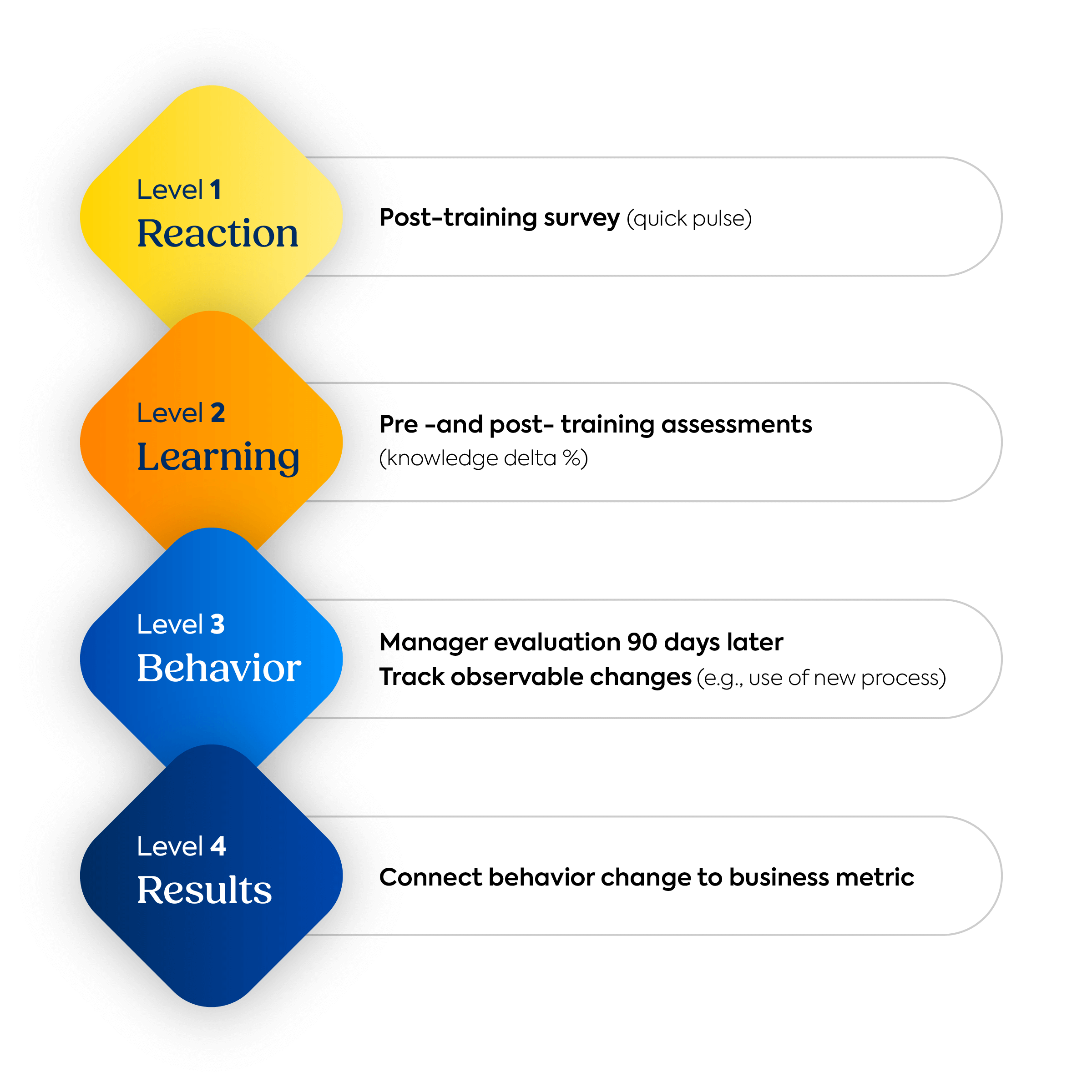
- Level 1. Reaction: This is your standard post-training survey (sometimes called a smile sheet). It gives you a quick pulse check on whether training was engaging. But it doesn’t prove ROI.
- Level 2. Learning: You measure this by giving employees a quiz or assessment before the training and another one after. The difference in scores (the knowledge delta) is your Level 2 measurement.
- Level 3. Behavior: You measure this about 90 days later by asking managers to observe employees to see if they’re using the new process.
- Level 4. Results: This is where you connect learning effectiveness to tangible business outcomes. For example, higher sales, fewer accidents, or better customer satisfaction.
Good training ROI only happens when you reach levels 3 and 4.
6. Measure skill application at 90 days
The next method ties directly into Level 3 of the Kirkpatrick Model we just talked about.
In our podcast L&D in 2026: Learning debt, AI, and transformation, David Kelly explains how we need to shift our way of measuring training ROI:
“Rethink language and let go of vanity metrics. Move beyond outdated labels and surface-level metrics that no longer reflect impact. Shifting language (for example, from “learners” to “doers”) can expand how teams define value and unlock solutions.”
Here’s how you measure skill application with that shift in mindset:
- Wait 90 days: Don’t check immediately. Give employees 3 months to settle into their workflow and build a habit. Real learning impact only occurs when learning shows up in the flow of work, not just in assessments.
- Survey managers: Ask leaders if their team consistently applies the new skill on the job.
- Check the KPIs: Look at the specific Key Performance Indicators tied to that skill. If it was a time-management class, are they hitting their deadlines more often now than they were 90 days ago?
7. Use forecasting to measure training ROI before you launch
The most effective L&D leaders don’t wait until after rollout to think about ROI. They model expected returns before seeking approval.
That is where forecasting comes in.
Forecasting ROI enables L&D leaders to build a strong business case that supports informed decision-making.
Here is a good process to follow:
- Estimate expected improvement: Make a conservative guess. If you think a new sales training program will boost sales by 10%, play it safe and estimate 5% for your pitch.
- Assign financial value: Turn that 5% into a dollar amount (just like we did in methods 1-4).
- Estimate total cost: Calculate how much the training will cost to build, buy, and deliver (including direct and indirect costs).
- Model the projected ROI: Subtract your estimated cost from your estimated financial value.
When HR or L&D leaders do this, executives stop seeing L&D initiatives as expenses and start seeing them as training investments.
What SMBs get wrong about proving training ROI—and how to fix it
SMBs often fall into a very specific trap of trying to prove ROI after training has taken place.
Imagine going on a diet for three months, stepping on a scale, and trying to figure out how much weight you lost without ever knowing your starting weight. That’s exactly what happens when companies don’t plan their performance metrics ahead of time.
They also tend to rely on the wrong signals. We call these vanity metrics:
- Attendance: Everyone showed up!
- Completion rates: 100% of the team clicked to the end of the video!
- Smile sheets: They gave the instructor 5 stars!
As we learned with the Kirkpatrick Model, those are Level 1 and Level 2 metrics. They’re nice to have, but they don’t prove financial value.
Here’s the fix:
- Define business KPIs before training: Know exactly what needle you’re trying to move. (For example, call time, sales numbers, or error rates.)
- Assign monetary value to outcomes: Figure out what a 1% improvement is actually worth in dollars.
- Design training with measurement built in: Don’t let measurement be an afterthought. Plan your baseline checks and follow-ups before the training session even starts.
- Check impact at 90 days: Give employees time to turn new knowledge into a daily habit.
A training ROI checklist
Measuring training ROI requires consistency. Baselines, follow-up intervals, and financial calculations must be defined and planned before launch.
A structured training ROI checklist helps ensure that measurement is set and embedded into program design rather than added retrospectively. It formalizes your approach and reduces the risk of missed data points.
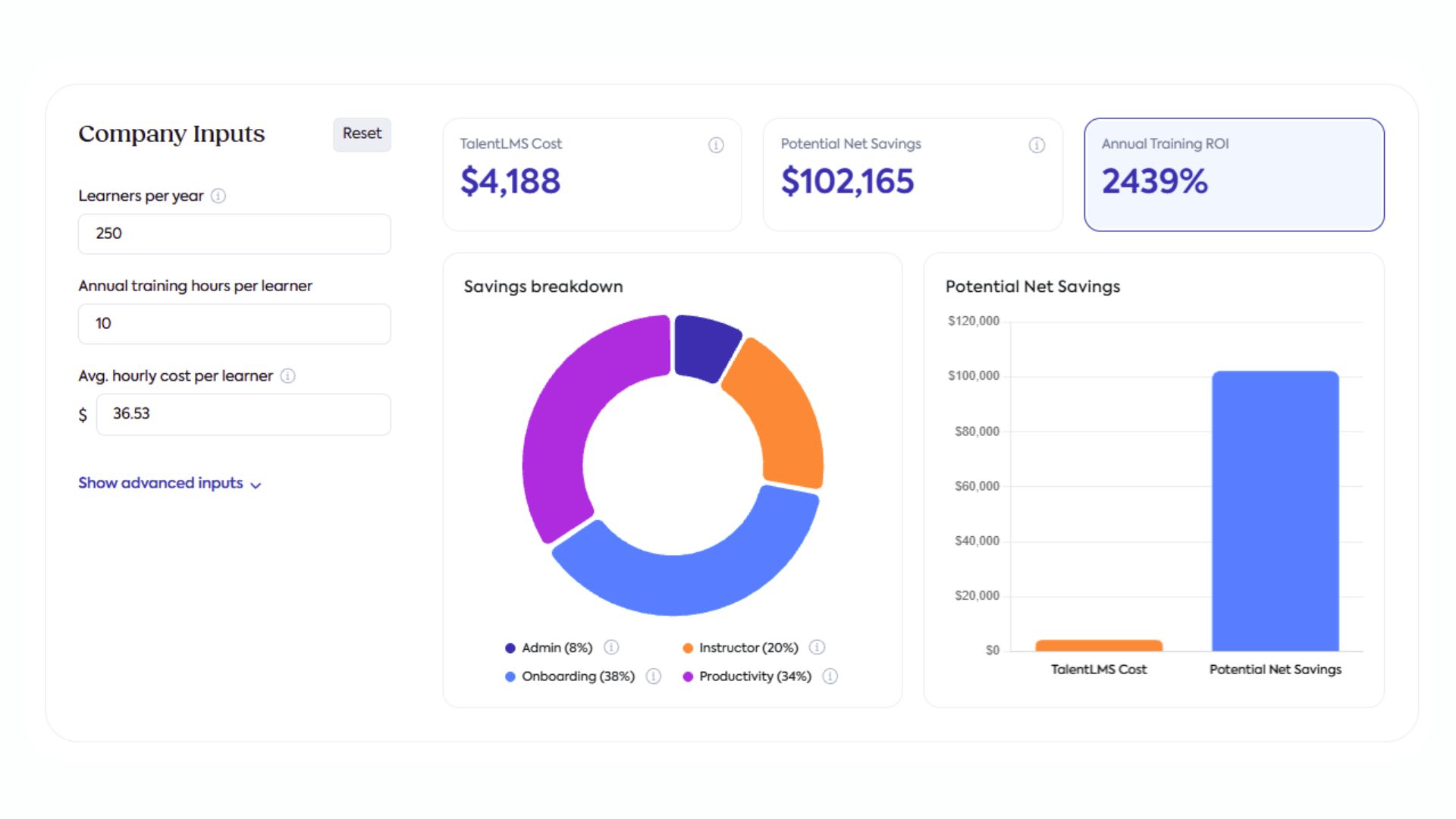
To support more rigorous planning, combine your checklist with a training ROI calculator to model projected impact.
It enables you to estimate performance improvements, quantify financial return, and evaluate investment scenarios before rollout.
How to maximize training ROI from day one with TalentLMS
Understanding the formula is only part of the equation. Maximizing training ROI requires designing programs with measurable impact, cost discipline, and performance tracking built in from the start.
TalentLMS’s learning platform is a powerful tool that can support that process, not just deliver content.
Here are five ways it can be used to strengthen ROI from day one:
1. Tie learning to measurable business outcomes
Before building content, define the performance metric and the specific measurement you want your training to influence.
For example:
- Reduce onboarding time by 20%.
- Increase sales conversion by 10%, or
- Decrease compliance incidents quarter over quarter.
Clear KPIs ensure the program is designed to drive a specific business outcome rather than simply transfer knowledge.
2. Optimize delivery costs through scalable formats
Blended and digital-first delivery models reduce overheads by minimizing travel, venue expenses, and instructor hours.
Asynchronous (self-paced) learning, microlearning, and reusable video content allow organizations to scale learning across teams without proportionally increasing delivery costs. When content can be reused and distributed widely, the marginal cost per learner declines significantly.
3. Build measurement into the platform
ROI depends on reliable data.
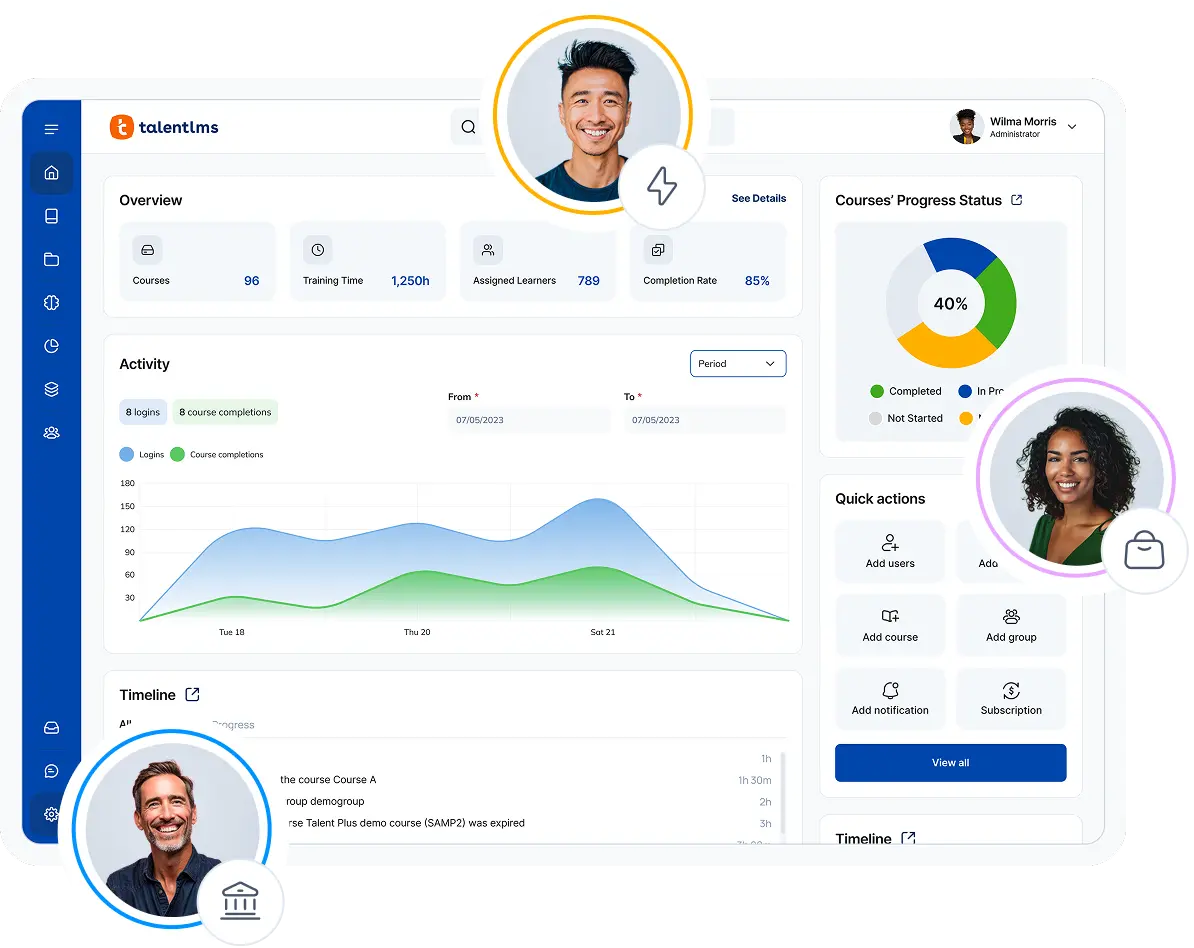
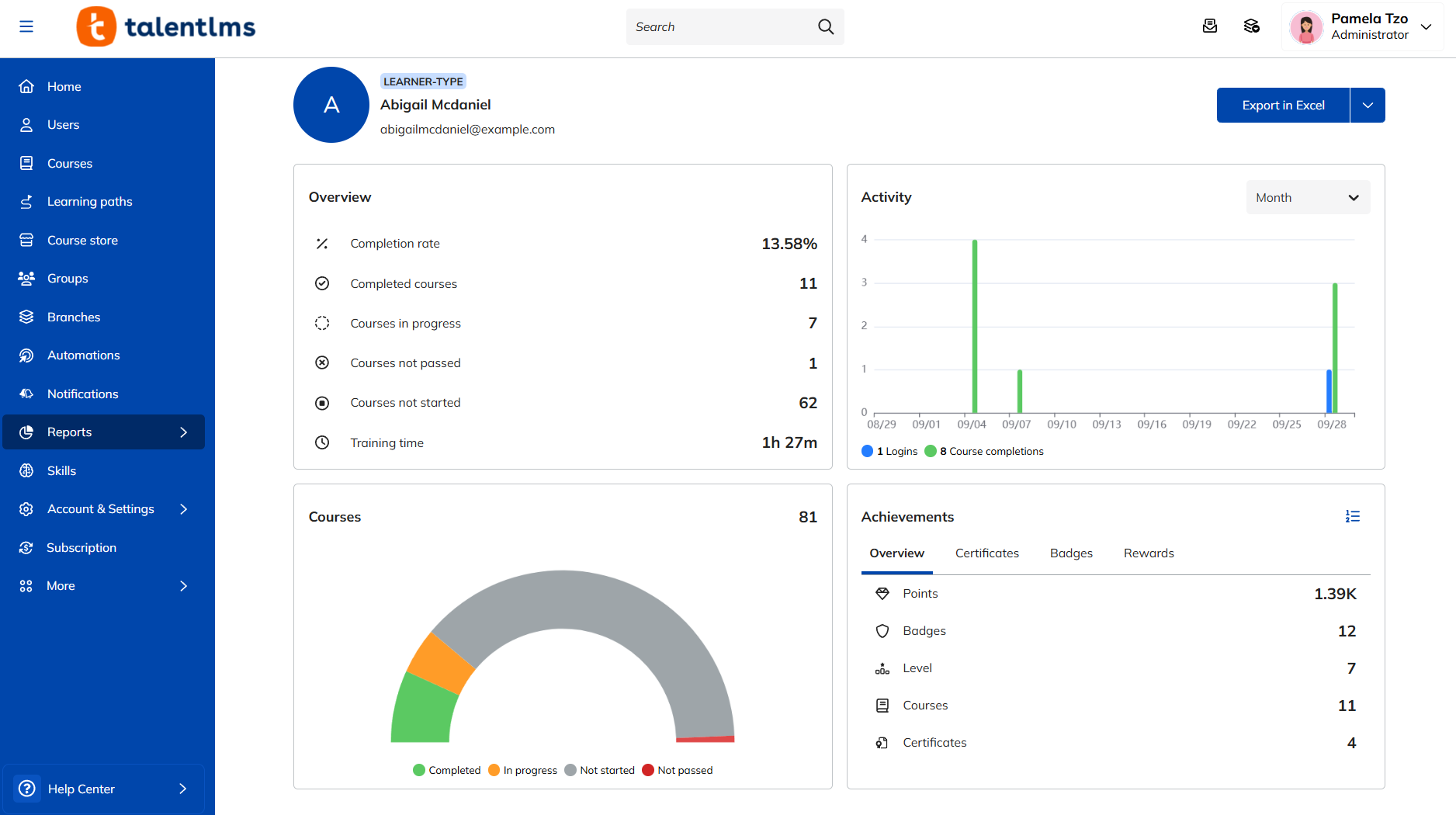
Reporting dashboards in TalentLMS can be used to monitor assessment tracking. And to source custom analytics that make it easier to monitor completion, knowledge acquisition, and engagement metrics.
When data collection is automated, it becomes significantly easier to connect learning activity to performance indicators.
4. Validate behavior change over time
Short-term assessments aren’t enough. Sustained performance improvement requires follow-up.
Scheduling 3- to 6-month reassessments, manager feedback loops, and KPI reviews ensures that skill application is measured beyond initial completion. Automated reminders in TalentLMS and follow-up workflows reduce administrative burden while reinforcing accountability.
5. Present ROI in stakeholder-ready formats
Demonstrating training ROI often requires translating data into executive-ready insights.
Exportable reports and visual dashboards help L&D leaders communicate performance improvements and financial impact clearly—supporting stronger business cases and more informed investment decisions.
Unlock the real value of measuring training ROI
L&D teams often struggle to secure budgets because they bring completion rates to conversations where executives expect financial data.
Measuring training ROI bridges that gap. It translates the hard work of upskilling a workforce into the universal language of business. The frameworks and tools exist to make this measurement straightforward, whether you’re predicting revenue impact before launch or tracking skill application months later.
The result? Training becomes a performance driver, not a compliance activity.
FAQs
What is training ROI?
Training ROI compares the financial and training benefits generated by training initiatives to their total cost, showing the measurable business impact. To calculate training ROI, use the formula (net benefits ÷ training costs) × 100. When done right, it turns training from a cost center into a strategic investment.
How do you measure training ROI?
To measure training ROI, start with a clear business goal. Capture baseline data before training, remeasure performance 60 to 90 days later, and convert the improvement into financial value. Finally, subtract the total cost of training. That’s how you move beyond training completion rates and measure real impact.
What metrics should you track for training ROI?
The metrics you track for employee training ROI should reflect the business outcomes your training aims to influence. In most cases, that includes improvements in performance, efficiency, cost reduction, or employee outcomes. The key is to connect training results to measurable business impact, not just participation or satisfaction scores.
Why is training ROI hard to prove?
Training ROI can be difficult to prove because many companies measure activity instead of outcomes. Completion rates and survey scores don’t prove impact. To prove training ROI, define KPIs before launch, assign financial value to improvements, and check results 60 to 90 days after training. Measurement should be designed in—not added later.
Originally published on: 08 Feb 2023 | Tags: Learner Engagement,Training ROI