It’s tough out there. But the pressure has changed.
AI is reshaping roles. Performance expectations are rising. And employees are being asked to do more and do it faster.
In fact, according to The TalentLMS 2026 Annual L&D Benchmark Report, 65% of employees say expectations at work have increased, and more than half say they don’t have enough time for training.
At the same time, expectations around learning are climbing. 73% of employees say training would make them stay longer, and 95% of HR managers agree training improves retention.
Training is no longer a nice-to-have. It’s a retention strategy, a performance driver, and a way to keep up with change, all at once.
So how do you make it work in 2026?
Let’s break down the most effective employee training methods and how to use them.
10 employee training methods to upskill your team
Employee training methods are simply how learning is delivered. That might sound basic, but it’s where most programs succeed or fail.
Today, the challenge is making space for learning to take place. Half of employees and learning leaders say workloads leave little room for learning. Time is still the #1 barrier to training.
So the method you choose needs to do one thing well. Fit into real work. Not compete with it. That’s why the most effective methods in 2026 are flexible, personalized, and built around how people actually work.
| Training method | What it is |
|---|---|
| On-the-job training | Employees learn by doing real tasks in their actual work environment. |
| Instructor-Led Training | Structured sessions led by an instructor, either in person or virtually. |
| Job shadowing | Employees observe experienced colleagues to learn processes and workflows. |
| Gamification | Uses game elements like points and leaderboards to boost engagement. |
| eLearning | Digital, self-paced training delivered through online training platforms. |
| Microlearning | Short, focused learning bursts designed to fit into busy schedules. |
| Simulation training | Realistic, risk-free scenarios to practice skills and decision-making. |
| Role-playing | Employees act out real-life situations to build soft skills and confidence. |
| Coaching and mentorship | One-on-one guidance from experienced employees or leaders. |
| Cross-training | Employees learn different roles to build versatility and team understanding. |
1. On-the-job training
On-the-job training is one of the most expected employee training methods, giving employees the opportunity to gain practical experience and critical thinking skills by completing real-life job-related tasks.
Most companies include on-the-job training as part of their learning. Even remote employees can mimic on-the-job training through the use of video calls and team collaboration. In 2026, this method is often combined with mentoring and real-time guidance, making it more structured and impactful.
For example, a new hire may meet with senior team members to complete hands-on training, such as using the tools, technology, and processes expected in their day-to-day work. Senior team members can course correct along the way to ensure new employees understand company protocols and preferences. This approach is especially important as teams adopt AI tools, where learning happens best through guided, real-world use.
Pros:
- Hands-on practice and learning experience
- Cost-effective and internally resourced
- Learn the businesses’ preferred approaches to job duties and problem-solving
Cons:
- Unstructured and dependent on internal resources
- Hard to track
- Impacts productivity for the new hire and team trainers
2. Instructor-Led Training
Instructor-Led Training (ILT) mimics traditional classroom training, led by an internal resource or external instructor.
Instructor-led sessions give team members the ability to gain new knowledge and ask questions specific to their job function. They can discuss scenarios and share ideas peer-to-peer, with the added guidance of an instructor. In 2026, ILT is rarely used on its own. It’s part of a blended approach that combines live sessions with digital and self-paced learning.
For example, many companies bring in external instructors to facilitate more sensitive trainings (like sexual harassment or diversity, equity, and inclusion (DEI) trainings), so employees have an external view of expected behaviors and approaches. These sessions are increasingly paired with interactive elements or even VR-based scenarios to make learning more immersive.
Pros:
- Structured agenda
- Group training, collaborative discussions, and Q&A sessions
- Real-life demonstrations and tailored learning
Cons:
- May be expensive, especially for large trainings or external instructors
- Creating the course content can be time-intensive and costly
- Reduced productivity for training resources and team members
3. Job shadowing
Job shadowing is a traditional employee training method that enables new hires to observe and learn from seasoned employees.
Job shadowing is a cost-effective way for employees to gain practical skills. Employees learn by seeing real-world strategies for resolving workplace issues and scenarios. In 2026, job shadowing is more effective when combined with clear goals and follow-up learning, turning observation into measurable skill development.
For example, a new graphic designer might shadow a more senior graphic designer, learning about the company’s brand style, tool set, and best practices.
Pros:
- Real-world exposure to tasks and processes
- Ability to ask questions as they arise
- Builds relationships and collaboration
Cons:
- Success is dependent on the quality of the mentor
- Productivity of both the trainer and employee is impacted
- Difficult to cover a wide breadth of tasks and scenarios
4. Gamification training
Gamification training aims to make learning fun by using popular gaming elements (e.g., scoring activities, leaderboards, level advancement) to engage employees throughout structured training.
For example, a cybersecurity company might set up gamified training where junior analysts are exposed to different cyber threats in a virtual environment. They can practice email phishing awareness through simulated security scenarios involving suspicious messages and data breaches, earning points and badges for correctly identifying and responding to potential threats. As employees gain points, they’re highlighted on a leaderboard, encouraging camaraderie and healthy competition.
In 2026, gamification often includes social learning elements, like team-based challenges and shared progress, to increase engagement.
Pros:
- Nurtures healthy competition and teamwork
- Motivates employees to advance and participate
- Easy to track progress and measure success
Cons:
- May be expensive to initially set up
- Time-consuming to develop the gaming structure
- Adoption may be arbitrary (participation may be high for some employees, whereas others may not actively participate without external motivation)
5. eLearning
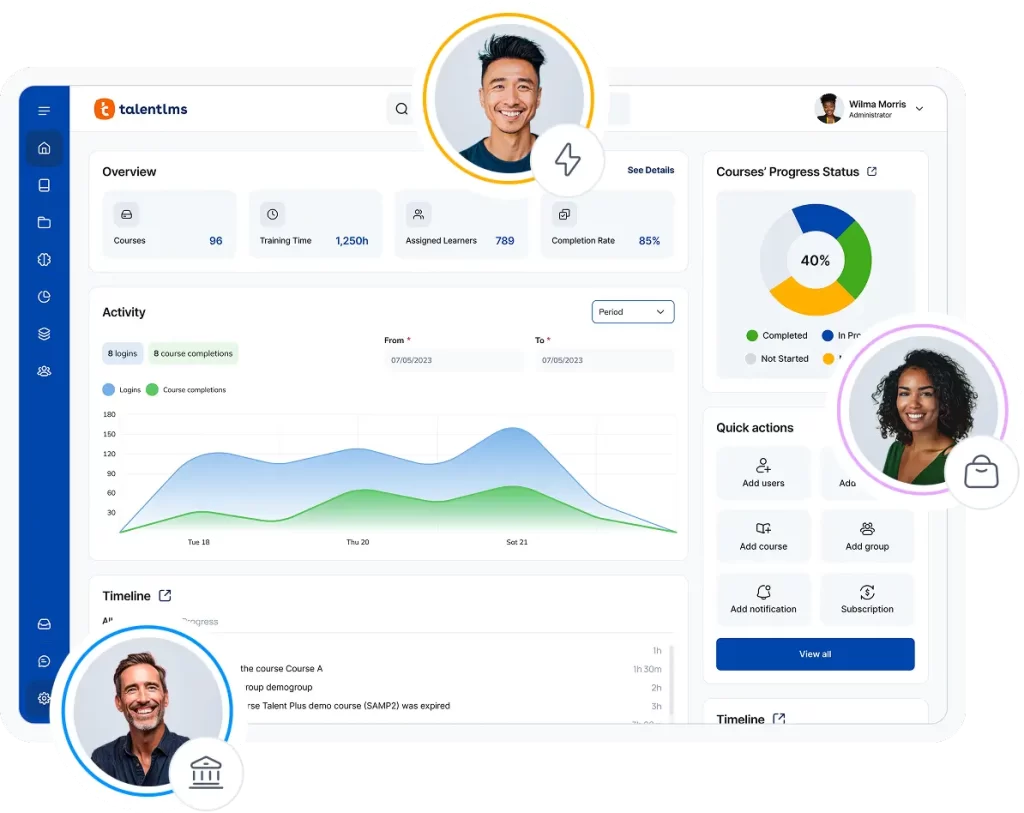
eLearning (or online learning) uses digital platforms like an LMS to deliver online training. It’s now the foundation of most training strategies. If you’re comparing platforms, our guide to the best LMS for employee training can help you evaluate the top options.
Today, content volume isn’t the problem. Relevance is. Even though 84% of employees say they’re satisfied with training, expectations are rising just as fast. That’s why modern eLearning platforms use AI to personalize learning paths based on individual performance, role, and pace.
So, eLearning makes it easy to measure adoption and success rates, send reminders and notifications, and benchmark completion across your organization. Adaptive learning ensures employees see content that’s directly relevant to their needs and helps reduce time wasted on generic training.
Pros:
- Flexible for employees and remote workers to train at their own pace
- Cost-effective for large-scale training
- Success and adoption is measurable through online courses
Cons:
- Requires modern technology and a decent internet connection
- Limited access to instant instructor feedback
- May require upfront investment to develop the course material
6. Microlearning
Microlearning solves the biggest problem in L&D: time.
It’s a nod to both gamification and eLearning by breaking down larger training courses into smaller doses that are easily digestible. In 2026, microlearning is often delivered just in time, right when employees need it, not weeks or months in advance.
Microlearning typically uses digital technology, video learning, or online modules to deliver short bursts of education or reinforce key training concepts. By enabling team members to digest training information in small quantities, it frees employees’ time, supports productivity, and increases participation and course completion.
For example, a product marketing team might help their sales teams understand product features and value cases through quick microlearning videos. Sales members can access the content on-demand and learn on the go, while marketing can measure whether their team is actively participating in their microlearning. This approach is especially useful for fast-changing topics like AI tools, where employees need quick, practical guidance.
Pros:
- Bite-sized content for quick absorption of information
- Fits well into busy schedules
- Reinforces learning through repetition and reinforcement
Cons:
- Limited depth for complex topics
- Dependency on the quality of content delivery
- Requires employee motivation and commitment
7. Simulation training
Simulations are a type of experiential learning, where employees can simulate workplace processes, situations, and customer interactions in a risk-free environment. They can react in real-time and practice likely scenarios without the fear of negatively impacting the business.
For example, medical professionals train on simulated emergencies to ensure they can respond effectively, sharpen clinical skills, and practice crisis management without impacting a person in need. By 2026, simulation-based learning is becoming standard across industries, especially for high-stakes or technical roles.
Simulation training boosts employees’ confidence, efficiency, and competency by providing a safe place for trial and error, issue resolution, technology adoption, and communications.
Pros:
- Practices real-world scenarios without impact or risk
- Develops skills and decision-making under pressure
- Boosts employee confidence and credibility
Cons:
- Can be expensive to invest in simulation technologies
- May be complex for different industries, roles, and scenarios
- Lacks an emotional component to nurture culture and camaraderie
8. Role-playing
Like simulations, role-playing is an effective training technique, placing employees in real-world scenarios to practice handling situations.
Typically, employees are assigned roles or interactive prompts to improvise common scenarios and workplace challenges with their colleagues. They then discuss their experience with the larger team for feedback and guidance before switching roles. This method is increasingly used to build soft (power) skills like communication, adaptability, and emotional intelligence, skills that are critical in AI-augmented workplaces.
For example, new managers may role-play giving constructive feedback and placing employees on a fictional performance improvement plan (PIP). This tends to be an uncomfortable and awkward conversation for less experienced managers, and role-playing offers the critical thinking and experience needed to feel confident and prepared.
Pros:
- Improves communication and interpersonal skills, particularly around sensitive subjects
- Practices empathy and immediate responses to real-world scenarios
- Gives the opportunity for discussion, immediate feedback, and guidance from more experienced team members
Cons:
- Not all employees are comfortable role-playing
- Requires skilled facilitators to put team members at ease and implement scenarios
- May be hard to set up for certain types of roles or skill sets
9. Coaching and mentorship programs
Coaching and mentorship programs are popular ways to give employees hyper-personal workplace training.
Companies pair less experienced hires with more experienced peers or leadership team members to train and drive employee motivation. The coaches and mentors offer personal feedback and take an active role in advancing that employees’ professional growth. Coaching particularly helps build soft skills both in a remote and in a physical work environment. This approach plays a key role in developing both AI literacy and human (power) skills, combining technical learning with real-world guidance.
For example, human resources may pair junior managers with director-level managers on their teams. The junior member can ask questions and collaborate with their coach or mentor in a one-to-one setting, receiving senior-level guidance and advice from a respected team member experienced handling their work tasks.
Pros:
- 1:1 support and guidance in a personal and collaborative fashion
- Knowledge transfer from experienced employees
- Encourages peer-to-peer advocacy, development plans, and long-term employee loyalty
Cons:
- Requires mentors and senior leaders to make time for employee advancement
- Success is highly dependent on mutual commitment and collaboration
- Difficult to measure and scale across larger organizations
10. Cross-training
Cross-training exposes employees to other team members’ roles and responsibilities.
It is a great way for employees to gain hands-on experience in other areas of the business and grow their skill set. This offers them a big-picture view of how different job functions add value and advance business goals. Cross-training is increasingly used in 2026 to prepare employees for evolving roles, especially as AI reshapes job responsibilities.
This method, combined with other experienced professionals, demonstrates how contributions impact other teams’ goals and needs, creating a more collaborative and empathetic work environment.
It can also safeguard companies from the negative impact of staffing changes or employee churn, so transitions are smoother and skill sets are distributed across the organization.
Pros:
- Spreads skills and knowledge sharing across the company
- Enables smoother employee transitions
- Nurtures teamwork, empathy, and a better understanding of cross-team dynamics and dependencies
Cons:
- Availability and scheduling conflicts create challenges
- Requires employee commitment to cross-train effectively
- May be challenging for more specialized skills or high-pressure roles
Key areas of focus for training in 2026
Training methods matter, but what you focus on matters more in 2026.
Here’s where organizations are investing now:
1. AI literacy & digital transformation
AI is already clocked in. However, a significant friction point exists between access and actual ability. Current TalentLMS data suggests a disconnect in intent: 47% of HR managers admit AI training is primarily aimed at automating roles. But employees often feel a widening gap between leadership’s digital vision and their daily reality.
More broadly, there’s a visibility gap, as 90% of managers say they understand their team’s skills, but only 69% of employees agree, according to TalentLMS’s Skills Visibility report. Both gaps show up clearly in AI adoption, where leadership expectations don’t always match day-to-day reality.
To bridge this, AI training must pivot from a focus on replacement to a strategy of enablement.
- The skills shift: It’s no longer enough to just have the software. Employees need to master prompt engineering, understand AI output validation, and learn how to integrate these tools into their specific workflows.
- Continuous adaptation: Because the tech moves fast, AI literacy is a mindset of constant evolution.
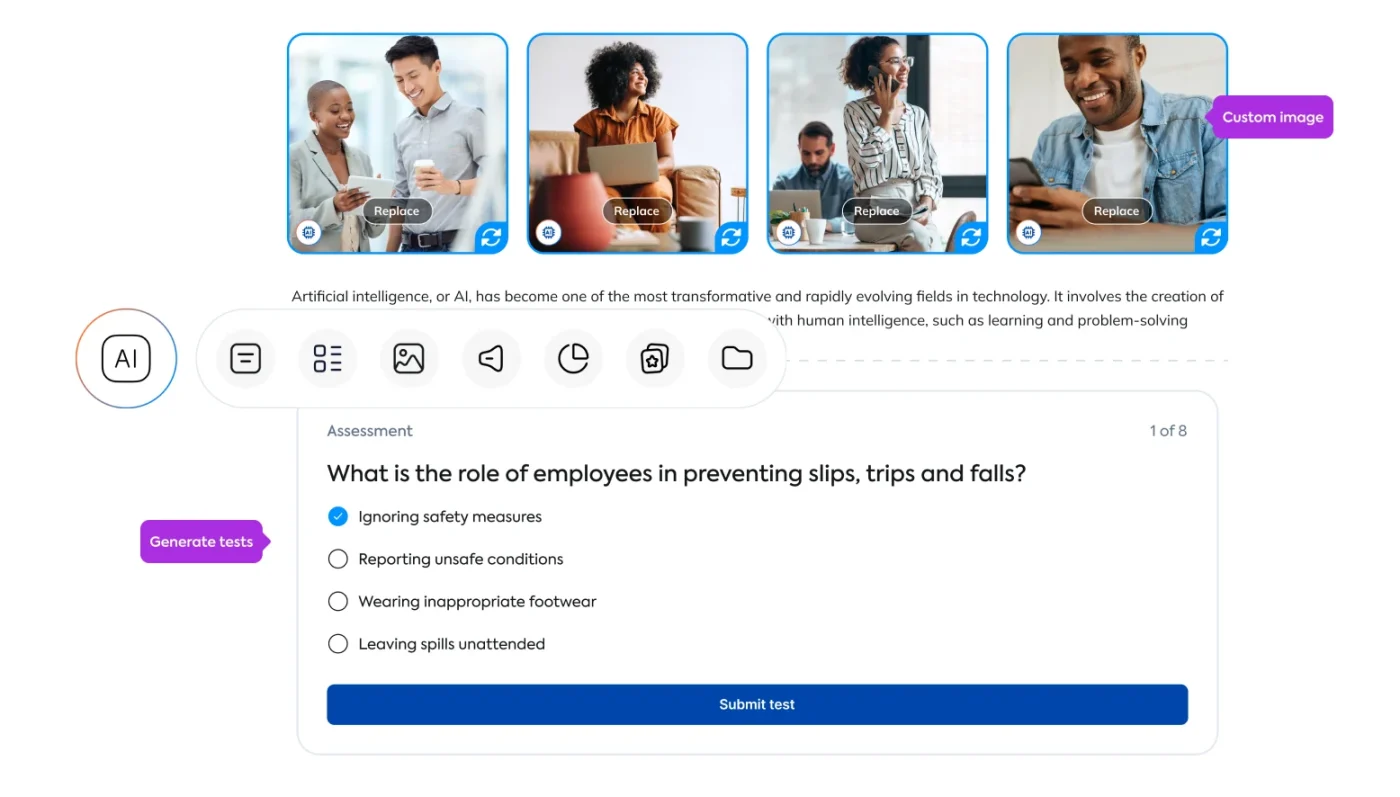
- Agile content: To keep pace, L&D teams should use rapid content creation tools like TalentCraft. By streamlining the production of training modules, you ensure your workforce is learning today’s best practices.
2. Soft skills
As AI takes over routine work, human skills become more valuable. But they’re also harder to measure and develop. And that’s where many organizations struggle. In fact, 56% of employees say their career growth is held back at least sometimes because their skills go unnoticed. This also makes soft skills development harder to prioritize and track.
Soft skills like communication, adaptability, and emotional intelligence are critical for both employee performance and leadership.
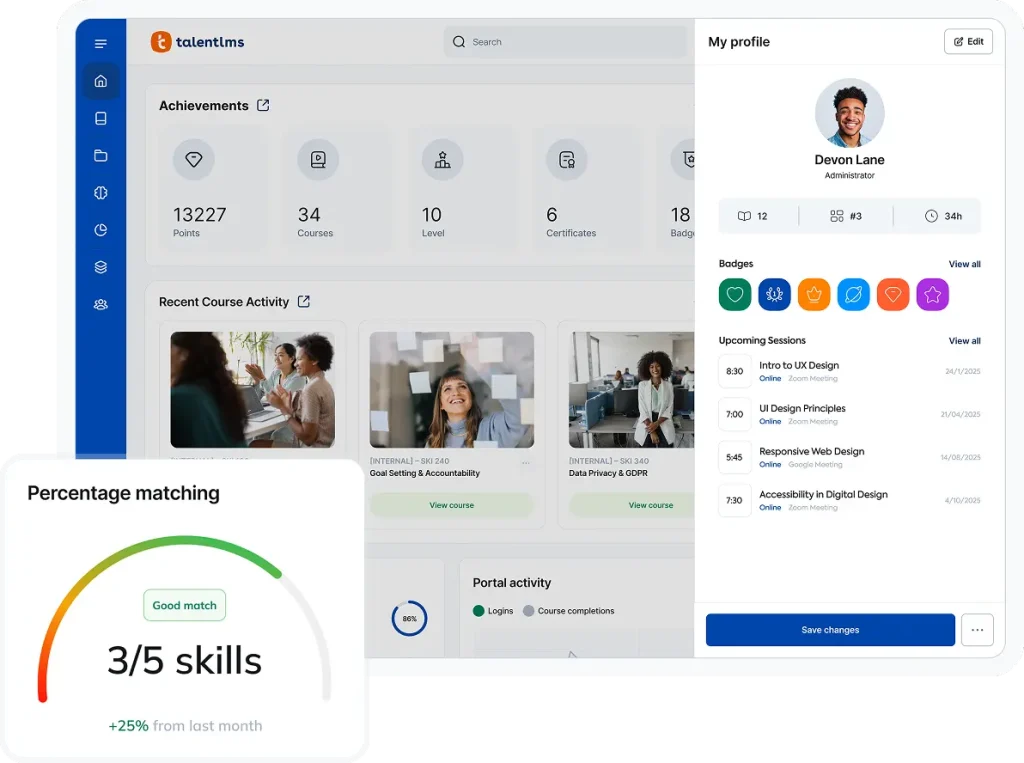
Skills is a TalentLMS feature that helps map and track employee skills, so development becomes visible.
TalentLMS’s Skills allow you to map, track, and quantify these skills. By making development visible, you turn abstract potential into measurable performance.
3. Diversity, equity, and inclusion (DEI)
DEI training is undergoing a major shift. The era of the one-off annual workshop is over, as these sessions often fail to create lasting behavioral change.
Today, employees expect DEI to be woven into the company culture and ask for:
Ongoing learning rather than isolated events.
Real-world scenarios that reflect modern workplace challenges.
Practical application that moves beyond theory into daily habits.
So, organizations must look past basic compliance to build truly inclusive environments where every voice has a seat at the table.
Use ready-made courses from TalentLibrary to launch structured, professional DEI programs quickly. This ensures your training is consistent, high-quality, and updated to reflect current social nuances.
What are the most effective employee training techniques?
There’s no one-size-fits-all training method. Different teams, roles, and goals require different approaches. The most effective training programs combine methods that fit how people actually work.
And it pays off, as 73% of employees say they’re more likely to stay with a company that invests in their training, making learning a key driver of retention.
What makes training effective? The goal is to build a mix of training techniques that are relevant, flexible, and easy to apply on the job. So, it comes down to a few factors:
- Types of skills (soft skills, technical, AI literacy)
- Company culture (in-house, remote, hybrid)
- Resources (L&D teams, mentors, external partners)
- Technology (LMS, AI-powered tools)
- Communication and feedback loops
- Time availability (still the #1 barrier to learning)
Which factors to consider before choosing a training technique?
Choosing the right training method is about fit. Many companies will try a mix of different types of employee training, learning through trial and error the types of programs that create the most effective and valuable outcomes.
The most effective programs match the method to the goal, the audience, and the realities of how your team works.
1. Training objectives and content
Start with what you’re trying to achieve. This also means factoring in AI literacy and rapidly evolving skills, where training needs to be updated frequently and applied immediately.
- Goal type: Is the training focused on consistency (e.g., compliance) or behavior change (e.g., leadership, communication)?
- Skill type: Are you building knowledge, soft skills, or hands-on skills?
- Depth: Does the training need to drive long-term behavior change or quick understanding?
2. Audience characteristics
Not all learners need the same approach. And with tight workloads, employees also expect training to be personalized and relevant to their role.
- Experience level: New hires need structure; experienced employees benefit from discussion and real-world scenarios
- Learning preferences: Mix formats (visual, interactive, hands-on) to improve engagement
- Location and size: Remote or distributed teams benefit from asynchronous learning, while smaller teams can lean on in-person or on-the-job training
3. Resources and budget
Every method comes with trade-offs. But keep in mind that in fast-changing areas like AI, the ability to create and update content quickly is just as important as cost.
- Cost: On-the-job training is cost-effective; custom eLearning, simulations, or VR require higher upfront investment
- Time: If speed matters, microlearning and video-based training are easier to deploy
- Technology: Do you have the tools (like an LMS or AI-powered platform) to deliver and scale training?
4. Work environment and culture
Training needs to fit into the way your team works. That’s why microlearning and just-in-time training are gaining traction—they fit into real workflows instead of disrupting them.
- Availability: Can employees step away for training, or does it need to happen during the flow of work?
- Work style: Collaborative teams may prefer group learning, while fast-paced teams often rely on on-demand resources
5. Measurement and feedback
If you can’t measure it, you can’t improve it. In 2026, visibility is key; employees and managers expect to clearly see skill progress and impact.
- Tracking: How will you evaluate success, like completion rates, assessments, or performance outcomes?
- Application: Does the method allow employees to apply what they’ve learned (e.g., simulations, role-playing)?
- Feedback loops: Are you collecting input to improve future training?
Recommended approach
The most effective strategy is usually a mix.
A blended learning approach that combines eLearning, instructor-led sessions, and hands-on practice helps reinforce learning, improve retention, and adapt to different needs.
Add personalization and just-in-time learning into that mix, and training becomes far more relevant and far more likely to stick.
Empower your teams with better training
Effective employee training methods have a direct impact on employee satisfaction, performance, and retention. By combining the right approaches and focusing on the skills that matter most you give your team what they actually need to grow and succeed.
Training means building skills that keep your business moving forward, whether that’s adapting to AI, strengthening collaboration, or closing critical skill gaps.
That’s why it pays to invest in training that’s relevant, flexible, and easy to apply on the job. With the right platform in place, you can create, deliver, and scale learning that fits into real work and delivers real results.
FAQs
What are the most effective training methods for employees?
The most effective training methods for employees combine flexibility, relevance, and real-world application. Popular options include eLearning, microlearning, on-the-job training, and coaching. In 2026, blended learning approaches that mix digital and hands-on methods deliver the best results.
What are the different types of training methods?
There are several different training methods used in organizations, including instructor-led training, eLearning, simulation training, role-playing, gamification, and cross-training. Each method supports different learning goals, from technical skills to soft skills development.
Which training method is best for employee development?
The best training method depends on the goal. For example, microlearning works well for quick skill updates, while coaching and mentorship are ideal for long-term development. Most companies use a mix of training and development methods to meet different needs.
How do you optimize customer learning paths?
Optimize customer paths by focusing entirely on product adoption and reducing friction. Keep modules short, interactive, and relevant. Track where users drop off, and continuously refine the content so they experience your product’s value as quickly as possible.
What is the difference between training methods and training techniques?
Training methods refer to how learning is delivered (e.g., eLearning or on-the-job training), while training techniques are the specific approaches used within those methods, such as quizzes, simulations, or role-playing exercises.
How do you choose the right training method for employees?
To choose the right training method for employees, consider factors like training goals, employee experience level, available resources, and time constraints. In modern workplaces, methods that fit into daily workflows—like microlearning and just-in-time training—are often the most effective.