


- Key manager training topics based on must-have manager skills
- New manager training courses and collections that may interest you
- Challenges new managers face
- When should you start training new managers?
- How to build a new manager training program
- How to help new managers succeed
- Tips for new managers
- The power of a strong new manager
- FAQs
Most companies have a predictable, yet flawed, habit. They take their highest-performing employees (the ones who hit every deadline and crush every KPI) and reward them with a promotion. Then, they hand over a manager title with almost zero preparation for what comes next.
The problem with that is that being “the best at the work” doesn’t automatically mean you’re “the best at leading people.”
On top of that, when managers are left to wing it, the team morale dips, productivity stalls, and your newly appointed leader feels like they’re drowning.
To fix this, you have to provide effective new manager training.
Effective new manager training focuses on transitioning from an individual contributor to a leader, covering essential skills like communication, coaching, performance management, and delegation. Key training components include conducting one-on-one meetings, setting goals, conflict resolution, and providing constructive feedback. This training is essential for boosting team morale, engagement, and productivity.
If you want to stop playing catch-up and start building a leadership engine that actually works, you have to change how you view the transition. This guide will show you how to move past the trial by fire and create a structured path to achieve success.
Key manager training topics based on must-have manager skills
Since effective training for new managers is about transitioning from an individual contributor to a leader, it requires a unique set of training topics.
Beyond management skills training, the final step in a manager’s career development is building true business acumen.
A new manager who can read a P&L statement or explain the company’s go-to-market strategy can answer their team’s “why” questions with genuine authority.
| Manager skill | Importance of manager skill |
|---|---|
| 1. Leadership training for managers | A foundational topic for first-time manager training courses is situational leadership, which teaches them that real leadership qualities are about influence. Daniel Goleman’s Six Leadership Styles provides a practical framework for this lesson. The stakes are high, since Gallup research shows managers account for 70% of the variance in team engagement. |
| 2. Communication skills | Another core topic is mastering high-stakes communication. New managers often dread giving constructive feedback, the most common form they’ll need to use in this role. A framework like Kim Scott’s “Radical Candor” gives a powerful guide for these moments. It teaches managers how to care personally while challenging themselves directly, turning a feared conversation into a tool for growth. |
| 3. Delegation and decision-making | The third topic is teaching delegation and confident decision-making. Training should frame delegation as an act of empowerment that boosts job satisfaction, a link shown in research from the University of La Verne. To build confidence in their own calls, a simple model like the OODA loop (Observe, Orient, Decide, Act) gives managers a clear process to follow under pressure. |
| 4. Performance management | Effective performance management training programs are a must-have for new manager training courses. A great system to teach is the Objectives and Key Results (OKR) framework, which was pioneered at Intel and made famous by Google. It gives effective managers a simple way to align their teams around clear, forward-looking organizational goals and have productive conversations about progress. It also equips them with a host of employee evaluation comments they can deliver to make the experience feel more personal. |
| 5. Conflict resolution | Another advanced topic is systematic conflict resolution. New managers often either ignore conflict until it explodes or handle it clumsily, making things worse. The Thomas-Kilmann Conflict Mode Instrument (TKI) gives them a sophisticated map for these situations. It outlines five distinct ways to handle a dispute, like collaborating or compromising, helping a manager intentionally choose a path instead of just reacting. |
| 6. Change management | Managers need training in leading people through change. Their job is to be a transition guide who can manage the human and emotional journey their team experiences. Prosci’s ADKAR model offers a simple roadmap for this, breaking the change process into five individual stages, such as Awareness and Desire. Achieving those early stages depends entirely on the candid management skills mentioned earlier. |
| 7. Time management | Many new and experienced managers need help with structuring their time and the team’s time with intention. Frameworks like the Eisenhower Matrix help them distinguish between the truly important and the merely urgent. Understanding concepts like “Maker vs. Manager” schedules also helps them protect their focus for deep work. |
| 8. Coaching and mentorship | A manager’s role eventually evolves from being the team’s best problem-solver to becoming its best coach. Learning a structured framework like the GROW model helps them build their team’s own problem-solving skills instead of just giving answers. They can guide conversations through goals and options, often using powerful questions like the “Five Whys” to get to the root of an issue. |
| 9. Business acumen | Beyond management skills training, the final step in a manager’s career development is building true business acumen. A new manager who can read a P&L statement or explain the company’s go-to-market strategy can answer their team’s “why” questions with genuine authority. |
| 10. Emotional intelligence (EQ) | Being a manager means managing people, not just processes. New leaders quickly learn that understanding what motivates, worries, or frustrates their team is far more critical than knowing all the technical answers. EQ often beats technical expertise in early leadership. Training should focus on self-awareness and active listening so managers learn to judge actions and root causes, rather than just reacting to the energy in the room. |
| 11. Meeting facilitation | Individual contributors just have to attend meetings; managers have to run them. Without this skill, new managers often waste hours of collective team time on basic status updates. Teach them the simple mechanics of respect. Things like always having an agenda, managing dominant voices so quieter folks can speak, and ensuring every meeting ends with clear, assigned action items. |
| 12. Psychological safety | If a team is afraid to make mistakes, they will hide problems until they explode. New managers need to know how to create an environment where it is safe to take risks and speak up. It starts with modeling vulnerability. Managers need to learn to get comfortable being uncomfortable, which includes admitting when they make a wrong call, fixing it, and moving forward. |
| 13. Hiring and interviewing | Eventually, the new manager will need to grow their team or replace someone. Interviewing candidates objectively and spotting real talent is a completely foreign muscle for most individual contributors. Provide them with a structured rubric for evaluating candidates to remove personal bias, and teach them how to ask behavioral questions rather than just looking at a resume. |
| 14. Boundary setting | New managers often fall into a productivity paradox. They try to do their old “doer” job while taking on their new leadership duties. They need to learn how to say no. They must shift from doing the work to directing it. This means learning to protect their time, step back from fixing every little thing, and let their team step up. |
| 15. Giving feedback and coaching | New managers are usually reluctant to give feedback. It’s embedded in the fear of upsetting or insulting someone on their team. However, constructive feedback doesn’t insult. It opens a conversation about improvement. And that conversation leads to clarity around the expectations of the role. That’s why this skill is one of the most important to master. If a manager doesn’t offer clarity, then their team member has less chances to succeed in their role. |
New manager training courses and collections that may interest you
Knowing you need to train your new managers is one thing. But how to go about it is another. Click below to see all the courses and collections we recommend for your training needs.
- Leadership Tool Kit
- Leadership Training Essentials
- The Leadership Role Model
- Remote Leadership
- Adaptive Leadership
- Practicing Leadership
- Safety Leadership
Unsure of where to start? Our team has curated a New Manager Training Solutions Guide which gives you the blueprint for this challenging, yet rewarding training journey. Plus, with our ready-made Learning Path available, you tailor the training to the needs of your new or first-time managers. Now, you have all you need. The only thing left for you to do is take the first step to kick-starting your new manager training program.
Click below and get started for free—no hidden fees. Explore at your own pace, and only upgrade if you’d like to. No credit card needed.

Challenges new managers face
The most profound challenge for a new manager is often the disorienting shift in their professional identity from “peer” to “boss.” The change can trigger intense feelings of imposter syndrome, an especially common struggle, as a KPMG study found 75% of female executives have experienced it.
Imposter syndrome is often compounded when managers don’t provide adequate training. In fact, 71% of employees believe their managers need upskilling or reskilling, which can lead employees to undermine their managers and make them feel like an imposter.
Another challenge they often face is distinguishing between manager vs leader. Often, you want them to have a mix of these two roles, being inspirational leaders that get their hands dirty, while also managing resources and time.
A new title can also bring a deep sense of isolation. Managers often feel caught in the middle, no longer truly part of the team they lead, but not yet fully integrated with their new leadership peers.
New managers also struggle with a strange productivity paradox. They often try to keep doing their old “doer” job on top of their new duties, leading to longer hours but a feeling of decreased personal output.
On top of these personal struggles, they rarely start with a clean slate. They often inherit unresolved team conflicts, tricky dynamics, or performance issues left behind by the previous manager.
The combination of fear and pressure often manifests as the destructive habit of micromanagement. It’s a common reaction that has a huge impact, with one Trinity Solutions study finding that 69% of employees have considered leaving their job because of it.

When should you start training new managers?
Organizations that treat the promotion as the starting line will always be playing catch-up.
That’s because technical skills and behavioral skills have very different learning curves. If you need to learn a new software tool, you can watch a tutorial and figure it out. Management behaviors—like giving someone tough feedback, navigating team conflict, or shifting from being a peer to being a boss—do not work like that. You cannot learn those in a two-day workshop. They require months of awkward repetition, messing up, and trying again.
There is an obvious limit here, of course. You can’t fully practice being a manager until you actually have a team to manage. But that’s exactly why pre-promotion training (like simulations or role-playing) is so important. You are building the foundation and the muscle memory early, so that the actual role just finishes building the house.
In practice, this means identifying your high-performing individual contributors 6 to 12 months before you actually need them to be managers. You use that window to put them in a training cohort, give them a stretch project to lead, or pair them with a mentor. Not only are they learning, but you get a very real preview of whether they actually want and are ready for management before you make the official decision.
How to build a new manager training program
Building a successful new manager training program requires a logical framework. While you might have a few extra steps, depending on your needs or tools, the base steps should follow this flow.
1. Needs assessment
Start by looking at what is currently breaking down when they are handed a new title with no real preparation.
Are exit interviews mentioning poor communication? Are employee engagement scores dropping on specific teams? Is there a spike in unresolved team conflicts?
It’s also a good idea to talk to your current managers about the disorienting shift from “peer” to “boss,” and ask employees what they wish their leaders did better.
A proper needs assessment helps you find the actual cracks in your organization’s foundation so you can build a training program that fixes them, rather than just checking a box.
2. Core topics
Once you know the problems, you can better select your core topics. For example, if you find that your team is lacking strong engagement, they can take new manager training courses online on how to encourage engagement.
Using the essential skills we covered earlier (like communication, coaching, and conflict resolution) also gives you a strong idea of what to focus on. But you do not need to teach everything all at once. You have to prioritize.
Always put behavioral skills before operational ones. Learning how to navigate the complex emotional journey of a team effectively or how to deliver constructive feedback without ruining relationships takes a lot of time and emotional energy.
The operational tasks, like approving timesheets or learning the project management software, can be picked up quickly through basic tutorials. Focus your heavy-lifting training efforts on how to lead people, empower decision-making, and manage conflict. The process stuff can wait.
3. Format and delivery
Most training programs fail because they rely on one-off workshops that don’t build long-term habits. However, behavioral skills require a blended approach. This means combining self-paced digital modules for theory with live peer cohorts for practicing real-world scenarios.
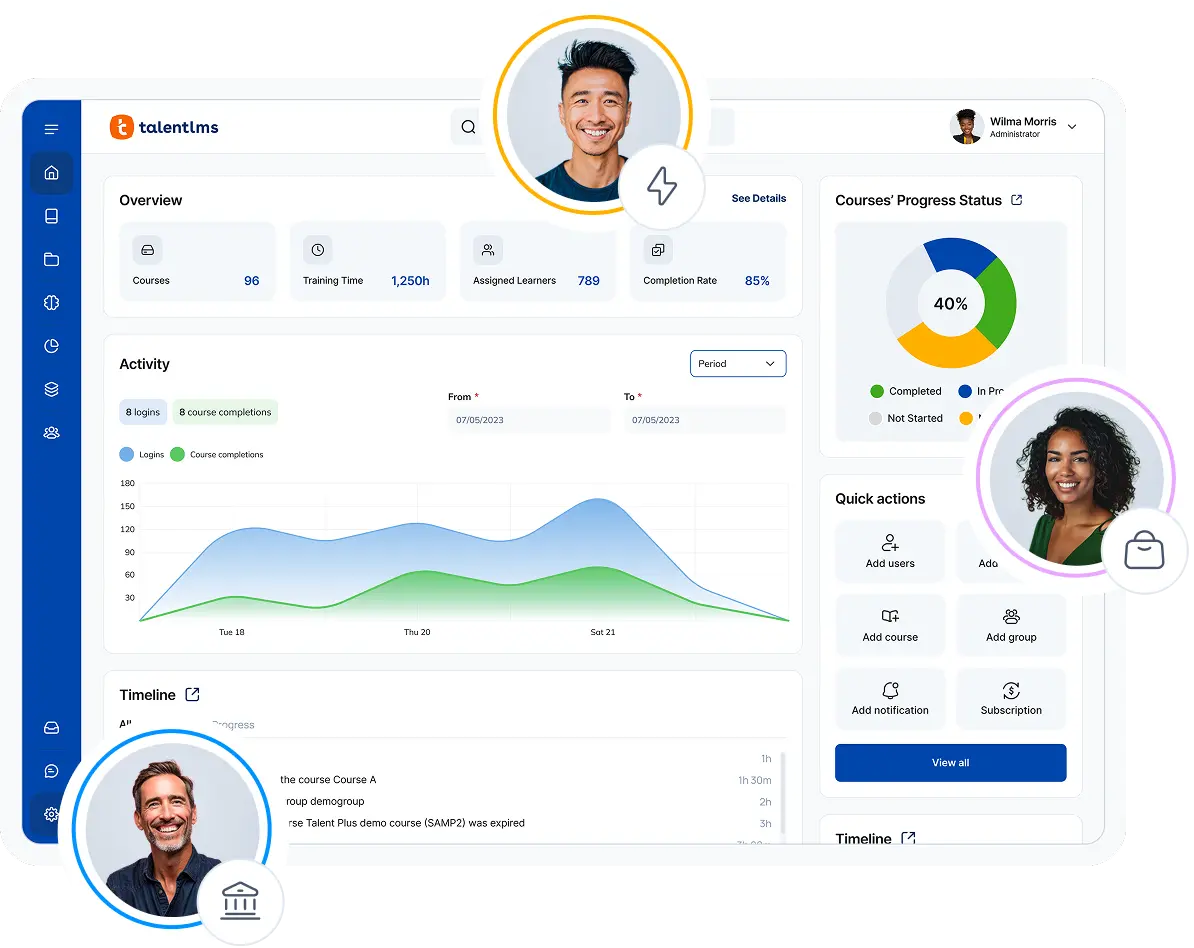
Using a platform like TalentLMS provides the necessary infrastructure to make this complex, blended delivery manageable and scalable for HR teams.
4. Timeline
Real leadership development should realistically span 6 to 12 months. This timeline ties directly back to our earlier strategy of identifying high-potential contributors well before they are promoted.
By stretching the training over several months, you make room for the ‘awkward repetition’ phase necessary to turn a new behavior into a habit. A slow-burn timeline makes sure that when the manager title finally hits their email signature, they have already spent months building the muscle memory required to succeed.
5. Measurement
Completion rates tell you that people clicked “next,” but they tell you nothing about whether the training actually worked.
To measure true effectiveness, look for metrics connected to business outcomes. Are employee engagement scores rising for those managers? Is your manager retention rate improving?
You should also track time to productivity for their new teams or a reduction in the number of HR-mediated conflicts.
These data points prove that your managers are actually leading, rather than just checking boxes in a learning system.
How to help new managers succeed
To help new managers succeed, the best organizations build a complete ecosystem of support to guide managers through their difficult first year.
The foundation of this ecosystem is a formal training program that equips them with the practical skills and top soft skills they need. Classroom learning is best reinforced through a dedicated mentorship program that pairs the new manager with a seasoned company leader.
You can also give their first few months structure by following a clear onboarding plan. Michael D. Watkins’s book, The First 90 Days, is the gold standard for this, offering a roadmap for navigating professional transitions.
To combat the isolation many new managers feel, you can create peer support groups. These new manager cohorts can meet regularly to share struggles and exchange advice in a safe, supportive environment.
Finally, the organization must clearly define what organizational success looks like for its managers. Looking beyond simple team output to metrics like employee engagement scores and retention rates gives new emerging leaders a clear target and a way to measure their growth.
 Gary Cookson
EPIC
Gary has more than 20 years of experience in strategic and operational HR, Learning and Development (L&D), and Organization Development (OD).
Emotional Intelligence Beats Expertise in Early Leadership
My mum once told me that success in life comes not from what you know, but who you know. As a child I laughed at this, but later in life and particularly my career I’ve come to realise she was right.
A manager can often believe that they should know more than their direct reports and teams. It’s a natural reaction to becoming a new manager. But far more important than that is knowing those direct reports and teams – what motivates them, what worries them, what frustrates them and what delights them / both in and outside of work.
As a new manager you should focus on your interpersonal skills and emotional intelligence, and not on measuring and displaying one’s own knowledge. Get to know your people, and then the performance could take care of itself.
Tips for new managers
After teaching new managers the formal frameworks, the most effective training programs, you then show them how to use their tools. The following are the core, teachable habits and tips that turn leadership training into effective daily practice.
Build relationships
The curriculum should equip new managers with the essential skills to build relationships from their first day. Teach them to schedule dedicated one-on-ones with no agenda other than asking powerful questions like, “What does great support from a manager look like to you?”
The purpose of these conversations is to build a foundation of psychological safety. It shows the team that their new manager is there to support them, not just supervise them.
Set clear expectations, then step back
Equip new managers with a tangible tool, like a “team charter” template, for setting clear expectations. They can use this immediately to work with their teams to define goals and communication norms.
Emphasize in the training that the collaborative process of creating the charter is as valuable as the document itself. The process builds shared ownership over the team’s success.
Once they have set clear expectations with their team, they should step back and let the team members figure it out for themselves.
Delegate tasks and authority
Training must move from “how to delegate tasks” to “this is an act of giving employees development opportunities.” Teach new managers to always explain why they chose a specific person for a task, linking the work to that employee’s skills.
The curriculum should also instruct new managers to schedule a “debrief” after the task is done. The debrief can focus on what the employee learned from the experience.
Seek feedback
New manager training courses should teach them how to ask for feedback in a way that generates useful advice. Teach them to use a “Start, Stop, Continue” framework and to ask about specific situations, not generalities.
The curriculum must also cover how to receive that feedback. Teach new managers to listen without defending and to always thank the person for their candor, which encourages honesty in the future.
Practice active listening
Your program must teach active listening as a practical skill, not just a concept. Include modules that train managers to paraphrase for understanding and to listen for the emotional subtext in a conversation.
The goal is to make employees feel genuinely seen and heard. That feeling is a primary driver of engagement and loyalty, and it prevents small misunderstandings from becoming larger problems.
Be transparent
The training can use role-playing scenarios to help new managers practice transparency in difficult situations. An exercise like this helps them build the habit of proactively sharing the “why” behind decisions.
The ultimate point of this practice is to cultivate authenticity. It teaches new managers that effective leadership isn’t about having all the answers, but about being honest on the journey.
Be open to feedback
Managers are used to giving feedback, but they rarely think about it flowing the other way. The truth is, they can’t grow as leaders without being open to feedback, especially from the people they manage.
Feedback should be a two-way street. Make sure to set aside time in 1:1s not just to share feedback, but to receive it. And act on what you hear. Feedback that goes nowhere quickly loses its value, so managers should show their teams that input matters by following through.

Resist micromanaging
Equip new managers with mental models to resist the urge to micromanage. Teach them the concept of “commander’s intent” and the simple self-coaching question: “Am I adding value, or just my preference?”
The training should also explain the corrosive effect of micromanagement. The habit sends a message of “I don’t trust you,” which destroys the very confidence a manager is supposed to build.
Empower your team
Teach empowerment through a simple, memorable rule known as the “manager as a shield.” The training should instill the habit of giving their team public credit for all successes and taking private responsibility for all failures.
The next step in empowerment is teaching managers to grant their teams real autonomy. True empowerment means giving them the authority to make decisions within their defined scope.
 Marialena Kanaki
Strategic Content Marketing Leader with a strong record of shaping brand narratives and driving growth through creative storytelling. Experienced in managing high-performing teams, building impactful content strategies, and bridging business goals with authentic, human-centered communication. Dedicated to turning vision into execution and empowering others to achieve success with clarity and impact.
Expert Tip: The Mindset Shift That Makes or Breaks New Managers
Good management is more about people than processes. The hardest part? Letting go of being the one who does the work best and becoming the one who helps others do their best. That mental leap is where most new managers get stuck.
- Shift from doing to directing: You’re no longer measured by what you produce. You’re measured by how well your team performs. Stop jumping in to fix things. Start clarifying, delegating, and stepping back.
- Judge the work, not the energy: Someone being loud in meetings doesn’t mean they’re contributing. And someone who’s quiet isn’t necessarily struggling. Track actions. That’s what counts.
- Get comfortable being uncomfortable: Hard conversations will feel awkward at first. That’s normal. Your job isn’t to avoid discomfort. It’s to create enough safety so it leads to progress instead of shutdown.
- Act like a manager even when you don’t feel like one: You’ll overthink decisions and question your authority. Separate choices that need deep thought from ones that just need a decision. Overthinking is a trap. Make the call. If it’s wrong, fix it. But don’t sit still.
Takeaway: Great managers aren’t born. They’re made by people who adapt their skills to focus on developing others instead of perfecting their own work.
The power of a strong new manager
A great manager changes everything. They directly boost team morale, engagement, and overall productivity.
Training them right means you also stop losing your best employees to frustration, and you stop losing their direct reports to clumsy leadership skills. It transforms management from a panicked survival exercise into a massive competitive advantage.
You build strong leaders who truly understand their people, and the performance simply takes care of itself.
FAQs
Effective new manager training directly boosts team morale, engagement, and productivity. It equips early leaders with the practical new manager skills to navigate conflicts, set clear goals, and communicate effectively before small issues escalate into major problems. Ultimately, preparing managers early protects your company from losing top individual contributors to easily preventable leadership mistakes.
New manager training focuses on the immediate, practical survival skills needed to successfully transition from being a peer to being a boss, such as running effective meetings, delegating tasks, and delivering constructive feedback. Leadership development is a broader, long-term process typically aimed at more experienced managers to help them shape company culture, set strategic vision, and drive large-scale organizational change.
You measure its success by tracking tangible business outcomes and overall team health, rather than just looking at basic course completion rates. The most accurate indicators that the training actually worked are rising employee engagement scores, increased team output, and higher retention rates within that specific new manager’s team.
1. What are the benefits of new manager training?
2. What's the difference between new manager training and leadership development?
How do you measure the effectiveness of new manager training?
Originally published on: 16 Jul 2024 | Tags: leadership,managers training,People management