

Many companies pour a lot of money into management training programs and rarely see a return. They know the importance of leadership training, like the fact that managers are responsible for 70% of the variance in employee engagement, but struggle to get the execution right.
A lot of that has to do with using traditional leadership training. With that, leaders end up memorizing high-level theories instead of learning the practical skills they need to be managers.
You can see the exact cost of that approach in the TalentLMS Skills Visibility Report. 90% of managers think they understand their team’s skills, but only 69% of employees actually agree.
That 21-point perception gap proves they haven’t learned how to assess team skills.
While that is a big reason, there are many others that get in the way of effective leadership development for managers. Below, we’ll take a look at the biggest ones and how you can fix them.
Why most leadership development programs for managers fall short
Let’s break down where leadership development training for managers usually goes wrong before we look at the fixes.
1. Building everything from scratch
L&D teams often spend months creating internal courses before anyone ever sees them. You script content, design modules, and review drafts with stakeholders while weeks tick by.
By the time you finally launch the program, the company’s needs have already shifted.
You end up wasting precious resources creating foundational concepts that you no longer need or that might already exist elsewhere.
2. Treating all managers the same
Giving every leader the exact same training ignores their unique day-to-day challenges.
For example, a first-time manager needs to learn how to run a basic one-on-one meeting. A director needs to focus on high-level strategy and aligning multiple teams.
They both can’t get what they need from one generic course on team management.
On top of that, learners check out when the material does not match their current responsibilities.
3. Training leadership in the abstract
According to the TalentLMS L&D Report, 46% of employees and 49% of HR managers now view training as time away from real work. That means they either don’t see it as productive or applicable to what they are doing.
Leaders need immediate, actionable tactics they can use in their next team meeting rather than abstract philosophy. They need leadership training that engages them fully and helps them to feel (and be!) productive.
4. Measuring attendance instead of impact
Checking off a completion box tells you nothing about whether a manager actually grew.
Relying on basic feedback forms is just as risky. Research from the 2025 Global Leadership Development Study reveals that 62% of organizations rely on employee surveys for measuring leadership effectiveness.
However, most organizations track seat time because actual skill data is incredibly hard to find. In fact, 92% of companies operate with incomplete or outdated information about what their people can do.
You cannot fix leadership development for managers by tracking compliance rather than capability.

Quick diagnostic: Is your leadership development program working?
Before you look at the fixes, it’s wise to audit your current setup. You need to know exactly where your leadership development for managers stands right now.
Ask yourself these questions to uncover the hidden gaps:
- Do you have defined skill outcomes for each management level, or does everyone get the exact same program?
- Do you rely on one delivery method instead of mixing self-paced learning, live sessions, and hands-on practice?
- Are managers involved in identifying their own skill gaps, or does the learning team decide for them?
- Is your leadership training a continuous process or just a one-time event?
- Do you track course completions instead of measuring actual demonstrated capability?
Struggling with more than one of those questions means your current approach needs a serious update. The good news is that we have practical fixes for every single one of those specific problems.

How to build leadership development that actually works
Rebuilding a leadership development program for managers does not mean throwing out everything you have and starting over from scratch. It means shifting your focus toward structured, practical steps that match how people actually learn and grow at work.
Build tiered leadership training programs that scale across management levels
Different levels need entirely different leadership skills:
- First-time managers need new-manager training in basic skills such as giving feedback, delegating tasks, and running effective one-on-one meetings.
- As leaders advance to mid-level roles, their needs shift toward strategic thinking, cross-functional alignment, and coaching their own direct reports. They need a custom leadership development program for middle managers to help them get these higher communication skills and use them effectively. As AI becomes part of everyday work, managers also need to adapt how they coach, assess, and support their teams. This guide to managing teams in the AI era explores what changes when employees work alongside AI.
- What top executives need is a very different emphasis on organizational strategy and building a strong learning culture in the company.
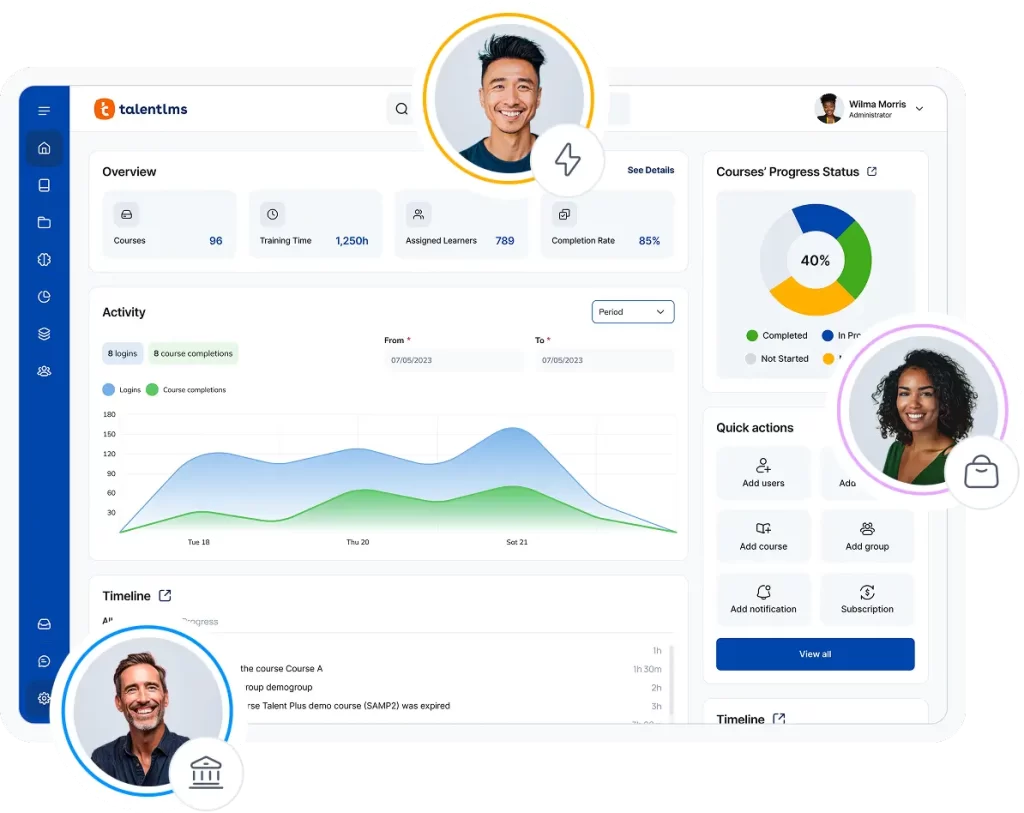
You can solve these varying needs by using TalentLMS Learning Paths to build distinct tracks with clear prerequisites. Groups and Group Supervisor features then let you segment managers by their specific level, so leaders can track cohort progress directly.
Combine self-paced learning with hands-on practice
During an episode of the TalentLMS podcast, The Manager Multiplier, guest Al Dea pointed out that when leaders do not feel capable or have not been shown how to do something, they hesitate to lean into it.
Skipping the practice phase leaves managers feeling under-equipped (impostor syndrome) and anxious about applying new skills. Giving them a space to try and fail before they talk to their teams builds immediate confidence.
Using blended learning, you can cover core theories with live leadership development activities for managers. Managers can learn the core theories on their own time at their own speed. They then reserve their live sessions strictly for roleplay and working through real business scenarios.
TalentLMS helps you build this exact mix by combining self-paced tracks with live, instructor-led sessions. You can also set up the Learning Playground to give your managers an interactive space for conversation simulations and realistic roleplay scenarios.
Accelerate learning with ready-made content
Creating leadership courses from scratch takes months of planning and design. Plus, as we mentioned earlier, slow rollouts mean what they need to learn might have evolved, making what you just spent months creating not effective.
Ready-made course collections, like the best leadership training topics, let you skip the slow development phase and launch high-quality training instantly. All you have to do is tailor the material to your specific business needs.
Sometimes your training needs a highly specific scenario or custom skill that off-the-shelf content misses. AI-powered LMS course creators can turn your raw expertise into a structured, professional course in minutes.
With TalentLibrary, you get instant access to ready-made collections like Leadership Essentials, New Manager, and Leadership Role Model. If you need a hyper-specific lesson that off-the-shelf content lacks, you can use TalentCraft to turn rough ideas into a structured course within minutes.
Using these resources together keeps your training fresh, relevant, and extremely fast to deploy.
Track skills development
Stats from the TalentLMS Skills Visibility Report reveal that 50% of organizations hire externally for skills their current employees already have. Managers miss these internal talents simply because they cannot see who is developing what skill.
Giving managers clear visibility into their team’s growing skills changes how they assign daily work or make hiring decisions. Better visibility also supercharges employee career development by matching people with roles they actually want to pursue. To do so, they need reports that show actual capability instead of just tracking seat time.
TalentLMS helps solve this with its Skills feature, which helps managers identify and track team capability gaps directly. They can also use the Custom Reports feature to see real progress over time. These tools track a learner’s path from their first enrollment all the way to demonstrating a brand-new skill.
Bonus tip: Broaden your leadership development for managers
Many companies limit leadership development for managers to a select group of high-potential employees. According to leadership coach Neena Newberry on the TalentLMS podcast, this selective approach ignores the diamonds in the rough who could thrive with the right investment.
Broadening your training pool creates a stronger leadership pipeline at every level of your business. It also helps to elevate underrepresented groups like women in tech who frequently get overlooked for promotion.
Expanding access is especially urgent because professional skills are expiring faster than ever, making those diamonds in the rough more valuable than ever. Stats from the TalentLMS Speed-to-Skill Report show that 47% of employees say their job skills have become outdated within the last five years.
You can accelerate leadership development for managers by integrating learning directly into daily workflows and encouraging peer-to-peer collaboration. Let managers share real-world tactics with each other to ease the natural isolation of leading teams.
FAQs
What is leadership development for managers?
Leadership development for managers is structured training designed to build the skills managers need to lead teams effectively. For example, giving feedback, running 1:1s, thinking strategically, and aligning cross-functionally. Unlike generic leadership courses, effective programs are tailored to the management level and focused on practical, day-to-day capabilities rather than abstract theory.
What are the most common mistakes in leadership development programs?
The biggest mistakes are treating all managers the same regardless of level, teaching leadership concepts without connecting them to real work, measuring course completions instead of actual skill growth, and building everything from scratch instead of starting with proven content. These structural issues explain why many programs see low engagement and minimal behavior change
How do you measure the success of a management training program?
Move beyond completion rates. Track whether managers can show specific skills after training, not just whether they attended. Use skills assessments, manager self-evaluations, and team performance indicators to measure real capability development over time.
What should a leadership development program for middle managers include?
Middle managers need different development than first-time managers. Focus on strategic thinking, coaching direct reports (who may be managers themselves), cross-functional collaboration, and translating organizational strategy into team-level action. A blended format, self-paced modules plus live practice, works best at this level.
How long does it take to build leadership training courses?
Building from scratch can take months. Starting with pre-built, expert-designed content and customizing it to your organization’s needs can cut that to weeks. The key is not to reinvent foundational leadership programs. Invest your time in what’s specific to your context.

![Managing Teams in the AI Era [+ Manager Checklist]](https://www.talentlms.com/blog/wp-content/uploads/2026/08/Managing-people-who-work-with-AI-19Aug2026-BIG-768x402.png)